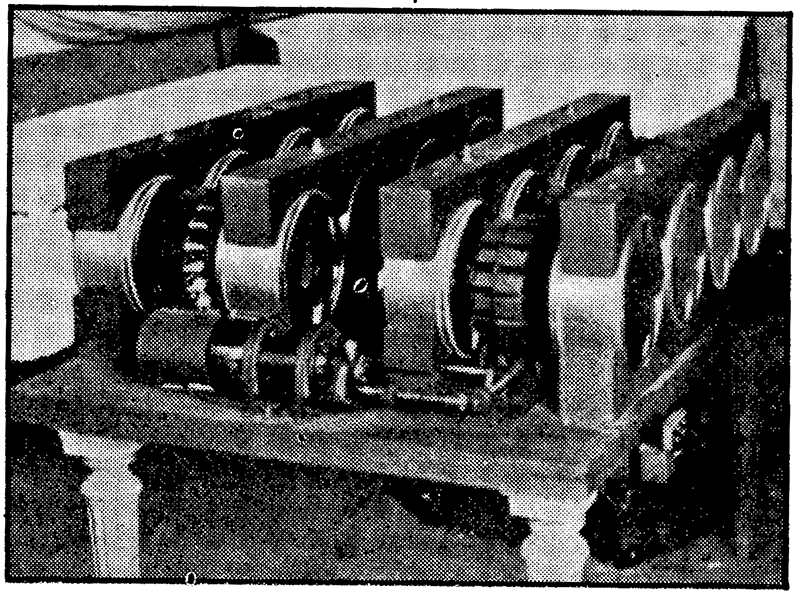
the ‘Clavier à Lampe’ (1927), ‘Automatic Electrical Musical Instrument’ (1929) and ‘Orgue Radioélectrique’. Joseph Armand Marie Givelet, France. 1927.

Armand Givelet behind the early monophonic Clavier a Lampe: “Les premiers essais de musique radio-électrique avec clavier ont été faits par Givelet qui construisit, avec des moyens plus que rudimentaires, un appareil fonctionnant parfaitement.” Image from: Phonographes et Musique Mécanique, Eugène-H. WEISS. Bibliothèque des Merveilles, Librairie Hachette. 1930.(édition de juin 1930), 16.

Armand Givelet was one of several post ww1 military radio operators who coincidentally discovered the musical possibilities of body capacitance to control the radio howl generated by vacuum tube radio feedback – in essence using the body as a variable capacitor to change the pitch of an audio oscillator. Alongside Maurice Martenot (The Ondes Martenot), Leon Termen (The Theremin) and others, Givelet exploited the feedback howl effect to generate a controllable sine pitch for an electronic instrument. Givelet’s instrument christened the Clavier à Lampe. This instrument was a simple a battery powered, monophonic, single oscillator device controlled by a two octave keyboard which Givelet designed to circumnavigate the poor audio fidelity of 1920s microphone technology by directly connecting the output of the instrument into a radio transmitter – the ‘direct injection’ method. The Clavier à Lampe premiered at the Trocadero Theatre, Paris in 1927  1 Hischak claims, probably in error, that Givelet took the Piano Radio Èlectrique on a promotional tour to the United States starting with a performance at the Trocadero Theatre in Philadelphia on June 9th 1927: Hischak. Thomas, S.  A Day-by-Day Chronicle of the Jazz Age’s Greatest Year, Rowman & Littlefield Publishers, 127.. The first broadcast using Givelet’s direct injection method was made on the 27th March 1928 at the “Société des Ingénieurs Civils, Paris.

Givelet’s ultimate ambition, however, was to create a multi-tube polyphonic organ for use in radio broadcasts and liturgical music. To achieve this, Givelet began a lengthy collaboration with Eloi Coupleux of Coupleux Frerès – organ manufacturer and distributor based in Tourcing near Lille. The first fruit of this collaboration was the prototype Automatic radio-electric piano – essentially a five note polyphonic version of the Clavier à Lampe combined with a pianola style punch-paper controller (Coupleux Frerès had the monopoly for the distribution of Aeolian player-pianos in France). The coupleux-Givelet Automatic radio-electric piano was successfully demonstrated to an enthusiastic audience at the Congrès de la Radiodiffusion at the Salle Pleyel  (252 Rue du Faubourg Saint-Honoré, 75008 Paris) on 16 November 1929:

The 1929 version of the ‘Automatic Radio Electric Piano’:  Eloi Coupleaux on the Left and Armand Givelet on the right. Image from: Phonographes et Musique Mécanique, Eugène-H. WEISS. Bibliothèque des Merveilles, Librairie Hachette. 1930. (édition de juin 1930), 14.

“After the remarkable speeches of M M. Mantoux and Ricard, organizers of the Congress were vigorously applauded by more than two thousand spectators, MM. Eloi Coupleux and A. Givelet, presented a musical wave (‘ondes musicales’) device of their own invention which automatically produces orchestral polyphony thanks to the unwinding of a perforated roller. […]

Eloi Coupleux and A. Givelet have succeeded in producing simultaneous notes thanks to several oscillating circuits operating at the same time with the help of a piano keyboard. From there to associating the automatic control of a piano, there was only one step: the strip (or the perforated cardboard) acts on a pan flute and controls the operation of the keys with more precision and accuracy using its electrical contacts instead of the ‘sledgehammers’ (of an organ or piano).

The extremely ingenious combinations of the device make it possible to obtain tremolo and other variable characteristics of the oscillating circuit of the corresponding note. Timbral variations are also created by the actions of filters, or superimposed oscillations. We also have at will a hard or soft, progressive attack of the note.

The re-creation of a piano or a radio organ obviously requires a large number of oscillating circuits and lamps but this number is considerably reduced by bringing in frequency doublers, for example, which make it possible to immediately obtain the notes of the upper scale.”2Lallemant, Paul, ‘En Marge De La Profession’ , Le Moniteur des architectes : organe… de la Société nationale des architectes de France, Paris, 01/04/1933, 66-70.

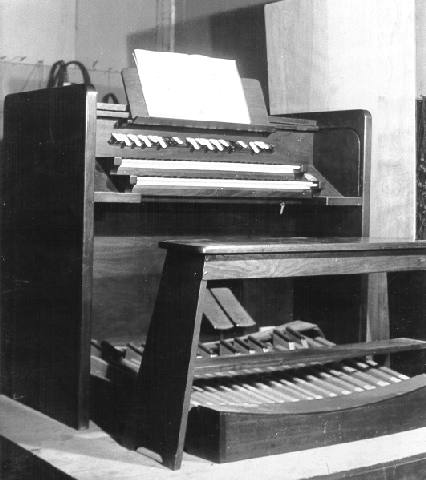
A third prototype from the Givelet-Coupleux collaboration was a was a fully polyphonic organ with 2 manuals and pedals known as the Orgue radio-électrique which was shown at the Académie des Sciences, Paris on October 6th, 1930. This instrument was developed into what became the final instrument from the Givelet–Coupleux team, a huge multi-oscillator polyphonic organ christened the Orgue des Ondes.

Armand Givelet Biographical notes

Armand Givelet (born: 21 07 1889 Reims France – died: 09 11 1963 La Varenne St-Hilaire, St-Maur-des-Fossés) was originally  an engineer in the French military during the First World War but  soon recognised the potential of Lee De Forest’s triode technology. He founded and became president of the Radio-Club de France (1921) and the T.S.F. (‘Transmission sans fil’ or Wireless) engineering school. Givelet became a recognised authority on radio technology and an inventor who held many patents for radio and broadcast equipment as well as his work with electromechanical (tone-wheel) and valve based electronic musical instruments; His particular contribution was a stabilised audio oscillator that used much less power than previous triode circuitry.

Givelet’s first complete instrument was the The monophonic Piano Radio-électrique unveiled in 1927. In early 1929 Givelet began a lengthy collaboration with the organ Builder Eloi Coupleux and the Coupleux-frères company  that produced some of the earliest polyphonic electronic organs – designed primarily for the church and religious music market. The largest of the Coupleux-Givelet instruments was the Orgue des Ondes built initially for Le Poste Parisien – a huge instrument which comprised of 200 oscillator tubes producing 70 different timbres or stops. Despite their unique features, The Coupleux-Givelet organs were rapidly made obsolete by much smaller and cheaper organs such as the Hammond Organ. Only four Orgue des Ondes were sold by Coupleux-frères to churches in France.

Givelet also wrote radio plays under the pseudonym Charles de Puymordant.3 Poincignon, Jean-Gabriel , La Renaissance du Radio Club de France, Le Haut-Parleur, N° 820, Juillet 1948, 359. and published a number of books on physics and music.

An article in Parole Libre (29-10-1927) describes the character and appearance of Armand Givelet:

“Mr. Armand Givelet has produced a number of inventions, including some outside the the wireless industry.  As early as 1917 he built a spark-gap transmitter without valves and the first commercial amplifier in 1918 . The silhouette of M. Givelet is amusing: very long, dry, a little bent. Author of magazines on the T.S.F., he always appears smiling. Very short-sighted, with wrinkled eyelids, he is constantly browsing. Very dark, he has a thick goatee, short mustache, high hair. He is gesticulating, active, endearing. Vice President short mustache, high hair. It is wide, overflowing, a little diffuse. At 38, he not only has a magnificent past, but the whole future of the most knowledgeable, most disinterested and most deserving scientist, despite being… French!”

Caricature of Armand Givelet: Armand Givelet Inventeur. La Parole libre : supplément du Journal parlé…. 10-29-1927, 2.

Sources

Carpentier, Olivier .’L’ Aventure industrielle des frères Coupleux, 1900-1935′ Préface de Douglas Heffer, éditions de l’ Inoui, 2004.

La Vie et les ondes : l’oeuvre de Georges Lakhovsky / Michel Adam et Armand Givelet, 1936.

Givelet, A. ‘L’Orgue Electronique Système Coupleux-Givelet de l’église de Villemomble, près Paris, Le Genie Civil: revue générale des industries françaises et étrangères, 1932-03-05. 244-246.

‘Instrument de Musique synthétique (Piano Radioélectrique), Le Genie Civil: revue générale des industries françaises et étrangères, 18/02/1928. 175.

Le Monde, 1989-07-21, 23.

References:

  • 1
    Hischak claims, probably in error, that Givelet took the Piano Radio Èlectrique on a promotional tour to the United States starting with a performance at the Trocadero Theatre in Philadelphia on June 9th 1927: Hischak. Thomas, S.  A Day-by-Day Chronicle of the Jazz Age’s Greatest Year, Rowman & Littlefield Publishers, 127. ↩︎
  • 2
    Lallemant, Paul, ‘En Marge De La Profession’ , Le Moniteur des architectes : organe… de la Société nationale des architectes de France, Paris, 01/04/1933, 66-70. ↩︎
  • 3
    Poincignon, Jean-Gabriel , La Renaissance du Radio Club de France, Le Haut-Parleur, N° 820, Juillet 1948, 359. ↩︎


the ‘Warbo Formant Orgel’, Harald Bode & Christian Warnke, Germany, 1937.


Harald Bode’s Warbo Formant Orgel of 1937. Image ZKM | Karlsruhe, Harald Bode Estate.

Harald Bode was an important figure in the development of electronic musical instruments in Germany during the late 1930s and later in the USA in the post WWII era. He had a major role in the designs of polyphonic electronic organs and after moving to the USA, went on to influence the designs of commercial synthesisers with his concepts of modular synthesis and one volt per octave controls adopted by Robert Moog and Donald Buchla in the 1960s.

Harald Bode’s first commercial design was the wonderfully named Warbo Formant Orgel, a partially polyphonic electronic organ built in Hamburg in 1937. The Warbo Formant Orgel was designed and built with the musical input from the, at the time, well known commercial music composer and band-leader Christian Warnke (hence ‘War- Bo’  Warnke/Bode); 1 Abocab, Caspar .(2010) Instruments and Sound Devices of Harald Bode, eContact! 13.4. , https://econtact.ca/13_4/abocab_bode_instruments.html, retrieved 21/04/2024.

“Christian made the contribution of a musician — that means he told me what to do as far as all the features the instrument should have. I’ll have to go into more detail. Christian Warnke was a composer and musician, a bandleader with a fine ear for music, and he was an excellent violinist. He wasn’t involved in the design per se, just the specifications of the Warbo. And he sponsored the project on a minimum budget. Mind you this was in the second part of the 30s, which had still terrible after-effects of the depression. But the Warbo was my first major contribution in the field.” 2Finch, James. (1980) Interview with Harald Bode, Syne Magazine, International Electronic Music Association (IEMA).

Warnke and Bode’s new instrument was presented at a cinema in Hamburg and at Bode’s own studio in September 1937 and received a great deal of interest from the local press:

The Warbo Formant Orgel from the Hamburger Anzeiger. 21 September 1938.
A contemporary description of the The Warbo Formant Orgel from the Hamburger Anzeiger. 21 September 1937.

Music of the future? Electricity as a sound source. Pioneering work in the field of electroacoustic musical instruments.

John W. R. Hellmann. Hamburger Tageblatt, 3 December 1937.

[…] This is where the shape development work of a young Hamburg electro acoustician comes in. Harald B0DE found the solution in his “Warbo-Formant Orgel” which allows the polyphonic playing on a manual. For each voice, only one tube is needed to produce the fundamental vibrations. The fundamental vibrations, which are amplified in the usual way are reproduced in the speaker, but still have no sound character. This sound character is achieved [in the Warbo Formant Orgel] by adding certain overtone groups or “formants” (hence the name!).

A large number of levers and knobs allow the synthetic production of any desired sound effect, both for imitating known sounds and to bring about completely new sound effects. Another new feature of Bode’s experimental instrument is the controllability of the “transient processes” by means of additional tubes, which also makes it possible to achieve the sound effects of beaten, rattling, and plucked tones with an arbitrarily long decay time.

An interesting feature of the “Formant organ” is that each voice can be coloured, highlighted and swelled for itself while playing on a manual, whereby auxiliary buttons also allow for voice crossovers. Thus, the possibilities of these devices, which are reminiscent of the “melody coupling” of individual organs, are much greater. Further, the instrument allows a pitch tremolo in addition to a dynamic tremolo and a sliding tone colour change during the playing.

Whether it has a future, whether it can gain a fine place alongside conventional instruments, or even – as optimists say – revolutionise our past music practice, that certainly can not be denied. The prerequisite for this is certainly that our composers must be prepared to create a new compositions for these new sound possibilities. 3J Hellmann, ohn W. R. (1937) Musik der Zukunft? Elektrizität als KlangqueIle.” Pionierarbeit auf dem Gebiet der elektroakustischen Musikinstrumente, Hamburger Tageblatt, 3 December 1937.

Description of the Formant operation of the Warbo Formant Orgel
Description of the Formant filter operation of the Warbo Formant Orgel

Diagram illustrating the 4 note polyphony of the Warbo Formant Orgel. European Electronic Music Instrument Design—Harald Bode, Journal of the AUDIO ENGINEERING SOCIETY, October 1961, Volume 9, NUMBER 4268, 268

European Electronic Music Instrument Design—Harald Bode, Journal of the AUDIO ENGINEERING SOCIETY, October 1961

A different and unique approach for a multitone instrument with a minimum of tone generators has been tried by the author in the Warbo Formant Organ (Fig. 3). In this experimentally built instrument, four relaxation-type oscillators were correlated to a 44-note keyboard by a switching system which coordinates the first oscillator O, to the highest note, the second oscillator Oz, to the note next to the highest, and so forth. The oscillator outputs were connected to gates (G, through G,), which were opened for the played notes only by an additional switching system. This instrument also comprised envelope control means for percussive tones and two sets of filters, one of which could be correlated at will to one group of voices (for instance, Ist and 3rd) and the other to the remaining ones (for instance, 2nd and 4th). Although this instrument was capable of producing interesting effects, the stability with the employed tone generating system was not sufficient, and the switching device was too expensive.

Two versions of the instrument were made and later stored at the  Heinrich-Hertz Institute (HHI) in Charlottenburg, Berlin. The institute’s building was completely destroyed during the war and with it the Warbo Formant Orgel. No recording of the Warbo Formant have been found. As with many other instruments designed by Bode the Warbo Formant Orgel pioneered aspects of electronics that became standard in later instruments. The Warbo Formant Orgel was a partially polyphonic (high note priority) four-voice, single keyboard instrument with 2 formant filters and key assigned dynamic envelope wave shaping allowing for variable wave shapes and percussive effects – features that were later used on Bode’s postwar instruments. With the assistance of Oskar Vierling at the HHI, between 1938 and 1939 Bode created a two monophonic manual and 30 note pedalboard version of the Warbo Formant Orgel he called the Melodium . 4Davies, Hugh. (2001) The Warbo Formant Orgel, The new Grove dictionary of music and musicians, New York : Grove, 74-5.

“… It [The Warbo Formant Orgel] was built with a relaxation type of oscillator. Four oscillators actually, that were selected for the 44-note keyboard. The major problem being the stability of the oscillators, which is critical when comparing one with the other, especially with four. So I dropped the idea of a four-note organ at that time and went on to the Melodium, which was created in 1938 and used in many large performances with the Berlin Philharmonic as a solo instrument. It was also used in some significant motion pictures of that era.” 5 Bode, Harald. (1980) Interview, Syne Magazine

Harald Bode. Biographical notes

Harald Bode; October 19, 1909 Hamburg Germany – January 15, 1987 New York USA.

Harald Bode (Born: Hamburg October 19, 1909 – Died: New York, January 15, 1987) studied  mathematics, physics and natural philosophy at Hamburg University, graduating in 1934. In 1937, with funding support provided by the composer and band-leader, Christian Warnke, Bode produced his first instrument the Warbo-Formant Orgel (‘Warbo’ being a combination of the names Warnke and Bode). Bode moved to Berlin in 1938 to complete a postgraduate course at the Heinrich Hertz Institute where he collaborated with Oskar Vierling and the light music composer, organist and Trautonium virtuoso, Fekko von Ompteda. During this period Bode developed the Melodium ;  a unique monophonic touch-sensitive, multi-timbral instrument used extensively in film scores of the period.

When WWII started in 1939 Bode worked on military submarine sound and wireless communication projects “…We had the only choice in Germany, to go to military service or do work for the government. I praise myself lucky, that I was able to go to the electronic industry” 6Finch, James. (1980) Interview with Harald Bode, Syne Magazine, International Electronic Music Association (IEMA). and moved to the  small village Neubeuern in southern Germany, where in 1947 Bode built the first European post-war electronic instrument, the Melochord. In 1949 Bode joined the AWB company where he created the  Polychord a simpler, polyphonic version of the Melochord which was followed by the Polychord III in 1951 and the  Bode Organ, a commercial organ which became the prototype for the famous Estey Electronic Organ. After leaving AWB, Bode’s designs included the Tuttivox, a miniature electronic organ and collaborated on a version of George Jenny’s Clavioline, both big sellers throughout Europe.

In 1954 Bode moved to the USA, settling in Brattleboro, Vermont where he lead the development team (and later, became Vice President)  at the Estey Organ Corporation. In 1958, while still working at Estey, Bode set up the Bode Electronics Company where in March 1960 he created another unique instrument; a modular synthesiser “A New Tool for the Exploration of Unknown Electronic Music Instrument Performances” known as the  ‘Audio System Synthesiser’ which Robert Moog used as the basis for his line of new Moog synthesisers.

After the Estey Organ Company foundered in 1960, Bode joined the Wurlitzer Organ Co and moved to Buffalo, New York where he was one of the first engineers to recognise the significance of transistor based technology in electronic music.  Bode’s concepts of modular and miniature self-contained transistor based machines was taken up and developed in the early 1960’s by Robert Moog and Donald Buchla amongst others. 1962 saw the beginning of a long collaboration between Bode and the composer Vladimir Ussachevsky at the  Columbia Princeton Center for Electronic Music which lead to the development of innovative studio equipment designs such as the  ‘Bode Ring Modulator’ and ‘Bode Frequency Shifter’. The commercial versions of these inventions were produced  under the Bode Sound Co and under license Moog Synthesisers.

Harald Bode retired in 1974 but continued to pursue his own research. In 1977 he created the ‘Bode Vocoder’ (licensed as the ‘Moog Vocoder’). In 1981 he developed his last instrument, the ‘Bode Barber Pole Phaser’.


References:

  • 1
    Abocab, Caspar .(2010) Instruments and Sound Devices of Harald Bode, eContact! 13.4. , https://econtact.ca/13_4/abocab_bode_instruments.html, retrieved 21/04/2024. ↩︎
  • 2
    Finch, James. (1980) Interview with Harald Bode, Syne Magazine, International Electronic Music Association (IEMA). ↩︎
  • 3
    J Hellmann, ohn W. R. (1937) Musik der Zukunft? Elektrizität als KlangqueIle.” Pionierarbeit auf dem Gebiet der elektroakustischen Musikinstrumente, Hamburger Tageblatt, 3 December 1937. ↩︎
  • 4
    Davies, Hugh. (2001) The Warbo Formant Orgel, The new Grove dictionary of music and musicians, New York : Grove, 74-5. ↩︎
  • 5
    Bode, Harald. (1980) Interview, Syne Magazine ↩︎
  • 6
    Finch, James. (1980) Interview with Harald Bode, Syne Magazine, International Electronic Music Association (IEMA). ↩︎

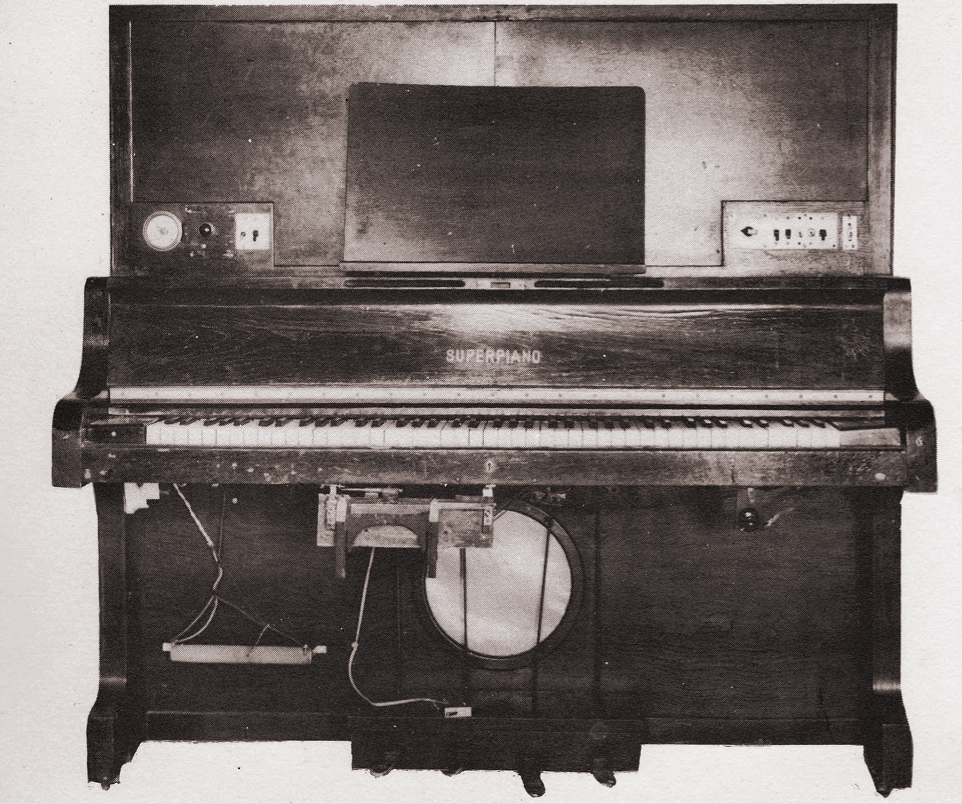
The ‘Superpiano’ and ‘Symphonium’. Emerich Spielmann, Austria, 1928

Front view of the Superpiano showing tone-mixing knee lever, pedals and loudspeaker

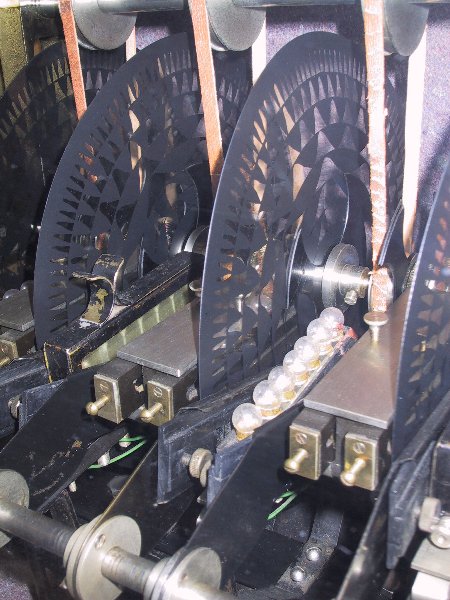
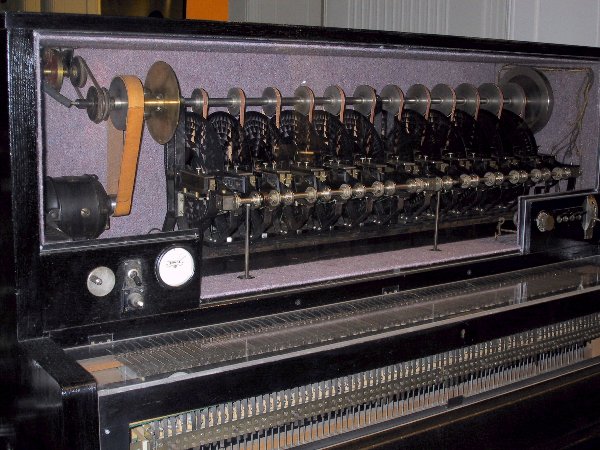
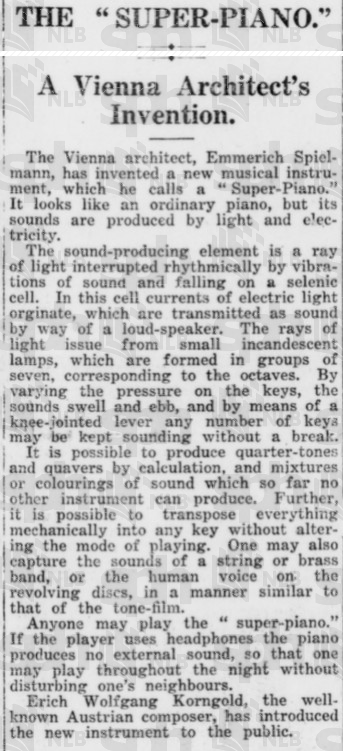
Spielmann’s Superpiano, patented in 1927, was a keyboard instrument based on the photo-optical principle used in a number of instruments during the 1920s and 30s: the  Cellulophone, the Radio Organ of a Trillion Tones,  ‘Sonothèque’, the Welte Licht-ton Orgel and others.  In general, this principle worked by projecting a light beam through a spinning glass disk onto a photoelectric cell. The regular interruption of the light beam causes an ‘oscillating’ voltage tone. Spielmann’s innovative instrument used two rows of twelve black, photographically reproduced celluloid disks. Each disk had a series of holes cut in seven concentric circles equating to the waveforms of the seven octaves of a note – the light beam being picked up by selenium photo-electrical cells.

Anni Spielmann (Emerich's daughter) playing the Superpiano
Anni Spielmann (Emerich’s daughter) playing the Superpiano. Image: The archive of  Regina Spelman, Deborah Lucas, and Dan Lucas.

The Superpiano created complex tones by allowing a combination of  ‘pure’ and harmonic sound waves of the same note; each note was duplicated with contrasting sound waves and harmonics  – hence two rows of twelve disks –  allowing the player to mix the sound waves of each note with a knee lever. Volume control was achieved by adjusting the pressure on the manual keyboard via variable resistors, thereby dimming and increasing the lightbulb brightness and, consequently, the note volume. The instrument’s overall pitch can be adjusted during play by varying the speed of the rotating disks. Spielmann intended the Superpiano to be used as an affordable ($300) home keyboard which could be played like a piano but also a type of early sampling keyboard – ‘drawings’ of different instruments’ waveforms could be made on the celluloid disks, allowing the player to reproduce the “entire instrumental range of an orchestra” – or so the advertising claimed.

The celluloid disks of the Superpiano for creating tones and harmonics

Spielmann’s instrument made its debut on January 9, 1929, at a concert organised by the Österreichische Kulturbund (Austrian Culture Union), performed by the renowned composer and pianist Erich Wolfgang Korngold, who played the piano with one hand and the Superpiano with the other. Later, on February 14, 1929, Spielmann presented the Superpiano on the Vienna radio station RAVAG, featuring lectures titled ‘Das Licht spricht, das Licht musiziert’ (Light speaks, light makes music).

“The piano has undisputedly dominated as a household instrument for more than 150 years. It owes its position to its ability to play polyphonically with sounds in which each individual note can be dynamically differentiated by attack, in contrast to the organ and harmonium. While the piano only enables polyphonic playing, the super piano also brings polychrome, sound-rich music. Not only can you sound many tones on the super piano, but you can also make every note sound with all the dynamic shades for as long as you want, unlike on the piano. This is why orchestra-like effects can be achieved on the super piano with a sound design that is analogous to singing. […] In the super piano, the tones of different timbres are produced synthetically. They represent the end product of a mixture of a tone without overtones and a tone rich in overtones, which can be easily achieved by the player by moving a toggle lever, which is produced using a light electric system by two sound disks running next to each other and effective at the same time. Continuously moving the lever from left to right allows the sound to slowly transition from the flute character to the string character and from there to the brass character. For the time being, I have refrained from constructing a multiple super piano on which a single musician could produce several timbres simultaneously in polyphonic playing and am avoiding the technical difficulty of polyphonic and polychrome playing by making music on two or more instruments, each of which is different Producing tonal colors in rich alternation, together contributing to create the impression of great tonal richness. Even if the ear thinks it can hear the sound of an organ, flute, violin, cello, timpani by comparing it with the sound of the traditional instruments from the superpiano, the superpiano neither wants to imitate nor replace the old instruments. But there is the possibility of revitalising the old music literature with a new richness of tone and expression, and it can open up new avenues for new music.”

1 Spielmann, Emerich (1933) WIE ICH DAS SUPERPIANO ERFAND, Radio Wien, 31 March 1933, 3.

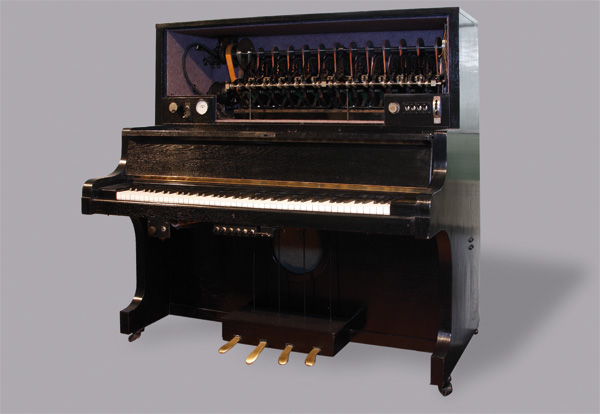
Spielmann's Superpiano 1927
Spielmanns Superpiano 1927. Image: the Museum of Technology, Vienna, Austria
The last Superpiano at the Vienna Technical Museum, Austria
The last Superpiano at the Vienna Technical Museum, Austria, showing the celluloid disks and light bulbs. Image: the Museum of Technology, Vienna, Austria
The last Superpiano at the Vienna Technical Museum, Austria
The last Superpiano at the Vienna Technical Museum. Image: the Museum of Technology, Vienna, Austria

Several instruments appear to have been built, but only one survived the ravages of WW2 and was sold to the Vienna Technical Museum in 1947. Spielmann developed a modification of the Superpiano called the Symphonium, where the Superpiano used organ-like sounds, the Symphonium was based on mixable combinations of orchestral sounds: woodwind, brass and strings, allowing fifteen possible combinations of timbres (to the Superpiano’s two). 2 Donhauser, Peter (2007), Elektrische Klangmaschinen: Die Pionierzeit in Deutschland und Österreich, Böhlau, Wien, 57–60.

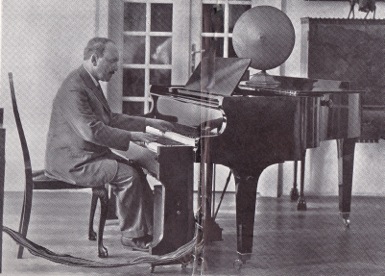
Emerich Spielmann playing the Superpiano
Emerich Spielmann playing the Superpiano as an add-on to a standard acoustic piano

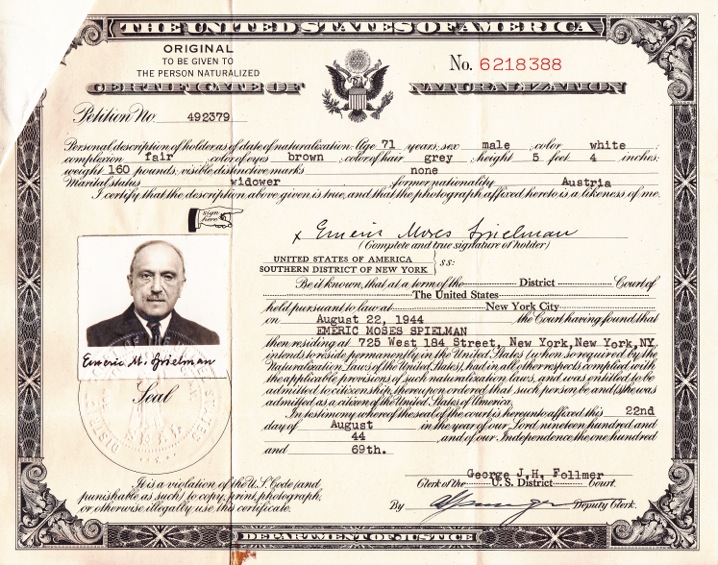
With the seizure of power by the National Socialists in Austria and Germany in 1933, the Superpiano project was disrupted, and the instrument failed to become a commercial proposition. As an Austrian Jew, Spielmann’s situation became increasingly precarious; his license to practice as an architect was revoked in 1938. Spielmann fled to London with his daughter Anni, and then to New York, where he became a naturalised US citizen in 1944. Spielmann appears to have continued the project in the USA, but the instrument was likely overshadowed by the Welte LichttonOrgel, which used similar technology (also Jewish escapees to New York), and by the dominance of the Hammond Organ in the home instrument market.

A view of the inside of the Superpiano. Image radio Wien, March 1933.
xx
Letter to Spielmann advocating the  Superpiano from Albert Einstein. USA 1944
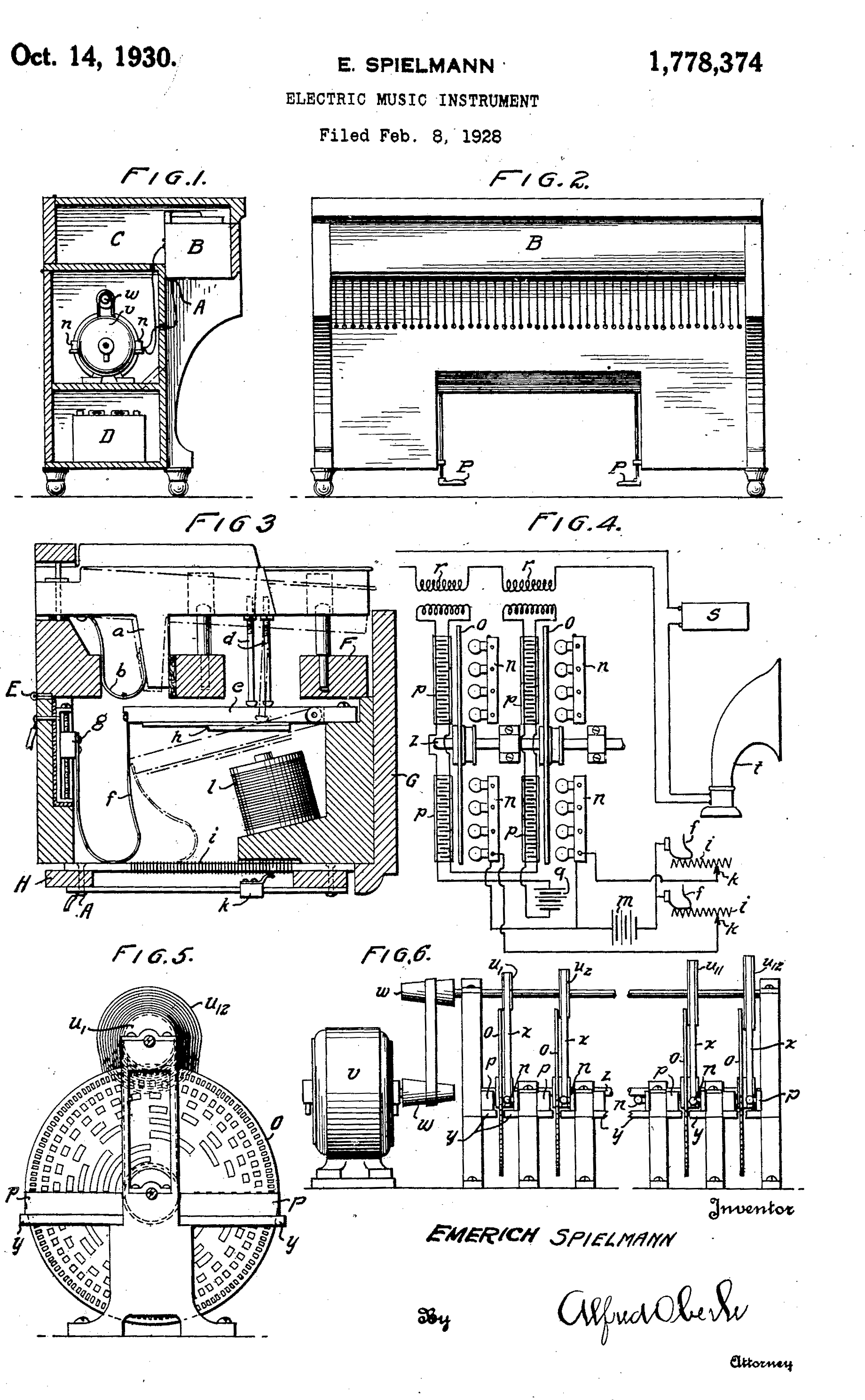
Spielmann's patent for the photo-electrical sound generator
Spielmann’s 1928 patent for the photo-electrical sound generator. Image: US Patent Office #1778374

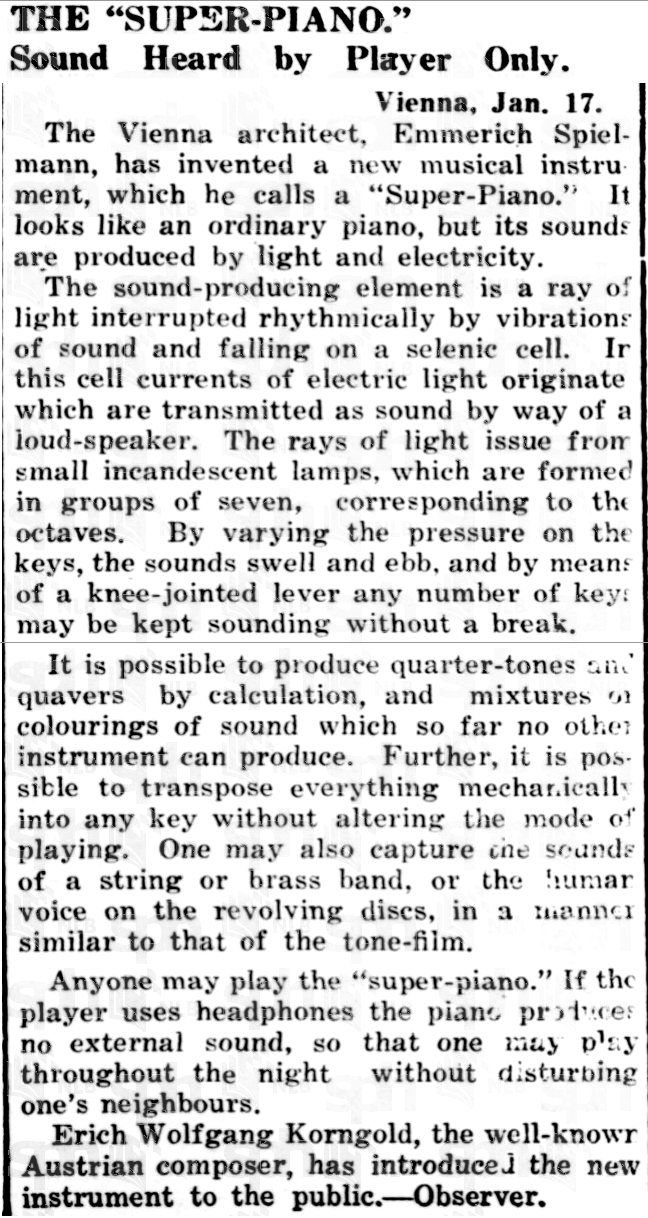
first show of the superpiano 2

Superpiano editorial in the Southeast Missourian Newspaper. 1929
Contemporary newspaper clippings The Mercury (Hobart, Tas. : 1860 - 1954)
Contemporary newspaper clippings The Mercury (Hobart, Tas. : 1860 – 1954)
Contemporary newspaper clippings. Straights Times, Singapore 1929
Contemporary newspaper clippings. The Straits Times, Singapore 1929
naturalisation papers of Emerich Spielmann. 1944
U.S. naturalisation papers of Emerich Spielmann. 1944

Emerich (Ernst) Moses Spielmann – 23.06.1873  Vienna, Austria – 1952 Elmhurst, Queens, New York, USA. Biographical notes

Emerich Spielmann was a Viennese architect born in Moravia to a Jewish family in the mid-19th century. His father was a merchant, Hermann Spielmann (1842-1925), and his mother was Josephine Franzos (1850-1918). Spielmann studied at the Institute of Technology at King Karl and Karl Mayr Eder from 1892 to 1899. He then worked until 1903 in the architectural practice of Wilhelm Stiassny and Friedrich Ohmann. In 1904, he began a collaboration with the architect Alfred Teller, working in the Viennese Secessionist style and later in neo-Baroque and classical forms, until 1932, when he worked independently in his own practice. As a Jew, in 1938, Spielmann’s license to practice was revoked by the Nazi authorities. He fled to London in 1939 with his daughter Anna on May 6 and arrived on August 22, 1944, in New York, where he became a naturalised citizen in 1944. He died in New York in 1952. 3Prokop U. (2016). On the jewish legacy in viennese architecture : the contribution of jewish architects to building in vienna 1868-1938. Böhlau. Retrieved December 2 2023, from http://www.oapen.org/download?type=document&docid=612510. and archive of  Regina Spelman, Deborah Lucas, Dan Lucas


references:

  • 1
    Spielmann, Emerich (1933) WIE ICH DAS SUPERPIANO ERFAND, Radio Wien, 31 March 1933, 3. ↩︎
  • 2
    Donhauser, Peter (2007), Elektrische Klangmaschinen: Die Pionierzeit in Deutschland und Österreich, Böhlau, Wien, 57–60. ↩︎
  • 3
    Prokop U. (2016). On the jewish legacy in viennese architecture : the contribution of jewish architects to building in vienna 1868-1938. Böhlau. Retrieved December 2 2023, from http://www.oapen.org/download?type=document&docid=612510. and archive of  Regina Spelman, Deborah Lucas, Dan Lucas ↩︎

The ‘Wave Organ’. Frank Morse Robb. Canada. 1927.


The 1937 version of the Robb Wave Organ. Image; National Music Centre,© 2016 National Music Centre, Calgary.AB.
The 1937 version of the Robb Wave Organ. Image: National Music Centre,© 2016 National Music Centre, Calgary, AB.

The Robb Wave Organ, designed by Morse Robb in Belleville, Ontario, was an early precursor, and said to be musically superior, to the Hammond Organ. The instrument sought to reproduce the sound of a cathedral pipe organ by amplifying the output of a similar tone-wheel mechanism. Robb based his tone-wheel design on Melvin Severy’s Choralcelo, but added amplification, which wasn’t available to Severy at the time.

Frank Morse Robb. Image: (c) Notable Bellevillians https://www.mybelleville.net/single-post/2018/05/06/notable-bellevillians-gone-but-not-forgotten.

“…Such an instrument as his (Severy’s ‘Choralcelo’), however, is both practically and theoretically impossible, as without amplification, far greater than the microphone type he suggests, nothing but the faintest trace of tones could be heard. The mere addition of amplification to his instrument would not be an invention. If this were done, moreover, the instrument could not function musically, as the circuit and wiring arrangement set forth in his patent would preclude that possibility due to internal resistance in the magnets. Every impulse generated by the tone disc would be absorbed in the circuits to such an extent that amplification would be impossible.”

Morse Robb's miniaturised tone wheels of the Wave Organ. From the collection of the Canada Science and Technology Museum, Ottowa, Ontarion Canada.
Morse Robb’s miniaturised tone wheels of the Wave Organ. From the collection of the Canada Science and Technology Museum, Ottawa, Ontario, Canada.

Robb’s aim was to miniaturise elements of earlier large-scale tone-wheel designs (Choralcelo of 1909 and Telharmonium 1897-1917) to create a practical, easy-to-maintain, and affordable electronic organ. This was achieved by reducing the size and number of the tone wheels, adding a gear system, and increasing the number of notes on each wheel by ‘doubling and redoubling the wave forms on the discs on one shaft’. The instrument was equipped with twelve tone wheels representing each note, the ‘character’ or timbre of note, corresponding to organ stops and photographed from a cathode ray oscillograph, plus the harmonics of each fundamental note. The variation in pitch of each note was achieved by changing the speed of the tone wheel’s rotation, giving the Wave Organ a total of five octaves. The tone wheels, spinning within a magnetic field, generated a voltage output for each note, which was made audible by being passed to a valve amplifier and a loudspeaker.

Significantly, the Wave Organ was unique in that it sought to replicate real organ sounds by cutting the tone wheels to the shape of a photographic image of a church organ’s waveform, rather than mechanically reproducing and combining ‘pure’ tones and overtones, as in the Telharmonium and Hammond Organ. In this way, the Wave organ can be seen as one of the earliest analogue sampling

The 1937 version of the Robb Wave Organ. Image; National Music Centre,© 2016 National Music Centre, Calgary.AB.
Tone Wheel housing of the 1937 version of the Robb Wave Organ. Image: National Music Centre,© 2016 National Music Centre, Calgary, AB.

The prototype Wave Organ was built in 1927, premiered in November of the same year at the Toronto Daily Star’s CFCA radio studio in Belleville, and was patented in 1928 (1930 in the USA). Robb planned to market the instrument by arranging a production contract with the General Electric Company in Schenectady, NY, and, later, with the organ builders Casavant Frères in Canada. The worsening economic conditions of the Great Depression permanently stalled the agreements in the spring of 1931. Undaunted by the commercial failure of his first prototype, Robb produced a new, two-manual, 32-note version of the Wave Organ in April 1934 and launched the ‘ Robb Wave Organ Company’- incorporated on 21 September 1934 – to market and sell the instrument. The first production models became available in July 1936 and were publicly demonstrated at Eaton’s department stores in Toronto and Montréal. Despite an initial positive reaction, Robb was unable to obtain funding for further production, and in 1938, he abandoned the project. Only 13 models were ever sold, and the Wave Organ was withdrawn from the market in 1941.1 Murphy, Michael and Cotter, Max, (2014) Frank Morse Robb’s Wave Organ, eContact! 17.3 — TIES 2014: The 8th Toronto International Electroacoustic Symposium.

The 1937 version of the Robb Wave Organ. Image; National Music Centre,© 2016 National Music Centre, Calgary.AB.
The 1937 version of the Robb Wave Organ. Image: National Music Centre,© 2016 National Music Centre, Calgary, AB.

The Robb Wave Organ was more expensive than other electronic organs of the period – notably the American Hammond Organ, which used an almost identical tone-wheel technology – and sales suffered because of World War II. The last remaining Wave Organ prototype is preserved at the Canada Science and Technology Museum in Ontario. 2 Murphy, Michael and Cotter, Max, (2014) Frank Morse Robb’s Wave Organ, eContact! 17.3, https://econtact.ca/17_3/murphy-cotter_robborgan.html retrieved 29/11/23

CPEMf6c
Second version of Morse Robb’s ‘Wave Organ’ c1936

Frank Morse Robb c1927. Image:

Frank Morse Robb

(born 28 January 1902 in Belleville, ON; died 5 August 1992 in Belleville)

Robb studied at McGill University from 1921 to 1924 and then returned to Belleville, where in 1926 began research on the Robb Wave Organ. After the commercial failure of the Wave Organ, Robb applied his inventing talent to devices for packing guns during the Second World War. He became vice president of his brother’s packing company and earned acclaim as a silversmith. He also wrote a Sci-Fi -post nuclear holocaust novel Tan Ming (1955) under the pseudonym Lan Stormont: “An amusing fantasy in which a department store window dresser falls in love with a robot mannequin and manages to conjure into its body the soul of a princess named Tan Ming from a postholocaust future.” 3 Morse Robb | The Canadian Encyclopedia”. thecanadianencyclopedia.ca. Retrieved September 11, 2019.

'Tan Ming' by
‘Tan Ming’ by Lan Stormont/Morse Robb 1955

References:

  • 1
    Murphy, Michael and Cotter, Max, (2014) Frank Morse Robb’s Wave Organ, eContact! 17.3 — TIES 2014: The 8th Toronto International Electroacoustic Symposium. ↩︎
  • 2
    Murphy, Michael and Cotter, Max, (2014) Frank Morse Robb’s Wave Organ, eContact! 17.3, https://econtact.ca/17_3/murphy-cotter_robborgan.html retrieved 29/11/23 ↩︎
  • 3
    Morse Robb | The Canadian Encyclopedia”. thecanadianencyclopedia.ca. Retrieved September 11, 2019. ↩︎

‘La Croix Sonore’ Nicolai Obukhov. Russia – France, 1929-1934

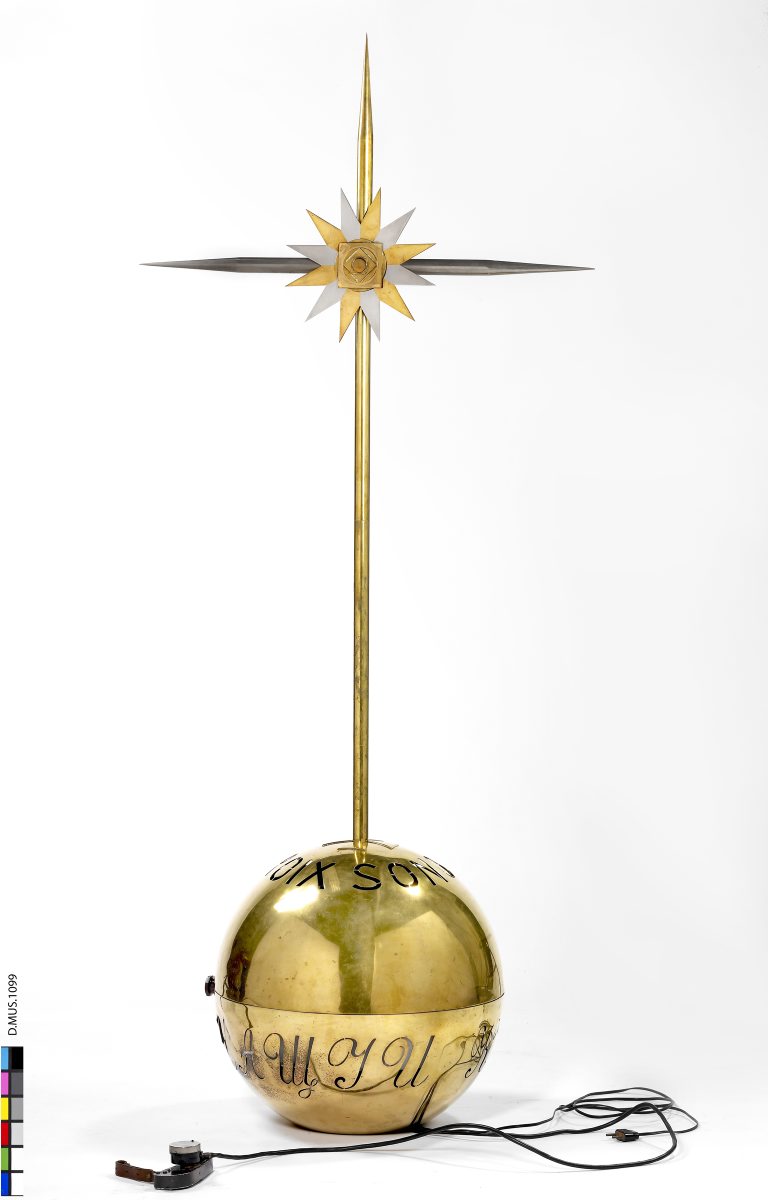
Modern reconstruction of the Croix Sonore at the musée de L'Opéra, Paris.
Modern reconstruction of the Croix Sonore at the musée de L’Opéra, Paris.

Nicolai Obukhov was a Russian composer who, after studying  at the Moscow and St. Petersburg Conservatories with  Maximilian Steinberg and Nikolai Tcherepnin, left Russia on the eve of the Bolshevik revolution in 1918. Obukhov settled in Paris in 1919 where he studied orchestration with Maurice Ravel and Marcel Orban while supporting his new family by working as a bricklayer. 

xcxc
Marie-Antionette Aussenac-Broglie plays the Croix Sonore. Image; ‘Comoedia’ Paris 5th March 1934.

Obukhov, who signed his name “Nicolas l’illuminé” (Nicholas the visionary), was a deeply religious mystical Christian and profoundly influenced by the new theosophical cult of the Salon de la Rose + Croix which became popular with artists and musicians in the early 1920s. These beliefs were expressed in his compositions which, like his fellow countryman Alexander Scriabin, were intended as a means of attaining a transcendent state and a bridge to the world of the spirit – rather than just an aesthetic creation – Obukhov was driven by the idea that there was a higher reality to which art could reach. He attempted to achieve this spiritual goal through, for the time, unconventional means; a “total harmony” of 12 tone composition, unusual rhythm, experimental methods of notation, new invented instruments and expressive vocal directions –Obukhov was probably the first composer to   require a singer to make ‘non musical’ vocal sounds:

 ‘I forbid myself any repetition: my harmony is based on twelve notes of which none must be repeated. Repetition produces an impression of force without clarity; it disturbs the harmony, dirties it.’1 Schloezer op. cit, p 47.

“…music enjoys decided advantages which endow it with possibilities of insinuation into the depths of the soul, and the mind, of emotions inaccessible to other arts. This faculty resides in the fact that music is hindered less than any other art in the realisation of its aims by material conditions.” 2Manuscript MS 15226, music department, Bibliothèque Nationale de France, Paris.

In order to achieve this musical ‘insinuation’ Obukhov supplemented the traditional orchestra with new instruments of his own invention. These included the “Crystal” a piano type instruments where hammers hit a row of crystal spheres and the “Éther” an electronically powered instruments where a large rotating paddle wheel created various, apparently inaudible infra- and ultra-sonic humming sounds that ranged from approximately five octaves below to five octaves above human hearing. This sound was intended to have a mystical effect on the listener – though the effect was probably physiological, depending on the volume and frequency of the instruments sound. Low frequency infra-sound is known to have a physical effect on the human nervous system causing disorientation, anxiety, panic, bowel spasms, nausea, vomiting and eventually unconsciousness (supposedly 7-8 hz is the most effective being the same frequency as the average brain alpha wave). The effect is unintentionally generated by the extreme low frequencies in church pipe organ music, instilling religious feelings and causing sensations of “extreme sense sorrow, coldness, anxiety, and even shivers down the spine.” 3‘Organ Music Instills Religious Feelings’ by Jonathan Amos, 9/8/2003 http://news.bbc.co.uk/1/hi/sci/tech/3087674.stm

The film actor Georges Colin presents Obukhov's "Chants Des Spheres " with the chorus and the Croix Sonore. Photo; L'Ouest-Éclair March 6th 1936.
The film actor Georges Colin presents the “Le Chant Des Spheres” with the Croix Sonore. Photo; L’Ouest-Éclair_03_06_1936_02

Obukhov’s only purely electronic instrument was “La Croix Sonore” or “Sonorous Cross” which was essentially one of several Theremin type instruments developed in Europe after Leon Termens departure to the USA in 1927 (others included the “Elektronische Zaubergeige” and the “Elektronde“). The Croix Sonore was designed and built in Paris by Michel Billaudot and Pierre Duvalier to Obukhov’s instructions in 1929 and was the result of several years experimenting with beat frequency/heterodyning oscillators probably after witnessing Termen’s demonstration of the Theremin while on tour around Europe. As with theTheremin the Croix Sonore was based on body capacitance controlling heterodyning vacuum tube oscillators. To suit Obukhov’s mystical and theatrical style, the circuitry and oscillators were built into a 44 cm diameter brass orb and the antennae disguised by a large 175 cm high crucifix adorned with a central star.

The Sonorous Cross was played in the same way as the Theremin – using the bodies capacitance to control the oscillators frequency, in this case moving the hands out from the central star on the crucifix altered the pitch and volume of the instrument. The ritualistic gestures made while playing this most unusual looking of instruments complemented the occult and mystical nature of Obukhov’s music and life.Obukhov continued to develop the instrument and produced an improved version, completed in 1934.

Nikolay Obukhov composed numerous pieces using his instrument as well as several using the Ondes-Martenot, culminating in his major work; “Le Livre De Vie” which exploited the glissando effects the Sonorous Cross could produce. The performances of these pieces were intended to be more like an occult church ceremony rather than an orchestral performance; Obukhov insisted that here were no spectators at his concerts – everyone would play their part in the mystical ritual which would take place in a circular ‘temple’:

“When the ‘Book of Life’ is performed, by which I mean when it is lived, the spectators, the participants will be arranged in spirals, in the interior of a circular and raised scene. The ‘terrestrial’ orchestra will be coiled up around the scene. A dome will contain the ‘celestial’ orchestra. Lighting changes will intervene in the ‘Sacred Action’, a synthesis of cult and orgy (the latter meant symbolically). Such is the ritual where science and religion are married.4‘Music of the Repressed Russian Avant-Garde, 1900-1929 p. 107. By Larry Sitsky, .Greenwood Press, Westport Connecticut and London, 1994.

“…some like priests will take part directly in the action, the others witness it, participating mentally like the faithful in church.” 5 ‘ de Schloezer, Boris , “Nicolas Obukhoff”, La Revue Musicale, 1, part 3, Nov. 1921, pp 38-56.

These performances received mixed reviews from the puzzled critics:

A Paris concert audience was stirred. and while it squirmed and tittered. tonight when Nicholas Obouhoff’ presented parts of his “Book of Life” and hitherto unknown “Annunciation of the Last Judgement.” to the accompaniment of the new electric musical instrument, the croix sonore.

Henry Prunieres introduced the concert. warning the audience that it was going to hear chords played on the piano. notes sung by a human voice and sounds drawn from an instrument such as it had never heard before. Even this warning. however. did not prepare the listeners for the sudden “shriek” – there is no other word for it-of Suzanne Balguerie on the opening note of one of Obouhoff‘s liturgic poems. There was no warning, either. when the singer suddenly began to whistle instead of sing. Some members of the audience thought it was one of their number expostulating in the classic manner and began to cry, “Hush! hush!“

Prunieres had praised the courage of the singers, Mme. Balguerie and Louise Matha. in attempting music so new, and as they produced strange note after strange note many felt that this praise was well merited. if only because their mastery of their effects prevented the audience from tittering more loudly.6 ‘Titters Greet Music of Obouhoff in Paris: Singers’ Strange Performance Accompanied by Electrical Instrument, Causes Stir’, 1. New York Times, May 16, 1934, p. 23.

“In “Annunciation of the Last Judgement” the singers stood together, one gowned in white. the other in red. while Obouhoff and Arthur Scholossberg played two pianos. and Princess Marie Antoinette Aussenac de Broglie, apart and sacramentally gowned in black, blue and orange, drew from the croix sonore notes that throbbed like twenty violins or at times sang like a human voice. In all this, it was the instrument that had the most success. Obuhoff’, it is said, dreamed of it long before the invention of the radio made application of the principle possible. He wrote music for it, calling it “the etherphone.” Out of it, by moving the hand back and forth, the Princess de Broglie drew an amazing sweetness or the most dreadful note, like the knocking of fate, to give Obouhofifs strange religious music far more power than his two pianos or even the distortions of his singers’ voices could produce.”7SHAW – MILLER, S. (2002). Visible Deeds of Music: Art and Music from Wagner to Cage. Yale University Press, p81 

Nicolas_Obouhow_35_h683
Nicolas or Nicolai Obukhov ( also Obouchov, Obuchov, Obouhow, Obuchow), Born April 22, 1892 in Ol’shanka, Kursk, Moscow – died, June 13, 1954 in St. Cloud, France

Nikolay Obukhov studied counterpoint at the Moscow Conservatory from 1911 and later at the St Petersburg Conservatory in 1913 (with Kalafati, Maksimilian Steinberg and Nikolay Tcherepnin). His first published works date from this period, and were published as ‘Quatre mélodies’ by Rouart et Lerolle in Paris in 1921.

Bienheureux6

In 1915 Obukhov developed his own idiosyncratic form of musical notation (similar to one invented in Russia by Golïshev during the same period) using a 12-tone chromatic language highly influenced by the mystical Russian composer Alexander Scriabin. The only performances of his music in Russia took place at this time. A report of the performance describes Obukhov as ‘a pale young man, with gazing eyes’ who ‘confused the audience’. Obukhov left Russia during the revolution with his wife and two children; they eventually settled near Paris a year later. In Paris he encountered financial hardship until helped by Maurice Ravel who found Obukhov a publisher allowing him to devote his time to his music.

The 1920s saw a handful of performances, most notably that of the ‘Predisloviye knigi zhizni’ (‘Introduction to the Book of Life’) under Kussevitzsky. During this and the next decade he put into practice ideas for electronic instruments Obukhov had conceived as early as 1917: the ‘efir’ and ‘kristal’ (‘ether’ and ‘crystal’) he had described in Russia eventually gave rise to the croix sonore, and even though he built and wrote for the ether, it was with the croix sonore that he gained most attention. He found an exponent of the instrument in his pupil Marie-Antoinette Aussenac-Broglie who had also performed some of his piano music; she demonstrated the instrument around France and Belgium. Similar to both the theremin and the ondes martenot in that pitch production is reliant upon the distance of the performer’s arm from the instrument, the croix sonore was the subject of a film of 1934. During the mid-1940s his notation again provoked heated discussion, this time in Paris; a book containing works from the 18th to the 20th centuries in Obukhov’s notation was published by Durand. In 1947, his ‘Traité d’harmonie tonale, atonale et totale’ ‚ which had already interested Honegger ‚ was published, while a year later he lectured on this subject in the Russian Conservatory in Paris. Obukhov spent his last years incapacitated by a mugging in 1949 where the final version of  ‘the Book of Life’ was stolen; he composed only a few works after this incident.

tumblr_mfwpbz0em51r5yt7ko6_1280

Commentary on Obukhov’s work by Jonathan Powell 8https://www.planettree.org/2000/crussian.html

Obukhov’s output is dominated by vast works of which the most notorious ‚ notwithstanding the gargantuan ‘Troisième et dernier testament’ and ‘La toute puissance’ ‚ is the ‘Kniga zhizni’ (‘The Book of Life’) on which he worked from around the time he left Russia until at least the mid-1920s. Described by the composer as ‘l’action sacrée du pasteur tout-puissant regnant’ it was intended to be performed (or ‘accomplished’) uninterruptedly every year on the night of the first and on the day of the second resurrection of Christ. Obukhov did not consider himself the composer of this work; instead, he saw himself as the person permitted, by divine forces, to ‘show’ it. Parts of the score, one version of which is nearly 2000 pages in length, are marked in the composer’s blood.9 Powell: “This is now regarded as not true (see Pol’dyaeva, 2006)” The music is preceded by a lengthy exposition in archaic Russian, while the work concludes with one section the score of which unfolds into the form of a cross and another, taking the shape of a circle, which is fixed onto a golden and silver box decorated with rubies and red silk. (Nicholas Slonimsky, in his memoir ‘Perfect Pitch’ relates that the composer’s wife, driven to despair by Obukhov’s obsessive behaviour regarding this piece, attempted to burn ‚ or ‘immolate’, in the composer’s terminology ‚ the manuscript but was interrupted in her crime.) Much of the instrumental writing is characterized by the alternation of chorale-like material (often ornamented by filigree arppegiation) with tolling patterns, building to textures of considerable rhythmic and contrapuntal complexity. The vocal parts ‚ as with his writing for the voice in most of his other works ‚ have huge tessituras and are bespattered with glissandi and instructions for screaming or whispering. The style which is consistently applied in this magnum opus is prevalent in all of his mature works and has its roots in the songs and piano miniatures written in Russia.

0cc9cbc899ba0ebfbae36e9f7eb8934985b7364b

Taking as a starting point the language employed by Skriabin in his mid- and late-period works, Obukhov evolved a harmonic technique based on the systematic configuration and manipulation of 12-note chords or harmonic areas. The sonorities resulting from this ‘total harmony’ are often broadly octatonic and frequently have a quasi-dominant character due to the prevalence of diminished fifths in the lower elements. Although longer structures appear to unfold in a schematized yet organic manner, the detail of musical procedure is curiously static. Obukhov saw his work as a musical articulation of his strongly-held religious beliefs and would sometimes sign his manuscripts ‘Nicolas l’illuminé’ or ‘Nicolas l’extasié’. Possibly inspired by Vladimir Solov´yov’s idea of ‘sobornost´’ (collective spiritual or artistic experience), Obukhov sought to abolish the traditional performer-audience polarity in favour of a merging of these previously mutually exclusive groups into one of participants. Obukhov mostly used his own texts which are frequently inspired by the Book of the Revelation or the Apocrypha. It is thus no coincidence that the only poets whose work appealed to him spiritually and compositionally were Solov´yov and Bal´mont, since it was the former’s orthodox mysticism that significantly informed the apocalyptic vision of the latter. In addition to these sources, mention should be made of Obukhov’s use of two verses by Musorgsky; it is between his work and that of Messiaen that Obukhov’s visionary language can be placed.


References

  • 1
    Schloezer op. cit, p 47. ↩︎
  • 2
    Manuscript MS 15226, music department, Bibliothèque Nationale de France, Paris. ↩︎
  • 3
    ‘Organ Music Instills Religious Feelings’ by Jonathan Amos, 9/8/2003 http://news.bbc.co.uk/1/hi/sci/tech/3087674.stm ↩︎
  • 4
    ‘Music of the Repressed Russian Avant-Garde, 1900-1929 p. 107. By Larry Sitsky, .Greenwood Press, Westport Connecticut and London, 1994. ↩︎
  • 5
    ‘ de Schloezer, Boris , “Nicolas Obukhoff”, La Revue Musicale, 1, part 3, Nov. 1921, pp 38-56. ↩︎
  • 6
    ‘Titters Greet Music of Obouhoff in Paris: Singers’ Strange Performance Accompanied by Electrical Instrument, Causes Stir’, 1. New York Times, May 16, 1934, p. 23. ↩︎
  • 7
    SHAW – MILLER, S. (2002). Visible Deeds of Music: Art and Music from Wagner to Cage. Yale University Press, p81  ↩︎
  • 8
    https://www.planettree.org/2000/crussian.html ↩︎
  • 9
    Powell: “This is now regarded as not true (see Pol’dyaeva, 2006)” ↩︎

Further Reading:

Hugh Davies. “Croix sonore.” In Grove Music Online. Oxford Music Online

E.Ludwig: “La Croix Sonore” ReM, nos 158-9(935),96 ReM,nos 290-91 (1972-73)

Consciousness, Literature and the Arts. Archive. Volume 1 Number 3, December 2000 “Skriabin and Obukhov: Mysterium & La livre de vie The concept of artistic synthesis”. By Simon Shaw-Miller
‘Nikolay Obukhov and the Croix Sonore’ Rahma Khazam. From: Leonardo Music Journal,Volume 19, 2009, pp. 11-12


The ‘Theremin’ or ‘Thereminvox’. Leon (or Lev) Sergeivitch Termen, Russia. 1922

Leon Termen plays the 'Theremin' or 'Thereminvox' . Paris, 1927
Leon Termen plays the ‘Theremin’ or ‘Thereminvox’ . Paris, 1927

The principles of beat frequency or heterodyning oscillators were discovered by chance during the first decades of the twentieth century by radio engineers experimenting with radio vacuum tubes. Heterodyning effect is created by two high radio frequency sound waves of similar but varying frequency combining and creating a lower audible frequency, equal to the difference between the two radio frequencies (approximately 20 Hz to 20,000 Hz). the musical potential of the effect was noted by several engineers and designers including Maurice Martenot, Nikolay Obukhov, Armand Givelet and the Russian Cellist and electronic engineer, Leon (or Lev) Sergeivitch Termen .

One problem with utilising the heterodyning effect (heterodyning is the effect where two high frequency signals are added producing a third audible tone which is the difference of the two high frequencies. This effect was the basis of many vacuum tube based electronic instruments.”) for musical purposes was that as the body came near the vacuum tubes the capacitance of the body caused variations in frequency.

opera1929

Leon Termen realised that rather than being a problem, body capacitance could be used as a control mechanism for an instrument and finally freeing the performer from the keyboard and fixed intonation. Termen’s first machine, built in the USSR in 1917 was christened the “Theremin” (after himself) or the “Aetherophone” (sound from the ‘ether’) and was the first instrument to exploit the heterodyning principle.

The original Theremin used a foot pedal to control the volume and a switch mechanism to alter the pitch. This prototype evolved into a production model Theremin in 1920, this was a unique design, resembling a gramophone cabinet on 4 legs with a protruding metal antennae and a metal loop. The instrument was played by moving the hands around the metal loop for volume and around the antennae for pitch. The output was a monophonic continuous tone modulated by the performer. The timbre of the instrument was fixed and resembled a violin string sound. The sound was produced directly by the heterodyning combination of two radio-frequency oscillators: one operating at a fixed frequency of 170,000 Hz, the other with a variable frequency between 168,000 and 170,000 Hz. The frequency of the second oscillator being determined by the proximity of the musician’s hand to the pitch antenna. The difference of the fixed and variable radio frequencies results in an audible beat frequency between 0 and 2,000 Hz. The audible sound came from the oscillators, later models adding an amplifier and large triangular loudspeaker. This Theremin model was first shown to the public at the Moscow Industrial Fair in 1920 and was witnessed by Lenin who requested lessons on the instrument. Lenin later commissioned 600 models of the Theremin to be built and toured around the Soviet Union.


Termen left the Soviet Union in 1927 for the United States where he was granted a patent for the Theremin in 1928. The Theremin was marketed and distributed in the USA by RCA during the 1930’s as a DIY kit form or as a finished instrument ( later aficionados of the instrument included Robert Moog who made and sold transistorised Theremins in the 1950s). The heterodyning vacuum tube oscillator became the standard method of producing electronic sound until the advent of the transistor in the 1960’s and was widely used by electronic musical instrument designs of the period.

The Theremin became known in the USA as a home ‘novelty instrument’ and featured in many film soundtracks of the 1940-50’s, it also appeared in several pop records of the 1960’s but never overcame it’s novelty appeal; used for effect rather than as a ‘serious instrument’, most recordings employ the Theremin as a substitute string instrument rather than exploiting the microtonal and pitch characteristics of the instrument. Leon Sergeivitch Termen went on to develop variations on the original Theremin which included the “Terpsitone“, The “Rhythmicon“, the “keyboard Theremin” and the “Electronic Cello”.

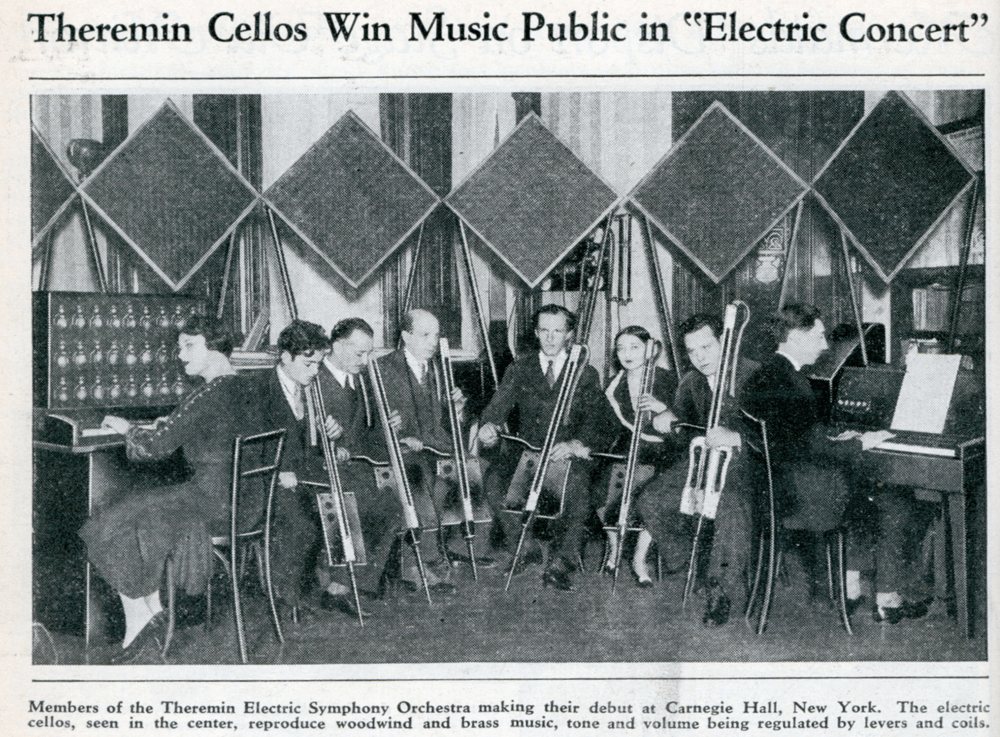
Theremin Orchestra, Carnegie Hall. C1930


Images of the Theremin

Promotional brochure for the RCA Theremin

Biographical Information: Leon Sergeivitch Termen. 1896 – 1993

The story of Lev Sergeivitch Termen is like some nightmarish John LeCarre novel. Prof. Termen was born in the Russian city of St Petersberg in 1896, he would become one of the most important pioneers in the development of electronic music through his instrument the Thereminvox (commonly referred to as the Theremin). Prof. Termen first invented a prototype Thereminvox in 1920, he worked upon his invention for the next few years, whilst also relocating from Russia to New York. A US patent was granted to Termen for the invention of the Thereminvox in 1928. Termen set up a studio there catering to high society patrons from whom he would extract the moneys he used to continue his experiments. His New York studio apparently was kitted out with a variety of devices, that in the late twenties must have seemed like pure science fiction: a variety of electronic audio devices; electronic lighting shows; an electronic dance platform; even a prototype colour television system.

Lev Termen and Theremin virtuoso Clara Rockmore

In 1938 Termen was rumoured to have been kidnapped in the New York apartment he shared with his American wife (the black ballet dancer, Iavana Williams) by the NKVD (forerunners of the KGB). Infact he returned to Russia for tax and financial problems in the USA as well as his concerns over the coming war.

“I left New York because at that time the war was coming. The military troops of the fascists were approaching Leningrad, and so on. I asked to be sent to the Soviet Union so as to make myself useful, I asked many times. For a whole year I asked to be sent back. The war had already started, and they didn’t send me, they didn’t send me. Then at last they permitted me. They assigned me to be an assistant to the captain of a large motor ship. So I went home, but they did not take my wife.”


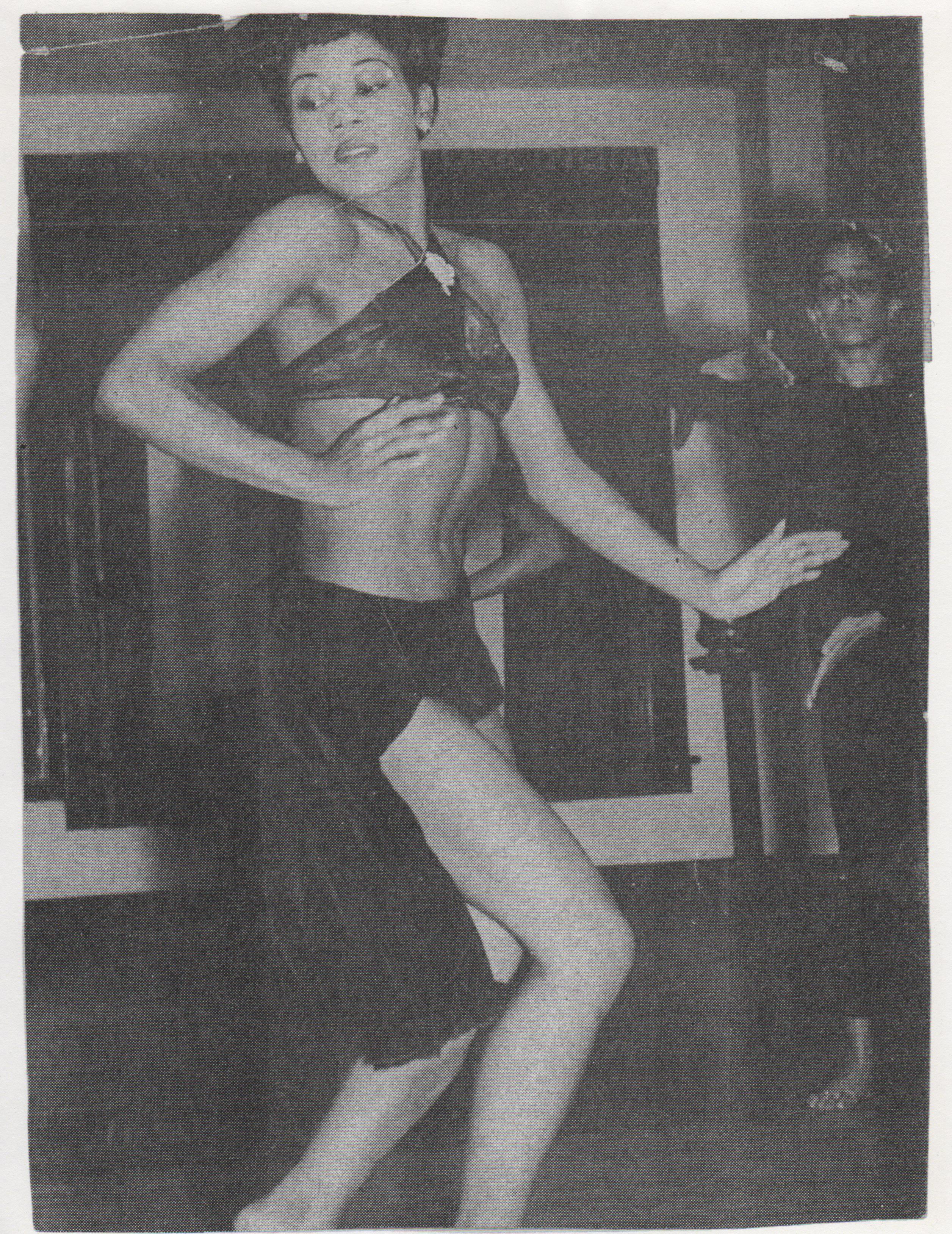
Termen's American born second wife, the dancer Lavinia Willaims
Termen’s American born second wife, the dancer Lavinia Willaims

On his return He was accused of propagating anti-Soviet propaganda by Stalin. Meanwhile reports of his execution were widely circulated in the West. In fact Termen was not executed, but interned in Magadan, a notoriously brutal Siberian labour camp.

 “I was arrested, and I was taken prisoner. Not quite a prisoner, but they put me in a special lab in the Ministry of Internal Affairs. There I worked in this lab just as others worked. [Airplane designer] Andrei Tupolev was imprisoned in such a way too, if you know about that. He was considered to be a prisoner, and I was considered a prisoner too…At one time, on the way to the laboratory, I was sent to a camp, where they did road construction. I was assigned to be supervisor over the prisoners. From there, after eight months on road construction, I was sent with Tupolev to the Aviation Institute. Many important people worked there: [Missile designer] Sergei Korolyov worked there for me.”

Leon Termen interview By Olivia Mattis and Robert Moog 1992

Termen was put to work on top secret projects by the Soviet authorities  (together with Andrei Tupolev, Sergei Korolev, and other well-known scientists and engineers)  which culminated in his invention of the first “bug,” a sophisticated electronic eavesdropping device. Termen supervised the bugging of both the American embassy, (and perhaps, Stalin’s private apartment). For this ground-breaking work he was awarded the Stalin Prize (first Class), Russia very highest honour.

After his rehabilitation Termen took up a teaching position at the Moscow conservatory of music. However he was ejected for continuing his researches in the field of electronic music. Post war Soviet ideology decreed that modern music was pernicious. Termen was reportedly told that electricity should be reserved for the execution of traitors. After this episode Termen took up a technical position, and worked upon non-music related electronics . Ironically his invention the Thereminvox, was becoming vastly influential in America, a development of which he was completely unaware.Before his death in 1993 Prof. Termen made one final visit to America lecturing, and demonstrating his Thereminvox.

leo


Sources:

“PULLING MUSIC OUT OF THIN AIR: AN INTERVIEW WITH LEON THEREMIN”By Olivia Mattis and Robert Moog. February 1992 issue of Keyboard Magazine.

‘Electronic and Experimental Music: Technology, Music, and Culture’. 2008 by Thom Holmes

‘Sound in Z: Experiments in Sound and Electronic Music in Early 20th Century Russia’. 2013. by Andrey Smirnov.
‘Theremin: Ether Music and Espionage (Music in American Life)’. Feb 2005. Albert Glinsky

The ‘Staccatone’. Hugo Gernsback & C.J.Fitch. USA, 1923

Hugo Gernsback’s ‘Staccatone’ c 1923. Image: The Staccatone, Practical Electrics, March 1924, 248-9
Hugo Gernsback, perhaps better known as the ‘Father of Science Fiction’  (and currently eponymously celebrated in the ‘Hugos’ Science Fiction Awards), also invented and built, with Clyde J. Fitch, an early electronic instrument called the Staccatone in 1923, which he later, in 1926, developed into one of the first polyphonic instruments, the Pianorad. Gernsback played a significant role in the development and popularization of television, radio, and amateur electronics. His ventures included a variety of sometimes questionable businesses, such as early science fiction publishing, pulp fiction, self-help manuals, and DIY electronics magazines, along with his own contributions to science fiction writing.
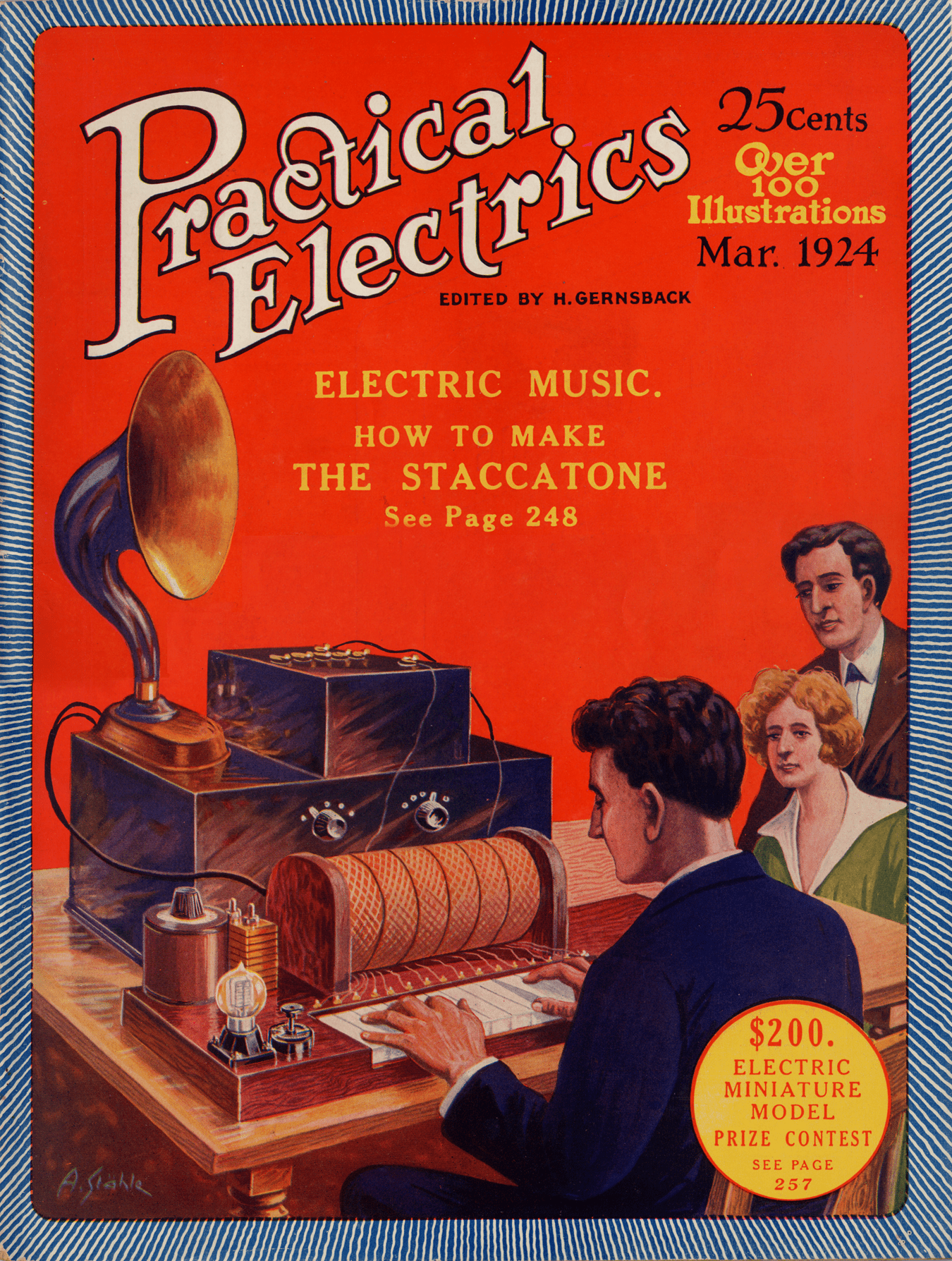
Practical_Electrics_Mar_1924_Cover
The Staccatone on the cover of Practical Electrics, March 1924, 248-9
The Radio World (New York, USA) in 1924 described the instrument in a ‘Radio Music’ feature:
“Everyone who has played with circuits calling for an oscillating vacuum tube has noted the bothersome howls and squeals produced by its improper manipulation. Mr H. Gernsback, editor of Science and Invention, is the originator of a circuit in which these once annoying noises can be made to produce music, much like an organ, but with a flute-like note peculiar to itself and agreeably surprising. “In Practical Electrics, Mr Gernsback says: ‘The characteristic squeal rising in pitch from zero to a high note beyond the limit of audibility is familiar to us all. This range of frequencies runs much higher than can be obtained from any known musical instrument. If properly controlled we have a musical instrument that surpasses in tonal range any musical instrument. . . . With several vacuum tubes, harmonic chords can be developed.
This device makes use of the Hartley oscillator circuit. By means of correct capacities, inductances, and controlling keys, the full-scale range can be obtained, and the instrument can be played through a loudspeaker in the manner of a piano or an organ. ” This staccatone, as the device is called, is simple in arrangement, and any experimenter can build and operate one. At the present time, the inventor is installing a model in one of the moving-picture theaters with a view of demonstrating its usefulness in playing full orchestrations. “The circuit used is shown in the diagram. The inductances consist of six 1,500-turn honeycomb coils in series, clamped together. Care should be taken that their magnetic fields assist rather than oppose. The coils can be connected properly if the outside lead of one is connected with the inside lead of the other, and each coil is placed in the same position as regards the direction in which the wire runs. The negative of the B battery is connected to the end of the first coil. The filament of the tube is connected in between the first and second coils, at the connecting juncture. Taps are then brought out and connected to the keys, as shown.
About twenty mica condensers of .006 microfarads each are required, with a 43-plate variable condenser of high efficiency. The variable condenser is included for tuning the instrument. The fixed condensers are arranged in a double bank as shown. The switches which form the keyboard are connected at proper intervals so that one octave is covered, including all half notes. Cutting out the extra condensers increases the tonal frequency by one octave.
When everything is connected and the tube lighted, a loud howl which can be varied in pitch by varying the condenser should be produced. It is then necessary to tune the staccatone A piano is best for this purpose, or in a pinch a tuning-fork. The lowest switch key is connected to the end of the last coil. Con-densers are added until the desired note is produced. It will probably be necessary to vary the capacity of the variable condenser in order to get the exact tone frequency at this point. The next key is then tuned by tapping the next coil until G flat is obtained. In tapping this coil, do it near the end, rather than at the end turn. As there is no set method, it will simply have to be a matter of experiment. The remaining coils are tapped in the same manner so as to form the complete musical scale over one octave, from G to A flat. At this point, by manipulating the keys, any musical selection can be played.”
The Staccatone controlled by a self-winding clock mechanism to broadcast regular call signals on the WJZR radio station.
The Staccatone was conceived as a simple self-build DIY project for amateur electronics enthusiasts via Gernsback’s ‘Practical Electrics’ magazine rather than a commercial instrument. Designed in 1921, the first prototype was built by Clyde J. Fitch at New York’s Radio News Laboratories and presented on the air in November 1923 by Gernsback on WJZ, New York. The instrument was later connected to a clockwork timer and used its distinctive sound as a call-signal for the WRNY station. According to Gernsback “The same instrument was also used in a theater, in April, 1924, when I loaned it to Dr. Hugo Riesenfeld, who had one of his musicians play it in the Rialto Theater in New York.” 1 The Staccatone at WRNY, Radio News, September 1925, 284-5.
Clyde Fitch’s self-build schematic of the Staccatone. Image: Practical Electrics, March 1924, 248-9
The instrument consisted of a single vacuum tube oscillator controlled by a crude switch-based 16-note ‘keyboard’. The switch-based control gave the note a staccato attack and decay – hence the ‘Staccatone’. Gernsback promoted the instrument through his many publications and on his own radio station,n WJZ, New York:
“The musical notes produced by the vacuum tubes in this manner have practically no overtones. For this reason the music produced on the Pianorad is of an exquisite pureness of tone not realised in any other musical instrument. The quality is better than that of a flute and much purer. the sound however does not resemble that of any known musical instrument. The notes are quite sharp and distinct, and the Pianorad can be readily distinguished by its music from any other musical instrument in existence.”2 Fitch, Clyde,(1924) The Staccatone, Practical Electrics, March 1924, 248-9.
Hugo Gernsback. Image: Life Magazine 1963. © Time Inc.
Self-build instructions for the Staccatone from ‘Practical Electrics’ magazine 1924:

References:

  • 1
    The Staccatone at WRNY, Radio News, September 1925, 284-5. ↩︎
  • 2
    Fitch, Clyde,(1924) The Staccatone, Practical Electrics, March 1924, 248-9. ↩︎

The ‘Pianorad’, Hugo Gernsback & Clyde.J.Fitch, USA, 1926.

Gernsback’s ‘Pianorad’ at the WRNY radio studio, New York, USA in 1926. Image: Radio News, vol. 8, no. 5, November 1926

The Pianorad, (‘Piano-radio’) designed by Hugo Gernsback and built by Clyde Finch at the Radio News Laboratories in New York was a development of Gernsback’s Staccatone of 1923. the Pianorad had 25 single vacuum tube oscillators, one for every key for its two octave keyboard making the instrument the first valve based electronic instrument to achieve full polyphony. 1The Telharmonium at the beginning of the 20th century earlier was a polyphonic electronic instrument but, because it generated sound using tone-wheels, it can be considered an eletro-acoustic instrument. The sound from the tubes was passed through a rudimentary mechanical filter that removed harmonic distortion producing virtually pure sine tones. The instrument played sound through a top mounted speaker or could be connected directly into a transmitter for radio broadcast.

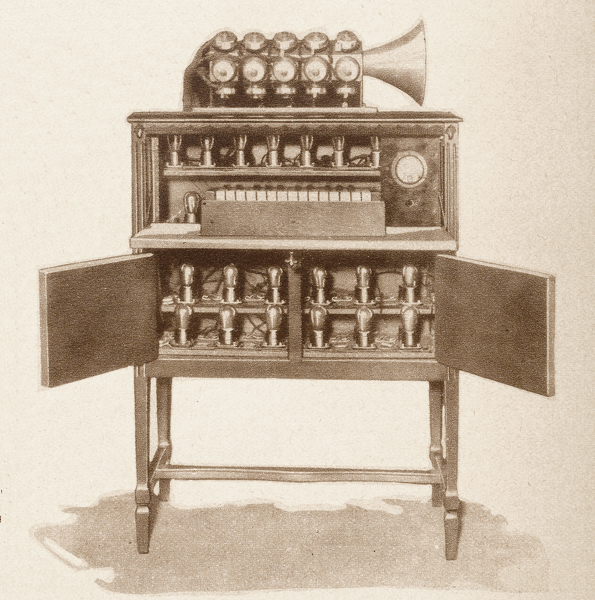
Hugo Gernsbacks' Pianorad
Hugo Gernsbacks’ Pianorad’ showing the cabinet containing 25 vacuum tubes – one for each note. Image: Radio News, vol. 8, no. 5, November 1926, 495.

Theory of the Instrument

The Pianorad has a keyboard like an ordinary piano, and there is a radio vacuum tube for each one of the piano keys. Every time a key is depressed, there is energized a radio-oscillator circuit which gives rise to a pure, flutelike note through the loud-speaker connected to the device. It is possible to connect any number of loud-speakers to the Pianorad if it is desired to flood an auditorium with its tones. Also, by arranging suitable outlets for loud-speakers on different floors or different rooms, the sounds of the Pianorad can be heard all over any large building.

The musical notes produced by the vacuum tubes in this manner have practically no overtones. For this reason the music produced on the Pianorad is of an exquisite pureness of tone not realised in any other musical instrument. The quality is better than that of a flute and much purer. the sound however does not resemble that of any known musical instrument. The notes are quite sharp and distinct, and the Pianorad can be readily distinguished by its music from any other musical instrument in existence.

Electric, Not Sound Waves

The loud-speaker arrangement makes it possible for an artist to play the keyboard while the music emerges, perhaps miles away from the Pianorad. It is thus possible for the pianist to play the instrument in absolute silence while the music is produced at a distance. This requires simply that a wire line must connect the output end of the Pianorad instrument with the loud-speaker at some distance away. It is quite feasible for the Pianorad to be played in New York while the music will be heard at the Chicago end, with any number of loudspeakers connected by amplifiers to a long-distance telephone wire line.

A novel idea is the connection of the Pianorad direct to the broadcast-station transmitter. In this case, instead of using a loud-speaker in the studio, the Pianorad is connected electrically to the broadcast transmitter. The artist now plays the Pianorad in the studio in absolute silence. No sound is heard. The radio audience, however, will enjoy the music, although no one in the studio can hear it. In order that the pianist may hear what he is playing, he will wear a set of head receivers attached to an ordinary radio set. The music, therefore, is picked out from the air by the receiver and thus only the artist hears it. In the studio itself, no sound is audible for the Pianorad itself is silent.

Developments Still Continuing

The Pianorad has as yet not entered the commercial stage. The instrument illustrated in this article has 25 keys and therefore, 25 notes. A full 88-note Pianorad has as yet not been constructed, but will be built in a short time. The larger instrument could have been built at once, but it would occupy almost as much space as a piano; and as this amount of room was not then available in the studio of WRNY, for which the first Pianorad was especially constructed, the smaller instrument was built instead.

The Pianorad at WRNY is usually accompanied by piano or violin or both; very pleasing combinations are produced in this manner. At present it uses a single stage of amplification, giving volume enough, in connection with one loud-speaker, to more than fill a fair sized room. By adding several stages of audio-frequency amplification, sufficient volume can be obtained to fill a large church or auditorium.

The Pianorad was first demonstrated publicly Saturday, June 12 at 9 P.M., with a number of brilliant selections played on it by Mr. Ralph Christman; the concert being broadcast over WRNY at The Roosevelt, New York.

The principle embodied in this instrument was first demonstrated in 1915 by Dr. Lee de Forest, inventor of the Audion. At that time Dr. de Forest was able to produce musical tones by means of vacuum tubes, but the radio art at that time had not progressed sufficiently to make possible the Pianorad.2Gernsback, Hugo, (1926) The “Pianorad” a New Musical Instrument which combines Piano and Radio Principles, Radio News, vol. 8, no. 5, November 1926, 493.

Each one of the twenty five oscillators had its own independent speaker, mounted in a large loudspeaker horn on top of the keyboard and the whole ensemble was housed in a housing resembling a harmonium. A larger 88 non keyboard version was planned but not put into production. The Pianorad was first demonstrated on June 12, 1926 at Gernsback’s own radio station WRNY in New York City performed by Ralph Christman. The Pianorad continued to be used at the radio station for some time, accompanying piano and violin concerts.

Pianorad’s 25 units designed to eliminate harmonics.Image: Radio News, vol. 8, no. 5, November 1926,.

Clyde Fitch gave instructions on how to build the Pianorad in radio News, 1926:

Image: “How to build the Pianorad, Clyde Fitch, Radio News December 1926, 655.

References:

  • 1
    The Telharmonium at the beginning of the 20th century earlier was a polyphonic electronic instrument but, because it generated sound using tone-wheels, it can be considered an eletro-acoustic instrument. ↩︎
  • 2
    Gernsback, Hugo, (1926) The “Pianorad” a New Musical Instrument which combines Piano and Radio Principles, Radio News, vol. 8, no. 5, November 1926, 493. ↩︎

The ‘Dynaphone’, René Bertrand, France, 1927.

René Bertrand (r) and Msr Nadal with their Dynaphone. Image: journal de la semaine. 1928-03-28, 45.

The French electrical engineer, mechanic and doll modeller, René Bertrand, who had been experimenting with electronic instruments as early as 1914, was a long time friend and collaborator with Edgard Varèse and with his support Bertrand developed the electronic instrument called the “Dynaphone” (not to be confused with Cahill’s “Dynamophone” or “Telharmonium“).

Promotional photograph of Bertrand and the Dynamophone. iImage: ‘future Music/ Zukunft Musik’ in Die Buhne, 1928.
Le-Petit-Parisien---journal-quotidien-du-soir-1928-04-24
A review of a Dynaphone concert ‘Angelic Music’ . Image: Le Petit Parisien, 14-04-1928.

The Dynaphone was a portable, monophonic instrument controlled not with a keyboard but played with a pitch-lever and volume switch. The instrument was semi-circular in shape with a diameter 0f 30 cm played on top of a table. The Dynaphone belonged to a family of dial-operated non keyboard electronic instruments developed around the 1930’s such as Mager’s ‘Spharaphon‘. The right hand controlled the pitch using a circular dial on a calibrated disc. Bertrand added a hemispherical cardboard template that allowed the inexperienced user to follow the music by tracing the lines by hand:

“I would also like to point out a new form of recorded music which was inserted into by Mr. Bertrand into the “dial” of his device. A hand operated lever moves on this dial forming a half-disc. The cardboard [form] follows the shape, and on this cardboard Mr. Bertrand has drawn a graph, the performer only has to follow the lines and the points to reconstruct the melody. The cardboard [template] can be changed for each piece.” 1 Gratia,L.E. (1928) La Musique des Ondes éthérées, Les Ménestrel, 48, 1928-11-30, 501.

The total rotation of the dial was equal to seven octaves but only the five highest or lowest could be selected at any one time by the means of a switch, giving an overlap of three octaves common to both ranges.

René Bertrand,
René Bertrand and the Dynaphone in 1928. Image : ‘L’Afrique du Nord illustrée’ 1928-05-05.

Additional vibrato effects could be added by moving the right hand to and fro slightly and the machine also included a push button for articulating the sound. The left hand controlled the volume and timbre – described as similar to a cello, low flute, saxophone or french horn. The Dynaphone generated sound by the by-now standard method of a heterodyning vacuum tube pair, originally used in Leon Termen’s ‘Theremin‘.

Dynaphone

A later development of the Dynaphone (which became known as the ” Radio-electric-organ”) used a five octave keyboard on which the note played could be doubled at the fifth and octave. The first public demonstration of the instrument in 1928 was a performance of Ernest Fromaigeat’s Variations Caractéristiques for six Dynophones and later in ‘Roses de Metal’ a ballet by the swiss composer Arthur Honegger.2 Gratia,L.E. (1928) La Musique des Ondes éthérées, Les Ménestrel, 48, 1928-11-30, 501-3.

After having moved to Neew York, In 1932 Varèse applied to the Guggenheim memorial fund for a grant towards continuing the development of the Dynaphone:

“…..The Dynaphone (invented 1927-28) is a musical instrument of electrical oscillations similar to the Theremin, Givelet and Martenot electrical instruments. But its principal and operation are entirely different, the resemblance being only superficial. The technical results i look for are as follows:

          • To obtain pure fundamentals
          • By means of loading the fundamentals with certain series of harmonics to obtain timbres which will produce new sounds.
          • To speculate on the new sounds that the combination of two or more interfering Dynaphones would create if combined as one instrument.
          • To increase the range of the instrument to reach the highest frequencies which no other instrument can give, together with adequate intensity.

The practical result of our work will be a new instrument which will be adequate to the creative needs of musician and musicologist…” 3 Chadabe J. (1997). Electric sound : the past and promise of electronic music. Prentice Hall,59.

Despite Varèse’s assertions, the Dynaphone was not distinctly different from its close competitors and the Guggenheim Foundation did not sponsor Bertrands work despite several further attempts by Varèse.
dynaphone_02

In 1941, Edgard Varèse, in the hope to resume his collaboration with Léon Theremin, wrote him the letter reported below (courtesy of Olivia Mattis ), but the inventor wasn’t able to read it until 1989, when musicologist Olivia Mattis, during an interview with Theremin (first emerged from Russia after 51 years), presented a copy of it. The letter is dated May 5, 1941.

Dear Professor Theremin,

On my return from the West in October I tried to get in touch with you. I wanted very much to see you again and to learn of the progress of your work. I was sorry – on my account – that you had left New York. I hope that you have been able to go on with your experiments in sound and that new discoveries have rewarded your efforts.

I have just begun a work in which an important part is given to a large chorus and with it I want to use several of your instruments – augmenting their range as in those I used for my Equatorial – especially in the high range. Would you be so kind as to let me know if it is possible to procure these and where … and in case of modifications in what they consist. Also if you have conceived or constructed new ones would you let me have a detailed description of their character and use. I don’t want to write any more for the old Man-power instruments and am handicapped by the lack of adequate electrical instruments for which I now conceive my music.

Mr. Fediushine has kindly offered to forward this letter to you. Please let me hear rom you as soon as possible. With cordial greetings and best wishes in which my wife joins me,

Sincerely, Edgard Varese

P.S. If any of your assistants or collaborators are continuing your work in New York would you kindly put me in touch with them. 4 mattis, (). An Interview with Leon Theremin – October 4, 2002, Therminvox.xom https://www.thereminvox.com/stories/history/an-interview-with-leon-theremin/3/ retrieved 27/11/23

Review from 'Numéro Le Gaulois' February 12th 1982.
Review of a concert of six Dynaphones. Image: Numéro Le Gaulois, February 12th 1982.


Ref:erences

  • 1
    Gratia,L.E. (1928) La Musique des Ondes éthérées, Les Ménestrel, 48, 1928-11-30, 501. ↩︎
  • 2
    Gratia,L.E. (1928) La Musique des Ondes éthérées, Les Ménestrel, 48, 1928-11-30, 501-3. ↩︎
  • 3
    Chadabe J. (1997). Electric sound : the past and promise of electronic music. Prentice Hall,59. ↩︎
  • 4
    mattis, (). An Interview with Leon Theremin – October 4, 2002, Therminvox.xom https://www.thereminvox.com/stories/history/an-interview-with-leon-theremin/3/ retrieved 27/11/23 ↩︎

The ‘Cellule Photo Electrique’ or ‘Cellulophone’. Pierre Toulon & Krugg Bass, France, 1927.

The Cellulophone : Image: ©Tom Rhea, Keyboard Magazine 1977

Created by the French engineer Pierre Marie Gabriel Toulon, with assistance from the electronic engineer Krugg Bass, the Cellulophone (“Cellule Photo-électrique”) made its debut as a prototype in France in 1927. The Cellulophone was an electro-optical tone generator instrument resembling an electronic organ controlled by two eight-octave keyboards and a foot pedal board. The instrument’s sound was created using a photo-electrical technique: a light beam was projected through slits in a variable-speed rotating disk cut with a number of equidistant slits – 54 slits for the lowest note, with different-shaped masks to create varied timbres. The light beam projected through the slits of the disk onto a photoelectric cell, which in turn generated an audible voltage pulse from a single vacuum-tube oscillator; the speed of the rotating disk, therefore, determined the frequency of the instrument’s output signal.

The Cellulophone used four tungsten-filament lamps to produce constant light beams, which were directed via mirrors and lenses through a single rotating disk onto a single selenium photocell, producing an amplified voltage signal from a vacuum tube. Toulon’s design, however, included a number of optical filters or ‘shutters’ that could modulate the tonal timbre of the instrument, allowing for complex overlapping timbral tones to be created. 1 Toulon, Pierre Marie Gabriel,(1934), Music Instrument Working Through a Keyboard and Photo-electric Cell, US Patent Office Granted Feb 1934, No.1948,996. Despite these innovations, according to Tom Rhea, the Cellulophone’s use of a single disk to create all twelve semitones in an octave meant that the instrument was constantly out of tune – i.e. above the 0.1% accuracy range. 2 Rhea, Tom, (1984) Photo-electric Instruments, The Art of Electronic Music, GPI Publications 1984, 13.

Pierre Toulon’s original 1928 patent of the Cellulophone ‘ Music Instrument Working Through a Keyboard and Photo-electric Cell’. Image: US Patent Office Granted Feb 1934 No.1948,996

Toulon’s Cellulophone won the Prix Jean Bares in 1933:

“Second prize (2,500 francs) was awarded to Mr.. Pierre Toulon, a father of three children and consulting engineer of the Electrical School, who made a large number of inventions, among which include “the relay arc” whose principle is applied in instruments referred to as “Thyratrons” and “Spark-gap convertors”, the latter enabling flattening and straightening of even high-powered electrical currents.

Mr Toulon also invented a device called “Cellulophone” – a musical instrument keyboard developed by the Pleyel company, which is an extremely reduced-size organ.” 3 Les Prix Jean S. Barès 1933, Office national des recherches scientifiques et industrielles et des inventions (France), 1934-10-01, 280.

The Cellulophone was one of a generation of instruments in the 1920-30’s that used a photoelectric sound-generation method; other examples include the Licht-ton Orgel, the Photona, the Superpiano, and the Radio Organ of a Trillion Tones. The increased sophistication and reliability of post-war electronic circuitry marked the decline of light-based synthesis after the 1940’s, except for a few pioneers such as Daphne Oram, who used a similar Oramics system to synthesise and sequence sounds.

Pierre Toulon, who held numerous related patents for early television scanners, electrical relays, large-screen televisions, audio amplifiers and sound reproduction and transmission devices, also proposed in the 1930’s a technique of speech synthesis using fragments of optical film mounted on a rotating drum.

Rotating disc mechanism of the Cellulophone<em> (©Tom Rhea, Keyboard Magazine 1977)</em>
Rotating disc mechanism of the Cellulophone. Image: ©Tom Rhea, Keyboard Magazine 1977)

A 1928 Extract from La Revue Hebdomadaire describes various new electronic instruments of the period, including the Cellulophone:

CHRONIQUE SCIENTIFIQUE. LA MUSIQUE RADIOPHONIQUE

Les concerts du professeur Theremin. Une expérience d’acoustique fort instructive. Battements électriques. Où interviennent les lampes à trois électrodes de la T. S. F. Le principe de l’éthérophone. Un précurseur. Piano et orgues radio électriques. Le cellulophone. Conclusion. On a beaucoup parlé ces derniers temps d’une rénovation de l’art musical par l’emploi d’instruments de musique utilisant la merveilleuse souplesse des ondes hertziennes. Les concerts donnés cet hiver à Paris par le professeur Léo Theremin, de Léningrad, ont attiré un nombreux public. Il n’est pas douteux que l’idée d’utiliser les ondes hertziennes à la production des sons puisse constituer une innovation heureuse. Essayons donc de décrire le merveilleux appareil du professeur Theremin et d’en faire comprendre le fonctionnement.

L’explication paraîtra très simple à tous les sans-filistes. Quant à mes autres lecteurs, s’ils veulent bien me prêter quelque attention, je suis certain qu’ils saisiront tout aussi aisément le principe de la musique radiophonique. Rappelons tout d’abord une expérience d’acoustique que chacun peut répéter, pourvu qu’il possède chez lui quelque instrument de musique.

Tout le monde sait que le son est produit par les vibrations de la matière et qu’il nous paraît d’autant plus aigu que les vibrations sont plus rapides. Lorsqu’on fixe l’extrémité d’une tige d’acier, une lame de fleuret par exemple, dans un étau, et qu’après l’avoir écartée de sa position on l’abandonne à elle-même, elle entre en vibration et produit un son, d’abord très grave, mais qui monte de plus en plus au fur et à mesure qu’on raccourcit la lame, ce qui augmente le nombre des oscillations par seconde. Les sons les plus graves que l’on puisse entendre correspondent à environ 30 vibrations par seconde, et les sons les plus aigus à 40 000. Entre ces limites s’étend toute la gamme des sons perceptibles.

Mettons en bran le deux diapasons identiques, donnant par exemple chacun le la normal, l’un d’eux ayant été désaccordé par un peu de cire fixée sur l’une des branches. Le diapason normal effectuant 435 vibrations par seconde, celui qui a été désaccordé en donnera par exemple 432. Dans ces conditions, lorsque les deux diapasons fonctionnent en même temps, on perçoit dans le son d’ensemble des renforcements et des affaiblissements sucessifs,des sortes de hou, hou, hou, répétés régulièrement etqu’on appelle des battements. L’expérience a permis de constater que le nombre deces hou, hou, hou. par seconde est exactement égal à la différence entre les nombres de vibrations par seconde que donnent séparément les deux diapasons, soit ici 435 diminué de 432. Il y a donc trois battements par seconde. Le phénomène est général. Chaque fois qu’on produit simultanément, au moyen d’appareils quelconques, deux séries de mouvements vibratoires dont les nombres d’oscillations par seconde sont différents, l’ensemble donne lieu à des renforcements et à des affaiblissements successifs,à des battements. Or les ondes hertziennes résultent d’une sorte de mouvement vibratoire d’un milieu hypothétique qu’on suppose répandu partout et auquel on a donné l’antique nom d’éther. Dans les ondes, dites entretenues, qu’utilise la radiophonie, les vibrations sont très régulières mais extrêmement rapides. Elles se produisent à raison de quelques centaines de mille par seconde. Envoyées directement dans un téléphone, ces ondes seraient sans actionsur lui, car à supposer qu’elles fussent capables de faire vibrer, suivant un rythme de quelques centaines de mille par seconde, la membrane du téléphone, nous serions incapables de percevoir des vibrations aussi rapides, pour les quelles notre oreille est atteinte d’une surdité absolue. Mais émettons simultanément, au moyen de deux appareils différents, deux séries d’ondes hertziennes, les unes, pour fixer les idées, à raison de ioo ooo vibrations par seconde, et les autres, à raison de 99 000. Leur production simultanée donnera naissance à des battements électriques, à des renforcements suivis d’affaiblissements des ondes hertziennes, dont le nombre par seconde sera égal à 100,000 diminué de 90,000. Et à ces battements électriques qui se produisent ainsi à raison de 1,000 par seconde, le téléphone peut être rendu sensible. Sa membrane oscillant à raison de r 000 vibrations par second eémettra un son aisément perceptible. Si donc, l’une des deux séries d’ondes demeurant invariable et se produisant toujours à la fréquence 100 000, nous avons le moyen de faire varier la fréquence de l’autre série d’ondes et de la rendre égale par exemple à 99,500, à 99,400, à 99,300. le nombre des battements, toujours égal à la différence des fréquences associées, sera successivement 500, 600, 700. par seconde. Le téléphone actionné par les battements fournira un son deplus en plus aigu, correspondant successivement à 500, 600, 700. vibrations par seconde. Et c’est là tout le secret de l’éthérophone. Des ondes hertziennes sont produites à la fréquence moyenne de 300 ooo vibrations par seconde par deux générateurs appelés hétérodynes. Si les deux séries d’ondes sont légèrement désaccordées, elles donnent lieu à des battements électriques qui, agissant dans un haut-parleur à la manière habituellement utilisée dans les réceptions radiophoniques, en actionnent la membrane et produisent un son. De la boîte où sont enfermées les deux hétérodynes émergent une tige métallique verticale jouant le rôled’antenne, et une spirale en fil de cuivre placée horizontal ement sur le côté. Le fonctionnement de l’appareil consiste à faire varier les constantes électriques de l’un edes deux séries d’ondes en approchant la main droitede l’antenne verticale et la main gauche de la spirale. Le premier mouvement fait varier la fréquence des battements et, par conséquent, détermine la hauteur de lanote le second mouvement agit sur l’amplitude des ondes et par suite sur l’intensité du son. De ces deux mouvements, le premier, qui doit suivre les notes de la partition musicale, est évidemment le plus compliqué etest de ce chef dévolu à la main droite le second est réservéà la main gauche en raison de sa simplicité.

L’idée qui est à la base de l’éthérophone n’est pas nouvelle. Dès 1917, les ingénieurs français travaillant au laboratoire de la tour Eiffel avaient songé à tirer un parti musical des battements radio-électriques dont nous venons de parler. M. Armand Givelet, vice-président du Radio-Club de France, avait eu l’idée de marquer à la craie sur le cadran du condensateur d’hétérodyne le réglage correspondant aux différentes notes de la gamme. En tournant rapidement ce condensateur variable et en arrêtant brusquement l’aiguille sur les repères du cadran, il était parvenu assez facilement à jouer des mélodies populaires simples. C’était, en somme, exactement le principe de l’éthérophone. Il a suffi de perfectionner quelques détails pour obtenir un appareil permettant de produire des effets véritablement artistiques.

D’ailleurs, M. A. Grivelet a réalisé, il y a quelques années, le premier piano radio électrique. On a pu voir cet instrument exposé récemment au premier Salon des Sciences et des Arts, au Grand Palais des Champs-Élysées. Chaque note est produite par un circuit séparé, engendrant les vibrations sans qu’il ait à intervenir des battements. De son côté, M. Bertrand a construit sous le nom d’orgue radio électrique un appareil d’un principe tout à fait analogue à celui du professeur Theremin, qui utilise les battements électriques de deux hétérogynes, et dans lequel le son est diffusé par un haut-parleur de grand modèle. La variation de la hauteur du son est produite par la commande d’une manette qui se déplace devant un cadran comportant une gamme de trois octaves.

Le Cellulophone de M. Pierre Toulon n’est pas moins curieux. Son principe est tout différent. Il utilise la propriété des cellules photoélectriques, sortes de piles qui donnent naissance à un courant lorsqu’elles reçoivent un faisceau de lumière. En envoyant sur une cellule, non un éclairage continu, mais un éclairage intermittent qu’on peut réaliser en interposant entre la source lumineuse et la cellule un disque tournant perforé, la pile produit une succession de courants instantanés dont le nombre par seconde dépend du nombre des trous que porte le disque et de sa vitesse de rotation. Envoyés dans un haut-parleur, ces courants le font vibrer avec la même fréquence. La hauteur de la note musicale dépend ainsi du nombre de trous que porte le disque et de sa vitesse de rotation, le timbre étant déterminé par la forme de ces trous. On conçoit qu’on puisse modifier à volonté la hauteur et le timbre, et obtenir des effets musicaux très variés.

Il serait difficile de prédire l’avenir qui est réservé aux appareils de musique radio électriques. Indiquons seulement qu’ils ont permis d’obtenir des effets artistiques très intéressants, et il ne serait pas surprenant que,grâce à eux, la musique, cette forme si élevée et si expressive de l’art qui a très peu évolué depuis des siècles, entre dans une voie entièrement nouvelle. A. BOUTARIC. 4 Boutaric, A. (1928), CHRONIQUE SCIENTIFIQUE. LA MUSIQUE RADIOPHONIQUE, La Revue Hebdomadaire: romans, histoire, voyages, Paris, mars 1928, 504 .

And from Le Genie Civil, February 7, 1928:

cellulophon_le_genie_civil_18feb_1928
‘Le Cellulophone’ from Le Genie Civil, 18 February 7th, 1928.

References:

  • 1
    Toulon, Pierre Marie Gabriel,(1934), Music Instrument Working Through a Keyboard and Photo-electric Cell, US Patent Office Granted Feb 1934, No.1948,996. ↩︎
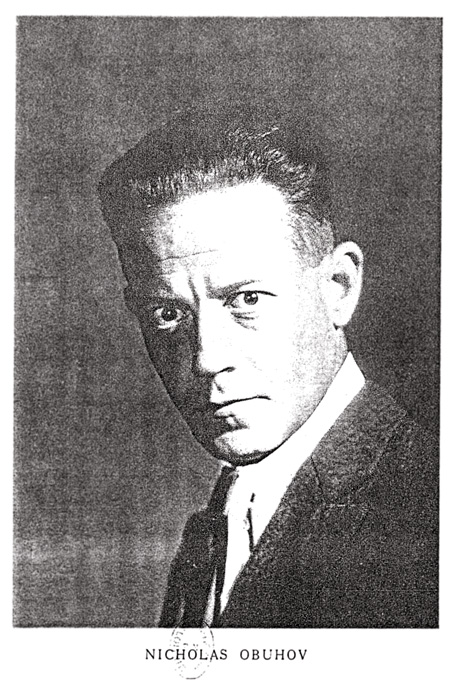
  • 2
    Rhea, Tom, (1984) Photo-electric Instruments, The Art of Electronic Music, GPI Publications 1984, 13. ↩︎
  • 3
    Les Prix Jean S. Barès 1933, Office national des recherches scientifiques et industrielles et des inventions (France), 1934-10-01, 280. ↩︎
  • 4
    Boutaric, A. (1928), CHRONIQUE SCIENTIFIQUE. LA MUSIQUE RADIOPHONIQUE, La Revue Hebdomadaire: romans, histoire, voyages, Paris, mars 1928, 504 . ↩︎