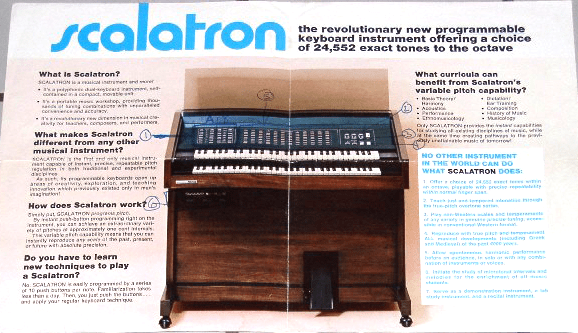
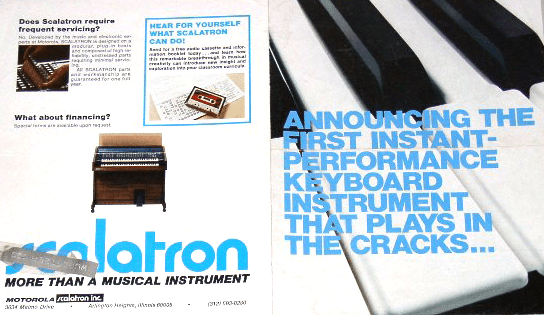
The Scalatron was an unusual microtonal electronic instrument developed in the early 1970s by Motorola as a new venture into the instrument market. Promoted as the ‘first instant-performance instrument that plays in the cracks’ the Scalatron was aimed squarely at a more experimental, microtonal market – if such a market existed. The instrument itself was a rather basic synthesiser consisting of 240 square wave oscillators (one for each key) built into a wooden home-organ casing. The instrument was manufactured in Chicago by Motorola for a brief period during the early 1970s (about 12 were constructed).
The original Scalatron had two five-octave manuals. Each note can be independently tuned and the tunings are selected and fixed before a performance begins; the frequency (about 3.5 MHz) of a master oscillator is divided by the operation of ten binary switches for each note, giving 1024 pitch possibilities per key, accurate to within less than half a cent. A second version, constructed in 1979-81 under the direction of Richard Harasek, features Secor’s design for the ‘Generalized Keyboard’, which has up to 56 notes per octave, controlled from 294 colour-coded oval keys (white naturals, red flats, black sharps). The keyboard can be electronically divided to provide two-manual effects. The system memory can store 17 switch-selected tunings. The Scalatron offers traditional organ sounds as well as synthesizer capabilities such as synthetic wave shapes, filters, and a white noise source. Outputs can be fed to a multi-track tape deck or to multiple channels for live performance. The Scalatron was used by Easley Blackwood at the University of Chicago in the late 1970s in the composition of his 12 Microtonal Etudes, each one of which explores an equal-tempered system having between 13 and 24 notes to the octave. Secor himself composed works in the 31-note system and in unequal temperaments using the Scalatron. A Scalatron electronic tuner was also marketed, in which stroboscopic patterns are aligned on a television screen.1Davies, Hugh. (2014) The Scalatron, The Grove dictionary of musical instruments, New York : Oxford University Press,418.
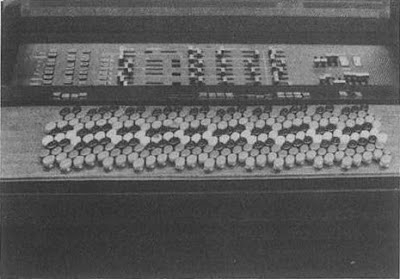
The instrument was controlled in early models by a dual manual and later using a multi-coloured ‘Bosanquet generalized keyboard’ designed by the Chicago microtonal composer George Secor. The Secor keyboard consisted of 240 tuneable oval multicolored keys and allowed the user to create complex tunings
“Earlier that year (1974) I had attended a demonstration of the Scalatron (digitally retunable electronic organ) prototype, and recognizing that conventional keyboards were not the best way to perform music with more than 12 tones in the octave, I unwittingly proceeded to re-invent the Bosanquet generalized keyboard and subsequently approached the Motorola Scalatron company with the proposal of employing it on their instrument.”… “Around that time several members of the xenharmonic movement had gotten in touch with Scalatron president Richard Harasek and sent him copies of the first two issues of Xenharmonikôn, which he passed on to me and which I promptly read. The second issue included Erv Wilson’s diagrams of a modification of Bosanquet’s keyboard, with hexagonal keys, at which point it became clear that my keyboard proposal was not new… For the remainder of the year I was heavily involved in the generalized (Bosanquet) keyboard Scalatron project and, after that, in using it to explore new tunings. In effect, the keyboard that I had discovered was destined to be overshadowed by the one that I had rediscovered.”
George Secor
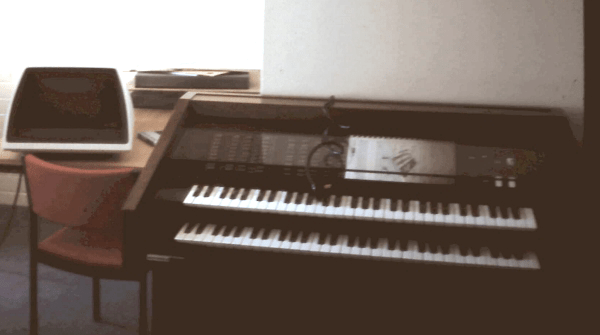
George Secor demonstrates the Scalatron.2 Track Listing: 0:00 opening musical excerpt 1:47 spoken introduction 2:33 renaissance dance in Pythagorean tuning piece 3:46 explanation 3:57 baroque sonata improvisation in quarter-tone meantone 4:47 Individual harmonics with band-pass filter 5:40 explanation 5:54 played overtone series in 31-EDO 6:16 explanation 6:28 Improvisation in 31-EDO 8:48 explanation 8:58 Study on Olympics pentatonic by Harry Partch 10:11 explanation 10:44 31-EDO Improvisation with effects 15:12 explanation 16:04 Ivor Darreg 19-EDO Prelude 17:28 Explanation 17:42 “Chromatic Prelude” in 31-EDO by Adriaan Fokker | 18:24 Explanation 18:50 11-EDO 19:19 Explanation 19:27 Improvisation in 11-EDO 22:04 Improvisation 27:56 Explanation 28:29 Final Musical Piece
The Motorola Scalatron.
What would you expect of a keyboard made by a conglomerate television/communications/defense-systems manufacturer? Why, the Motorola Scalatron, of course. The ideas of geniuses often appear laughable in their own time, so we’ll allow that maybe the Scalatron was a brilliant invention. Maybe. But you’ve got to admit that, on the face of it, George Secor’s “generalized keyboard” (another variation on the Janko design) looks a tad loony. Take the designer’s own remarks on the subject: “Even if it were completely impractical musically, it would make a wonderful prop for a futuristic movie.” Or maybe for The Cabinet of Dr. Caligari.
Actually, Secor’s generalized-keyboard Scalatron was an extension of the original instrument built by Motorola engineers Don Ryon and the late Dick Harasek, with help from now-retired DePaul University Professor Herman Pedtke, to play nontempered tunings. Their Scalatron had a standard black-and-white keyboard, but Secor’s multicolored arrangement of 240 push-button keys was adopted to make the instrument’s variable-tuning hardware practical with virtually any microtonal scale. The designer himself (a specialist in microtonal theory and musical temperament) toured with it, performing the works of Harry Partch and Ben Johnston. Of course, any technology has its limits. “There is not much point,” Secor writes, “in using this alternative keyboard for systems below 31 tones in the octave.” If you’re into playing standards, don’t bother looking for this baby on the used market. Two Secor-style Scalatrons were built — compared to about 12 with the standard keyboard — in the few years after the instrument’s introduction in 1974.
While Secor mentioned in a 1976 newsletter that “the synthesizer functions of the Scalatron seem to have been almost as important as the keyboard in putting the instrument over,” those functions look a little rudimentary even by contemporary standards, especially for a $6,500 machine. The square-wave oscillators, one for each note, were kept in tune by a reference frequency gener-ated by Motorola’s television technology. From there the waveforms were subjected to filtering and attack/release envelope control. Seven userdefinable tuning programs were provided at an additional cost of about $1,000. “I use mine all the time,” says Professor Easley Blackwood of the University of Chicago, “but only for research.” Blackwood still keeps a standard-keyboard Scalatron in his office. “It’s on the fritz now, but I’ll be getting it fixed soon. It has rock-steady tuning capabilities; you can always count on it to be right. But I would never consider it for live performance.”
Mark Vail, Keyboard presents Vintage synthesizer 1993. 3Vail, Mark.(1993)Keyboard presents Vintage synthesizers : ground breaking instruments and pioneering designers of electronic music synthesizers, San Francisco : GPI Books ; Emeryville, CA, 91-2.
Costing around $6000-$10,000, the Scalatron was an expensive and unusual instrument. Less than 20 Scalatrons were ever made (including only 2 Secor versions). The Scalatron came with a black and white monitor to adjust each key’s pitch (using Motorola’s TV tuning technology) – a split screen showed horizontal bars representing true pitch on the left side and the instruments variable pitch on the right side, and, for an additional $1000 a cassette interface was added with a number of tuning ‘programmes’. George Secor toured with the instrument playing works by Harry Partch (who also used the instrument towards the end of his life: “It’s just what I needed, 40 years too late.” 4 Burt, Warren. My History With Music Tech, http://www.warrenburt.com/my-history-with-music-tech2/, retrieved 16/04/24. ) and Ben Johnston. The Scalatron is still much in favour – though very hard to find – by microtonal composers and was used on several albums by Jon Hassell, most notably for the drone parts in ‘Vernal Equinox’ 1977.
Sources:
- 1Davies, Hugh. (2014) The Scalatron, The Grove dictionary of musical instruments, New York : Oxford University Press,418.
- 2Track Listing: 0:00 opening musical excerpt 1:47 spoken introduction 2:33 renaissance dance in Pythagorean tuning piece 3:46 explanation 3:57 baroque sonata improvisation in quarter-tone meantone 4:47 Individual harmonics with band-pass filter 5:40 explanation 5:54 played overtone series in 31-EDO 6:16 explanation 6:28 Improvisation in 31-EDO 8:48 explanation 8:58 Study on Olympics pentatonic by Harry Partch 10:11 explanation 10:44 31-EDO Improvisation with effects 15:12 explanation 16:04 Ivor Darreg 19-EDO Prelude 17:28 Explanation 17:42 “Chromatic Prelude” in 31-EDO by Adriaan Fokker | 18:24 Explanation 18:50 11-EDO 19:19 Explanation 19:27 Improvisation in 11-EDO 22:04 Improvisation 27:56 Explanation 28:29 Final Musical Piece
- 3Vail, Mark.(1993)Keyboard presents Vintage synthesizers : ground breaking instruments and pioneering designers of electronic music synthesizers, San Francisco : GPI Books ; Emeryville, CA, 91-2.
- 4Burt, Warren. My History With Music Tech, http://www.warrenburt.com/my-history-with-music-tech2/, retrieved 16/04/24.
Herman Pedtke was my uncle.
Herman Pedtke was a teacher of mine at DePaul University, back in the 70’s. He had a no-nonsense approach in the classroom that some of the students did not always appreciate. I did, though. We were aware of his invention called the scalatron..and one day he asked if I’d be interested in working with a guitar version of the instrument. (I was a major in classical guitar.) I felt quite honored by the offer and I thanked him but begged off. “Thank you, Mr. Pedtke,” I said. “But I already have enough trouble with 12 tones to the octave!” It was an unusual time for “modern music”, the beginnings of synthesizers, and performance art. Another one of our teachers, Phil Windsor, had Pauline Oliveros visit our smaller classroom. She shared a piece she had written for clucking human voices, tape recorder, slide projector, and woman in a bathing suit laying across the teacher’s desk. It was quite an eye opener! But Herman was a more refined, traditional, and ” serious” musician.
I admired him
… Rick Rogers
In 1977 when I was at Aaron Copland School of Music professor Joel Mandelbaum requisitioned a Skeletron for the schcool. He wanted to compose with it and eventually teach a course on it but I don’t think it ever got off the ground. I think the fact that it was a simple Square wave
output and had no real musical tone was its downfall.
Herman Pedtke was my Father. I have many of his original files and equipment for the Scalatron in my possession. Also he was interviewed on a Chicago radio station in the early 1970’s, the exact year escapes me. I have the recording. He was instrumental in getting this technology off the ground, having had these ideas in his head for years and years. I have not kept up with where it all progressed, but one day hope to go through all I have in my possession and decide where it best resides, from a historical standpoint. It was a great passion of his, no doubt.
Hello! I have been looking for information on the Scalatron for quite a while. My late father was a lifelong music teacher, musician and collector of everything. Considering your family and since you have a lot of Scalatron related equipment, I thought maybe you could help me. The piece I got from my Dad is a black box that is about 12″x 7″x 5″ labeled Scalatron. It has a microphone input and 10 switches at the top. Below that is a switch that toggles between Variable and Chromatic. Below that are 3 dials. The left goes from x 4 2 1 2 ÷. The center is labeled Octave and goes from 1-8. The right dial is labeled chromatic selector and goes chromatically through all the musical keys. This device produces different semitones, depending on what is selected. The microphone input seems to have no effect. My Dad also tuned pianos and I thought this was related to that work, but now I have my doubts. I did find two already sold ebay auctions related to this item. One was a manual that says “The System – The Motorolla Scalatron Tuning System”. The manual shows the unit I have paired with a video monitor. The second is a completed auction for a box like mine that claims to be a prototype for the Scalatron. I don’t really believe this is a prototype. It seems more like an ancillary piece to the actual keyboard. If you have any info or could point me in the right direction, it would be much appreciated.
Have you found a home for the material yet? If not, I would love to help find them a good home.
Chris Garcia
You may want it to reside along with George Secor’s papers st EMEAPP.org
I have a H. Pedtke & Son upright grand piano. I was wondering if you are the same Pedtke family that made pianos. I have been trying to find information about this piano but cannot find any inforation. I would love to know more about this piano. Thank you.
Hello Ms. Richter,
I am one of Herman Pedtke’s daughters. He was the grandson of Herman Pedtke who had the piano shop in Chicago. My dad’s father was Leo Pedtke. I believe I have a photo of the interior of the shop, but will have to search.
I have always wanted to obtain one of these pianos.
After my dad passed, I retained a great deal of the Scalatron material, of which he was greatly involved in for years.
I would love to hear from you regarding the piano, and love to see photos. Thank you, Debbie H
These pianos are very rare! I only know of one other besides yours, in the hands of a distant cousin of mine, Tom. I’d love to know more about yours, and I can probably answer some questions.
My father was Daniel F Pedtke, son of Daniel H Pedtke, son of Herman Ludwig Pedtke, AKA “H. Pedtke”. I forget which son was the “& Son” but it may have been my grandfather.
Yes. This is Herman’s son Paul.
My great grandfather Herman was a master carpenter. Mr grandfather Leo, a master piano tuner, and his brothers were involved in the piano production. It was short lived but they did make a few.
I have a Pedtke and Son metal plaque.
A few clarifications are in order.
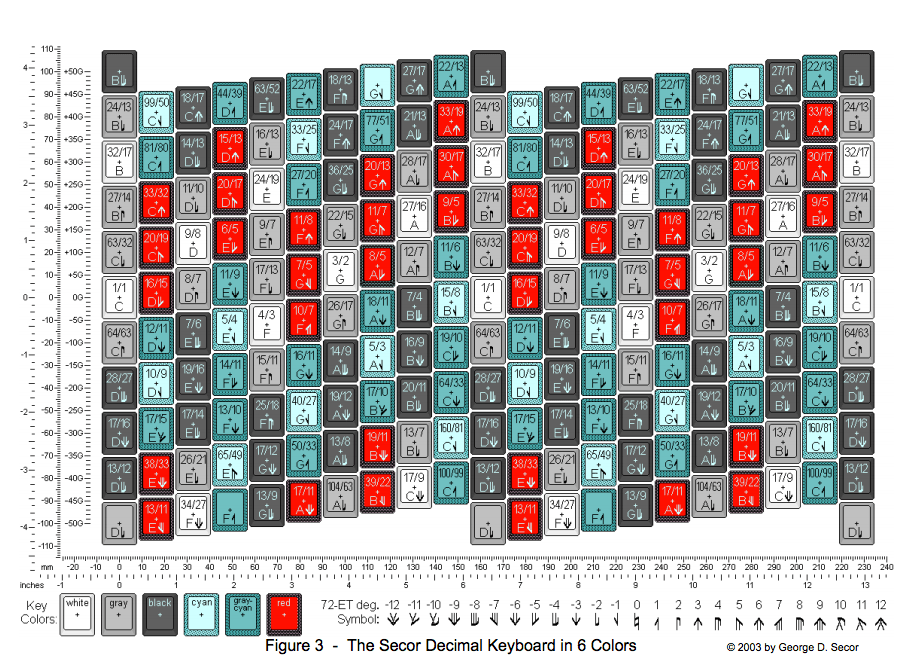
The illustration labeled “Secor Keyboard Diagram” is NOT the generalized keyboard layout (originally invented by Robert Bosanquet) that I proposed for the Scalatron. It is my design for a “decimal keyboard” (having 10 lateral keys per octave) which allows mapping the 31, 41, and 72 divisions of the octave, as well as Harry Partch’s just intonation and (what would later be named) the Miracle temperament. This diagram has nothing to do with the Scalatron and does not belong in this article.
Most articles about the Scalatron (and this one is a lot better than most) contain other inaccuracies, and I feel that it’s time to give credit to those who had a major part in the development of this unusual instrument. The concept of an electronic musical instrument with digitally programmable pitch originated with Herman Pedtke, and it was inspired by the appearance of electronic music instruments with programmable rhythm (a/k/a drum machines). I understand that Pedtke was a neighbor of Motorola employee Richard Harasek and that the two were frequently in contact, since both were musicians. Harasek was intrigued with the idea and succeeded in getting Motorola to support a new subsidiary under its New Ventures program. The Scalatron was developed by the Motorola Scalatron company with Harasek as president and Don Ryon as electrical engineer. The product was basically a two-manual electronic organ with independently retunable keyboards. My proposal for a generalized keyboard came several years later, and Erv Wilson provided valuable input regarding the most optimal shape for the keys.
Interesting article about a grand effort to develop a new product at Motorola. Don Ryon and I shared the patent on the split screen tuning display.
Hello Mr Secor! I have been looking for information on the Scalatron for quite a while. My late father was a lifelong music teacher, musician and collector of everything. I thought maybe you could help me identify a piece I got from my Dad. It’s a black box that is about 12″x 7″x 5″ labeled Motorolla Scalatron. It has a microphone input and 10 switches at the top. Below that is a switch that toggles between Variable and Chromatic. Below that are 3 dials. The left goes from x 4 2 1 2 ÷. The center is labeled Octave and goes from 1-8. The right dial is labeled chromatic selector and goes chromatically through all the musical keys. This device produces different semitones, depending on what is selected. The microphone input seems to have no effect. My Dad also tuned pianos and I thought this was related to that work, but now I have my doubts. I did find two already sold ebay auctions related to this item. One was a manual that says “The System – The Motorolla Scalatron Tuning System”. The manual shows the unit I have paired with a video monitor. The second is a completed auction for a box like mine that claims to be a prototype for the Scalatron. I don’t really believe this is a prototype. It seems more like an ancillary piece to the actual keyboard. Any information you could provide would be greatly appreciated.
Hi George,
I am a nephew of Herman’s & remember him playing the pump organ in his basement. I had the original prototype of the Scalatron which weighs about 80 lbs & 3ft x 1ft h x 2 ft deep, had many wires for changing or “programming the output. I remember hearing there was a lawsuit against the Moog synthesizer, but Moog won
My mother was a classmate of Dick Harasek’s wife growing up.
We had parties at times together. Nice people! I knew him as an uncle.
I actually helped in summer with the Scalatron production in Arlington Heights small shop. I made the electric whips cords in college.
There are two examples at EMEAPP. George Secor’s personal instrument being amoung them. One has a crystal based sound engine and a patch bay and the other is more conventional looking.
I found a Scalatron in a thrift shop in The San Fernando Valley a number of years ago. It was monstrously heavy even though it had been cut down (or was just missing the base) and had had the bottom part removed. I decided to get it nonetheless and my wife’s back was sore for 6 months after she helped me unload it from my car. It was the early regular keyboard.
I’m at a stage in my life where I need to cut down on things. Any ideas on what I should do with it? Donate? Sell?
There’s a section in Mark Vail’s Vintage Synthesizers book titled “Creatures from the Black Lagoon!” According to Vail, only 13 were ever produced.
Also, does anyone here have any idea about this particular piece and how it ended up in the Valley? Too, who might have been the original owner?
What a rare and crazy instrument!
Bob- Do you still have this instrument? We have two, one of which George Secor left to us. We are the Electronic Music Education and Preservation Project near Philly. info@emeapp.org