The Ondes Martenot, also known as the Ondes Musicale Martenot or simply the “Ondes,” is an early monophonic electronic musical instrument created by Maurice Martenot (1898-1980), a cellist and former World War I radio operator. Martenot’s instrument became one of the few early electronic musical instruments to enter commercial production and gain recognition in the canon of 20th and 21st-century music, particularly within the French new music movement of the 1930s and 1940s.
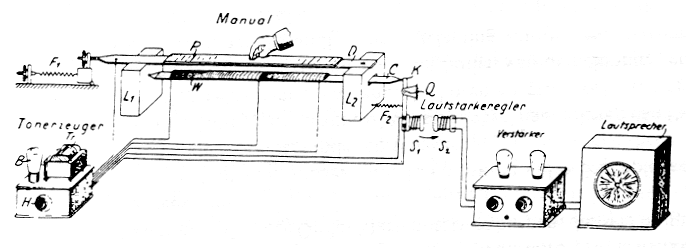
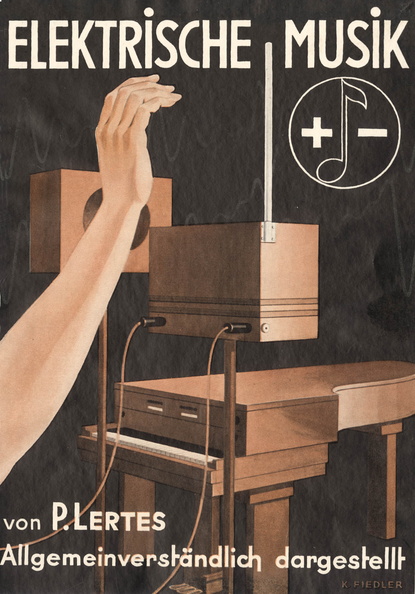
The Ondes was one of several electronic instruments developed after the First World War that utilised the heterodyning vacuum-tube effect to produce audible tones. Notable examples include Lev Termen’s Theremin (patented in 1928), Friedrich Trautwein’s Trautonium (patented in 1930), and Jorg Mager’s Elektrophon (patented in 1921), all of which were based on similar military radio technology. This method of electronically generating sound remained the predominant technique until the advent of integrated circuits in the 1960s.
While serving as a radio operator in the French army during the final years of World War I, Martenot began to realise the potential of electronic sound. By manipulating the radio feedback howl that plagued early radio transmitters and receivers, Martenot was able to play simple tunes 1 such as Debussy’s “Clair de Lune.” Laurendeau, Jean. (1990) Maurice Martenot, Luthier de l’électronique, Dervy-Livres, 48. —a trick he referred to as the “Mexican singing dog”— much to the amusement of his fellow troops. Once demobilised, Martenot put this experience into practice and began experimenting with designs for his new electronic instrument.


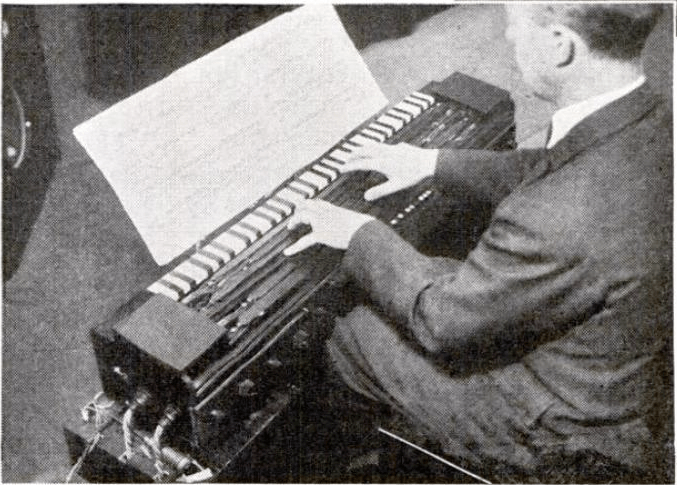
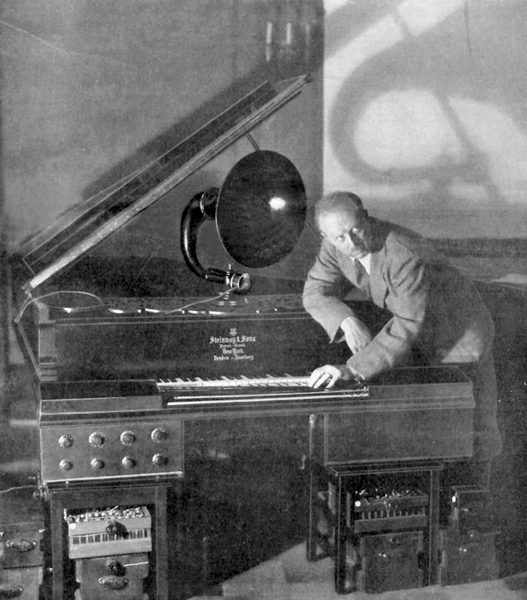
The first versions bore little resemblance to later production models and consisted of two table-mounted units in which the machine’s pitch was controlled by body capacitance, in a manner very similar to the Theremin. Based on a pair of heterodyning vacuum tubes, the Ondes produced a single, continuous monophonic tone similar to a sine tone but with added harmonic distortion from the vacuum tubes. The second model, known as the Ondes-Martenot, was patented on the 2nd of April 1928 under the title Perfectionnements aux instruments de musique électriques (improvements to electronic musical instruments). 2French patent FR666807A , in this model, the player, in a standing position, controlled the pitch with a string attached to a ring held in the performer’s hand, giving a continuous tonal glissando. Martenot first demonstrated the Ondes Martenot on April 20, 1928, as a soloist performing Dimitrios Levidis’s Poème symphonique at the Paris Opera. This model was quickly succeeded by the third model in 1929, which had a fixed, non-functioning printed 7 octave keyboard to guide the player to the relevant pitch using either the string controller or a finger-guard device held in the player’s hand. This third model, created in collaboration with the engineer Maurice du Breuil, featured a dual-speaker set housed in a framed box and a set of expression controls accessed via a left-hand sliding drawer.

The Ondes Martenot underwent several design improvements throughout the 1920s, ultimately stabilising with the modèle 37, which was introduced in 1931. Maurice Martenot aimed to create a versatile electronic instrument that would be familiar to orchestral musicians while distinguishing it from competitors, such as the Trautonium and the Theremin.

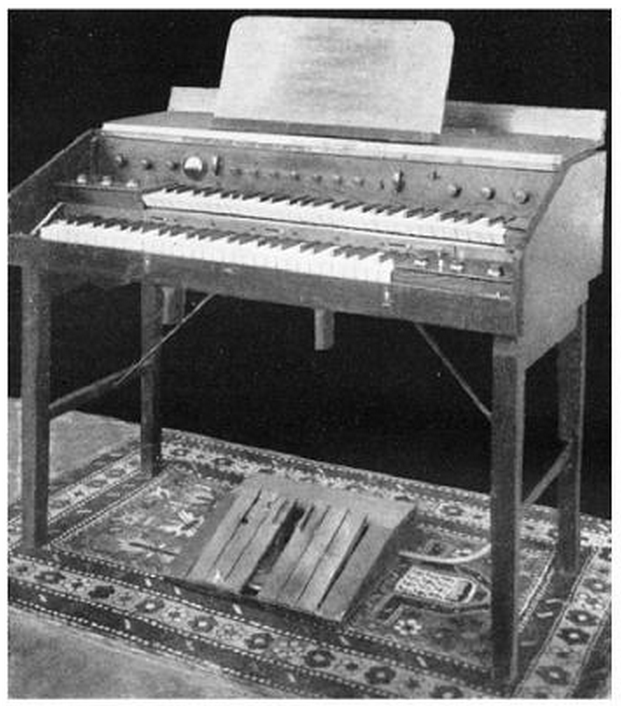
The modèle 37 was the first to feature a standard keyboard that could be played alongside a string controller known as the ‘ruban,’ which allowed for pitch glissandi. This new model incorporated features that would shape the design direction for subsequent versions. These features included two left-hand pitch controllers: a suspended vibrato device called the clavier and the aforementioned ruban, which runs parallel to the keyboard and allows for tonal and timbral glissandi. Additionally, it had a left-hand-controlled prismatic touche d’expression, which modulated the sound envelope.3Asimov, Peter. (2018) Une invention ‘essentiellement française’: seeing and hearing the Ondes Martenot in 1937, MUSIQUE – IMAGES – INSTRUMENTS N° 17, BNF, Paris, 107.
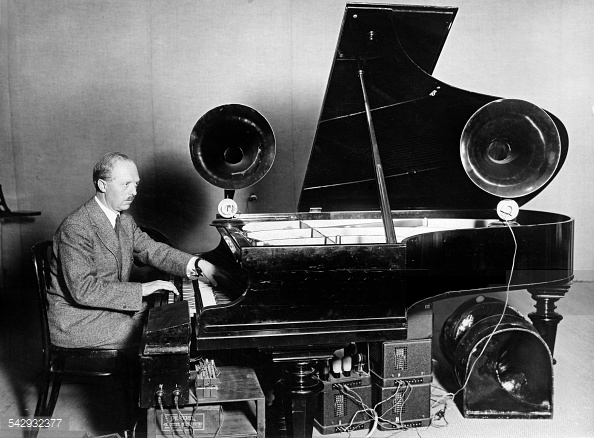
After a world tour promoting his instrument, Maurice Martenot developed an interest in the timbres of non-Western music, particularly the metallic sounds of the Javanese and Balinese gamelan. To replicate these sounds, Martenot dedicated the next decade to introducing various acoustically resonant loudspeakers, known as Diffuseurs, which enhanced the tonal richness of the instrument’s output. These include:
– Principal: A standard, large loudspeaker.
– Résonance: A loudspeaker that utilises springs to create a mechanical reverb effect.
– Métallique: A small gong serves as the diaphragm of this loudspeaker, producing a ‘halo’ effect rich in harmonics – introduced in the 1937 model.
– Palme: An iconic lotus-shaped loudspeaker that uses tuenable strings to generate sympathetic resonances – introduced in 1948 models.

Martenot also collaborated with the Indologist Alain Danielou to create a microtonal version of the instrument, designed for the renowned Hindu poet Rabindranath Tagore. This microtonal ondes of 1937 (Patent 841.128 February 1939) was shorter than the standard version and featured a 5-octave keyboard. According to Laurendeau, it included a set of control discs placed above the keyboard, allowing simultaneous tuning of notes such as C and D to the twelfth. This setup ensured that the overall keyboard tuning corresponded to the raga mode. Laurendeau, Jean. (1990) Maurice Martenot, Luthier de l’électronique, Dervy-Livres, 100.[/mfn]

The modèle 37 Ondes-Martenot was unveiled at the 1937 Paris Expo, an exhibition of art and industry held from May to October 1937. A key feature of the expo was a program of 46 musical events featuring prominent French and European composers, including Milhaud, Messiaen, Vellones, Honegger, Ibert, Schmitt, Koechlin, and others. These performances were broadcast throughout the event via loudspeakers positioned along the Seine River, attached to the Eiffel Tower, and even from aeroplanes flying over the city. The ondes-martenot gained a certain cult status during the Expo, being described in the event catalogue as “a new source of infinite artistic joy” and “the most sensational musical and scientific achievement of the 1937 exposition.” Eleven out of the eighteen composers commissioned to create works for the Expo wrote compositions specifically for the ondes. Among these was Ginette Martenot’s all-female electronic ondes orchestra, which frequently performed Messiaen’s commissioned piece, Fête des belles eaux. This performance was enhanced by a spectacular display of illuminated fountains and coloured lights, choreographed and synchronised to the music.

During the 1930s, Martenot enhanced the instrument by introducing features such as the ability to modify and simultaneously combine different sound waveforms using a set of control sliders in the left-hand sliding drawer. The later models of the Ondes included pre-set sounds that were:
-
-
- Onde (O): A simple sine wave. Similar in sound to the flute or ocarina.
- Creux (C): A peak-limited triangle wave. Similar in sound to a clarinet in high registers.
- Gambe (G): A timbre somewhat resembling a square wave. Intended to be similar in sound to string instruments, as the French title would suggest.
- Petit Gambe (g): A similar but less harmonically-rich timbre than Gambe. The player can control the number of harmonics in the signal using a slider in the control drawer.
- Nasillard (N): A timbre resembling a pulse wave. Similar in sound to a bassoon in low registers.
- Octaviant (8): A timbre with a reinforced first harmonic whose intensity in the signal can be controlled by using a slider. This setting is analogous to the 4-foot stop in organ terminology.
- Souffle (S): A timbre often described as white noise, but in fact pink noise of indefinite pitch.
-
With the introduction of transistors in the 1960s, Martenot developed an integrated circuit version of the instrument, followed by a digital version in the 1980s.
The Ondes Martenot is one of the few electronic musical instruments that have been embraced by the classical music world. It boasts a wide repertoire of works composed for it by prominent composers such as Edgard Varèse, Olivier Messiaen (including Turangalîla-Symphonie and Trois Petites Liturgies de la Présence Divine), Darius Milhaud, Arthur Honegger, Maurice Jarre, André Jolivet, Pierre Boulez, and many others.