“GROOVE is a hybrid system that interposes a digital computer between a human composer-performer and an electronic sound synthesizer. All of the manual actions of the human being are monitored by the computer and stored in its disk memory ”
Max Mathews and Richard Moore 1 Joel Chadabe, Electric Sound: The Past and Promise of Electronic Music, Prentice Hall, 1997.p158
In 1967 the composer and musician Richard Moore began a collaboration with Max Mathews at Bell Labs exploring performance and expression in computer music in a ‘musician-friendly’ environment. The result of this was a digital-analogue hybrid system called GROOVE (Generated Realtime Operations On Voltage-controlled Equipment) in which a musician played an external analogue synthesiser and a computer monitored and stored the performer’s manipulations of the interface; playing notes, turning knobs and so-on. 2Joel Chadabe, Electric Sound: The Past and Promise of Electronic Music, Prentice Hall, 1997.p158The objective being to build a real-time musical performance tool by concentrating the computers limited power, using it to store musical parameters of an external device rather than generating the sound itself :
“Computer performance of music was born in 1957 when an IBM 704 in NYC played a 17 second composition on the Music I program which I wrote. The timbres and notes were not inspiring, but the technical breakthrough is still reverberating. Music I led me to Music II through V. A host of others wrote Music 10, Music 360, Music 15, Csound and Cmix. Many exciting pieces are now performed digitally. The IBM 704 and its siblings were strictly studio machines–they were far too slow to synthesize music in real-time. Chowning’s FM algorithms and the advent of fast, inexpensive, digital chips made real-time possible, and equally important, made it affordable.” 3Max Mathews. “Horizons in Computer Music,” March 8-9, 1997, Indiana University.
Richard Moore with the Groove System
The system, written in assembler, only ran on the Honeywell DDP224 computer that Bell had acquired specifically for sound research. The addition of a disk storage device meant that it was also possible to create libraries of programming routines so that users could create their own customised logic patterns for automation or composition. GROOVE allowed users to continually adjust and ‘mix’ different actions in real time, review sections or an entire piece and then re-run the composition from stored data. Music by Bach and Bartok were performed with the GROOVE at the first demonstration at a conference on Music and Technology in Stockholm organized by UNESCO in 1970. Among the participants also several leading figures in electronic music such as Pierre Schaffer and Jean-Claude Risset.
“Starting with the Groove program in 1970, my interests have focused on live performance and what a computer can do to aid a performer. I made a controller, the radio-baton, plus a program, the conductor program, to provide new ways for interpreting and performing traditional scores. In addition to contemporary composers, these proved attractive to soloists as a way of playing orchestral accompaniments. Singers often prefer to play their own accompaniments. Recently I have added improvisational options which make it easy to write compositional algorithms. These can involve precomposed sequences, random functions, and live performance gestures. The algorithms are written in the C language. We have taught a course in this area to Stanford undergraduates for two years. To our happy surprise, the students liked learning and using C. Primarily I believe it gives them a feeling of complete power to command the computer to do anything it is capable of doing.” 4Max Mathews. “Horizons in Computer Music,” March 8-9, 1997, Indiana University.
The GROOVE System at the Bell Laboratories circa 1970
The GROOVE system consisted of:
14 DAC control lines scanned every 100th/second ( twelve 8-bit and two 12-bit)
An ADC coupled to a multiplexer for the conversion of seven voltage signal: four generated by the same knobs and three generated by 3-dimensional movement of a joystick controller;
Two speakers for audio sound output;
A special keyboard to interface with the knobs to generate On/Off signals
A teletype keyboard for data input
A CDC-9432 disk storage;
A tape recorder for data backup
Antecedents to the GROOVE included similar projects such as PIPER, developed by James Gabura and Gustav Ciamaga at the University of Toronto, and a system proposed but never completed by Lejaren Hiller and James Beauchamp at the University of Illinois . GROOVE was however, the first widely used computer music system that allowed composers and performers the ability to work in real-time. The GROOVE project ended in 1980 due to both the high cost of the system – some $20,000, and also to advances in affordable computing power that allowed synthesisers and performance systems to work together flawlessly. 5 F. Richard Moore, Elements of Computer Music, PTR Prentice Hall, 1990.
References
1
Joel Chadabe, Electric Sound: The Past and Promise of Electronic Music, Prentice Hall, 1997.p158 ↩︎
2
Joel Chadabe, Electric Sound: The Past and Promise of Electronic Music, Prentice Hall, 1997.p158 ↩︎
3
Max Mathews. “Horizons in Computer Music,” March 8-9, 1997, Indiana University. ↩︎
4
Max Mathews. “Horizons in Computer Music,” March 8-9, 1997, Indiana University. ↩︎
5
F. Richard Moore, Elements of Computer Music, PTR Prentice Hall, 1990. ↩︎
Max Mathews was a pioneering, central figure in computer music. After studying engineering at California Institute of Technology and the Massachusetts Institute of Technology in 1954 Mathews went on to develop ‘Music 1’ at Bell Labs; the first of the ‘Music’ family of computer audio programmes and the first widely used program for audio synthesis and composition. Mathews spent the rest of his career developing the ‘Music N’ series of programs and became a key figure in digital audio, synthesis, interaction and performance. ‘Music N’ was the first time a computer had been used to investigate audio synthesis ( Computers had been used to generate sound and music with the CSIR M1 and Ferranti Mk1 as early as 1951, but more as a by-product of machine testing rather than for specific musical objectives) and set the blueprint for computer audio synthesis that remains in use to this day in programmes like CSound, MaxMSP and SuperCollider and graphical modular programmes like Reaktor.
IBM 704 System . Image: The IBM 704 and 709 Systems1http://www.computer-history.info/Page4.dir/pages/IBM.704.dir
“Computer performance of music was born in 1957 when an IBM 704 in NYC played a 17 second composition on the Music I program which I wrote. The timbres and notes were not inspiring, but the technical breakthrough is still reverberating. Music I led me to Music II through V. A host of others wrote Music 10, Music 360, Music 15, Csound and Cmix. Many exciting pieces are now performed digitally. The IBM 704 and its siblings were strictly studio machines – they were far too slow to synthesize music in real-time. Chowning’s FM algorithms and the advent of fast, inexpensive, digital chips made real-time possible, and equally important, made it affordable.” 2Max Mathews, (1997), Horizons in Computer Music, March 8–9, Indiana University.
MUSIC I 1957
Music 1 was written in Assembler/machine code to make the most of the technical limitations of the IBM704 computer. The audio output was a simple monophonic triangle wave tone with no attack or decay control. It was only possible to set the parameters of amplitude, frequency and duration of each sound. The output was stored on magnetic tape and then converted by a DAC to make it audible (Bell Laboratories, in those years, were the only ones in the United States, to have a DAC; a 12-Bit valve technology converter, developed by EPSCO), Mathews says;
“In fact, we are the only ones in the world at the time who had the right kind of a digital-to-analog converter hooked up to a digital tape transport that would play a computer tape. So we had a monopoly, if you will, on this process“.3An Interview with Max Mathews. Tae Hong Park. Music Department, Tulane University. https://tinyurl.com/ypfdw2xb
In 1957 Mathews and his colleague Newman Guttman created a synthesised 17 second piece using Music I, titled ‘The Silver Scale’ ( often credited as being the first proper piece of computer generated music) and a one minute piece later in the same year called ‘Pitch Variations’ both of which were released on an anthology called ‘Music From Mathematics’ edited by Bell Labs in 1962.
Max Mathews and an IBM mainframe at Bell Laboratories. (Courtesy Max Mathews.)4image: ‘An Interview with Max Mathews’. Tae Hong Park. Music Department, Tulane University. https://tinyurl.com/ypfdw2xb
MUSIC II 1958
Was an updated more versatile and functional version of Music I . Music II still used assembler but for the transistor (rather than valve) based, much faster IBM 7094 series. Music II had four-voice polyphony and a was capable of generating sixteen wave shapes via the introduction of a wavetable oscillator.
MUSIC III 1960
“MUSIC 3 was my big breakthrough, because it was what was called a block diagram compiler, so that we could have little blocks of code that could do various things. One was a generalized oscillator … other blocks were filters, and mixers, and noise generators.” 5Max Mathews, (2011), ‘Max Mathews (1926–2011)’, Interview with Geeta Dayal, Frieze Magazine.09 MAY 2011. https://www.frieze.com/article/max-mathews-1926-E2-80-932011
The introduction of Unit Generators (UG) in MUSIC III was an evolutionary leap in music computing proved by the fact that almost all current programmes use the UG concept in some form or other. A Unit generator is essentially a pre-built discreet function within the program; oscillators, filters, envelope shapers and so-on, allowing the composer to flexibly connect multiple UGs together to generate a specific sound. A separate ‘score’ stage was added where sounds could be arranged in a musical chronological fashion. Each event was assigned to an instrument, and consisted of a series of values for the unit generators’ various parameters (frequency, amplitude, duration, cutoff frequency, etc). Each unit generator and each note event was entered onto a separate punch-card, which while still complex and archaic by today’s standards, was the first time a computer program used a paradigm familiar to composers.
“The crucial thing here is that I didn’t try to define the timbre and the instrument. I just gave the musician a tool bag of what I call unit generators, and he could connect them together to make instruments, that would make beautiful music timbres. I also had a way of writing a musical score in a computer file, so that you could, say, play a note at a given pitch at a given moment of time, and make it last for two and a half seconds, and you could make another note and generate rhythm patterns. This sort of caught on, and a whole bunch of the programmes in the United States were developed from that. Princeton had a programme called Music 4B, that was developed from my MUSIC 4 programme. And (theMIT professor) Barry Vercoe came to Princeton. At that time, IBM changed computers from the old 1794 to the IBM 360 computers, so Barry rewrote the MUSIC programme for the 360, which was no small job in those days. You had to write it in machine language.” 6Max Mathews, (2011), ‘Max Mathews (1926–2011)’, Interview with Geeta Dayal, Frieze Magazine.09 MAY 2011. https://www.frieze.com/article/max-mathews-1926-E2-80-932011
Max Mathews with Joan Miller co-author of Music V. (Courtesy Max Mathews.)7image: ‘An Interview with Max Mathews’. Tae Hong Park. Music Department, Tulane University. https://tinyurl.com/ypfdw2xb
MUSIC IV
MUSIC IV was the result of the collaboration between Max Mathews and Joan Miller completed in 1963 and was a more complete version of the MUSIC III system using a modified macro enabled version of the assembler language. These programming changes meant that MUSIC IV would only run on the Bell Labs IBM 7094.
“Music IV was simply a response to a change in the language and the computer. It Had some technical advantages from a computer programming standpoint. It made heavy use of a macro assembly program Which Existed at the time.”
Max Mathews 1980. 8Curtis Roads, ‘Interview with Max Mathews’, Computer Music Journal, Vol. 4, 1980.
MUSIC IVB, IVBF and IVF
Due to the lack of portability of the MUSIC IV system other versions were created independently of Mathews and the Bell labs team, namely MUSIC IVB at Princeton and MUSIC IVBF at the Argonne Labs. These versions were built using FORTRAN rather than assembler language.
MUSIC V
MUSIC V was probably the most popular of the MUSIC N series from Bell Labs. Similar to MUSIC IVB/F versions, Mathews abandoned assembler and built MUSIC V in the FORTRAN language specifically for the IBM 360 series computers. This meant that the programme was faster, more stable and could run on any IBM 360 machines outside of Bell Laboratories. The data entry procedure was simplified, both in Orchestra and in Score section. One of the most interesting news features was the definition of new modules that allow you to import analogue sounds into Music V. Mathews persuaded Bell Labs not to copyright the software meaning that MUSIC V was probably one of the first open-source programmes, ensuring it’s adoption and longevity leading directly to today’s CSound.
“… The last programme I wrote, MUSIC 5, came out in 1967. That was my last programme, because I wrote it in FORTRAN. FORTRAN is still alive today, it’s still in very good health, so you can recompile it for the new generation of computers. Vercoe wrote it for the 360, and then when the 360 computers died, he rewrote another programme called MUSIC 11 for the PDP-11, and when that died he got smart, and he wrote a programme in the C language called CSound. That again is a compiler language and it’s still a living language; in fact, it’s the dominant language today. So he didn’t have to write any more programmes.” 9Max Mathews, (2011), ‘Max Mathews (1926–2011)’, Interview with Geeta Dayal, Frieze Magazine.09 MAY 2011. https://www.frieze.com/article/max-mathews-1926-E2-80-932011
MUSIC V marked the end of Mathews involvement in MUSIC N series but established it as the parent for all future music programmes. Because of his experience with the real-time limitations of computer music, Mathews became interested in developing ideas for performance based computer music such as the GROOVE system (with Richard Moore in 1970) system in and The ‘Radio Baton’ (with Tom Oberheim in 1985 ).
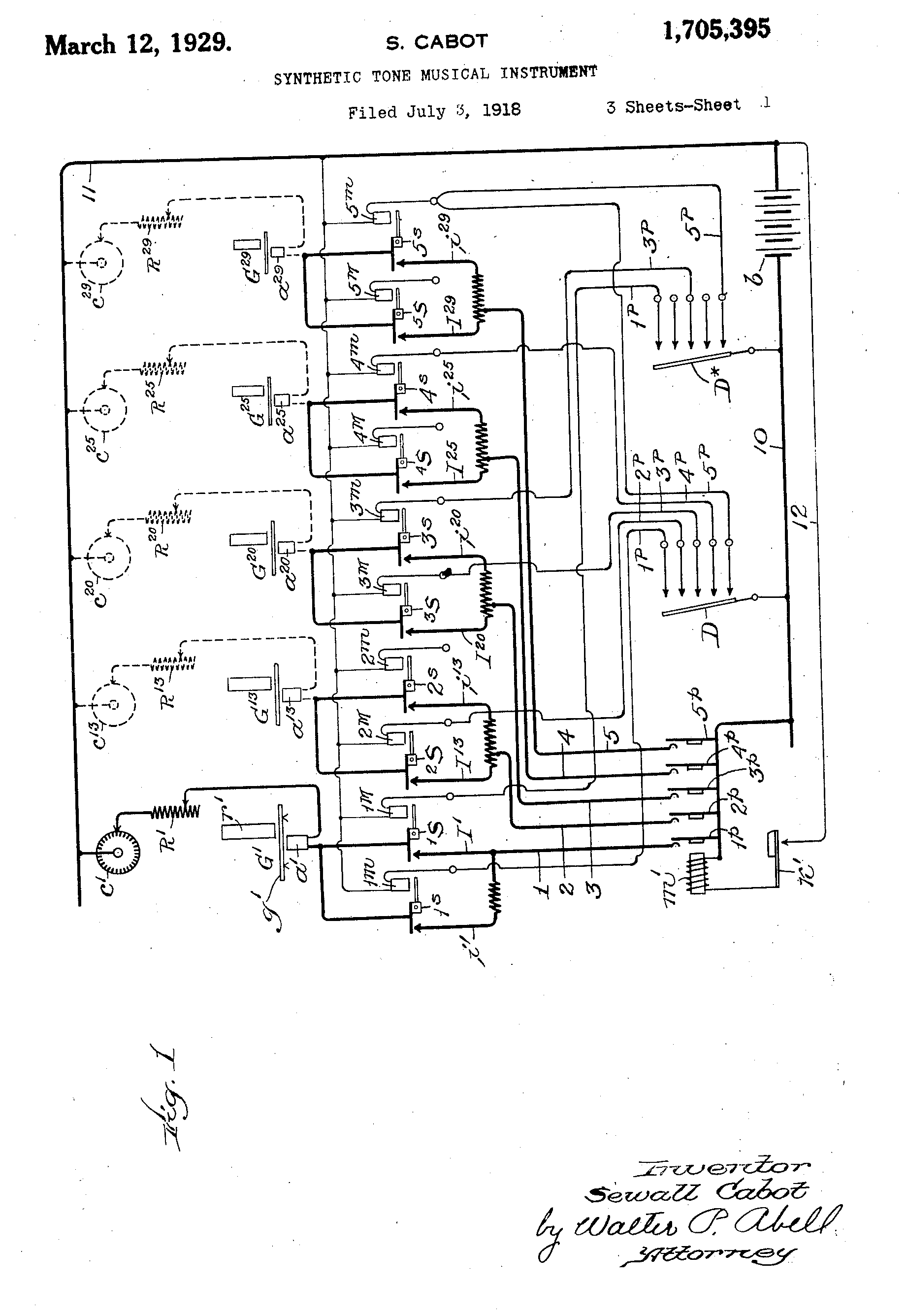
Patent documents of Cabot’s Synthetic Tone Instrument. Image United States Patent office.
The ‘Synthetic Tone’ was an electro-mechanical instrument similar but much smaller to the Choralcelo designed by the Brookline, Massachusetts electrical engineer Sewall Cabot. The instrument created complex tones by resonating metal bars with a tone-wheel generated electromagnetic charge.1Roads, Curtis,(1996) Early Electronic Music Instruments: Time Line 1899-1950, Computer Music Journal Vol. 20, No. 3 (Autumn, 1996), MIT Press, 20-23.
“One object of my present invention is to provide an improved musical instrument of relatively small cost and small dimensions in comparison to those of a pipe-organ, but capable of attaining all the musically useful results of which a pipe-organ is capable. Another object is to provide an instrument that will produce desirable tonal effects not heretofore obtainable from a pipe-organ.”2 United States Patent Office,#1705395
Sewall Cabot was a U.S. electrical engineer and an early (1906) contributor to the development of vacuum tube detectors before lee de Forest’s ‘Audion’ patent of 1912. 3 Cabot, Sewall, (1927) Detection—Grid or Plate, QST 1927-03: Vol 11 Iss 3, 30 Cabot was responsible for the later (1916) re-design of the Choralcelo electronic instrument.
References:
1
Roads, Curtis,(1996) Early Electronic Music Instruments: Time Line 1899-1950, Computer Music Journal Vol. 20, No. 3 (Autumn, 1996), MIT Press, 20-23. ↩︎
The Oscillon was a one-off vacuum tube instrument created by Dr. W.E. Danforth to play the wind instrument parts for his local amateur Swarthmore Symphony Orchestra. The instrument was played by sliding the finger over the metal box to produce French Horn or Bass Clarinet tones from the loudspeaker:
When he is not experimenting on cosmic rays, high-haired Director William Francis Gray Swann of Franklin Institute’s Bartol Research Foundation, plays a cello. Young William Edgar Danforth, his assistant, plays a cello too. Both are mainstays of the Swarthmore (Pa.) Symphony Orchestra, a volunteer organization of about 40 men and women who play good music free. Because nobody in the orchestra can handle a French horn or a bass clarinet, Drs. Swann and Danforth built an electrical “oscillion” so ingenious that it can be made to sound like either, so simple that a child can master it. Last week at a Swarthmore concert the oscillion made its world debut, playing the long clarinet passages in Cesar Franck’s D Minor Symphony without a mishap. Listeners thought the oscillion lacked color, was a little twangier in tone, otherwise indistinguishable from the woodwind it replaced.
The Danforth & Swann Oscillion is a simple-looking oblong wooden box with an electrical circuit inside. Current flows through a resistance, is stored up in a condenser, spills into a neon tube, becomes a series of electrical “pulses.” A loud speaker translates the pulses into sound.
To play music the oscillionist presses down on a keyboard and changes the resistance. This alters the frequency, thereby the pitch. As now constructed the oscillion has a range of five octaves which can easily be increased to eight. Inventors Danforth & Swann deplore the oscillion’s higher ranges, expect it will be most useful pinch-hitting for bass clarinet, bassoon, tuba and string bass.”1Time Magazine, Monday, May 31, 1937
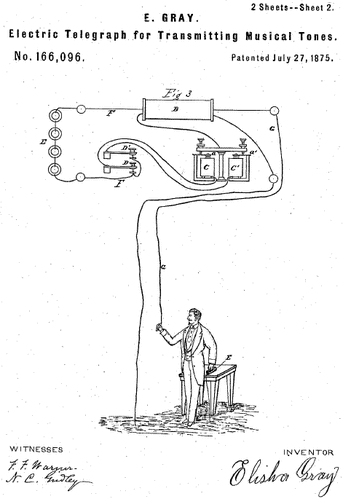
Elisha Gray demonstrating the results of his ‘bathtub experiments’ using a variable electric current to vibrate a silver plate fixed to the instrument’s body.
Elisha Gray would have been known to us as the inventor of the telephone if Alexander Graham bell hadn’t got to the patent office one hour before him. Instead, he goes down in history as the accidental creator of one of the first electronic musical instruments.1BEAUCHAMP, C. (2010). Who Invented the Telephone? Lawyers, Patents, and the Judgments of History. Technology and Culture, 51(4), 854–878. As legend has it, Gray was inspired to investigate electro-acoustic effects after witnessing his nephew playing with his uncle’s equipment. The child had connected one end of a battery to himself and the other to a bathtub; by rubbing his hand on the bathtub’s surface he created an audible humming tone proportional to the electric current. Gray discovered that he could control sound from a self vibrating electromagnetic circuit and in doing so invented a basic single note oscillator. The original intention was to use this principle to develop an early version of multiplex telegraphic transmission; sending multiple telegraphic messages encoded as different pitches simultaneously over the same line which could be decoded at the receiving end. Using this principle he designed a musical instrument; The ‘Musical Telegraph’ or ‘Electro-Harmonic Telegraph’ initially to demonstrate and promote his ideas. 2Hounshell, D. A. (1975). Elisha Gray and the Telephone: On the Disadvantages of Being an Expert. Technology and Culture, 16(2), 133-45. Gray described his invention in his patent notes of 1876:
My invention primarily consists in a novel art of producing musical impressions or sounds by means of a series of properly-tuned vibrating reeds or bars thrown into action by means of a series of keys opening or closing electric circuits. It also consists in a novel art of transmitting tunes so produced through an electric circuit and reproducing them at the receiving end of the line. 3Elisha Gray; Patent notes No. 173,618, Feb. 15, 1876.
Elisha Gray’s patent of the Musical or Harmonic Telegraph of 1876. Image: Patent notes No. 173,618, Feb. 15, 1876
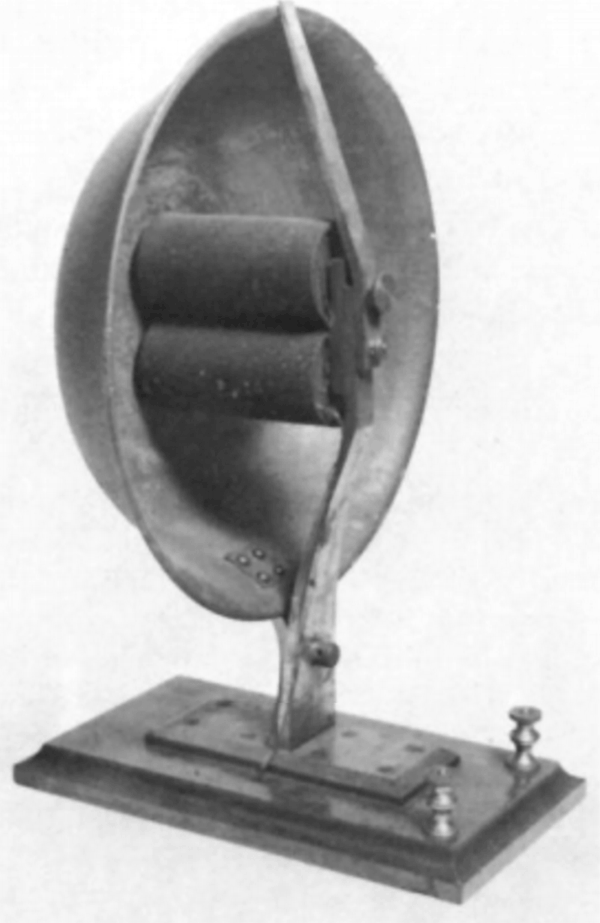
Gray’s invention used and electro-acoustic principle whereby a set of tuned steel reeds where vibrated by an electromagnetic current the resulting self-oscillating current could then be transmitted over a telephone line as a buzzing musical tone. Gray built a simple receiver and loudspeaker device called the ‘Washbasin Receiver’ – essentially a large telephone-like speaker built from an old washbasin mounted close to the poles of an electromagnet. By vibrating the metal washbasin the receiver recreated and amplified the sound of the instrument (which in this pre-amplifier era was the only way to make the instrument audible.)
Gray’s washbasin receiver of 1874. This device was designed to receive and amplify the signal remotely transmitted from the Musical Telegraph. Image: . Elisha Gray and the Telephone, 149.4Hounshell, D. A. (1975). Elisha Gray and the Telephone: On the Disadvantages of Being an Expert. Technology and Culture, 16(2), 149.
With each key having an associated ‘oscillator’ the Musical Telegraph was truly polyphonic. To prevent sympathetic vibrations from non-active keys Gray used a series of mechanical stops allowing the production of a clean individual tone per key.
Elisha Gray’s patent of the Musical or Harmonic Telegraph of 1876 showing the electromechanically vibrating tines and stops to prevent sympathetic vibration in other keys: ImageElisha Gray’s patent of the Musical or Harmonic Telegraph of 1876
The ‘Two-Tone’ transmitter of 1874. Image: Hounshell, D. A. (1975). Elisha Gray and the Telephone: On the Disadvantages of Being an Expert. Technology and Culture, 16(2), 1495Hounshell, D. A. (1975). Elisha Gray and the Telephone: On the Disadvantages of Being an Expert. Technology and Culture, 16(2), 149.
Elisha Gray’s first “Musical Telegraph” or “Harmonic Telegraph”used a simple two ‘oscillator’ keyboard design but later versions contained enough single-tone oscillators to play two octaves – Gray suggested that ‘Obviously the number of keys may be increased’ – and later models were equipped with a simple tone wheel control. Gray took the instrument on tour with him to the UK in 1874 transmitting musical tones over a distance of 200 miles or more.
Elisha Gray gave the first public demonstration of his invention for transmitting musical tones at the Presbyterian Church in Highland Park, Illinois on December 29, 1874 and transmitted “familiar melodies through telegraph wire” according to a newspaper announcement– possibly using a piano as a resonating amplifier.
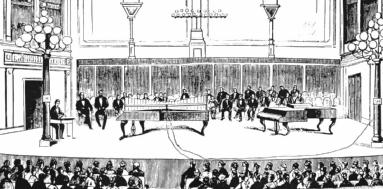
Gray also promoted his discoveries in the USA. On April 2, 1877, Elisha Gray staged a ‘Telephone concert’ at Steinway Hall on East 14th Street in New York – despite the fact that no telephone was actually used. Playing remotely from the Western Union office in Philadelphia, the famous pianist Frederick Boscovitz performed on the 16 note version of the Musical Telegraph to the astonished New York audience. The receiver at the Steinway Hall consisted of 16 resonant hollow wooden tubes, ranging from six inches to two feet in length, joined by a wooden bar with a receiver electromagnet attached. The whole receiver was mounted on a grand piano to further resonate and colour the buzzing tone of the electronic instrument. The tones were reported to be distinct though the higher notes were considered ‘rather feeble’ with the timbre somewhat resembling an organ;
“as a novelty, was highly entertaining, though unless an almost incredible improvement be effected, it is difficult to see how the transmission of music over the new instrument can be of permanent practical value.” 6National Republican (Washington, D.C.), April 10, 1877, page 1:
This initial concert was followed by five more performances in the same week, three in Steinway Hall, one at the Brooklyn Academy of Music, and one at Lincoln Hall in Washington:
MUSIC BY TELEGRAPH. __________
THE TELEPHONE EXHIBITION AT LINCOLN HALL. ________
Airs Played In Philadelphia Distinctly Audible In Washington–Description of the Apparatus–Its Sound and What It Resembles–The Performance a Great Success.
The atmospheric conditions last evening were far from favorable to the reception of music by telegraph, and it was not surprising, therefore, that the majority of those who went to Lincoln hall last evening to presence the latest triumph of American science–the telephone–were more or less doubtful of the success of the experiment they were about to witness. The interest manifested by our citizens in this grand and important invention could not have been attested in a more substantial manner, for the hall was filled to almost its amplest capacity by as intelligent and discriminating an audience as has gathered in that resort this season.
The preparation for the exhibition of the telephone were quite simple and were easily observable. Several wires depended from the aperture over the chandelier in the centre of the room, and communicated some with a regular telegraphic instrument on the stage to the left of the audience, others with the receiving apparatus of the telephone. The latter was placed on the floor of the stage, to the right of the audience. It is a small apparatus, about six feet long and less than two feet high, and consists of sixteen square boxes, resembling in appearance and arrangement the tubes of a large organ.
The entertainment began with the concert which Mr. Maurice Strakosch had provided, evidently to offset any disappointment that the audience might experience in the event of the inability of the telephone to surmount the obstacles of the inclement weather. The following was the programme:
Miss Fannie Kellogg is a young lady of prepossessing appearance, but evidently still a novice in the concert-room. Her rendition of the Polonaise from “Mignon,” which is an extremely difficult passage, requiring the greatest flexibility and control of voice, was not even a mediocre performance, although she took the liberty of omitting the trills and substituting a few notes of her own for those of the composer, and to cap the climax the finale of the air was sang entirely out of key as well as out of time. Indeed, it was as complete a faux pas as we have ever witnessed at a first-class concert. Miss Kellogg, nevertheless, found many admirers, for she was loudly encored, and in response to repeated calls essayed that sweet and plaintive air of Apt’s–Embarrassment–which she sang but indifferently well. To Signor Tagliapietra we cannot award too much praise. He was in exquisite voice, and his singing was perfection itself. Mr. S. Liebling’s performance on the piano was artistic and finished.
At the conclusion or the first part of the concert the piano was closed, and two young men raised the “receiving” apparatus of the telephone and placed it on the piano, after which a wire was adjusted to it, thus establishing direct communication with the “sending” instrument, in the office of the Western Union Telegraph Company in Philadelphia, presided over by Mr. F. Boscovitz. A telegraph operator next appeared and took up his position at the little table above referred to. Immediately afterwards a tall, spare gentleman with a beard came forward. This was Professor Gray, the inventor of the telephone. The Professor declared that he did not desire to exhibit the telephone as a great musical instrument, and if anybody expected to listen to grand music, he would inform them in advance that they would be disappointed. The Professor, although doubtless a genius in some respects, cannot be said to number oratory among his gifts. In a rambling, disconnected and ungrammatical speech, out or which it was impossible for the life of us to make head or tail, the Professor endeavored to explain in a scientific manner many things connected with the telephone. He was not permitted to continue the infliction very long, for the audience grew impatient, and manifested their feelings in a quiet way. The Professor was not slow to take the hint, and concluded his introductory remarks by requesting the greatest silence. He then directed the telegraph operator to inform Mr. Boscovitz at Philadelphia that everything was in readiness and he might begin. Within three or four seconds the first notes of “Home, Sweet Home” were distinctly audible in every part of the spacious ball, the melody being recognized perfectly.
We can best describe the music of the telephone as heard last night by comparing it to the sound that would be produced slowly on an organ with one finger. The higher notes were rather feeble. The utmost stillness prevailed, and at the finish the applause was long and enthusiastic. The remaining selections on the programme were played in the order given, all with the same success, as follows:
1. “Home, Sweet Home.” 2. “Come Genil.”–Don Pasquale. 3. “Then You’ll Remember Me”–(Bohemian Girl.) 4. “The Last Rose of Summer.” 5. “M’Appari,” Romance–(Martha.) 6. “The Carnival of Venice.”
At the conclusion of the exhibition the judgment of all present was highly flattering to what may yet be numbered among the greatest inventions of modern times. 7New York Times, July 10, 1874
National Republican (Washington, D.C.), April 10, 1877, page 1.8 National Republican (Washington, D.C.), April 10, 1877, 1.
After many years of litigation, Alexander Graham Bell was legally named the inventor of the telephone despite Gray’s allegations that Bell had plagiarised his ideas and Gray seems to have lost interest in his musical exploration soon after the legal battles with Bell.
The One Octave transmitter built in the summer of 1874. The seventh (left) electromagnet is missing.
Elisha Gray’s two octave keyboard transmitter now held at the Smithsonian Institution.
Despite this, Gray’s ideas had a profound influence on other inventors. Thaddeus Cahill was influenced by the Harmonic Telegraph when designing his Telharmonium of 1897; Cahill, rather unfairly, criticised the numerous shortcomings of Gray’s instrument in a letter supporting his patent application, highlighting the superiority and uniqueness of his own invention. These faults, according to Cahill, included low power –affecting transmission range and volume – and the lack tone shaping ability or expression control resulting in an unpleasant overall sound. Cahill declared Gray’s instrument to be:
” practically useless . No person of taste or culture could be supposed to derive any enjoyment from music rendered in poor, harsh tones with uneven power and absolutely without expression or variation”.
Thaddeus Cahill application for letters patent to the commissioner of patents April 1915. quoted in ”Magic Music from the Telharmonium’ Reynold Weidenaar [mf] Weidenaar, R. (1995). Magic music from the telharmonium [Dissertation]. Scarecrow Press.[/mfn]
Grays ideas were further developed in 1885 by the German physicist Ernst Lorenz who added an experimental envelope control to Gray’s design. Alexander Graham Bell also designed an experimental ‘ Electric Harp’ for speech transmission over a telephone line using similar technology to Gray’s. Gray later founded the Western Electric Manufacturing Company In 1872 – parent firm of the present Western Electric Company – and two years later he retired to continue independent research and teaching at Oberlin College (Oberlin, Ohio, USA).
Gray’s patent for the Musical Telegraph
Biographical Information:
(born; Barnesville, Ohio, on Aug. 2, 1835, died Newtonville, Mass., on Jan. 21, 1901)
Elisha Gray, the American inventor, who contested the invention of the telephone with Alexander Graham Bell. He was born in Barnesville, Ohio, on Aug. 2, 1835, and was brought up on a farm. He had to leave school early because of the death of his father, but later completed preparatory school and two years at Oberlin College while supporting himself as a carpenter.
At college he became fascinated by electricity, and in 1867 he received a patent for an improved telegraph relay. During the rest of his life he was granted patents on about 70 other inventions, including the Telautograph (1888), an electrical device for reproducing writing at a distance.On Feb. 14, 1876, Gray filed with the U.S. Patent Office a caveat (an announcement of an invention he expected soon to patent) describing apparatus ‘for transmitting vocal sounds telegraphically.’ Unknown to Gray, Bell had only two hours earlier applied for an actual patent on an apparatus to accomplish the same end. It was later discovered, however, that the apparatus described in Gray’s caveat would have worked, while that in Bell’s patent would not have. After years of litigation, Bell was legally named the inventor of the telephone, although to many the question of who should be credited with the invention remained debatable.
In 1872, Gray founded the Western Electric Manufacturing Company, parent firm of the present Western Electric Company. Two years later he retired to continue independent research and invention and to teach at Oberlin College. Gray died in Newtonville, Mass., on Jan. 21, 1901.
References
1
BEAUCHAMP, C. (2010). Who Invented the Telephone? Lawyers, Patents, and the Judgments of History. Technology and Culture, 51(4), 854–878. ↩︎
2
Hounshell, D. A. (1975). Elisha Gray and the Telephone: On the Disadvantages of Being an Expert. Technology and Culture, 16(2), 133-45. ↩︎
“The Audion Piano May Entertain Us in the Near Future With Music Purer Than That Obtainable With Any Instrument Now Available. Also it will Imitate Faithfully Any Orchestral Piece.” from “Audion Bulbs as Producers of Pure Musical Tones” by Lee de Forest, Electrical Experimenter, December 1915.
Lee de Forest , The self styled “Father Of Radio” inventor and holder of over 300 patents, invented the triode electronic valve or ‘Audion valve’ (a portmanteau of ‘Audio’ and ‘Ionise’) in 1906 – a much more sensitive development of John A. Fleming’s diode valve. The immediate application of de Forest’s triode valve was as a more efficient signal detector and amplifier in the emerging radio technology of which de Forest was a tenacious promoter. In 1915 de Forest discovered that the Audion could be used to generate simple audio tones and constructed a rudimentary electronic instrument – The ‘Audion Piano’. de Forest’s instrument was the the first true electronic musical instrument in that it generated sound from electrical oscillations (rather than, say, the electro-mechanical generation of sound by the Telharmonium) – and as such it was the precursor for all the future developments in electronic musical instruments design. The Audion Piano is described in de Forest’s patent of April 24th 1915 ‘Electrical Means for the Production of Musical Notes’:
de Forest’s 1915 patent ‘Electrical Means for Producing Musical Notes.’
The innovations of the Audion Piano were that, as described above, it created sounds through electronic means using a beat frequency or heterodyning effect (a way of creating audible sounds by combining two high frequency signals to create a composite lower frequency within audible range – a technique that was used by Leon Termen in his Theremin and Maurice Martenot in the Ondes Martenot some years later) and that it used electrical capacitance to control the pitch of these tones – techniques used in all electronic instrument designs until vacuum tubes began to be replaced by transistors in the 1960s. The instrument was able to produce eight separate pitches from each bulb and allowed the player to feed variable amounts of the output back into the circuit creating harmonic distortion and timbral effects. The output of the instrument were audible, in this pre-amplifier age, through the sound produced by the bulbs themselves – for public performance the tones were ‘amplified’ using acoustic horns or, like the Telharmonium, distributed over the telephone network. The pitch and relative tuning of the Audio Piano’s bulbs could be adjusted using simple condensers which could also be manipulated to produce constant glissandi or “siren notes” 1 de Forest, Lee (1915), Electrical Means of Producing Musical Notes, United States Patent Office, June 30th 1925 (Filed April 24th 1915) Pat# 1,543,990.. de Forest, realising that he was able to vary the pitch of the Audion bulbs by touching the circuitry also experimented with body capacitance and claimed that his instrument was the precursor to the Theremin (1922) and the Hammond Novachord (1939). de Forest later in 1931 sued the RCA corporation – manufacturer of the Victor Theremin – and “all other instruments employing vacuum tubes in the synthetic reproduction of music” for transgression of the Audion patent. de Forest’s successful petition resulted in a $6,000 award for damages from RCA to the de Forest Co. Although this was not a damaging award, it brought RCA’s production of the Theremin to a halt and had the a long term effect of supressing the commercial development of vacuum tube instruments in the USA. 2 de Forest, Lee,(1950) Father of Radio – THE autobiography OF Lee de Forest, Wilcox & Follet Co, Chicago ILL, 331-2 and 386..
Lee de Forest’s Triode Valve of 1906
The Audion Piano, controlled by a single keyboard manual, used a single triode valve per octave, controlled by a set of keys allowing one monophonic note to be played per octave. This audio signal could be processed by a series of capacitors and resistors to produce variable and complex timbres and the output of the instrument could be sent to a set of speakers placed around a room giving the sound a novel spatial effect. de Forest planned a later version of the instrument that would have separate valves per key allowing full polyphony- it is not known if this instrument was ever constructed. de Forest described the Audio Piano as capable of producing:
“Sounds resembling a violin, Cello, Woodwind, muted brass and other sounds resembling nothing ever heard from an orchestra or by the human ear up to that time – of the sort now often heard in nerve racking maniacal cacophonies of a lunatic swing band. Such tones led me to dub my new instrument the ‘Squawk-a-phone’….The Pitch of the notes is very easily regulated by changing the capacity or the inductance in the circuits, which can be easily effected by a sliding contact or simply by turning the knob of a condenser. In fact, the pitch of the notes can be changed by merely putting the finger on certain parts of the circuit. In this way very weird and beautiful effects can easily be obtained.” 3de Forest, Lee (1950) Father Of Radio – THE autobiography OF Lee de Forest , Wilcox & Follett Co., Chicago, 331-2
And From a 1915 news story on a concert held for the National Electric Light Association
“Not only does de Forest detect with the Audion musical sounds silently sent by wireless from great distances, but he creates the music of a flute, a violin or the singing of a bird by pressing button. The tune quality and the intensity are regulated by the resistors and by induction coils…You have doubtless heard the peculiar, plaintive notes of the Hawaiian ukulele, produced by the players sliding their fingers along the strings after they have been put in vibration. Now, this same effect, which can be weirdly pleasing when skilfully made, can he obtained with the musical Audion.”4de Forest, lee (1915), Audion Bulbs as Producers of Pure Musical Tones, The Electrical Experimenter, Experimenter Publishing Company, Inc. New York, December 1915, 394.
“Diagram of Connections for Creating Pure Musical Tones with Any Audion Bulb.” Electrical Experimenter 1915, New York.
de Forest argued that the Audion Piano was the natural successor to Thaddeus Cahill’s huge Telharmonium instrument that had for the previous ten years transmitted electronically generated music to subscribers across the country:
“Several years ago, as the public of New York remembers, a very elaborate undertaking was started for producing music by gigantic electric dynamos mixing the tones from WC or more machines in accordance with the wishes of the skilled performer who in that way produced musical tones of large volume, and which simulated almost those of every instrument in an orchestra. This instrument was termed the telharmonium. The idea was to generate this music at a central station, where highly trained organists were constantly at the keyboard, and distribute it through telephone wires throughout the city to hotels, restaurants, lobbies, concert halls and private residences. This was a most meritorious idea and deserved great success. However, the extraordinary heavy cost of the original plant, the maintenance of the wire cables, etc., rendered it commercially a failure.
Now, with the audion or incandescent lamp as a generator of musical tones, we have on a small scale all of the possibilities of the large telharmonium. Now, this same little bulb which I have just described, in addition to being a receiver of wireless messages and an amplifier for long distance wire telephones (in which use it is now employed on the transcontinental lines of the American Telephone & Telegraph Company), can be made to actually generate alternating current. It receives the energy which is expended in these currents from the dry battery or dynamo. The audion is, in other words, a transformer of energy. The alternating current, if of low frequency, can actuate the telephone diaphragm and make musical notes which the ear can hear, and this is the germ idea involved in the musical instrument which I have just described. The bulbs for musical purposes which I have thus far used are not larger than three inches in diameter.”5de Forest, lee (1915), Audion Bulbs as Producers of Pure Musical Tones, The Electrical Experimenter, Experimenter Publishing Company, Inc. New York, December 1915, 395.
Advert for de Forest radio telephone & telegraph Co. wireless equipment – New York, 1916
de Forest, the tireless promoter, demonstrated his electronic instrument around the New York area at public events alongside fund raising spectacles of his radio technology. These events were often criticised and ridiculed by his peers and led to a famous trial wherede Forest was accused of misleading the public for his own ends:
“de Forest has said in many newspapers and over his signature that it would be possible to transmit human voice across the Atlantic before many years. Based on these absurd and deliberately misleading statements, the misguided public… has been persuaded to purchase stock in his company. “6(Not Credited), 2001, I Wish I’d Never Said That. Everlasting Gaffes of the Famous, Past Times, Oxford, 2001, 61..
Lee de Forest – Born August 26, 1873, Council Bluffs, Iowa. Died June 30, 1961
de Forest collaborated with a sceptical Thaddeus Cahill in broadcasting early concerts of the Telharmonium using his radio transmitters (1907) – these transmissions were the first broadcast of music using radio and therefore the first musical radio broadcasts were not of live or recorded music but electronic music:7Adams, Mike, (2012) Lee de Forest: King of Radio, Television, and Film, Copernicus, 111.
“Also I had carried a little arc transmitter to the office of the Cahill Telharmonium Company, Broadway and 45th Street, and there energized it from the powerful music currents which they were generating for exhibition and distribution by wire to various halls and restaurants around the city. From my transmitter circuit in their offices a single antenna wire ran up to a flagpole on the roof. By these means I was hoping to show the Cahill brothers that their fine, synthetic, electric music could be widely distributed without wires.”8de Forest, Lee,(1950) Father of Radio – THE autobiography OF Lee de Forest, Wilcox & Follet Co, Chicago ILL, 225.
The New York Tribune reported on the unexpected range of de Forest’s early Telharmonic broadcasts:
“There is music in the air about the roof of the Hotel Normandy these days. A good deal of it is being collected by Lee de Forest’s wireless telephone, ready for distribution to possible purchasers. The power used to transmit the music from the sending apparatus on Telharmonic Hall to the Hotel Normandy was the same used to light an incandescent lamp. Dr. de Forest thought that this would not transmit the music more than a mile at most, but was astonished on Tuesday night when George Davis, chief of the United States Wireless Staff at the Navy Yard, telephoned Telharmonic Hall that the strains of “William Tell” were being mixed up with Naval orders at the Navy Yard five miles away. Yesterday when Dr. de Forest was demonstrating the telephone apparatus, messages from an incoming steamer were intercepted and heard distinctly.”9 New York Tribune, May 15, 1907
Despite this successful proof of concept, Cahill rejected wireless transmission of his instrument – Cahill’s insistence on using the telephone wire network to broadcast his electronic music was a major factor in the demise of the Telharmonium. Vacuum tube technology was to dominate electronic instrument design until the invention of transistors in the 1960’s. The Triode amplifier also freed electronic instruments from having to use the telephone system as a means of amplifying the signal.
References:
1
de Forest, Lee (1915), Electrical Means of Producing Musical Notes, United States Patent Office, June 30th 1925 (Filed April 24th 1915) Pat# 1,543,990. ↩︎
2
de Forest, Lee,(1950) Father of Radio – THE autobiography OF Lee de Forest, Wilcox & Follet Co, Chicago ILL, 331-2 and 386. ↩︎
3
de Forest, Lee (1950) Father Of Radio – THE autobiography OF Lee de Forest , Wilcox & Follett Co., Chicago, 331-2 ↩︎
4
de Forest, lee (1915), Audion Bulbs as Producers of Pure Musical Tones, The Electrical Experimenter, Experimenter Publishing Company, Inc. New York, December 1915, 394. ↩︎
5
de Forest, lee (1915), Audion Bulbs as Producers of Pure Musical Tones, The Electrical Experimenter, Experimenter Publishing Company, Inc. New York, December 1915, 395. ↩︎
6
(Not Credited), 2001, I Wish I’d Never Said That. Everlasting Gaffes of the Famous, Past Times, Oxford, 2001, 61.. ↩︎
7
Adams, Mike, (2012) Lee de Forest: King of Radio, Television, and Film, Copernicus, 111. ↩︎
8
de Forest, Lee,(1950) Father of Radio – THE autobiography OF Lee de Forest, Wilcox & Follet Co, Chicago ILL, 225. ↩︎
Adams, Mike, (2012) Lee de Forest: King of Radio, Television, and Film, Copernicus.
Collins, N., Schedel, M., & Wilson, S. (2013). Electronic Music (Cambridge Introductions to Music). Cambridge: Cambridge University Press.
de Forest, Lee,(1950) Father of Radio – THE autobiography OF Lee de Forest, Wilcox & Follet Co, Chicago ILL. ( free pdf version here.)
Glinsky, Albert, (2005) Theremin: Ether Music and Espionage, University of Illinois press.
Gurevich, Vladimir, (2005) Electric Relays: Principles and Applications, CRC Press.
Hong, Sungook, (2001) Wireless: From Marconi’s Black-Box to the Audion, Transformations: Studies in the History of Science and Technology, Cambridge, MA: MIT Press.
Niebisch, Arndt, (2012) Media Parasites in the Early Avant-Garde: On the Abuse of Technology and Communication, Palgrave Macmillan New York.
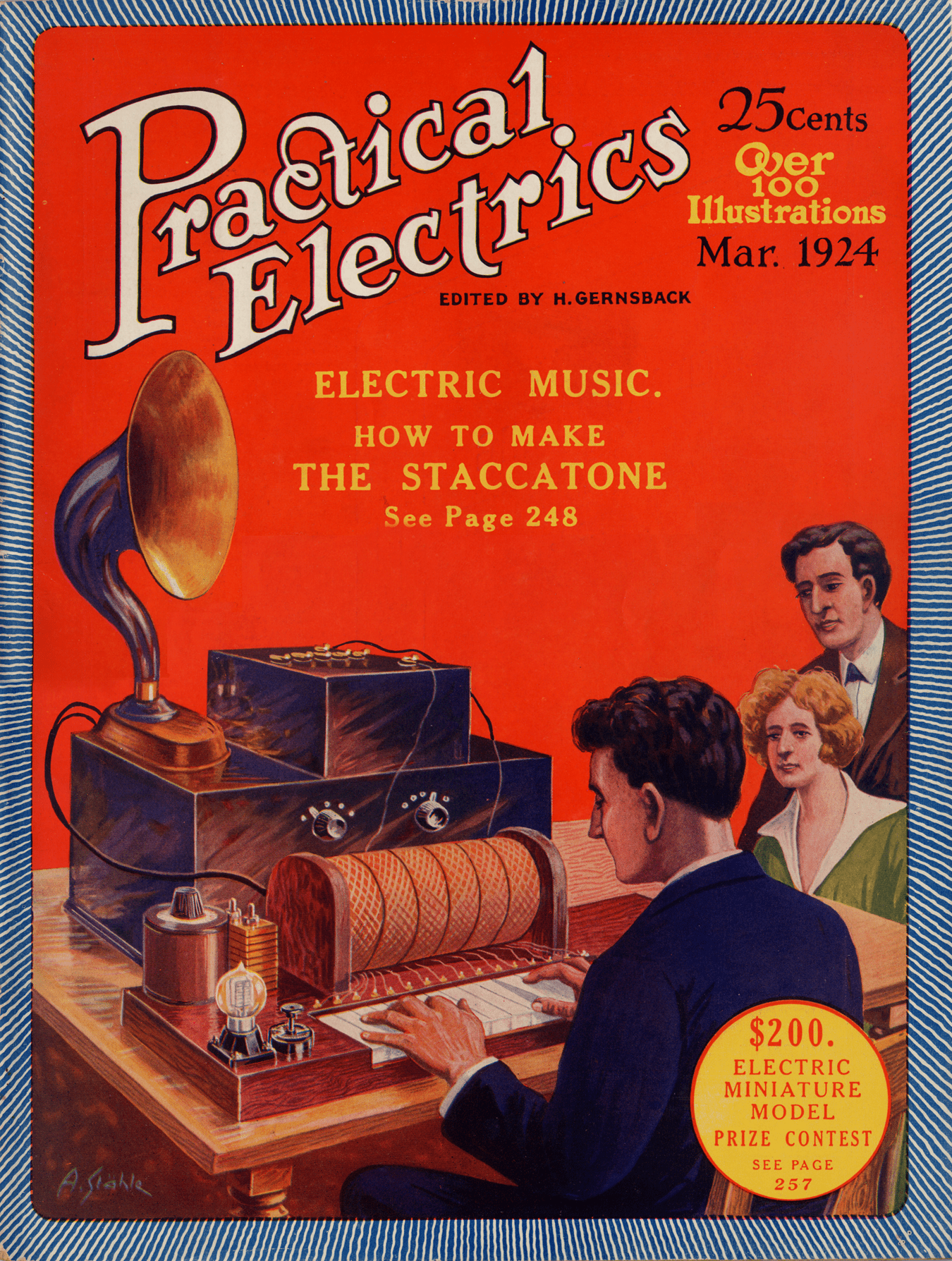
Hugo Gernsback’s ‘Staccatone’ c 1923. Image: The Staccatone, Practical Electrics, March 1924, 248-9
Hugo Gernsback, perhaps better known as the ‘Father of Science Fiction’ (and currently eponymously celebrated in the ‘Hugos’ Science Fiction Awards), also invented and built, with Clyde J. Fitch, an early electronic instrument called the Staccatone in 1923, which he later, in 1926, developed into one of the first polyphonic instruments, the Pianorad. Gernsback played a significant role in the development and popularization of television, radio, and amateur electronics. His ventures included a variety of sometimes questionable businesses, such as early science fiction publishing, pulp fiction, self-help manuals, and DIY electronics magazines, along with his own contributions to science fiction writing.
The Staccatone on the cover of Practical Electrics, March 1924, 248-9
The Radio World (New York, USA) in 1924 described the instrument in a ‘Radio Music’ feature:
“Everyone who has played with circuits calling for an oscillating vacuum tube has noted the bothersome howls and squeals produced by its improper manipulation. Mr H. Gernsback, editor of Science and Invention, is the originator of a circuit in which these once annoying noises can be made to produce music, much like an organ, but with a flute-like note peculiar to itself and agreeably surprising. “In Practical Electrics, Mr Gernsback says: ‘The characteristic squeal rising in pitch from zero to a high note beyond the limit of audibility is familiar to us all. This range of frequencies runs much higher than can be obtained from any known musical instrument. If properly controlled we have a musical instrument that surpasses in tonal range any musical instrument. . . . With several vacuum tubes, harmonic chords can be developed.
This device makes use of the Hartley oscillator circuit. By means of correct capacities, inductances, and controlling keys, the full-scale range can be obtained, and the instrument can be played through a loudspeaker in the manner of a piano or an organ. ” This staccatone, as the device is called, is simple in arrangement, and any experimenter can build and operate one. At the present time, the inventor is installing a model in one of the moving-picture theaters with a view of demonstrating its usefulness in playing full orchestrations. “The circuit used is shown in the diagram. The inductances consist of six 1,500-turn honeycomb coils in series, clamped together. Care should be taken that their magnetic fields assist rather than oppose. The coils can be connected properly if the outside lead of one is connected with the inside lead of the other, and each coil is placed in the same position as regards the direction in which the wire runs. The negative of the B battery is connected to the end of the first coil. The filament of the tube is connected in between the first and second coils, at the connecting juncture. Taps are then brought out and connected to the keys, as shown.
About twenty mica condensers of .006 microfarads each are required, with a 43-plate variable condenser of high efficiency. The variable condenser is included for tuning the instrument. The fixed condensers are arranged in a double bank as shown. The switches which form the keyboard are connected at proper intervals so that one octave is covered, including all half notes. Cutting out the extra condensers increases the tonal frequency by one octave.
When everything is connected and the tube lighted, a loud howl which can be varied in pitch by varying the condenser should be produced. It is then necessary to tune the staccatone A piano is best for this purpose, or in a pinch a tuning-fork. The lowest switch key is connected to the end of the last coil. Con-densers are added until the desired note is produced. It will probably be necessary to vary the capacity of the variable condenser in order to get the exact tone frequency at this point. The next key is then tuned by tapping the next coil until G flat is obtained. In tapping this coil, do it near the end, rather than at the end turn. As there is no set method, it will simply have to be a matter of experiment. The remaining coils are tapped in the same manner so as to form the complete musical scale over one octave, from G to A flat. At this point, by manipulating the keys, any musical selection can be played.”
The Staccatone controlled by a self-winding clock mechanism to broadcast regular call signals on the WJZR radio station.
The Staccatone was conceived as a simple self-build DIY project for amateur electronics enthusiasts via Gernsback’s ‘Practical Electrics’ magazine rather than a commercial instrument. Designed in 1921, the first prototype was built by Clyde J. Fitch at New York’s Radio News Laboratories and presented on the air in November 1923 by Gernsback on WJZ, New York. The instrument was later connected to a clockwork timer and used its distinctive sound as a call-signal for the WRNY station. According to Gernsback “The same instrument was also used in a theater, in April, 1924, when I loaned it to Dr. Hugo Riesenfeld, who had one of his musicians play it in the Rialto Theater in New York.” 1The Staccatone at WRNY, Radio News, September 1925, 284-5.
Clyde Fitch’s self-build schematic of the Staccatone. Image: Practical Electrics, March 1924, 248-9
The instrument consisted of a single vacuum tube oscillator controlled by a crude switch-based 16-note ‘keyboard’. The switch-based control gave the note a staccato attack and decay – hence the ‘Staccatone’. Gernsback promoted the instrument through his many publications and on his own radio station,n WJZ, New York:
“The musical notes produced by the vacuum tubes in this manner have practically no overtones. For this reason the music produced on the Pianorad is of an exquisite pureness of tone not realised in any other musical instrument. The quality is better than that of a flute and much purer. the sound however does not resemble that of any known musical instrument. The notes are quite sharp and distinct, and the Pianorad can be readily distinguished by its music from any other musical instrument in existence.”2 Fitch, Clyde,(1924) The Staccatone, Practical Electrics, March 1924, 248-9.
Gernsback’s ‘Pianorad’ at the WRNY radio studio, New York, USA in 1926. Image: Radio News, vol. 8, no. 5, November 1926
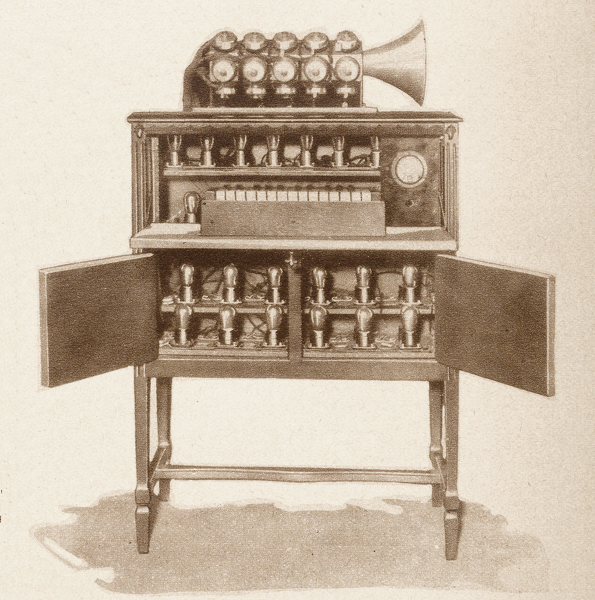
The Pianorad, (‘Piano-radio’) designed by Hugo Gernsback and built by Clyde Finch at the Radio News Laboratories in New York was a development of Gernsback’s Staccatone of 1923. the Pianorad had 25 single vacuum tube oscillators, one for every key for its two octave keyboard making the instrument the first valve based electronic instrument to achieve full polyphony. 1The Telharmonium at the beginning of the 20th century earlier was a polyphonic electronic instrument but, because it generated sound using tone-wheels, it can be considered an eletro-acoustic instrument. The sound from the tubes was passed through a rudimentary mechanical filter that removed harmonic distortion producing virtually pure sine tones. The instrument played sound through a top mounted speaker or could be connected directly into a transmitter for radio broadcast.
Hugo Gernsbacks’ Pianorad’ showing the cabinet containing 25 vacuum tubes – one for each note. Image: Radio News, vol. 8, no. 5, November 1926, 495.
Theory of the Instrument
The Pianorad has a keyboard like an ordinary piano, and there is a radio vacuum tube for each one of the piano keys. Every time a key is depressed, there is energized a radio-oscillator circuit which gives rise to a pure, flutelike note through the loud-speaker connected to the device. It is possible to connect any number of loud-speakers to the Pianorad if it is desired to flood an auditorium with its tones. Also, by arranging suitable outlets for loud-speakers on different floors or different rooms, the sounds of the Pianorad can be heard all over any large building.
The musical notes produced by the vacuum tubes in this manner have practically no overtones. For this reason the music produced on the Pianorad is of an exquisite pureness of tone not realised in any other musical instrument. The quality is better than that of a flute and much purer. the sound however does not resemble that of any known musical instrument. The notes are quite sharp and distinct, and the Pianorad can be readily distinguished by its music from any other musical instrument in existence.
Electric, Not Sound Waves
The loud-speaker arrangement makes it possible for an artist to play the keyboard while the music emerges, perhaps miles away from the Pianorad. It is thus possible for the pianist to play the instrument in absolute silence while the music is produced at a distance. This requires simply that a wire line must connect the output end of the Pianorad instrument with the loud-speaker at some distance away. It is quite feasible for the Pianorad to be played in New York while the music will be heard at the Chicago end, with any number of loudspeakers connected by amplifiers to a long-distance telephone wire line.
A novel idea is the connection of the Pianorad direct to the broadcast-station transmitter. In this case, instead of using a loud-speaker in the studio, the Pianorad is connected electrically to the broadcast transmitter. The artist now plays the Pianorad in the studio in absolute silence. No sound is heard. The radio audience, however, will enjoy the music, although no one in the studio can hear it. In order that the pianist may hear what he is playing, he will wear a set of head receivers attached to an ordinary radio set. The music, therefore, is picked out from the air by the receiver and thus only the artist hears it. In the studio itself, no sound is audible for the Pianorad itself is silent.
Developments Still Continuing
The Pianorad has as yet not entered the commercial stage. The instrument illustrated in this article has 25 keys and therefore, 25 notes. A full 88-note Pianorad has as yet not been constructed, but will be built in a short time. The larger instrument could have been built at once, but it would occupy almost as much space as a piano; and as this amount of room was not then available in the studio of WRNY, for which the first Pianorad was especially constructed, the smaller instrument was built instead.
The Pianorad at WRNY is usually accompanied by piano or violin or both; very pleasing combinations are produced in this manner. At present it uses a single stage of amplification, giving volume enough, in connection with one loud-speaker, to more than fill a fair sized room. By adding several stages of audio-frequency amplification, sufficient volume can be obtained to fill a large church or auditorium.
The Pianorad was first demonstrated publicly Saturday, June 12 at 9 P.M., with a number of brilliant selections played on it by Mr. Ralph Christman; the concert being broadcast over WRNY at The Roosevelt, New York.
The principle embodied in this instrument was first demonstrated in 1915 by Dr. Lee de Forest, inventor of the Audion. At that time Dr. de Forest was able to produce musical tones by means of vacuum tubes, but the radio art at that time had not progressed sufficiently to make possible the Pianorad.2Gernsback, Hugo, (1926) The “Pianorad” a New Musical Instrument which combines Piano and Radio Principles, Radio News, vol. 8, no. 5, November 1926, 493.
Each one of the twenty five oscillators had its own independent speaker, mounted in a large loudspeaker horn on top of the keyboard and the whole ensemble was housed in a housing resembling a harmonium. A larger 88 non keyboard version was planned but not put into production. The Pianorad was first demonstrated on June 12, 1926 at Gernsback’s own radio station WRNY in New York City performed by Ralph Christman. The Pianorad continued to be used at the radio station for some time, accompanying piano and violin concerts.
Pianorad’s 25 units designed to eliminate harmonics.Image: Radio News, vol. 8, no. 5, November 1926,.
Clyde Fitch gave instructions on how to build the Pianorad in radio News, 1926:
Image: “How to build the Pianorad, Clyde Fitch, Radio News December 1926, 655.
References:
1
The Telharmonium at the beginning of the 20th century earlier was a polyphonic electronic instrument but, because it generated sound using tone-wheels, it can be considered an eletro-acoustic instrument. ↩︎
2
Gernsback, Hugo, (1926) The “Pianorad” a New Musical Instrument which combines Piano and Radio Principles, Radio News, vol. 8, no. 5, November 1926, 493. ↩︎
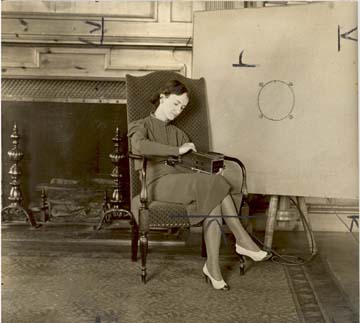
The composer Joseph Schillinger and the Rhythmicon. Image (c)
In 1916 the American Avant-Garde composer Henry Cowell was working with ideas of controlling cross rhythms and tonal sequences with a keyboard, he wrote several quartet type pieces that used combinations of rhythms and overtones that were not possible to play apart from using some kind of mechanical control- “un-performable by any known human agency and I thought of them as purely fanciful”(Henry Cowell) 1Cowell, H. . In 1930 Cowell introduced his idea to Leon Termen, the inventor of the Theremin, and commissioned him – for the fee of $200 – to build a machine capable of transforming harmonic data into rhythmic data and vice versa.2 According to Mead “Even though Theremin was at the time receiving offers as high as $10,000 from Hollywood studios for work with his earlier instrument, the Theremin, he only charged Cowell $200 for the Rhythmicon because, according to Mrs Cowell, he always enjoyed Cowell and was glad to help him” – Mead, Rita H,(1981) Henry Cowell’s New Music, 1925-1936 : the Society, the music editions, and the recordings, Ann Arbor, Mich. : UMI Research Press,188-9.
“My part in its invention was to invent the idea that such a rhythmic instrument was a necessity to further rhythmic development, which has reached a limit more or less, in performance by hand, an needed the application of mechanical aid. The which the instrument was to accomplish and what rhythms it should do and the pitch it should have and the relation between the pitch and rhythms are my ideas. I also conceived that the principle of broken up light playing on a photo-electric cell would be the best means of making it practical. With this idea I went to Theremin who did the rest – he invented the method by which the light would be cut, did the electrical calculations and built the instrument.” Henry Cowell 3 Henly, H (1932) Music: New Futures for Rhythms, Argonaut, CX/2846 (May 20, 1932), 10.
“The rhythmic control possible in playing and imparting exactitudes in cross rhythms are bewildering to contemplate and the potentialities of the instrument should be multifarious… Mr. Cowell used his rythmicon to accompany a set of violin movements which he had written for the occasion…. The accompaniment was a strange complexity of rhythmical interweavings and cross currents of a cunning and precision as never before fell on the ears of man and the sound pattern was as uncanny as the motion… The write believes that the pure genius of Henry Cowell has put forward a principle which will strongly influence the face of all future music.” 4 Henly, H (1932) Music: New Futures for Rhythms, Argonaut, CX/2846 (May 20, 1932), 10.Homer Henly, May 20, 1932.
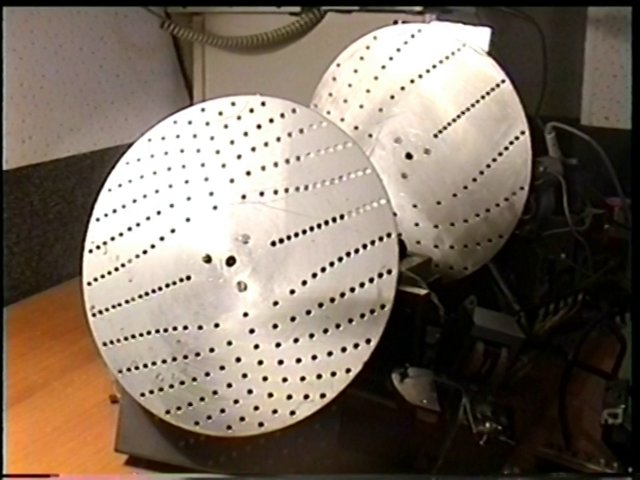
Optical rhythm discs of the Rhythmicon. Image (o)
Termen and Cowell christened their machine the Rythmicon or Polyrhythmophone (or sometime the Theremin-Cowell Rythmicon) and it can be seen as the first electronic rhythm machine. The 17 key polyphonic keyboard produced a single note repeated in periodic rhythm for as long as it was held down, the rhythmic content being generated using a photo-electrical technique: rotating perforated disks interrupted light beams that triggered photo-electric cells which in turn generated a rhythmical electronic pulse. The keyboard was laid out in a non-standard fashion arranged in a regular sequence of black
and white – the lowest note produced a unit of rhythm; white keys produced even divisions of it; black keys produced odd-numbered divisions up to a fifteenth of that basic pulse.5Sachs, Joel,(2012), Henry Cowell: A Man Made of Music, Oxford University Press, Inc, 223. . The transposable keyboard was tuned to an unusual pitch, based on the rhythmic speed of the sequences and the basic pitch and tempo – essentially each separate rhythm had its own pitch which was combined into a polyrhythmic-melodic piece.
Henry Cowell playing the Rhythmicon c 1932. Image: (c) the Imogen Cunningham Trust
The instrument was first unveiled at The New School New York on January 19, 1932, with the assistance of Clara Reisenberg (the famed Theremin virtuoso Clara Rockmore) and with Lev termen who demonstrated his Theremin Cello and keyboard Harmonium, and later at the same location on March 10th where termen also demonstrated his dance-performance instrument, the Terpsitone where Clara Reisenberg’s movements controlled the instruments pitch. The Rhythmicon never lived up to Cowell’s musical ambitious expectations and generally received a negative reception from critics who, focussing on the instruments harmonic shortcomings, disregarded Cowell’s rhythmic-melodic ideas.6Sachs, Joel,(2012), Henry Cowell: A Man Made of Music, Oxford University Press, Inc, 225. .
The sound of the Rhythmicon, produced by an array of six vacuum tubes was characteristically thin and was often described as unimpressive: “The melodic possibilities of the instrument seem small, though its theoretical interest is high. The sound is like that of a reed organ.” 7 Mead, Rita H,(1981) Henry Cowell’s New Music, 1925-1936 : the Society, the music editions, and the recordings, Ann Arbor, Mich. : UMI Research Press,189.) or in another review by the music journalist Alfred Metzger in the San Francisco Chronicle (May, 1932) “like a cross between a grunt and a snort in the low ‘tones’ and like an Indian war whoop in the high tones”8 Metzger, A, (1932), Newest invention in music makes debut in SF, San Francisco Chronicle, May 16th 1932.
Cowell wrote two works for the Rythmicon;Rythmicana (renamed Concerto for Rhythmicon and Orchestra 1931 9 Mead, Rita H,(1981) Henry Cowell’s New Music, 1925-1936 : the Society, the music editions, and the recordings, Ann Arbor, Mich. : UMI Research Press,189.) and Music for Violin and Rythmicon (now lost, 1931 – a computer simulation of this work was reproduced in 1972). Cowell, however, discouraged by the instruments negative reception, eventually lost interest in the machine, transferring his interest to ethnic music and the machine was mothballed.
“In 1934, realizing that he [musicologist and financer of the Rhythmicon Nicolas Slonimsky] never could bring the instrument to Boston because, in those days of unstandardized electric service, the predominant DC current required a costly converter for the AC Rhythmicon, he offered it to Henry or the New School for half the original price. 108 In the end Slonimsky sold it for $90 to [US Composer] Joseph Schillinger, who used it in his teaching and eventually gave it to the Smithsonian. The second Rhythmicon was stored by Henry at Stanford, where it eventually fell apart and was scrapped.” 10Sachs, Joel,(2012), Henry Cowell: A Man Made of Music, Oxford University Press, Inc, 222. .
The remaining existing version of the Rhythmicon is a model created by Termen on his return to the USSR in the 1960s and resides at the Theremin Institute in Moscow (as of 2020).
The 1960s Rhythmicon at the Theremin Institute Moscow. Image: Theremin Institute/Andrei Smirnov
According to Mead “Even though Theremin was at the time receiving offers as high as $10,000 from Hollywood studios for work with his earlier instrument, the Theremin, he only charged Cowell $200 for the Rhythmicon because, according to Mrs Cowell, he always enjoyed Cowell and was glad to help him” – Mead, Rita H,(1981) Henry Cowell’s New Music, 1925-1936 : the Society, the music editions, and the recordings, Ann Arbor, Mich. : UMI Research Press,188-9. ↩︎
3
Henly, H (1932) Music: New Futures for Rhythms, Argonaut, CX/2846 (May 20, 1932), 10. ↩︎
4
Henly, H (1932) Music: New Futures for Rhythms, Argonaut, CX/2846 (May 20, 1932), 10. ↩︎
5
Sachs, Joel,(2012), Henry Cowell: A Man Made of Music, Oxford University Press, Inc, 223. ↩︎
6
Sachs, Joel,(2012), Henry Cowell: A Man Made of Music, Oxford University Press, Inc, 225. ↩︎
7
Mead, Rita H,(1981) Henry Cowell’s New Music, 1925-1936 : the Society, the music editions, and the recordings, Ann Arbor, Mich. : UMI Research Press,189. ↩︎
8
Metzger, A, (1932), Newest invention in music makes debut in SF, San Francisco Chronicle, May 16th 1932. ↩︎
9
Mead, Rita H,(1981) Henry Cowell’s New Music, 1925-1936 : the Society, the music editions, and the recordings, Ann Arbor, Mich. : UMI Research Press,189. ↩︎
10
Sachs, Joel,(2012), Henry Cowell: A Man Made of Music, Oxford University Press, Inc, 222. ↩︎
Robert Moog started working with electronic instruments at the age of nineteen when, with his father, he created his first company, R.A.Moog Co to manufacture and sell Theremin kits (called the ‘Melodia Theremin’ the same design as Leon Termen’s Theremin but with an optional keyboard attachment) and guitar amplifiers from the basement of his family home in Queens, New York. Moog went on to study physics at Queens College, New York in 1957 and electrical engineering at Columbia University and a Ph.D. in engineering physics from Cornell University (1965). In 1961 Moog started to produce the first transistorised version of the Theremin – which up until then had been based on Vacuum tube technology.
In 1963 with a $200 research grant from Columbia University Moog Collaborated with the experimental musician Herbert Deutsch on the the design of what was to become the first modular Moog Synthesiser.
Herb Deutsch discusses his role in the origin of the Moog Synthesiser.
Herbert A. Deutsch working on the Development of the Moog Synthesiser c 1963
Moog and Deutsch had already been absorbing and experimenting with ideas about transistorised modular synthesisers from the German designer Harald Bode(as well as collaborating with Raymond Scott on instrument design at Manhattan Research Inc). In September 1964 he was invited to exhibit his circuits at the Audio Engineering Society Convention. Shortly afterwards in 1964, Moog begin to manufacture electronic music synthesisers.
“…At the time I was actually still thinking primarily as a composer and at first we were probably more interested in the potential expansion of the musical aural universe than we were of its effect upon the broader musical community. In fact when Bob questioned me on whether the instrument should have a regular keyboard (Vladimir Ussachevsky had suggested to him that it should not) I told Bob “I think a keyboard is a good idea, after all, having a piano did not stop Schoenberg from developing twelve-tone music and putting a keyboard on the synthesizer would certainly make it a more sale-able product!!” 1Interview with H.A.Deutsch, October 2003, and February 2004: http://moogarchives.com/ivherb01.htm
Early version of the Moog Modular, 1964
The first instrument the Moog Modular Synthesiser produced in 1964 became the first widely used electronic music synthesiser and the first instrument to make the crossover from the avant-garde to popular music. The release in 1968 of Wendy Carlos’s album “Switched on Bach” which was entirely recorded using Moog synthesisers (and one of the highest-selling classical music recordings of its era), brought the Moog to public attention and changed conceptions about electronic music and synthesisers in general. The Beatles bought one, as did Mick Jagger who bought a hugely expensive modular Moog in 1967 (which was only used once, as a prop on Nicolas Roeg’s film ‘Performance’ and was later sold to the German experimentalist rock group, Tangerine Dream). Over the next decade Moog created numerous keyboard synthesisers, Modular components (many licensed from design by Harald Bode), Vocoder (another Bode design), Bass pedals, Guitar synthesisers and so-on.
Early Moog Modular from 1964 at the Musée de la music in Paris, France
Moog’s designs set a standard for future commercial electronic musical instruments with innovations such as the 1 volt per octave CV control that became an industry standard and pulse triggering signals for connecting and synchronising multiple components and modules.
Despite this innovation, the Moog Synthesiser Company did not survive the decade, larger companies such as Arp and Roland developed Moog’s prototypes into more sophisticated and cost effective instruments. Moog sold the company to Norlin in the 1970’s whose miss-management lead to Moog’s resignation. Moog Music finally closed down in 1993. Robert Moog re-acquired the rights to the Moog company name in 2002 and once again began to produce updated versions of the Moog Synthesiser range. Robert Moog died on Aug 21 2005.
Moog Production Instruments 1963-2013
Date
Model
1963–1980
Moog modular synthesiser
1970–81
Minimoog
1974–79
Moog Satellite
1974–79
Moog Sonic Six
1975–76
Minitmoog
1975–79
Micromoog
1975–80
Polymoog
1976–83
Moog Taurus bass pedal
1978–81
Multimoog
1979–84
Moog Prodigy
1980
Moog Liberation
1980
Moog Opus-3
1981
Moog Concertmate MG-1
1981
Moog Rogue
1981
Moog Source
1982-1985
Memorymoog
Moog Company relaunch
1998–present
Moogerfooger
2002–present
Minimoog Voyager
2006–present
Moog Little Phatty
2010
Slim Phatty
2011
Taurus 3 bass pedal
2012
Minitaur
2013
Sub Phatty
References
1
Interview with H.A.Deutsch, October 2003, and February 2004: http://moogarchives.com/ivherb01.htm ↩︎