The ‘Staccatone’. Hugo Gernsback & C.J.Fitch. USA, 1923

Hugo Gernsback’s ‘Staccatone’ c 1923. Image: The Staccatone, Practical Electrics, March 1924, 248-9
Hugo Gernsback, perhaps better known as the ‘Father of Science Fiction’  (and currently eponymously celebrated in the ‘Hugos’ Science Fiction Awards), also invented and built, with Clyde J. Fitch, an early electronic instrument called the Staccatone in 1923, which he later, in 1926, developed into one of the first polyphonic instruments, the Pianorad. Gernsback played a significant role in the development and popularization of television, radio, and amateur electronics. His ventures included a variety of sometimes questionable businesses, such as early science fiction publishing, pulp fiction, self-help manuals, and DIY electronics magazines, along with his own contributions to science fiction writing.
Practical_Electrics_Mar_1924_Cover
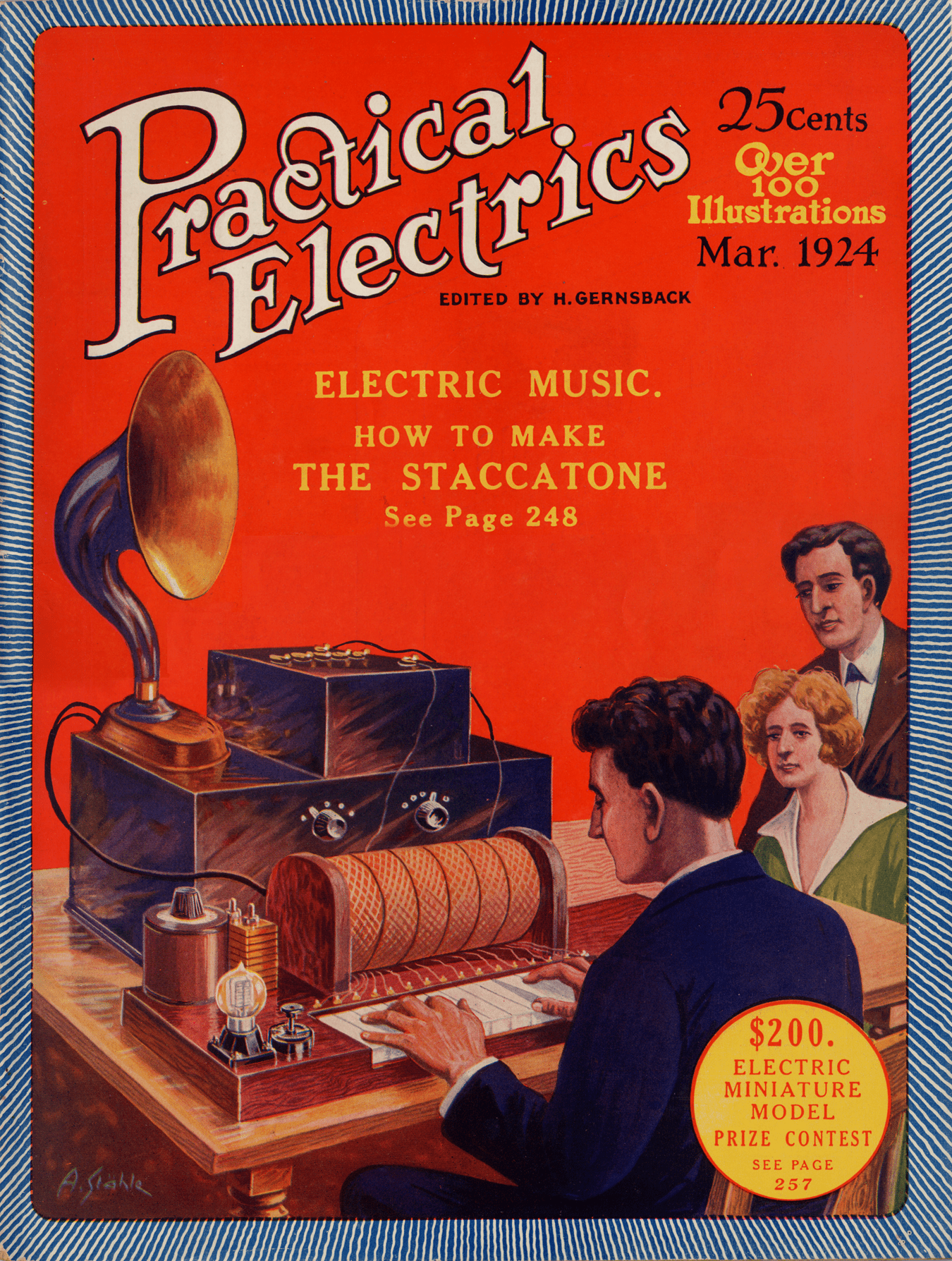
The Staccatone on the cover of Practical Electrics, March 1924, 248-9
The Radio World (New York, USA) in 1924 described the instrument in a ‘Radio Music’ feature:
“Everyone who has played with circuits calling for an oscillating vacuum tube has noted the bothersome howls and squeals produced by its improper manipulation. Mr H. Gernsback, editor of Science and Invention, is the originator of a circuit in which these once annoying noises can be made to produce music, much like an organ, but with a flute-like note peculiar to itself and agreeably surprising. “In Practical Electrics, Mr Gernsback says: ‘The characteristic squeal rising in pitch from zero to a high note beyond the limit of audibility is familiar to us all. This range of frequencies runs much higher than can be obtained from any known musical instrument. If properly controlled we have a musical instrument that surpasses in tonal range any musical instrument. . . . With several vacuum tubes, harmonic chords can be developed.
This device makes use of the Hartley oscillator circuit. By means of correct capacities, inductances, and controlling keys, the full-scale range can be obtained, and the instrument can be played through a loudspeaker in the manner of a piano or an organ. ” This staccatone, as the device is called, is simple in arrangement, and any experimenter can build and operate one. At the present time, the inventor is installing a model in one of the moving-picture theaters with a view of demonstrating its usefulness in playing full orchestrations. “The circuit used is shown in the diagram. The inductances consist of six 1,500-turn honeycomb coils in series, clamped together. Care should be taken that their magnetic fields assist rather than oppose. The coils can be connected properly if the outside lead of one is connected with the inside lead of the other, and each coil is placed in the same position as regards the direction in which the wire runs. The negative of the B battery is connected to the end of the first coil. The filament of the tube is connected in between the first and second coils, at the connecting juncture. Taps are then brought out and connected to the keys, as shown.
About twenty mica condensers of .006 microfarads each are required, with a 43-plate variable condenser of high efficiency. The variable condenser is included for tuning the instrument. The fixed condensers are arranged in a double bank as shown. The switches which form the keyboard are connected at proper intervals so that one octave is covered, including all half notes. Cutting out the extra condensers increases the tonal frequency by one octave.
When everything is connected and the tube lighted, a loud howl which can be varied in pitch by varying the condenser should be produced. It is then necessary to tune the staccatone A piano is best for this purpose, or in a pinch a tuning-fork. The lowest switch key is connected to the end of the last coil. Con-densers are added until the desired note is produced. It will probably be necessary to vary the capacity of the variable condenser in order to get the exact tone frequency at this point. The next key is then tuned by tapping the next coil until G flat is obtained. In tapping this coil, do it near the end, rather than at the end turn. As there is no set method, it will simply have to be a matter of experiment. The remaining coils are tapped in the same manner so as to form the complete musical scale over one octave, from G to A flat. At this point, by manipulating the keys, any musical selection can be played.”
The Staccatone controlled by a self-winding clock mechanism to broadcast regular call signals on the WJZR radio station.
The Staccatone was conceived as a simple self-build DIY project for amateur electronics enthusiasts via Gernsback’s ‘Practical Electrics’ magazine rather than a commercial instrument. Designed in 1921, the first prototype was built by Clyde J. Fitch at New York’s Radio News Laboratories and presented on the air in November 1923 by Gernsback on WJZ, New York. The instrument was later connected to a clockwork timer and used its distinctive sound as a call-signal for the WRNY station. According to Gernsback “The same instrument was also used in a theater, in April, 1924, when I loaned it to Dr. Hugo Riesenfeld, who had one of his musicians play it in the Rialto Theater in New York.” 1 The Staccatone at WRNY, Radio News, September 1925, 284-5.
Clyde Fitch’s self-build schematic of the Staccatone. Image: Practical Electrics, March 1924, 248-9
The instrument consisted of a single vacuum tube oscillator controlled by a crude switch-based 16-note ‘keyboard’. The switch-based control gave the note a staccato attack and decay – hence the ‘Staccatone’. Gernsback promoted the instrument through his many publications and on his own radio station,n WJZ, New York:
“The musical notes produced by the vacuum tubes in this manner have practically no overtones. For this reason the music produced on the Pianorad is of an exquisite pureness of tone not realised in any other musical instrument. The quality is better than that of a flute and much purer. the sound however does not resemble that of any known musical instrument. The notes are quite sharp and distinct, and the Pianorad can be readily distinguished by its music from any other musical instrument in existence.”2 Fitch, Clyde,(1924) The Staccatone, Practical Electrics, March 1924, 248-9.
Hugo Gernsback. Image: Life Magazine 1963. © Time Inc.
Self-build instructions for the Staccatone from ‘Practical Electrics’ magazine 1924:

References:

  • 1
    The Staccatone at WRNY, Radio News, September 1925, 284-5. ↩︎
  • 2
    Fitch, Clyde,(1924) The Staccatone, Practical Electrics, March 1924, 248-9. ↩︎

The ‘Pianorad’, Hugo Gernsback & Clyde.J.Fitch, USA, 1926.

Gernsback’s ‘Pianorad’ at the WRNY radio studio, New York, USA in 1926. Image: Radio News, vol. 8, no. 5, November 1926

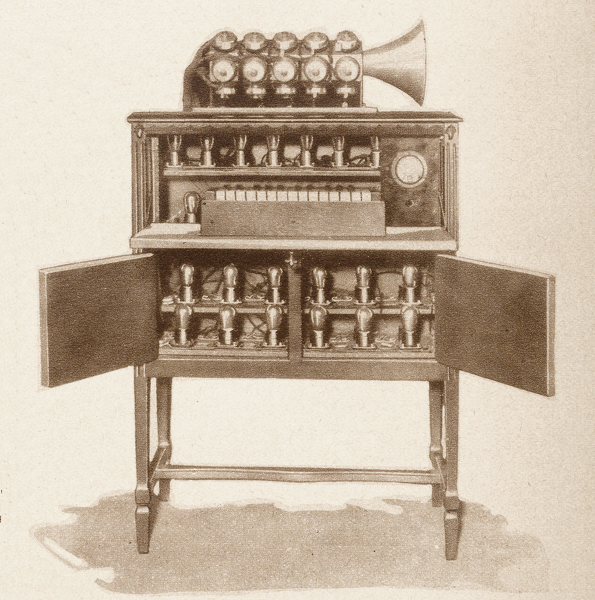
The Pianorad, (‘Piano-radio’) designed by Hugo Gernsback and built by Clyde Finch at the Radio News Laboratories in New York was a development of Gernsback’s Staccatone of 1923. the Pianorad had 25 single vacuum tube oscillators, one for every key for its two octave keyboard making the instrument the first valve based electronic instrument to achieve full polyphony. 1The Telharmonium at the beginning of the 20th century earlier was a polyphonic electronic instrument but, because it generated sound using tone-wheels, it can be considered an eletro-acoustic instrument. The sound from the tubes was passed through a rudimentary mechanical filter that removed harmonic distortion producing virtually pure sine tones. The instrument played sound through a top mounted speaker or could be connected directly into a transmitter for radio broadcast.

Hugo Gernsbacks' Pianorad
Hugo Gernsbacks’ Pianorad’ showing the cabinet containing 25 vacuum tubes – one for each note. Image: Radio News, vol. 8, no. 5, November 1926, 495.

Theory of the Instrument

The Pianorad has a keyboard like an ordinary piano, and there is a radio vacuum tube for each one of the piano keys. Every time a key is depressed, there is energized a radio-oscillator circuit which gives rise to a pure, flutelike note through the loud-speaker connected to the device. It is possible to connect any number of loud-speakers to the Pianorad if it is desired to flood an auditorium with its tones. Also, by arranging suitable outlets for loud-speakers on different floors or different rooms, the sounds of the Pianorad can be heard all over any large building.

The musical notes produced by the vacuum tubes in this manner have practically no overtones. For this reason the music produced on the Pianorad is of an exquisite pureness of tone not realised in any other musical instrument. The quality is better than that of a flute and much purer. the sound however does not resemble that of any known musical instrument. The notes are quite sharp and distinct, and the Pianorad can be readily distinguished by its music from any other musical instrument in existence.

Electric, Not Sound Waves

The loud-speaker arrangement makes it possible for an artist to play the keyboard while the music emerges, perhaps miles away from the Pianorad. It is thus possible for the pianist to play the instrument in absolute silence while the music is produced at a distance. This requires simply that a wire line must connect the output end of the Pianorad instrument with the loud-speaker at some distance away. It is quite feasible for the Pianorad to be played in New York while the music will be heard at the Chicago end, with any number of loudspeakers connected by amplifiers to a long-distance telephone wire line.

A novel idea is the connection of the Pianorad direct to the broadcast-station transmitter. In this case, instead of using a loud-speaker in the studio, the Pianorad is connected electrically to the broadcast transmitter. The artist now plays the Pianorad in the studio in absolute silence. No sound is heard. The radio audience, however, will enjoy the music, although no one in the studio can hear it. In order that the pianist may hear what he is playing, he will wear a set of head receivers attached to an ordinary radio set. The music, therefore, is picked out from the air by the receiver and thus only the artist hears it. In the studio itself, no sound is audible for the Pianorad itself is silent.

Developments Still Continuing

The Pianorad has as yet not entered the commercial stage. The instrument illustrated in this article has 25 keys and therefore, 25 notes. A full 88-note Pianorad has as yet not been constructed, but will be built in a short time. The larger instrument could have been built at once, but it would occupy almost as much space as a piano; and as this amount of room was not then available in the studio of WRNY, for which the first Pianorad was especially constructed, the smaller instrument was built instead.

The Pianorad at WRNY is usually accompanied by piano or violin or both; very pleasing combinations are produced in this manner. At present it uses a single stage of amplification, giving volume enough, in connection with one loud-speaker, to more than fill a fair sized room. By adding several stages of audio-frequency amplification, sufficient volume can be obtained to fill a large church or auditorium.

The Pianorad was first demonstrated publicly Saturday, June 12 at 9 P.M., with a number of brilliant selections played on it by Mr. Ralph Christman; the concert being broadcast over WRNY at The Roosevelt, New York.

The principle embodied in this instrument was first demonstrated in 1915 by Dr. Lee de Forest, inventor of the Audion. At that time Dr. de Forest was able to produce musical tones by means of vacuum tubes, but the radio art at that time had not progressed sufficiently to make possible the Pianorad.2Gernsback, Hugo, (1926) The “Pianorad” a New Musical Instrument which combines Piano and Radio Principles, Radio News, vol. 8, no. 5, November 1926, 493.

Each one of the twenty five oscillators had its own independent speaker, mounted in a large loudspeaker horn on top of the keyboard and the whole ensemble was housed in a housing resembling a harmonium. A larger 88 non keyboard version was planned but not put into production. The Pianorad was first demonstrated on June 12, 1926 at Gernsback’s own radio station WRNY in New York City performed by Ralph Christman. The Pianorad continued to be used at the radio station for some time, accompanying piano and violin concerts.

Pianorad’s 25 units designed to eliminate harmonics.Image: Radio News, vol. 8, no. 5, November 1926,.

Clyde Fitch gave instructions on how to build the Pianorad in radio News, 1926:

Image: “How to build the Pianorad, Clyde Fitch, Radio News December 1926, 655.

References:

  • 1
    The Telharmonium at the beginning of the 20th century earlier was a polyphonic electronic instrument but, because it generated sound using tone-wheels, it can be considered an eletro-acoustic instrument. ↩︎
  • 2
    Gernsback, Hugo, (1926) The “Pianorad” a New Musical Instrument which combines Piano and Radio Principles, Radio News, vol. 8, no. 5, November 1926, 493. ↩︎