The ‘Electronic Keyboard Oboe’, ‘the Elastic Tuning Organ’ and ‘Electronic Keyboard Drum’. Ivor Darreg. USA 1936.

Darreg’s Electronic Keyboard Oboe of 1936

The Electronic Keyboard Oboe was a one-off experimental vacuum-tube based instrument made by the US microtonal composer and prolific instrument designer, Ivor Darreg in 1935. Darreg was a contemporary of Harry Partch and other US composers of the 1930s and 40s who pursued a vision of microtonal music free from the restrictions of equal temperament and the classical instrumentarium. Darreg designed and built numerous electronic and electro-acoustic instruments based around microtonal controllers such as the Amplified Cello, Amplified Clavichord, Electric Organ, Electric Keyboard Oboe and the Electric Keyboard Drum. Darreg coined the term ‘Xenharmonic’ – roughly translatable as “unfamiliar modes” – to describe microtonal tuning beyond the twelve tone system : “intended to include just intonation and such temperaments as the 5-, 7-, and 11-tone, along with the higher-numbered really-microtonal systems as far as one wishes to go.” 1Xenharmonic music https://en.wikipedia.org/wiki/Xenharmonic_music#cite_note-1 retrieved 09-12-21


Aged 19 (in 1936), Darreg designed his first electronic instrument, the Electronic Keyboard Oboe which he intended to be a ‘generalised reed instrument’ imitating the oboe, bagpipe, saxophone, basson etc. The instrument was monophonic, generating a rough sine tone from a single vacuum tube based on a design of a of a telegraph oscillator circuit Darreg found in a radio hobbyist magazine. The oboe and horn sounds were created by passing the basic sine tones through a series of five formant filters and the notes could be further modulated using a series of pitch buttons to drop or raise the pitch by specified intervals. Although the Keyboard Oboe lacked any sound shaping capabilities – resulting a rather basic harsh tone and timbre – the pitch buttons gave it the tonal flexibility to be used in microtonal compositions. In the early 1960s, Darreg extended his original design to create the ‘Elastic Tuning Organ’ which consisted of sixty vacuum tube oscillators that were individually tunable via potentiometers allowing for every note of the instrument to be set at any pitch.2McLaren, Brian. (1990) Ivor darreg – a tour of his studio, video interview.

Excerpt from Brian Mc Laren’s 1990 interview of Ivor Darreg showing Darreg demonstrating the Electronic Keyboard Oboe and Keyboard Drum.

Jonathan Glasier described his life and work circa 1988:3Glasier, J. (1997) Ivor Darreg and Xenharmonics, Biography by Jonathan Glasier, Perfect Sound Forever, https://www.furious.com/perfect/xenharmonics.html#cd retrieved 03-12-21 ‘

“Ivor Darreg was born Kenneth Vincent Gerard O’Hara in Portland Oregon. His father John was editor of a weekly Catholic newspaper and his mother was an artist. Ivor dropped out of school as a teenager because he had a series of illnesses that left him without teeth and with very little energy. He did have energy to learn. He was self-taught in at least ten languages that he read and spoke. He had a basic understanding of all the sciences. His real love was music and electronics. Because of his choice of music, his father cast him out and he and his mother set out on their own with little help from anyone. At that point he took on the name “Ivor,” which means “man with bow” (from his cello-playing talents) and “Drareg” (the retrograde inversion of “Gerard”), soon changed to Darreg.

Ivor’s life with his mother was a huge struggle, and Ivor’s health was poor until his mother died in 1972. Part of the reason was that they lived on canned soup, and the salt kept his blood pressure sky-high. Being poor in health and wealth, Ivor became resourceful. He picked up stray wires that were cut off telephone poles and other things on the street and from friends. He said he learned to “pinch a penny so hard, it would say ouch.” Ivor created his first instrument, the Electronic Keyboard Oboe, in 1937. Following the current history of electronics and reading from the journals of the day, he learned circuitry. He made the instrument, which still runs today, because the orchestra he was playing in needed an oboe and Ivor took the challenge. The Electronic Keyboard Oboe is not only one of the first synthesizers, but a microtonal one at that. It plays the regular twelve tones, but there are eight buttons that move the tone in gradation from a few cents for a tremolo effect to a full quarter-tone.

In the forties, Ivor built the Amplified Cello, Amplified Clavichord and the Electric Keyboard Drum. The Amplified Clavichord no longer exists, but the Electric Keyboard Drum, which uses the buzzer-like relays, and the Amplified Cello are still working.

In the sixties Ivor created an organ with elastic tuning. The circuitry would justify thirds and fifths. In the early sixties, Ivor met Ervin Wilson and Harry Partch. Upon conversing with Wilson and seeing his refretted guitars and metal tubulongs (3/4″ electric conduit), Ivor took the plunge into non-quartertone microtonality or Xenharmony. He began refretting guitars and making tubulongs and metallophones in 10, 14, 15, 16, 17, 19, 21, 22, 24, 31 and 34 tone equal temperaments. He shared his new beginning with others through his Xenharmonic Bulletin and other writings. The Xenharmonic Alliance [a network of people interested in alternative tuning systems] was created. When we met Ivor in 1977, through John Chalmers, I saw a need to give Ivor and others a more public forum, so I started the journal Interval/Journal of Music Research and Development. Then in 1981, Johnny Reinhard created the American Microtonal Festival in New York, and in 1984 the 1/1 just intonation group started in San Francisco. Recently the South East Just Intonation Center has been created by Denny Genovese.

In the seventies, Ivor created his Megalyra family of instruments, the Megalyra itself being the tour de force of Ivor instrumental creations (featured in EMI Vol. II #2). This six to eight foot long contrabass slide guitar is strung on both sides to solo (I-I-V-I) and bass (I-V-I) configurations. This instrument sounds like tuned thunder and is waiting for some heavy metal or slide guitar pro to make it a celebrity. Other instruments in the Megalyra family are the Drone, Kosmolyra, and the Hobnailed Newel Post, which is a 6″ by 6″ beam strung with over seventy strings. Ivor called this instrument his harmonic laboratory.

Those of you who knew Ivor or read his writings knew that he had a special outlook on music, and a comprehensive mind that explored many subjects. His compositions, of which all are either on tape or written down, date from 1935. Many of his piano compositions are available on cassette, played by Ivor. Detwelvulate! contains a selection of his tapes Beyond the Xenharmonic Frontier, Vols. 1, 2 and 3 as well as earlier acoustic recordings Ivor made on his reel-to-reel machine.

Elizabeth and I brought Ivor to San Diego in 1985, and he seemed to get younger every year. He was in the best health of his life for those years. We were very happy to be there to share time with this great man and friend, and see him spend the most productive and stable years of his life here in San Diego.

We miss you Ivor.”


Sources

  • 1
    Xenharmonic music https://en.wikipedia.org/wiki/Xenharmonic_music#cite_note-1 retrieved 09-12-21 ↩︎
  • 2
    McLaren, Brian. (1990) Ivor darreg – a tour of his studio, video interview. ↩︎
  • 3
    Glasier, J. (1997) Ivor Darreg and Xenharmonics, Biography by Jonathan Glasier, Perfect Sound Forever, https://www.furious.com/perfect/xenharmonics.html#cd retrieved 03-12-21 ‘ ↩︎

Further reading:

Xenharmonic Wiki: https://en.xen.wiki/

Xenharmonic Alliance: Microtonal Music Forum: https://www.facebook.com/groups/476404232379884
http://www.worldharmonyproject.com/

http://www.furious.com/perfect/xenharmonics.html

The Motorola Scalatron. Herman Pedtke & George Secor. USA, 1974

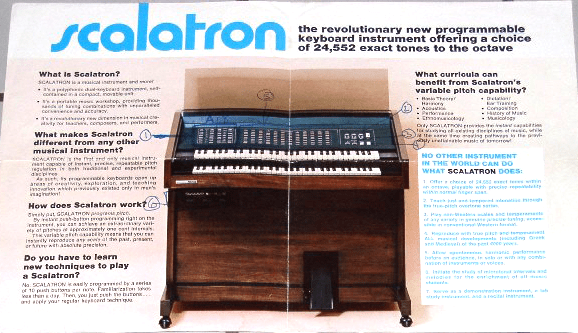
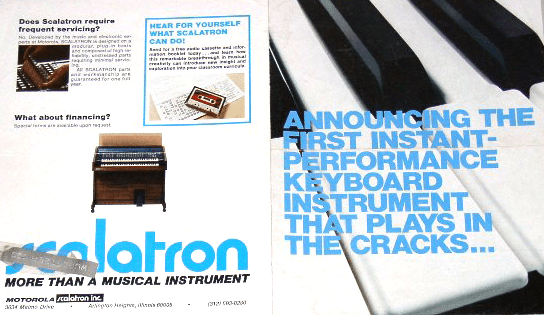
The Scalatron was an unusual microtonal electronic instrument developed in the early 1970s by Motorola as a new venture into the instrument market. Promoted as the ‘first instant-performance instrument that plays in the cracks’ the Scalatron was aimed squarely at a more experimental, microtonal market – if such a market existed. The instrument itself was a rather basic synthesiser consisting of 240 square wave oscillators (one for each key) built into a wooden home-organ casing. The instrument was manufactured in Chicago by Motorola for a brief period during the early 1970s (about 12 were constructed).

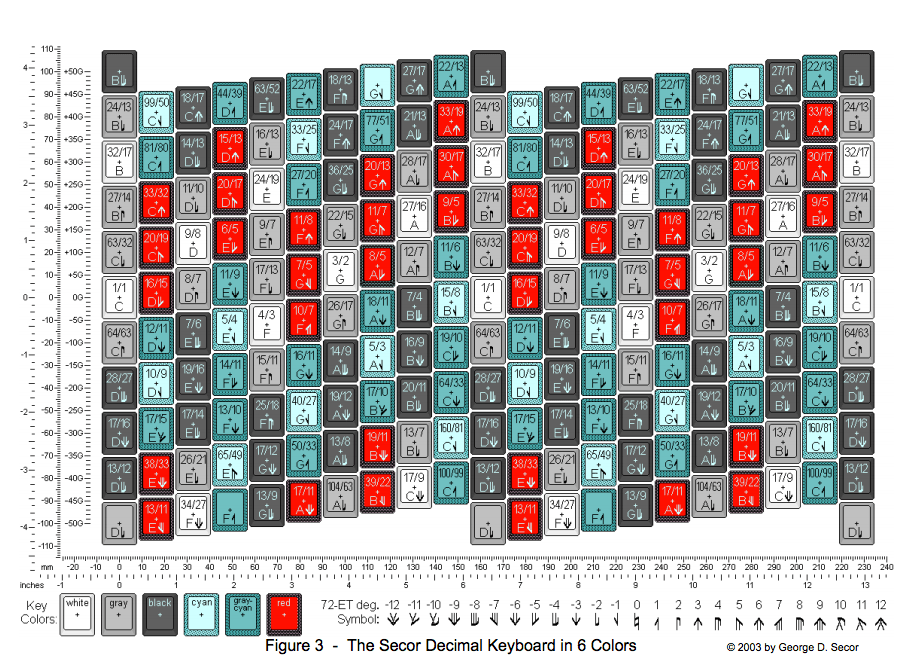
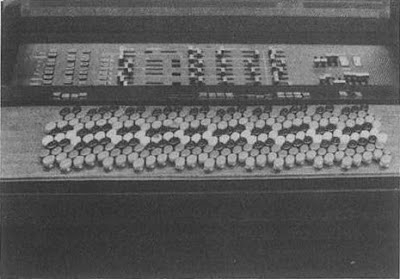
The original Scalatron had two five-octave manuals. Each note can be independently tuned and the tunings are selected and fixed before a performance begins; the frequency (about 3.5 MHz) of a master oscillator is divided by the operation of ten binary switches for each note, giving 1024 pitch possibilities per key, accurate to within less than half a cent. A second version, constructed in 1979-81 under the direction of Richard Harasek, features Secor’s design for the ‘Generalized Keyboard’, which has up to 56 notes per octave, controlled from 294 colour-coded oval keys (white naturals, red flats, black sharps). The keyboard can be electronically divided to provide two-manual effects. The system memory can store 17 switch-selected tunings. The Scalatron offers traditional organ sounds as well as synthesizer capabilities such as synthetic wave shapes, filters, and a white noise source. Outputs can be fed to a multi-track tape deck or to multiple channels for live performance. The Scalatron was used by Easley Blackwood at the University of Chicago in the late 1970s in the composition of his 12 Microtonal Etudes, each one of which explores an equal-tempered system having between 13 and 24 notes to the octave. Secor himself composed works in the 31-note system and in unequal temperaments using the Scalatron. A Scalatron electronic tuner was also marketed, in which stroboscopic patterns are aligned on a television screen.1Davies, Hugh. (2014) The Scalatron, The Grove dictionary of musical instruments, New York : Oxford University Press,418.

Scalatron with the
The Scalatron with a Secor Generalised Microtonal Keyboard

The instrument was controlled in early models by a dual manual and later using a multi-coloured ‘Bosanquet generalized keyboard’ designed by the Chicago microtonal composer George Secor.  The Secor keyboard consisted of 240 tuneable oval multicolored keys and allowed the user to create complex tunings

 “Earlier that year (1974) I had attended a demonstration of the Scalatron (digitally retunable electronic organ) prototype, and recognizing that conventional keyboards were not the best way to perform music with more than 12 tones in the octave, I unwittingly proceeded to re-invent the Bosanquet generalized keyboard and subsequently approached the Motorola Scalatron company with the proposal of employing it on their instrument.”… “Around that time several members of the xenharmonic movement had gotten in touch with Scalatron president Richard Harasek and sent him copies of the first two issues of Xenharmonikôn, which he passed on to me and which I promptly read. The second issue included Erv Wilson’s diagrams of a modification of Bosanquet’s keyboard, with hexagonal keys, at which point it became clear that my keyboard proposal was not new… For the remainder of the year I was heavily involved in the generalized (Bosanquet) keyboard Scalatron project and, after that, in using it to explore new tunings. In effect, the keyboard that I had discovered was destined to be overshadowed by the one that I had rediscovered.”

George Secor

Secor Keyboard
Secor Keyboard Diagram

George Secor demonstrates the Scalatron.2 Track Listing: 0:00 opening musical excerpt 1:47 spoken introduction 2:33 renaissance dance in Pythagorean tuning piece 3:46 explanation 3:57 baroque sonata improvisation in quarter-tone meantone 4:47 Individual harmonics with band-pass filter 5:40 explanation 5:54 played overtone series in 31-EDO 6:16 explanation 6:28 Improvisation in 31-EDO 8:48 explanation 8:58 Study on Olympics pentatonic by Harry Partch 10:11 explanation 10:44 31-EDO Improvisation with effects 15:12 explanation 16:04 Ivor Darreg 19-EDO Prelude 17:28 Explanation 17:42 “Chromatic Prelude” in 31-EDO by Adriaan Fokker | 18:24 Explanation 18:50 11-EDO 19:19 Explanation 19:27 Improvisation in 11-EDO 22:04 Improvisation 27:56 Explanation 28:29 Final Musical Piece

The Motorola Scalatron.

What would you expect of a keyboard made by a conglomerate television/communications/defense-systems manufacturer? Why, the Motorola Scalatron, of course. The ideas of geniuses often appear laughable in their own time, so we’ll allow that maybe the Scalatron was a brilliant invention. Maybe. But you’ve got to admit that, on the face of it, George Secor’s “generalized keyboard” (another variation on the Janko design) looks a tad loony. Take the designer’s own remarks on the subject: “Even if it were completely impractical musically, it would make a wonderful prop for a futuristic movie.” Or maybe for The Cabinet of Dr. Caligari.

Actually, Secor’s generalized-keyboard Scalatron was an extension of the original instrument built by Motorola engineers Don Ryon and the late Dick Harasek, with help from now-retired DePaul University Professor Herman Pedtke, to play nontempered tunings. Their Scalatron had a standard black-and-white keyboard, but Secor’s multicolored arrangement of 240 push-button keys was adopted to make the instrument’s variable-tuning hardware practical with virtually any microtonal scale. The designer himself (a specialist in microtonal theory and musical temperament) toured with it, performing the works of Harry Partch and Ben Johnston. Of course, any technology has its limits. “There is not much point,” Secor writes, “in using this alternative keyboard for systems below 31 tones in the octave.” If you’re into playing standards, don’t bother looking for this baby on the used market. Two Secor-style Scalatrons were built — compared to about 12 with the standard keyboard — in the few years after the instrument’s introduction in 1974.

While Secor mentioned in a 1976 newsletter that “the synthesizer functions of the Scalatron seem to have been almost as important as the keyboard in putting the instrument over,” those functions look a little rudimentary even by contemporary standards, especially for a $6,500 machine. The square-wave oscillators, one for each note, were kept in tune by a reference frequency gener-ated by Motorola’s television technology. From there the waveforms were subjected to filtering and attack/release envelope control. Seven userdefinable tuning programs were provided at an additional cost of about $1,000. “I use mine all the time,” says Professor Easley Blackwood of the University of Chicago, “but only for research.” Blackwood still keeps a standard-keyboard Scalatron in his office. “It’s on the fritz now, but I’ll be getting it fixed soon. It has rock-steady tuning capabilities; you can always count on it to be right. But I would never consider it for live performance.”

Mark Vail, Keyboard presents Vintage synthesizer 1993. 3Vail, Mark.(1993)Keyboard presents Vintage synthesizers : ground breaking instruments and pioneering designers of electronic music synthesizers, San Francisco : GPI Books ; Emeryville, CA, 91-2.

Costing around  $6000-$10,000, the Scalatron was an expensive and unusual instrument. Less than 20 Scalatrons were ever made (including only 2 Secor versions). The Scalatron came with a black and white monitor to adjust each key’s pitch (using Motorola’s TV tuning technology) – a split screen showed horizontal bars representing  true pitch on the left side and the instruments variable pitch on the right side, and, for an additional $1000  a cassette interface was added with a number of tuning ‘programmes’. George Secor toured with the instrument playing works by Harry Partch (who also used the instrument towards the end of his life: “It’s just what I needed, 40 years too late.” 4 Burt, Warren. My History With Music Tech, http://www.warrenburt.com/my-history-with-music-tech2/, retrieved 16/04/24.  ) and Ben Johnston.  The Scalatron is still much in favour – though very hard to find – by microtonal composers and was used on several albums by Jon Hassell, most notably for the drone parts in ‘Vernal Equinox’ 1977.

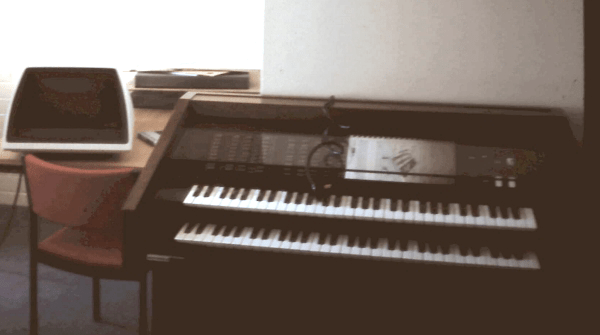
A dual manual Scalatron at La Trobe University Melbourne
A dual manual Scalatron at La Trobe University Melbourne 1976. Each key can be tuned to one of 1024 different pitches. Image Warren Burt, My History With Music Tech.

scalatron_02 scalatron_01


Sources:

  • 1
    Davies, Hugh. (2014) The Scalatron, The Grove dictionary of musical instruments, New York : Oxford University Press,418. ↩︎
  • 2
    Track Listing: 0:00 opening musical excerpt 1:47 spoken introduction 2:33 renaissance dance in Pythagorean tuning piece 3:46 explanation 3:57 baroque sonata improvisation in quarter-tone meantone 4:47 Individual harmonics with band-pass filter 5:40 explanation 5:54 played overtone series in 31-EDO 6:16 explanation 6:28 Improvisation in 31-EDO 8:48 explanation 8:58 Study on Olympics pentatonic by Harry Partch 10:11 explanation 10:44 31-EDO Improvisation with effects 15:12 explanation 16:04 Ivor Darreg 19-EDO Prelude 17:28 Explanation 17:42 “Chromatic Prelude” in 31-EDO by Adriaan Fokker | 18:24 Explanation 18:50 11-EDO 19:19 Explanation 19:27 Improvisation in 11-EDO 22:04 Improvisation 27:56 Explanation 28:29 Final Musical Piece ↩︎
  • 3
    Vail, Mark.(1993)Keyboard presents Vintage synthesizers : ground breaking instruments and pioneering designers of electronic music synthesizers, San Francisco : GPI Books ; Emeryville, CA, 91-2. ↩︎
  • 4
    Burt, Warren. My History With Music Tech, http://www.warrenburt.com/my-history-with-music-tech2/, retrieved 16/04/24.  ↩︎