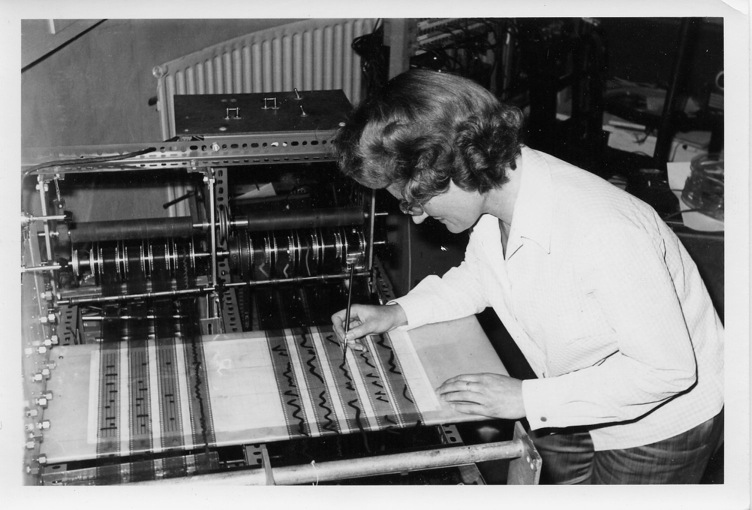
The technique of Oramics was developed by the composer and electronic engineer Daphne Oram in the UK during the early 1960s. It consisted of drawing onto a set of ten sprocketed synchronised strips of 35mm film which covered a series of photo-electric cells that in turn generated an electrical charge to control the frequency, timbre, amplitude and duration of a sound. This technique was similar to many previous photo-electric sound synthesis systems such as Yevgeny Sholpo’s Variophone some years earlier in Leningrad, the Superpiano (1928) and probably the earliest, the Luminaphone of 1925. The output from the instrument was only monophonic relying on multi-track tape recording to build up polyphonic textures.
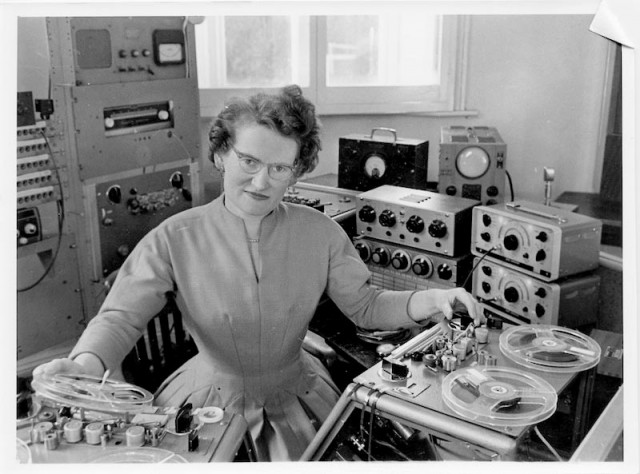
Oram worked at the BBC from 1942 to 1959 where she established the Radiophonic Workshop with Desmond Briscoe. She resigned from the BBC in 1959 to set up her own studio the ‘Oramics Studios for Electronic Composition’ in a converted oast-house in Wrotham, Kent. With the help of the engineer Graham Wrench, she built “with an extremely tight budget and a lot of inverted, lateral thinking” the photo-electrical equipment she christened ‘Oramics’ which she used to compose and record commercial music for not only radio and television but also theatre and short commercial films.1 Daphne Oram Website at: http://daphneoram.org
“There was an octagonal room,” remembers Graham, “where she’d set up her studio, but on a board covering a billiard table in an adjoining reception room was displayed the electronics for Oramics. There wasn’t very much of it! She had an oscilloscope and an oscillator that were both unusable, and a few other bits and pieces — some old GPO relays, I remember. Daphne didn’t seem to be very technical, but she explained that she wanted to build a new system for making electronic music: one that allowed the musician to become much more involved in the production of the sound. She knew about optical recording, as used for film projectors, and she wanted to be able to control her system by drawing directly onto strips of film. Daphne admitted the project had been started some years before, but no progress had been made in the last 12 months. I said I knew how to make it work, so she took me on. I left my job with the Medical Research Council and started as soon as I could.”2Steve Marshall, (2009),”Graham Wrench: The Story Of Daphne Oram’s Optical Synthesizer’ Sound on Sound magazine, february 2009.

The attraction of this technique was a direct relation of a graphic image to the audio signal and even though the system was monophonic, the flexibility of control over the nuances of sound production was unmatched in all but the most sophisticated analogue voltage controlled synthesisers. Daphne Oram continued to use the process throughout the sixties producing work for film and theatre including; “Rockets in Ursa Major”(1962), “Hamlet”(1963) and “Purple Dust” (1964).
References
- 1Daphne Oram Website at: http://daphneoram.org ↩︎
- 2Steve Marshall, (2009),”Graham Wrench: The Story Of Daphne Oram’s Optical Synthesizer’ Sound on Sound magazine, february 2009. ↩︎