Bell Labs Hal Alles Synthesiser, Hall Alles, USA, 1976.

Hal Alles Synthesiser
Hal Alles Synthesiser. (Image; Computer Music Journal Vol1 Number 4.)

The ‘Bell Labs Digital Synthesiser’ or ‘Hal Alles Synthesiser’ was one of the first ‘real-time’ digital instrument – as opposed to a non-real time digital/analogue hybrid performance such as the GROOVE system. The instrument was the result of Alles’ experiments with digital filters and tone generators for telephonic applications at Bell Labs (Murray Hills, New Jersey, USA) during the mid 1970’s.

Alles was tasked with ‘selling in’ the fruits of his digital telephony research to a Bell Labs internal audience and he discovered that – despite his complete lack of musical ability – his job became much easier if he included real-time synthesised music in his presentations:

“As a research organization (Bell labs), we had no product responsibility. As a technology research organization, our research product had a very short shelf life. To have impact, we had to create “demonstrations”. We were selling digital design within a company with a 100 year history of analog design. I got pretty good at 30 minute demonstrations of the real time capabilities of the digital hardware I was designing and building. I was typically doing several demonstrations a week to Bell Labs people responsible for product development. I had developed one of the first programmable digital filters that could be dynamically reconfigured to do all of the end telephone office filtering and tone generation. It could also be configured to play digitally synthesized music in real time. I developed a demo of the telephone applications (technically impressive but boring to most people), and ended the demo with synthesized music. The music application was almost universally appreciated, and eventually a lot of people came to just hear the music.”

Max Mathews – creator at Bell Labs of the MUSIC X series of computer synthesis languages – witnessed one of these demonstrations and excitedly encouraged Alles to develop the a musical instrument using purely digital technology.

“The goal was to have recording studio sound quality and mixing/processing capabilities, orchestra versatility, and a multitude of proportional human controls such as position sensitive keyboard, slides, knobs, joysticks, etc. It also needed a general purpose computer to configure, control and record everything. The goal included making it self-contained and “portable”. I proposed this project to my boss while walking back from lunch. He approved it before we got to our offices. “

With no background in music technology, Alles, inspired and intrigued by Robert Moog’s recent instruments and Carlos’s ‘Switched on Bach’  began to assemble the new digital synthesiser in the mid-1970’s; a ‘fragile laboratory one-off of questionable reliability’.

However, Once completed, the Alles Synthesizer project was sidelined in favour of more business oriented research and was little used apart from internal presentations. This changed in 1977 when Bell Labs and AT&T used the instrument as the centerpiece for the Motion Picture Academy’s 50th anniversary celebration of talking pictures.

Doug Bayer (a Bell Labs software researcher) was brought in to improve the human interface and operating system and the rather delicate instrument was flown to Hollywood where – Roger Powell (Todd Rundgren’s Utopia, David Bowie band and later Apple Computers Audio lab)– was hired to perform in front of a live audience. The video below was recorded to be shown if the instrument broke down before the show:

Despite a renewed interest from the music industry, Alles moved to other fields of research at Bell labs, Max Mathews worked with the machine for a while and in 1981 it was donated to Oberlin College Conservatory TIMARA department  where it has recently been rebuilt using modern components.

Description of the Hal Alles Synthesiser from the Computer Music Journal Volume 1 Number 3 (Fall 1976)

A Portable Digital Sound Synthesis System
H. G. Alles Bell Laboratories ‘
Murray Hills New Jersey 07974

The Hal Alles Synthesiser consisted of three units;

1. A DEC LS1-11 micro-computer with two floppy discs, a 64k word ROM mapable memory for table look-up  and i/o buffering and an ASCII AT&T colour graphics monitor with full ASCII keyboard.Since there are no hard-wired connections between the input devices and the synthesizer hardware, and since synthesizer interconnections are accomplished through program loaded control registers, the whole system may be used in a variety of ways. For example:A. All the control parameters may be specified in real time and at performance time.B. Several files may be prepared in real time but before the performance. Then at performance time, the files may be played with some subset of the control parameters supplied during the performance.C . Files may be prepared and/or edited in nonreal time, incrementally improving the original performance.2. A Sound generator banks; consisting of 64 oscillators. The first set of 32 oscillators were used for sound generation – giving a potential 32 note polyphony. The second set of 32 oscillators were used to create the harmonics of the sound generation oscillators. The waveforms of the sound were created by looking up amplitude from the 64k word ROM table. In addition to the sound generators were a bank of 32 programmable filters, 32 amplitude multipliers, and 256 envelope generators. All of these signals could be mixed to one of four 16-bit output channels, and from there to a digital-to-analog converter for output.3. various input devices; including two 61 note keyboard manual – giving two part multitimbrality, four 3-axis analog joysticks and a bank of 72 slider pots. These controllers could be used –within the computers limited bandwidth of around 1,000 parameter changes per second –to make real-time changes to the parameter of the sound generators and allowing the instrument to be able to deliver ‘100 reasonably complex notes per second’(Alles. Computer Music Journal Vol.1 Number 4.)


Alles’s instrument had significant but quiet influence on the development of electronic instruments, most notably the Italian company Crumar’s high-end GDS ‘General Development System’ which was essentially a commercially repackaged version of the Alles Synthesiser released in 1980 . The GDS was a 16-bit digital synthesizer with 32 oscillators offering a mix of both additive and FM/Phase Distortion synthesis and consisted of the sound generator and keyboard unit controlled by a  Z-80-microcomputer. With a hefty price tag of around $30,000, the GDS was intended as a general music production system for recording studios giving consistent and real time performance capabilities far beyond the rather erratic analog synthesisers of the day. Wendy Carlos was an early (and current) champion of the GDS.

Wendy Carlos. A soundtrack  example of the Crumar GDS on the theme from ‘Tron’ 1982.

As the components used in the prototype eventually became cheaper, more cost effective versions were produced such as the DKI (Crumar again) Synergy, released in 1981 for around $5,300, this instrument disposed of the external computer in favour of a much simplified push-button interface (or an optional Kaypro 2 computer) and housed the entire instrument in a more conventional keyboard housing. In 1981  Ceasar Castro and Alan Heaberland produced their Casheab S-100 system clearly influenced by the Alles Synthesiser design. The Japanese computer company Atari initiated the Sierra Project; a 64 oscillator single chip version of the Alles synthesiser intended for games effects and music – known as the AMY1 chip it never saw the light of day due to legal difficulties.

A Crumar GDS restored by Dan Wilson, Hideaway Studio

Ultimately all of these early digital additive/FM instruments and projects were rendered obsolete by the arrival of Yamaha’s affordable digital DX7 FM Synthesiser in 1983. Production of the Synergy finished in 1985 – though a rack mounted MIDI version (by Mercer Stockell, Jim Wright and Jerry Ptascynski)  called the  Mulogix Slave 32 was produced until 1989.

image: Popular Science Magazine, USA,  January 1978

Sources & Bibliography

http://www.sonicstate.com/news/2015/06/19/hear-the-worlds-first-digital-additive-synth/

Interview with Hal Alles. October 2017 by Simon Crab.

Chadabe, Joel .”Electric Sound”, Prentice Hall, 1997, pg. 178

Alles, Hal,, “A Portable Digital Sound Synthesis System”, Computer Music Journal, Volume 1 Number 3 (Fall 1976), pg. 5-9

Alles, Hal, (Alles 1979), “An Inexpensive Digital Sound Synthesizer”, Computer Music Journal, Volume 3 Number 3 (Fall 1979), pg. 28-37

Alles, Hal, “Music Synthesis Using Real Time Digital Techniques”, Proceedings of the IEEE, Volume 68 Number 4 (April 1980), pg. 436–449

Manning, Peter “Electronic and Computer Music”, Oxford University Press US, 2004

Click to access Alles_synth_1977.pdf

www.hideawaystudio.co.uk

Minshall Organs. Burton Minshall, Canada/USA. 1946

Minshall Organ
‘Mt Vernon’ Minshall Organ

The Minshall range of electronic Organs were designed by the ex-radio repairman Burton Minshall (Born; Dereham Township, Oxford, Ontario, Canada 9th aug 1907 . Died; 10 Feb 1957 aged 49 ).  These electronic tube organs were an early post war design – targeting a new and affluent US middle class and competing with tone wheel, pipe and reed based organs. Numerous electronic organs were produced during the 1950s in what became a fiercely competitive market, eventually dominated by companies such as Hammond, Conn and Gulbranson (who in turn were forced out by heavy competition from Japanese integrated circuit designs in the 1960s).

minshall_01 copy

Minshall’s design was originally intended  as a home build project. This first amateur design eventually lead to the establishment of a successful organ manufacturing company selling mainly to churches and funeral parlours as well as the home organ market.

Minshall’s original plant in Ontario Canada moved in 1946 to Brattleboro, Vermont USA due to the proximity of Estey Organ Co – a well known and established manufacturer of reed organs. In 1947 Minshall’s company merged with Estey to form ‘Minshall-Estey Organ Inc’ where they continued to produce electronic organs based ion Minshall’s designs until 1954 when Minshall severed ties with Estey.

The Minshall company finally came to an end in 1955; Burton Minshall became ill, sold all of his shares in the company and eventually died in 1957.

Vacuum tubes of the MNinshall OPrgan
Tone generator cabinet showing the vacuum tubes and speakers of the Minshall Organ (image copyright Swartko)

The Instruments produced sound using 52 vacuum tubes mostly 12AU7s or 12AX7s – using 3 tubes per tone generator, one as a phase shift oscillator and five sections as RC frequency dividers. The Minshall Organs, which were considerably cheaper than similar competing models, had a reputation for unreliability and problems with pitch drifting of the overheating tubes.

 Minshall Sales Brochure

Article from ‘Mechanix Illustrated’. May 1954.


Sources:

‘Manufacturing the Muse: Estey Organs and Consumer Culture in Victorian America’. By Dennis G. Waring

‘Mechanix Illustrated’ Magazine. May 1954. H.W.Kellick

‘Sound-Producing Device’ Melvin Linwood Severy, USA. 1913


sever_diagram

Melvin L. Severy was an American engineer and inventor from Arlington Heights, Massachusetts – probably best known as the inventor of the Choralcelo; a huge hybrid electronic and electro-mechanical organ and the culmination of many years research and experimentation with electro-acoustics1 See US patents US1098983, US1104282, US1137544, US1181486, US1190332, US1196401,US1201513, US1218324, US1245518, US1899884, US2155741. Severy was also responsible for numerous patents on inventions as diverse as typewriters (1903), bottling machines (1882), piano-tuning devices (1912), telegraphic systems, steam boilers (1893), steam engines (1894), cameras (1907), orthopaedic shoes, thermo-chemical batteries (1899), solar panels for generating electricity (1894), an iron-lung (1916) and what is probably the first audio ‘sampling’ instrument, which he described simply as ‘Sound Producing Device’ in 1912:2US Patent Office. Melvin L Severy US1218324 A. Publication date 6 Mar 1917

“The object of the present invention is the construction of an improved musical instrument in which the sonorous vibrations are produced electromagnetically by the movement of phonograms of magnetic material past electromagnetic sound producing mechanism.”3 M L Severy, Sound producing device, application filed mar, 22 1913. Patented mar 6, 1917 p1, part 10.

Diagram showing the key-action that moves the magnetic pick-up closer to the sound wheel.
Diagram showing the key-action that moves the magnetic pick-up closer to the sound wheel.  US1218324 A.2 March 1913.

It is unknown whether the ‘Sound-Producing Device’  was actually built – Severy didn’t use any similar mechanisms in the Choralcelo – yet the ‘Sound-Producing Device’ predicted the future of sampling instruments such as the Chamberlin and Mellotron by half a century and perhaps invented the concept of sampling.


severy_synthetic_harmonogram_02

Severy’s device was based around the concept of printing numerous magnetic spectrogram or recorded sounds as endless loops on rotating wheels. A magnetic pick-up would be placed near the spectrogram disk and in turn, transmit a variable magnetic pulse that would active a speaker membrane – or, in a manner similar to Cahill’s Telharmonium, transmit the signal through the newly established telephone network.

Melvin Severy

The instrument was to have numerous spectrogram for each note representing the various fundamentals and timbres of the recorded sound – a concept that was new for the time and most likely inspired by H. Helmholtz’s ‘On the Sensations of Tone as a Physiological Basis for the Theory of Music‘ (first published in English in 1875). These different timbres could be mixed using organ-style stops. Variation in pitch was achieved simply by altering the speed of the disc for each note and the volume of each note by keyboard pressure which moved the pick-up nearer to the sonogram disc.

Each note of the instrument had its own speaker making the ‘Sound-Producing Device’ fully polyphonic as well as velocity sensitive.

Severy suggested several possible formats for encoded spectrograms including a (fig 11) paper-roll strips for long recordings, (fig 14, 14) disks with multiple pick-ups and an Edison type tube (fig 13):

“There are many ways in which the timbre forms may be made, such as stamping them from thin sheet metal; printing them on the cylinder with a magnetic ink; printing them with a sticky ink and then dusting the impression with iron filings or other magnetic particles; by electroplating, or by using a coating of paste impregnated with magnetic filings and various other methods, as will be obvious. The main idea is to secure a uniform layer of magnetic material whose lateral extent varies according to the variations of the sound waves to be produced.” 4Melvin Severy. U.S. Patent notes. US1218324 A.2 March 1913

Severy had already, In 1910,  patented an automatic spectrogram or ‘Harmonograms’ recorder that mechanical wrote a sound recording to a rotating disc that would allow the recording and production of spectrograms for his instrument:

Severy explained how the instrument could be used to record and playback any sound:

“It is evident that by having some fine singer deliver into a phonautograph one or more complete octaves of musical notes, singing the broad A, for instance, and then having these phonautographs reproduced into timbre forms the instrument can be adapted for the repetition of the tones of the human voice. It is only necessary to secure a phonautograph of a single octave of the original notes for the reason that the other tones required are the mere variable speed of the first.”5Melvin Severy. U.S. Patent notes. US1218324 A.2 March 1913

Melvin Linwood Severy. Biographical Notes.

Melvin Linwood Severy; born August 5, 1863 Melrose, Mass; died. Los Angeles, California 1951.

Severy was educated at Walpole, Mass. high school, Boston; grad school and  Monroe Coll. of Oratory. Severy worked as a florist and as a teacher teaching elocution and oratory and as an actor (where he acted with Edwin Booth, brother of the assassin of  Abraham Lincoln) Severy began his lengthy and successful career as an inventor in 1882 and eventually held over 80 patents including the Severy Printing Process (which won him  John Scott medal of Franklin Institute in 1898), the Choralcelo, Vocalcelo and Vocalsevro (later name for the Choralcelo), fluid transmission for cars, telegraphic devices, engines, Health devices, typewriters and so-on.

Severy founded numerous businesses from his own inventions including the Ex-pres Severy Impression Process Co., Choralcelo Mfg. Co., Choralcelo Co., dir. Solar Power Co., and the Automatic Tympan Co.

As well as inventing, Severy found time to write books of fiction and non fiction including: ‘Fleur-de-lis and Other Stories’, ‘Materialization and Other Spiritual Phenomena from a Scientific Standpoint’ (1897), ‘The Darrow Enigma’( 1904), ‘ ‘The Mystery of June Thirteenth’ (1905), ‘Maitland’s Master Mystery’ and ‘Gillette’s Social Redemption (1907), ‘Gillette’s Industrial Solution’ (1903) both commissioned by King Gillette the inventor of the safety razor.

In  ‘The Darrow Enigma’( 1904) Severy accurately predicts the use of light beams (lasers) as a surveillance method:

“The device whereby I secure this at such a distance is an invention of my own which, for patent reasons–I might almost say ‘patent patent reasons’–I will ask you to kindly keep to yourself. To the diaphragm there I fasten this bit of burnished silver. Upon this I concentrate a pencil of light which, when reflected, acts photographically upon a sensitised moving tape in this little box, and perfectly registers the minutest movement of the receiving diaphragm. How I develop, etch, and reproduce this record, and transform it into a record of the ordinary type, you will see in due time–and will kindly keep secret for the present.” 6 Severy, Melvin L. The Darrow Enigma, Project Gutenberg Australia, Chapter III.


Sources

  • 1
    See US patents US1098983, US1104282, US1137544, US1181486, US1190332, US1196401,US1201513, US1218324, US1245518, US1899884, US2155741 ↩︎
  • 2
    US Patent Office. Melvin L Severy US1218324 A. Publication date 6 Mar 1917 ↩︎
  • 3
    M L Severy, Sound producing device, application filed mar, 22 1913. Patented mar 6, 1917 p1, part 10. ↩︎
  • 4
    Melvin Severy. U.S. Patent notes. US1218324 A.2 March 1913 ↩︎
  • 5
    Melvin Severy. U.S. Patent notes. US1218324 A.2 March 1913 ↩︎
  • 6
    Severy, Melvin L. The Darrow Enigma, Project Gutenberg Australia, Chapter III. ↩︎

The Keyboard Electric Harmonium, Lev Sergeyevich Termen, USA/Russia, 1926.

Lev Termen at the Theremin_Harmonium c1926.

Lev Sergeyevich Termen, best known for creating the ‘Theremin‘, also invented many other electronic instruments based on the heterodyning vacuum tube technology of the day – including the Keyboard Theremin, Theremin Cello, Terpsitone, Rhythmicon, and the Electric Harmonium or Theremin Harmonium.

Theremin Harmonium
Termen’s Theremin Harmonium of 1926

Termen’s Harmonium was an early vacuum-tube-based polyphonic instrument, tuned to accompany and train vocal performances, built at the Laboratory of Acoustics and Sound Recording of the Moscow Conservatory from 1926 and continuously developed until the 1960s. The portable desktop instrument had a three-octave keyboard with variable tuning, allowing 1,200 microtonal divisions per octave. The sound volume can be adjusted using a dedicated volume roller at the front of the keyboard. The timbre and acoustic envelope could be varied by a “rotary timbre register with 12 different sound characteristics”. The output reached a tuning stability of 3 cents once the machine had been active for fifteen minutes and had a maximum output of 3 watts “increased by connecting a powerful amplification device with additional loudspeakers.” 1 Termen, L. S. (1964) Harmonium for working with choirs, report, Laboratory of Acoustics and Sound Recording of the Moscow Conservatory, TOPIC Z-N, 1964. http://www.theremin.ru/archive/harmonium.htm retrieved 25/11/2023.

Lev Termen playing the Keyboard Theremin. Image: Popular Science Jun 1932.

“The new Keyboard Theremin, which is designed in the form of a piano to produce synthetic music. […] With huge banks of vacuum tubes, Prof. Theremin conducts experiments in his laboratory, which led to a harmonious reproduction of the radio squeals.” (Popular Science, USA, Jun 1932) 2 Radio Squeals Turned Into Music for Entire Orchestra, Popular Science Jun 1932, 51.

The Theremin Harmonium (left) accompanying a Theremin Cello ensemble, New York. Image: Popular Science, June 1932.
Early version of the Theremin Harmonium. From the The Theremin Center for Electroacoustic Music , Moscow, Russia(1)
Early version of the Theremin Harmonium. Image: The Theremin Centre for Electroacoustic Music, Moscow, Russia.
Theremin's later version of the Harmonium. Each key plays a tunable (micro)tone which is reproduced with its own amplifier and speaker.
Theremin’s later version of the Harmonium. Each key plays a tunable (micro)tone, reproduced by its own amplifier and speaker. Image: The Theremin Centre for Electroacoustic Music, Moscow, Russia.

Sources:

  • 1
    Termen, L. S. (1964) Harmonium for working with choirs, report, Laboratory of Acoustics and Sound Recording of the Moscow Conservatory, TOPIC Z-N, 1964. http://www.theremin.ru/archive/harmonium.htm retrieved 25/11/2023. ↩︎
  • 2
    Radio Squeals Turned Into Music for Entire Orchestra, Popular Science Jun 1932, 51. ↩︎

The ‘Keyboard Theremin’ Leon Termen, USA, 1930.

Leon Termen's 'Keyboard Theremin' 1932
Leon Termen’s ‘Keyboard Theremin’ 1932


Leon Termen, the creator of one of the first widely used and mass produced electronic instruments the eponymous ‘Theremin’ developed a keyboard version of the instrument during his stay in New York. The Keyboard Theremin used the same heterodyning technique to generate a monophonic tone but this time controlled by a five octave 61 key manual instead of the Theremin’s difficult to master hand gestures. The ex-cellist Termen also added a fingerboard continuous controller so that the player could switch between keyboard and string like playing. The instrument had two foot pedal to shape the sound and add vibrato and a series of organ-like stops to emulate the timbres of conventional instruments such as the organ, Piano, brass, woddwind as well as percussive timpani effects. The amplified output of 100 watts was fed into a bank of six twelve inch speakers.(1)

The 'Theremin Electric Symphony Orchestra' c1932. The Keyboard Theremin is on the right with a Theremin Harmonium on the left and several Theremin Cellos in the centre.
The ‘Theremin Electric Symphony Orchestra’ c1932. The Keyboard Theremin is on the right with a Theremin Harmonium on the left and several Theremin Cellos in the centre.

The Theremin Keyboard was premiered at a concert at the Carnegie Hall in 1932 by the ‘Theremin Electrical Symphony Orchestra’; a ten player ensemble (Termen originally wanted forty musicians) all playing fingerboard and keyboard theremins, each instrument tuned to take the part of an orchestral instrument and performing a ‘conventional’ classical repertoire including J.S.Bach’s ‘Fantasia in G’ and ‘Ave Maria’. Impressed by it’s range and portability, the composer Leopold Stokowski used the Keyboard Theremin at orchestral concerts in Philadelphia, New York and Washington.

'The Theremin Electro Ensemble' later called 'The Electrio' in 1932. (Left)Playing the RCA theremin is Leon Theremin's assistant, Julius Goldberg (with customised "lightning bolt" art deco, brass nickel chrome antennas). (Centre) playing the "Theremin Cello" is the Leonid Bolotine and (Right) Pianist Gleb Yellin is playing a Theremin Keyboard. In 1932, the ensemble could be heard on the radio every Monday afternoon at 2:15 over the Columbia Network, KMBC. (2)
‘The Theremin Electro Ensemble’ later called ‘The Electrio’ in 1932. (Left)Playing the RCA theremin is Leon Theremin’s assistant, Julius Goldberg (with customised “lightning bolt” art deco, brass nickel chrome antennas). (Centre) playing the “Theremin Cello” is the Leonid Bolotine and (Right) Pianist Gleb Yellin is playing a Theremin Keyboard. In 1932, the ensemble could be heard on the radio every Monday afternoon at 2:15 over the Columbia Network, KMBC. (2)

Sources

(1)’ Theremin: Ether Music and Espionage’ By Albert Glinsky. p145

(2)http://www.peterpringle.com/visitgoldie1.html

‘Music From Electrons’ Radio News. August 1972 P76. Irving J. Saxl. Phd

The Thyratone. Richard Henry Goldfogle Dorf. USA, 1945

The keyboard of Richard H Dorf's 'Thyratone'
The keyboard of Richard H Dorf’s ‘Thyratone’

Richard H. Dorf (b 14 Mar 1921; d New York, 21 June 1989) was an electronic engineer, prolific author on the subject of vacuum tube electronics and electronic organs, and the head of the Schober Organ Corporation – a supplier of self-build electronic organ kits (using patents licensed from Baldwin organ Co.).

In 1945 Dorf patented the Thyratone which was also supplied in kit form or simply as a circuit diagram and again, in terms of circuitry and filter formant construction, used a design inspired by Winston Kock’s Baldwin Organ .

The Thyratone's seperate tone and amplifier unit
The Thyratone’s seperate tone and amplifier unit

The device was a simple, compact monophonic neon/thyratone vacuum tube instrument similar to the Hammond Solovox and Clavioline family of instruments i.e. designed as a conventional piano extension. The Thyratone was powered by a three octave keyboard with a single sawtooth oscillator for each octave and a series of filters and vibrato effects to colour the tone. The keyboard could be attached to the host-piano keyboard using metal brackets and connected to the Thyratone’s tone generator box, amplifier and loudspeaker via a cable.

Thyratone circuit diagram


Thyratone tone unit and amplifier circuit diagram

Dorf designed as a miniature pipe organ, with familiar stop -based controls for timbre, pitch and vibrato (from another neon tube ‘LFO’); essentially preset setting for the tone filters and vibrato. A foot operated ‘expression pedal’ allowed the player control over the Thyratone’s output envelope.

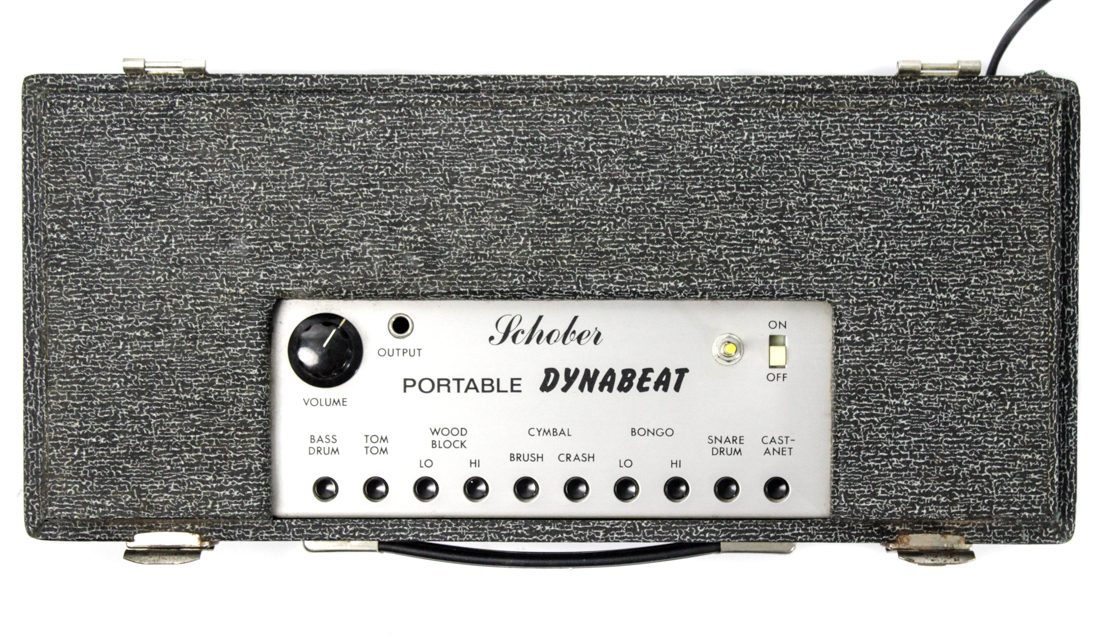
Schober under Dorf’s supervision continued to develop electronic organ kits – starting in 1954 with valve based organs and moving to transistor organs in the mid 1960s – as well as various peripherals such as the  Schober Tunesmith (1969), The Dynabeat drum machine (1968) and various tape echo units and stroboscopic tuning devices.

Schober Dynabeat, top view showing small percussion pads

Schober Dynabeat drum synthesiser

The Dynabeat was an early solid state transistor based drum machine that was played via pads or a keyboard rather then the usual pre-set rhythms. Percussion sounds included:

  1. Bass
  2. Tom Tom
  3. Woodblock LO
  4. Woodblock HI
  5. Cymbal Brush
  6. Cymbal Crash
  7. Bongo LO
  8. Bongo HI
  9. Snare Drum (when held down does a roll)
  10. Castanets (when held down does a roll)

Tunesmith control panel

Schober Tunesmith

The tunesmith was basically the evolution of the Thyratone but equipped with solid state transistors rather than neon tubes.

dynabeat_popmechandec69-1Like the Thyratone, The Tunesmith was a monophonic 32 note portable mini-organ with a two and half octave range. The basic tone controls allowed the player to switch between different organ voices, trumpet, violin, cello, oboe and flute and modify the note with a variable speed vibrato.


Sources

Hugh Davies. The Grove Dictionary of Musical Instruments, 2nd edition, issue Published in print January 2001 | Published online February 2013 | e-ISBN: 9781561592630

‘Electronic Musical Instruments’ by Richard H. Dorf. New York : Radiofile, [1968]

‘Neon Organs’ by Richard H. Dorf . Electronics. p36 August 29, 1958

‘Electronics and Music’ Part IX-X by Richard H. Dorf. Radio Electronics. p39-68 March 1951.

Schober Organ Orphans’ Page

The Wobble Organ. Larned Ames Meacham, USA, 1951

wobble_organ_popmech_jan52
The ‘electronic barbershop quartet’ equipped with the Wobble Organ

The Wobble Organ was a monophonic electronic instrument created by Bell Laboratories electrical engineer Larned A. Meacham in 1951. The device was intended as an inexpensive, portable recreational instruments where a family could get together to create an electronic “Barbershop quartet”. The Wobble Organ was not intended as a commercial instrument but designed for the popular self-build market of the time.

The Wobble Organ © Popular Mechanics Magazine January 1952.

The instrument was designed to be playable by performers who “have little or no experience with the manipulation of conventional musical instruments”(1).  Meacham’s solution to this was to avoid using a conventional keyboard and instead control the Wobble Organ with a pivoted joystick, or ‘wobble arm’ sliding against a curved form marked with pitch intervals ( a similar control method to Jörg Mager’s Sphärophon of 1926) . By raising and lowering the joystick the player could alter the pitch of a single neon/thyratron sawtooth oscillator over two and half octaves – the note could be turned on and off with a hand-held button.

The Wobble Organ © Popular Mechanics Magazine January 1952.

This slideshow requires JavaScript.


Sources

(1) Electronic musical entertainment device
US 2544466 A Filed April 27, 1950 Patented Mar. 6, 1951 UNITED STATES PATENT OFFICE ELECTRONIC MUSICAL ENTERTAINMENT DEVICE

Tom L. Rhea ‘The Evolution of Electronic Musical Instruments in the United States’ George Peabody College for teachers. 1972

‘Tomorrow’s electronic barbershop quartet’ Larned Ames Meacham ‘Popular Mechanics’ January 1952 Volume 97, #1.

The ‘Electronic Keyboard Oboe’, ‘the Elastic Tuning Organ’ and ‘Electronic Keyboard Drum’. Ivor Darreg. USA 1936.

Darreg’s Electronic Keyboard Oboe of 1936

The Electronic Keyboard Oboe was a one-off experimental vacuum-tube based instrument made by the US microtonal composer and prolific instrument designer, Ivor Darreg in 1935. Darreg was a contemporary of Harry Partch and other US composers of the 1930s and 40s who pursued a vision of microtonal music free from the restrictions of equal temperament and the classical instrumentarium. Darreg designed and built numerous electronic and electro-acoustic instruments based around microtonal controllers such as the Amplified Cello, Amplified Clavichord, Electric Organ, Electric Keyboard Oboe and the Electric Keyboard Drum. Darreg coined the term ‘Xenharmonic’ – roughly translatable as “unfamiliar modes” – to describe microtonal tuning beyond the twelve tone system : “intended to include just intonation and such temperaments as the 5-, 7-, and 11-tone, along with the higher-numbered really-microtonal systems as far as one wishes to go.” 1Xenharmonic music https://en.wikipedia.org/wiki/Xenharmonic_music#cite_note-1 retrieved 09-12-21


Aged 19 (in 1936), Darreg designed his first electronic instrument, the Electronic Keyboard Oboe which he intended to be a ‘generalised reed instrument’ imitating the oboe, bagpipe, saxophone, basson etc. The instrument was monophonic, generating a rough sine tone from a single vacuum tube based on a design of a of a telegraph oscillator circuit Darreg found in a radio hobbyist magazine. The oboe and horn sounds were created by passing the basic sine tones through a series of five formant filters and the notes could be further modulated using a series of pitch buttons to drop or raise the pitch by specified intervals. Although the Keyboard Oboe lacked any sound shaping capabilities – resulting a rather basic harsh tone and timbre – the pitch buttons gave it the tonal flexibility to be used in microtonal compositions. In the early 1960s, Darreg extended his original design to create the ‘Elastic Tuning Organ’ which consisted of sixty vacuum tube oscillators that were individually tunable via potentiometers allowing for every note of the instrument to be set at any pitch.2McLaren, Brian. (1990) Ivor darreg – a tour of his studio, video interview.

Excerpt from Brian Mc Laren’s 1990 interview of Ivor Darreg showing Darreg demonstrating the Electronic Keyboard Oboe and Keyboard Drum.

Jonathan Glasier described his life and work circa 1988:3Glasier, J. (1997) Ivor Darreg and Xenharmonics, Biography by Jonathan Glasier, Perfect Sound Forever, https://www.furious.com/perfect/xenharmonics.html#cd retrieved 03-12-21 ‘

“Ivor Darreg was born Kenneth Vincent Gerard O’Hara in Portland Oregon. His father John was editor of a weekly Catholic newspaper and his mother was an artist. Ivor dropped out of school as a teenager because he had a series of illnesses that left him without teeth and with very little energy. He did have energy to learn. He was self-taught in at least ten languages that he read and spoke. He had a basic understanding of all the sciences. His real love was music and electronics. Because of his choice of music, his father cast him out and he and his mother set out on their own with little help from anyone. At that point he took on the name “Ivor,” which means “man with bow” (from his cello-playing talents) and “Drareg” (the retrograde inversion of “Gerard”), soon changed to Darreg.

Ivor’s life with his mother was a huge struggle, and Ivor’s health was poor until his mother died in 1972. Part of the reason was that they lived on canned soup, and the salt kept his blood pressure sky-high. Being poor in health and wealth, Ivor became resourceful. He picked up stray wires that were cut off telephone poles and other things on the street and from friends. He said he learned to “pinch a penny so hard, it would say ouch.” Ivor created his first instrument, the Electronic Keyboard Oboe, in 1937. Following the current history of electronics and reading from the journals of the day, he learned circuitry. He made the instrument, which still runs today, because the orchestra he was playing in needed an oboe and Ivor took the challenge. The Electronic Keyboard Oboe is not only one of the first synthesizers, but a microtonal one at that. It plays the regular twelve tones, but there are eight buttons that move the tone in gradation from a few cents for a tremolo effect to a full quarter-tone.

In the forties, Ivor built the Amplified Cello, Amplified Clavichord and the Electric Keyboard Drum. The Amplified Clavichord no longer exists, but the Electric Keyboard Drum, which uses the buzzer-like relays, and the Amplified Cello are still working.

In the sixties Ivor created an organ with elastic tuning. The circuitry would justify thirds and fifths. In the early sixties, Ivor met Ervin Wilson and Harry Partch. Upon conversing with Wilson and seeing his refretted guitars and metal tubulongs (3/4″ electric conduit), Ivor took the plunge into non-quartertone microtonality or Xenharmony. He began refretting guitars and making tubulongs and metallophones in 10, 14, 15, 16, 17, 19, 21, 22, 24, 31 and 34 tone equal temperaments. He shared his new beginning with others through his Xenharmonic Bulletin and other writings. The Xenharmonic Alliance [a network of people interested in alternative tuning systems] was created. When we met Ivor in 1977, through John Chalmers, I saw a need to give Ivor and others a more public forum, so I started the journal Interval/Journal of Music Research and Development. Then in 1981, Johnny Reinhard created the American Microtonal Festival in New York, and in 1984 the 1/1 just intonation group started in San Francisco. Recently the South East Just Intonation Center has been created by Denny Genovese.

In the seventies, Ivor created his Megalyra family of instruments, the Megalyra itself being the tour de force of Ivor instrumental creations (featured in EMI Vol. II #2). This six to eight foot long contrabass slide guitar is strung on both sides to solo (I-I-V-I) and bass (I-V-I) configurations. This instrument sounds like tuned thunder and is waiting for some heavy metal or slide guitar pro to make it a celebrity. Other instruments in the Megalyra family are the Drone, Kosmolyra, and the Hobnailed Newel Post, which is a 6″ by 6″ beam strung with over seventy strings. Ivor called this instrument his harmonic laboratory.

Those of you who knew Ivor or read his writings knew that he had a special outlook on music, and a comprehensive mind that explored many subjects. His compositions, of which all are either on tape or written down, date from 1935. Many of his piano compositions are available on cassette, played by Ivor. Detwelvulate! contains a selection of his tapes Beyond the Xenharmonic Frontier, Vols. 1, 2 and 3 as well as earlier acoustic recordings Ivor made on his reel-to-reel machine.

Elizabeth and I brought Ivor to San Diego in 1985, and he seemed to get younger every year. He was in the best health of his life for those years. We were very happy to be there to share time with this great man and friend, and see him spend the most productive and stable years of his life here in San Diego.

We miss you Ivor.”


Sources

  • 1
    Xenharmonic music https://en.wikipedia.org/wiki/Xenharmonic_music#cite_note-1 retrieved 09-12-21 ↩︎
  • 2
    McLaren, Brian. (1990) Ivor darreg – a tour of his studio, video interview. ↩︎
  • 3
    Glasier, J. (1997) Ivor Darreg and Xenharmonics, Biography by Jonathan Glasier, Perfect Sound Forever, https://www.furious.com/perfect/xenharmonics.html#cd retrieved 03-12-21 ‘ ↩︎

Further reading:

Xenharmonic Wiki: https://en.xen.wiki/

Xenharmonic Alliance: Microtonal Music Forum: https://www.facebook.com/groups/476404232379884

http://www.worldharmonyproject.com/

http://www.furious.com/perfect/xenharmonics.html

The ‘Singing Keyboard’, Fredrick Minturn Sammis & James H. Nuthall, USA, 1936.

Operation of the Singing Keyboard. Image: Radio Craft may 1936

Wurlitzer employee James Nutall and RCA engineer Frederick Sammis created the Singing Keyboard in 1936, a precursor of modern samplers, the instrument played electro-optical recordings of audio waves stored on strips of 35mm film. The Singing Keyboard was designed for use in film studios to create and preview sound effects and music before the final edit:

“Let us suppose that we are to use this machine as a special-purpose instrument for making “talkie” cartoons. At once it will be evident that we have a machine with which the composer may try out various combinations of words and music and learn at once just how they will sound in the finished work. The instrument will probably have ten or more sound tracks recorded side by side on a strip of film and featuring such words as “quack” for a duck, “meow” for a cat, “moo” for a cow. . . . It could as well be the bark of a dog or the hum of a human voice at the proper pitch.”1 Sammis, F,(1936) The Singing Keyboard, Radio Craft, May 1936, 617.

Sammis had moved to Hollywood in 1929 to lead RCA Phototone into the era of film sound. Sammis was already familiar with the Moviola, a sound- and film editing table that incorporated photoelectric cells. This photo-electrical technique was used by Sammis in a number of musical instruments – the Polytone, the Radio Organ of a Trillion Tones and here with the Singing Keyboard. Using methods that were being developed for the new ‘talkies’, he recorded sung and spoken words onto individual strips of film. He then attached the resulting strips to the keyboard in such a way that a specific strip would be drawn across the optical cell when he depressed a corresponding key.

Operation of the Singing Keyboard. Image: Radio Craft, May 1936. 617
The Singing Keyboard had a variable amount of keys depending on the model design and its intended use – film studio or home/office use:
“It will be noted that there is nothing unusual about the appearance for, in fact, it is simply an orthodox 5- octave organ keyboard with the usual electrically  connected stop keys. The form of the console may be whatever taste dictates: this model was designed for the home of a “cliff dweller” in a New York City apartment, hence, the keys telescope into the cabinet when not in use. In a cabinet no larger than the one shown. as many as 3 manuals may be accommodated with all the necessary stops, couplers. etc.”
which each controlled a pre-recorded film soundtrack – sound, speech, music – which played back when the key was pressed and silently returned to the beginning of the recording when the key was released – a technique used in later analogue sample instruments such as the Mellotron and Chamberlin.2Davies, Hugh, (2014), The Singing Keyboard, Grove Dictionary of Musical Instruments, Oxford University Press, 523.

Biography: Frederick Minturn Sammis.

Born: 23-05-1877 Lexington, Greene, New York, United States – Died:1953 Santa Barbara, Ventura, California.
Frederick Minturn Sammis. Image: American Organist 02-1939, 50.

Sammis joined the Marconi Wireless Telegraph Company of America in 1902 and eventually promoted to Chief Engineer in 1910 – which at that time was mainly focussed on radio connections between shipping and land stations. in 1915, Sammis resigned from Marconi and joined The American Radio and Research Association (AMRAD) where he specialised in making radio receivers for the U.S. Navy and the domestic US market. Following the war, Sammis moved to Hollywood in order to work for RCA Photophone as their Pacific Coast Manager. RCA Photophone Inc. was a subsidiary of RCA, set up in 1928 in order to exploit the Photophone sound-on-film system. During this period, Sammis experimented with the musical aspects of  sound film and created three musical instruments: the Radio Organ of a Trillion Tones (1930), the Polytone (1933) the Singing Keyboard (1936) and Electrone (1939). In 1940 he joined the Overseas Trading Corp, as resident agent in charge of the LA office. Sammis died in 1953 in Santa Barbara, Ventura, California.

3 The life and career of Frederick Minturn Sammis, Irelands Eye, https://irelandseye.ie/the-life-and-career-of-frederick-minturn-sammis, retrieved: 19-01-24.


References

  • 1
    Sammis, F,(1936) The Singing Keyboard, Radio Craft, May 1936, 617. ↩︎
  • 2
    Davies, Hugh, (2014), The Singing Keyboard, Grove Dictionary of Musical Instruments, Oxford University Press, 523. ↩︎
  • 3
    The life and career of Frederick Minturn Sammis, Irelands Eye, https://irelandseye.ie/the-life-and-career-of-frederick-minturn-sammis, retrieved: 19-01-24. ↩︎

‘Photo-Electric Marimba’ or ‘Marimbalite’. Dr. Phillips Thomas. USA, 1934

The Marimbalite on the cover of the October 1934 edition of Radio Craft (USA)
Pogot_eectric Marimba
Photo-electric Marimba

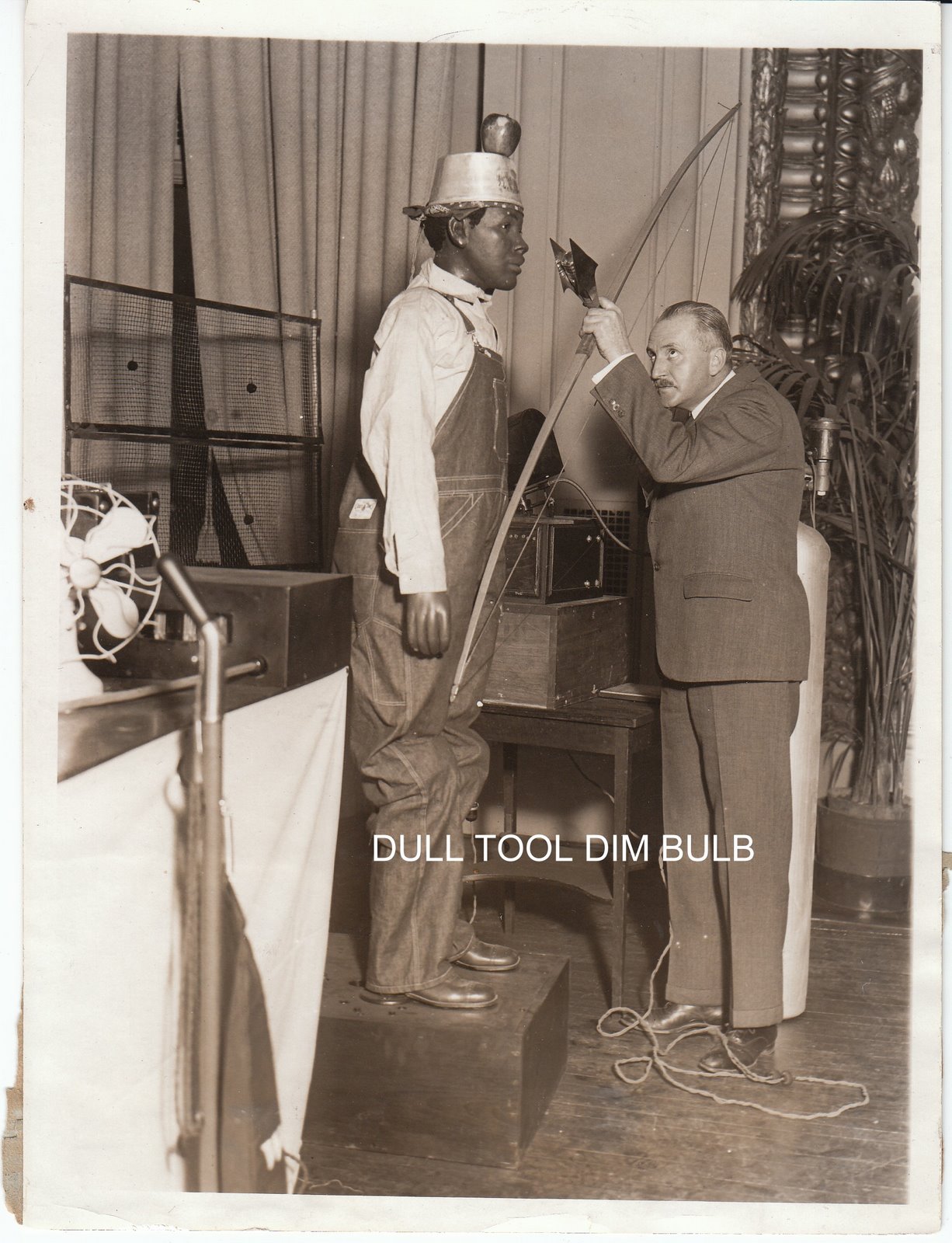
Dr Phillip Thomas a research physicist at the Westinghouse Research laboratory created the ‘Marimbalite’ sometime around 1935 as a way of publicising Westinghouse’s research into photo-electric technology. Other promotional applications included ‘Rastus’ the rubber negro robot who could be commanded to stand up and talk when illuminated by a torch beam.

Dr Thomas plays the Marimbalite

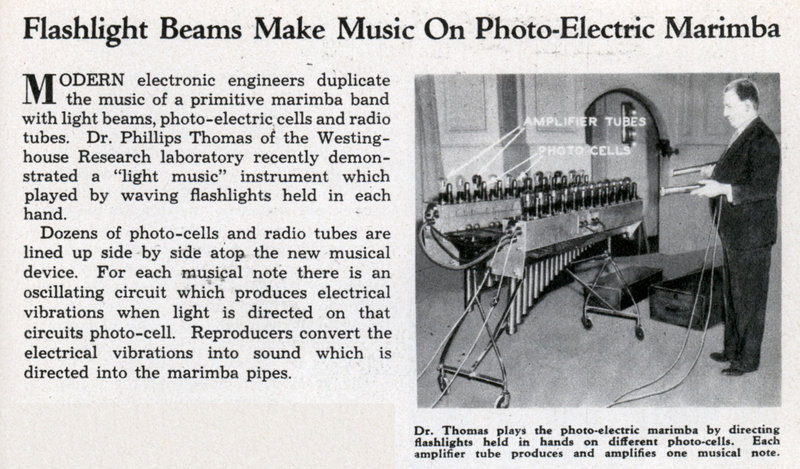
The Marimbalite was an electro-mechanical device which created sounds mechanically from light triggered vibrating tubes, Dr Thomas was able to ‘play’ the Marimbalite with a torch in each had:

“Dozens of photo-cells and radio tubes are lined up side by side atop the new musical device. For each musical note there is an oscillating circuit which produces electrical vibrations when light is directed on that circuits photo-cell. Reproducers convert the electrical vibrations into sound which is directed into the marimba pipes.”

‘Modern Mechanix Magazine’ Archive. September 1935

Dr Phillip Thomas worked at Westinghouse Research laboratory for thirty five years and developed numerous inventions including primitive robots, ‘vortex chimneys’, lightbulbs, voice activated switches, ultra-audible microphones. After retirement he proposed to study the possibility of recording telepathic human thoughts –there is no record of his findings with this endeavour.

Dr Phillips Thomas shoots 'Rastus' the Negro robot
Dr Phillips Thomas shoots ‘Rastus’ the African-American robot with a light beam bow and arrow.
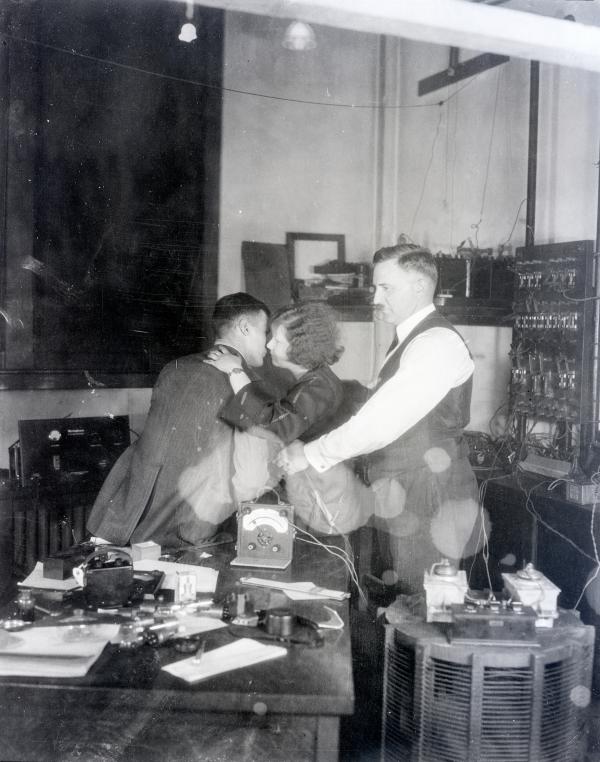
Dr Phillips Thomas
Westinghouse electrical engineer Phillips Thomas measures the heart palpitations of a couple kissing with his “ultra-audible” microphone, Pittsburgh, PA, March 15, 1924.

“In the early 1920s Thomas invented an “ultra-audible” microphone that enabled “scientists to hear sounds inaudible to the naked ear.” He would later work on radio signal-controlled electric circuitry, and a vortex gun designed to eliminate smoke from factories by shooting it in vortex rings high into the atmosphere. After World War II, Thomas believed that the answer to mental telepathy might be found in the unexplored frequency band between ultra-short radar waves and the longest waves of light.”

Marimbalite


Sources:

‘Modern Mechanix Magazine’ Archive. September 1935

‘Popular Science’ Magazine. May 1949

Telelux and rastus: Westinghouse’s forgotten robots