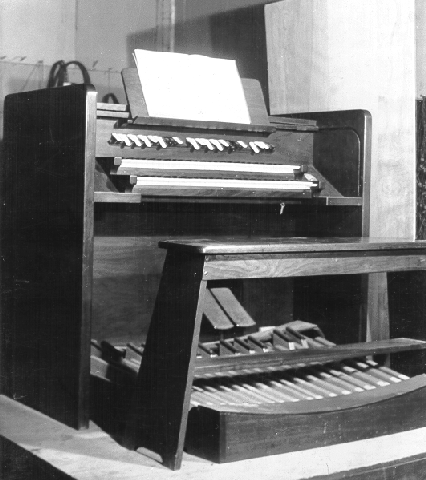
Désilets “Wireless Organ’ was a unique instrument that was designed to create and transmit musical tones generated by electronic sparks. Désilets, the bishop of the small town of Nicolet in Quebec, Canada, had set up his own radio station to transmit religious music and required an organ to complete his choir. Using the standard, pre vacuum tube process of generating radio waves with a spark-gap alternator; Désilets mounted a series of spark-gap ‘studded’ disks on a rotating conical drum spinning at a fixed rate powered by an electrical motor . The ratio interval between the studs caused an approximate sinusoidal waveform to be created in a series of predetermined musical pitches. The instrument was designed to be audible over a wireless transmission – this being, in these pre-amplification days, the only way the instrument could be heard;

The first version of the instrument was a had a short drum that delivered a 1 1/2 octave range, Désilets later attached a 4 octave touch sensitive organ keyboard to a much longer spark-drum and attached a foot controlled rheostat to allow expression control. To produce higher and lower octaves (without the complexity and scale of creating a longer spark-drum) the motor speed could be varied to double or half the speed to deliver the required pitch change. Semitones were achieved by a gearing mechanism:
“…semitones are obtained in the preferred form by a set of rows exactly corresponding to the rows 27 30, 36, 40 and 45 traveling at a rate -of speed 1/20 less than the rotor 1. For example, if the rotor 1 is revolving at 500 r. p. m. The semitone rows must revolve at 47 5 r. p. m. The different speeds of rotation may be obtained by gearing”1 Désilets, George,(1920) Music By Radio Spark Tones, Radio Amateur News’, June 1920, 681.


The instrument was capable of playing polyphonically if the input charge was boosted to allow multiple spark generation:
“…Obviously, in order to produce chords, it is only necessary to supply a current of sufficient intensity to permit of a plurality of different sets of sparks at the same time consequent upon the pressure of the corresponding number of keys.”2United States Patent Office #1166582

Désilets experimented with early musical broadcasts by attaching his Wireless Organ to the seminary’s own radio transmitter. Jean Narrache, one of Désilets’ students describes the first experimental transmission made in 1912:
AN INTERESTING ANECDOTE ABOUT ABBÉ GEORGES DESILETS
[…] Father Baillargeon, my phlegmatic, distinguished and patient professor (he had to be patient to support me) installed in the physics office one of the best Marconi TSF (Wireless) devices that he could obtain. The installation had been perfected with the help of Abbot Georges Désilets, one of the most modest and most learned physicists in the country, and the two abbots: one at the seminary, and the other at the Bishopric of Nicolet, were working on messages in T.S.F. code, similar then to ordinary telegraphy. My colleague Adélard Vincent and I were the official operators of the laboratory, and we took no time in carrying out our own TSF experiments.
At that time, transmitters and receivers were not locked in cabinets like our current radios. Too bad for anyone putting their fingers where they didn’t belong – I remember that a spark from the transmitter almost went through my hand. But Father Désilets, a musician at heart, conceived the idea of transmitting by wireless sounds – sounds more harmonious than the crackling of the telegraph code which up to then had been produced by his wireless device – and began transforming an old, disused harmonium into an instrument that would transmit real music wirelessly.
One day, the abbot instructed Vincent and me to go to Lake St-Pierre, a few miles from Nicolet, in a yacht equipped with an antenna and a wireless telegraph station. At our destination, Vincent turned on our transmitter and informed the abbot that we were ready. With our ears glued to the headphones, we wait anxiously – as you can imagine. Suddenly, the very distinct first notes of the song “Nearer my God to Thee” made each of us utter a cry of admiration. Father Désilets’ harmonium transmitted the music by wireless telegraphy.
I will not attempt to translate our joy to you today; even less the harmony so wonderfully transformed. An amusing thing for us, but which was less so, for a moment, for the wireless operator of a steamer which was passing at that same moment on the lake, and heard this hymn in their telegraph headphones. The telegraph operator, remembering that the orchestra of the “Titanic” had played this song before the ship made its final dive, thought he was hearing things and telegraphed Montreal station in all haste to ask if we had heard the same thing there as him. As these two transmission posts were too far away, obviously no one had heard the mysterious music. I wonder if the poor boy would have lost his mind if the abbot had not hastened to telegraph him directly himself to explain the experiment he was trying to do.
And that, my dear friends, is how I , without you knowing it before today, became one of the earliest listeners of music transmitted by wireless. If you ever pass through Nicolet, stop at the old seminary – I believe the strange harmonium is still preserved there. 3Narache, jean(1943) UNE ANECDOTE INTÉRESSANTE AU SUJET DE L’ABBÉ GEORGES DESILETS, Le Nicoletain. VOL.X.—No15. Imprimé à SAINT-JUSTIN,VENDREDI, 12 MARS 1943, 1.
Désilets radio station was closed during the 19-14-18 war – the Canadian government closed all non-military radio stations for security reasons –and his wave-organ silenced. When the station reopened after the war, Désilets continued his musical broadcasts but a law passed in Canada in 1923 prohibiting amateur musical broadcasts (to protect advertising revenue) once again brought his experimental broadcasts to an end. 4La Premiere Musique Dans L’air, Le Nicoletain, VOL.X.—No14,VENDREDI, 5 MARS 1943, 1.
“Those who have heard it agree that it is real music. Chords are produced by pressing two or three keys, and if the feeding transformer can supply the necessary power we have surprising results and pleasant effects. Obviously a more elaborate machine, constructed on the lines suggested, would give even better effects. Unhappily my station was closed las year on account of the war, and my organ is now silent. I hope to resume my experiments later on; meanwhile, I wish I could, for a time, live on the free soil of the United States, paradise of the wireless amateur. 5 Désilets, George,(1920) Music By Radio Spark Tones, Radio Amateur News’, June 1920, 681.
Désilets’ technique of spark-gap sound generation was rendered obsolete by the post WW1 invention of the vacuum tube by Lee De Forest – the relatively cheap and low-powered vacuum tube audio oscillator became a standard feature of post WW1 electronic musical instrument designs.
Biographical notes

Georges Désilets was born in Nicolet, Quebec, Canada on November 29, 1866, the son of Isaiah Désilets, farmer and Léocadie Belcourt. After studying classics and theology at the Seminaire de Nicolet (1880-1888), he was ordained as a priest on July 26, 1893. Désilets began teaching at the seminary as a professor of physics, chemistry and astronomy (1893-1897) and then from 1900 to 1904 natural history and music. Désilets was then appointed chaplain of the ‘Hospital Sisters of St. Joseph’ in Arthabaska, Quebec, which he left four years later due to health problems. Désilets became the resident Bishop of Nicolet, where he had his own amateur radio laboratory installed in the turret of the bishopric building. he created the radio station ‘9 AB’ which broadcast music for an hour every week performed by the orchestra of the Nicolet Seminary “Quartet 9-AB”. In 1914, Désilets began experimenting with a way of creating musical tones using electronic sparks which led to the design of the ‘Wireless Organ’. He was also responsible for a number of patents in the field of wireless communications. Father Désilets died in hospital of Christ the King of Nicolet, on 29 June 1954 at the age of 88. Buried in the cemetery of the Major Seminary.6 The archives of the Seminaire Nicolet. https://archivesseminairenicolet.wordpress.com/2013/05/09/fonds-georges-desilets/ retrieved 10-11-2023
References:
- 1Désilets, George,(1920) Music By Radio Spark Tones, Radio Amateur News’, June 1920, 681. ↩︎
- 2United States Patent Office #1166582 ↩︎
- 3Narache, jean(1943) UNE ANECDOTE INTÉRESSANTE AU SUJET DE L’ABBÉ GEORGES DESILETS, Le Nicoletain. VOL.X.—No15. Imprimé à SAINT-JUSTIN,VENDREDI, 12 MARS 1943, 1. ↩︎
- 4La Premiere Musique Dans L’air, Le Nicoletain, VOL.X.—No14,VENDREDI, 5 MARS 1943, 1. ↩︎
- 5Désilets, George,(1920) Music By Radio Spark Tones, Radio Amateur News’, June 1920, 681. ↩︎
- 6The archives of the Seminaire Nicolet. https://archivesseminairenicolet.wordpress.com/2013/05/09/fonds-georges-desilets/ retrieved 10-11-2023 ↩︎