The history of electronic musical instruments from 1800 to 2019
The ‘Welte Licht-Ton-Orgel’ or ‘Phototone Organ’. Edwin Welte, Germany, 1936
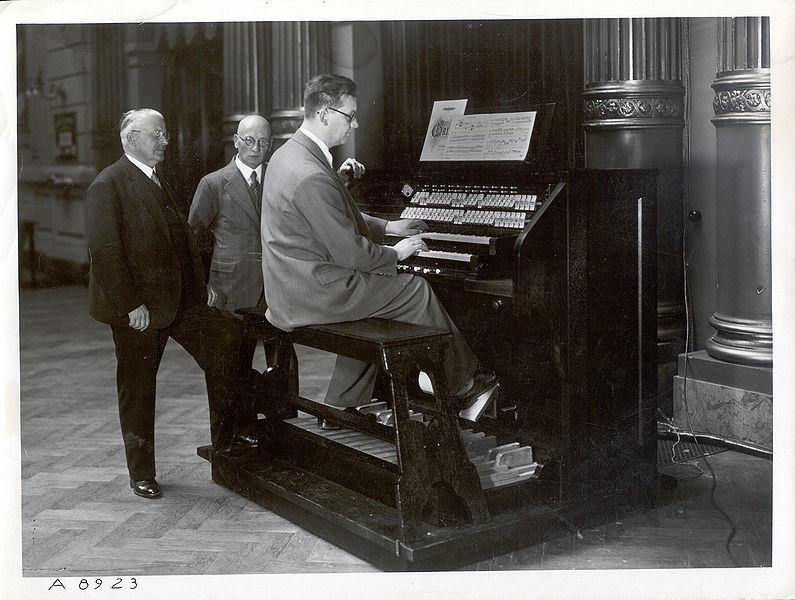
L-R Edwin Welte, technical consultant Wilhelm Faass and the Organist Richard Neumann at a Telefunken press presentation of the “Welte Licht-Ton Orgel” in 1936. Image: Augustinermuseum Freiburg.
The Welte Licht-Ton-Orgel (Welte Light-Tone organ) was one of the last instruments designed by Edwin Welte (1876-1958), the famous founder of the Welte-Mignon mechanical instrument manufacturer. Welte had become fascinated with the possibility of using optical disks since 1925 and produced a number of prototypes using clay optical disks before completing the glass-disk-based production version of the Licht-Ton-Orgel. The sounds of the Licht-Ton-Orgel consisted of photographically drawn ‘recordings’ of different models of famous organs of the day, but in theory could play back any recording of any instrument.
Welte working on an early prototype of the disc reading mechanism of the Light-ton orgel. Image:Donhauser, Peter (2007) Elektrische Klangmaschine, Die Pionierzeit in Deutschland und Österreich, Böhlau Verlag, 171.
The organ premiered on November 6th 1936 at the Berlin philharmonic played by the virtuoso German organist Kurt Grosse and received enthusiastic review from the National Socialist newspaper the Völkische Beobachter (9. November 1936) “ A unique miracle, perfection in the entire realm of concert instruments” and speculated that it would be a perfect instrument for National Socialist rallies – on the strength of this endorsment, The German Telefunken comany negotiated a production deal. Any potential the instrument had was destroyed by the Nazi’s discovery of Welte’s marriage to a German Jew and Telefunken’s immediate withdrawal of their contract. After the war, Welte continued to try to make the instrument a commercial success, but eventually foundered due to the complexity of the photoelectric system and increasing competition from cheaper, more efficient instruments such as the Hammond Organ. Welte. Only three production models of the Licht-Ton-Orgel were completed.
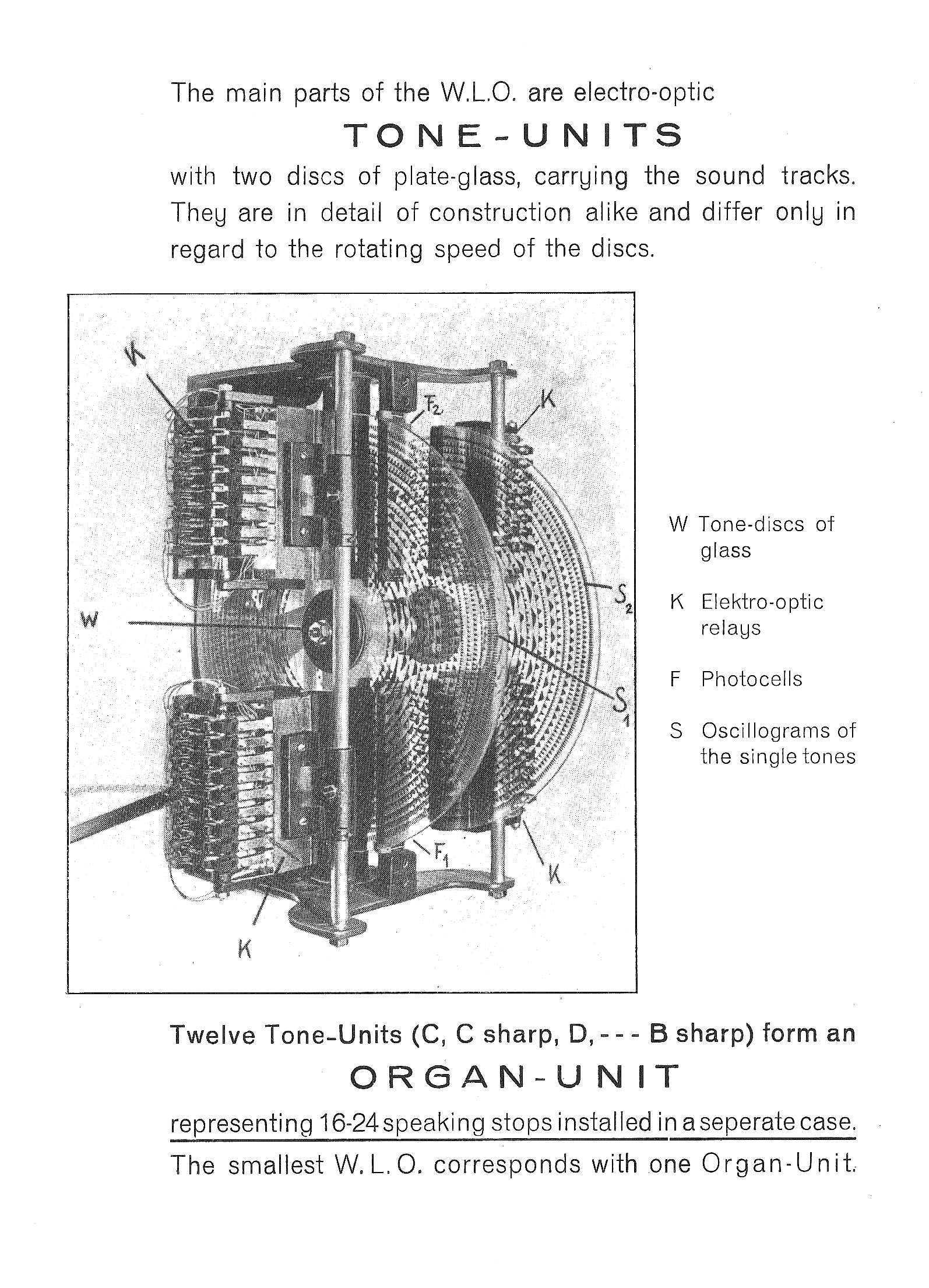
A detail of one of the Light Tone Organ’s glass disks. Image: Edwin Welte schuf die ideale Orgel. Funkshau, 1936, Nr. 48, S. 377-378.
The instrument’s sound-generating unit consisted of 12 glass disks, each printed with 18 different looped waveforms arranged in concentric rings. These glass “tone wheel” disks rotated over a series of photoelectric cells, which filtered a light beam to control the sound’s timbre and pitch. The resulting combinations of tones yielded three different timbres across all octave registers for each note on the keyboard. Unfortunately, the German branch of the Welte-Mignon company in Freiburg was completely destroyed by Allied bombing in 1944, resulting in the permanent loss of all the company’s closely guarded secret designs.1 Donhauser, Peter (2007) Elektrische Klangmaschine. Die PIonierzeit in Deutschland und Österreich, Böhlau Verlag, 169–184.
Light beam disk of the Licht-ton OrgelThe disc reading mechanism of the Licht-ton Orgel
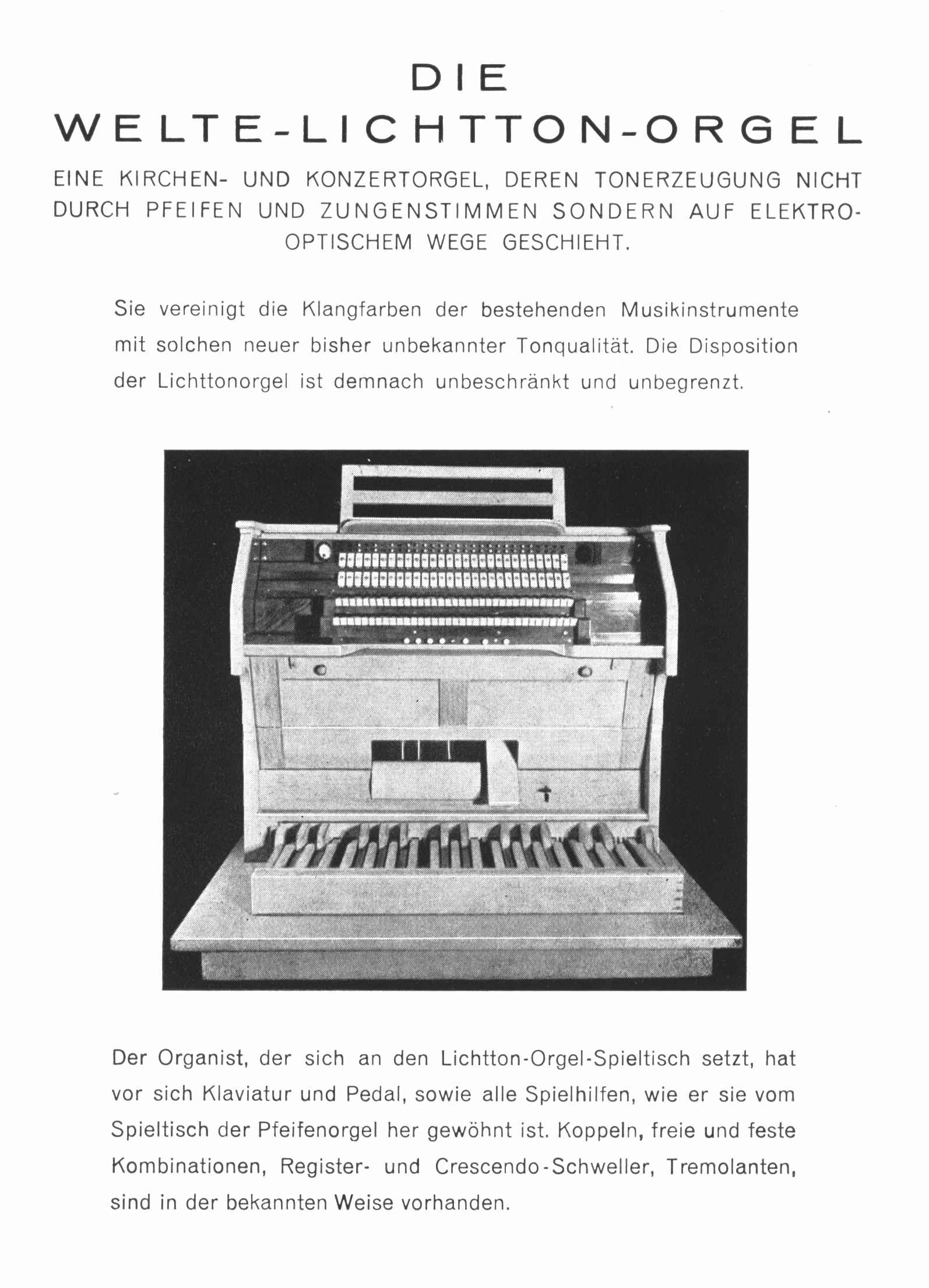
Promotional brochure of Welte’s Licht-Ton-Orgel
Edwin Welte. March 28 1876 in Freiburg im Breisgau , † January 4 1958 in Freiburg im Breisgau
Biographical Information
Edwin Welte (1876-1958) and his brother-in-law, Karl Bockish, developed the Welte-Mignon reproducing piano in 1904 for M. Welte & Söhne of Freiburg, Germany. Music roll recording began in 1905. The recording piano and the reproducing system were entirely new inventions that astonished musicians and fans across Europe. In 1906, Welte established “The Welte Artistic Player Piano Company” in a showroom in New York, where he soon began producing pianos and music rolls for American customers.
The Welte Company
The Welte Company was a German organ manufacturer founded in 1832 in Vörenbach, located in the Black Forest, by automata designer Michael Welte (1807-1880). In 1865, he relocated the company to Freiburg/Breisgau, where it was registered under the name M. Welte & Söhne. Throughout the remainder of the 19th century, the company expanded significantly and became particularly renowned for its orchestrions.
Welte’s “Cabinet Player,” a reproducing piano without a keyboard that carried the Mignon label, was patented in 1904 while Edwin Welte (1876-1958), the founder’s grandson, was in charge. The prototype was showcased in Leipzig in late 1904 and became commercially available by early 1905. The Vorsetzer, another innovation, was introduced in 1908.
In 1909, the Mignon technology was integrated into their upright pianos, and in 1913, it was incorporated into their grand pianos. In 1908, the technology was also adapted for the Welte “Philharmonic Autograph Organ,” which served as a precursor to the “Welte-Philharmonie Organ.” This organ was first publicly displayed at the Turin Exhibition of 1911. The company successfully marketed player organs, cinema organs, and, in response to a contracting market during the 1930s, church organs.
Simultaneously, they produced rolls of performances by some of the era’s greatest organists and sold them with significant commercial success. From 1865 to 1917, they also operated a branch in New York called M. Welte & Sons, led by Emil Welte (1841-1923), the founder’s eldest son. However, this branch was closed during World War I as it was considered an “alien enterprise.”
Welte factory in Freiburg, Germany
Welte’s instruments became status symbols and represented the pinnacle of entertainment during their time. They were installed in grand residences, palaces, schools, department stores (including Harrods in London), yachts, and ships—one instrument was even manufactured justtoo late to be aboard the Titanic. Additionally, they found their way into a “house of pleasure,” specifically the Atlantic Garden orchestrion. Welte’s creations were distributed globally, with a market that extended beyond Europe and the USA to Istanbul, Russia, China, and Sumatra.
At the top of Welte’s orchestrion and player-organ range was the Welte-Philharmonie. Very few of the full-sized models were ever manufactured. However, starting around 1926, Welte began to face threats from the rapidly growing radio and recording industry. This led to a significant decline in business, and by 1932, the company narrowly avoided bankruptcy. During this period, Welte also collaborated with the Telefunken Company to develop electronic organs. This partnership was ultimately terminated due to the circumstances surrounding Edwin Welte’s first wife, Betty Dreyfuss, who was Jewish.2 The History of M. Welte & Sons, Freiburg and New York, https://www.welte-mignon.de/ retrieved: 22-02-2026]
The stalled collaboration aimed to create electronic organs using (analogue) sampling and photo-cells—truly innovative concepts for that time. Had Welte succeeded, they might have eliminated the Hammond organ from history. However, it was World War II that ultimately led to the company’s downfall. In November 1944, the British bombing annihilated the Freiburg premises, including all stock, instruments, and historical documents. The bombed-out factory remained a landmark near the Freiburg railway station for almost a decade, until the mid-1950s. 3 https://www.musikautomaten.ch/ retrieved 02/22/2026
Sources
1
Donhauser, Peter (2007) Elektrische Klangmaschine. Die PIonierzeit in Deutschland und Österreich, Böhlau Verlag, 169–184.
2
The History of M. Welte & Sons, Freiburg and New York, https://www.welte-mignon.de/ retrieved: 22-02-2026]
7 thoughts on “The ‘Welte Licht-Ton-Orgel’ or ‘Phototone Organ’. Edwin Welte, Germany, 1936”
Due to the complex structure of sounds made by pipes, organs which simulated with sound generators and filters the sound of pipe organs never sounded convincing. Welte avoided this problem by recording real pipes and replaying these samples. He was years ahead of his time. Most modern digital organs do the same thing. The main difference is that Welte stored samples on rotating glass discs and digital organs use solid state storage for the pipe samples. Edwin Welte was a very clever inventor. He died in 1958 when electronic organs became popular in jazz and pop music. The Lichtton-Orgel could have been enormously successful due to its more realistic sounds.
DER ERSTE BEISPIEL EINES BEWEISES AUS ELEKTROMECHANISCHER OPTISCHER SCHEIBE UND KUPPLER, EINE REVOLUTION VOR DEM AMERIKANISCHEN ORGAN MIT HARMONISCHEM ZEICHNUNGSHAMMOND, dem Vorfahren des Melotrons, FÜR IMMER VERLOREN.






Due to the complex structure of sounds made by pipes, organs which simulated with sound generators and filters the sound of pipe organs never sounded convincing. Welte avoided this problem by recording real pipes and replaying these samples. He was years ahead of his time. Most modern digital organs do the same thing. The main difference is that Welte stored samples on rotating glass discs and digital organs use solid state storage for the pipe samples. Edwin Welte was a very clever inventor. He died in 1958 when electronic organs became popular in jazz and pop music. The Lichtton-Orgel could have been enormously successful due to its more realistic sounds.
And, at least in my reconstruction, it ABSOLUTELY ROCKS with overdrive! So it would’ve probably also been an influence for rock music.
DER ERSTE BEISPIEL EINES BEWEISES AUS ELEKTROMECHANISCHER OPTISCHER SCHEIBE UND KUPPLER, EINE REVOLUTION VOR DEM AMERIKANISCHEN ORGAN MIT HARMONISCHEM ZEICHNUNGSHAMMOND, dem Vorfahren des Melotrons, FÜR IMMER VERLOREN.
How does one request permission for usage of a photo – The ‘Welte Licht-Ton-Orgel’ or ‘Phototone Organ’?
Thak you.
Hi – let me know which specific images you are interested in and I’ll try and find the source/owner. thanks, simon
I actually created wavetables of the Lichttonorgel’s sounds from an image of the tone generator:
https://github.com/QCrafter/Welte-Lichttonorgel-Reconstruction
Probably a bit late, but I have somehigher res partial images of the tone discs if that is useful? – Simon