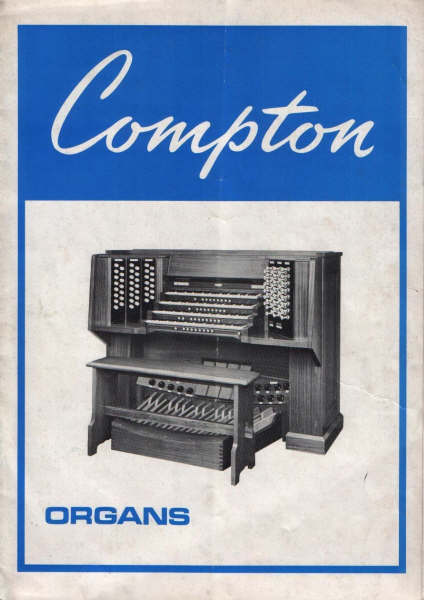
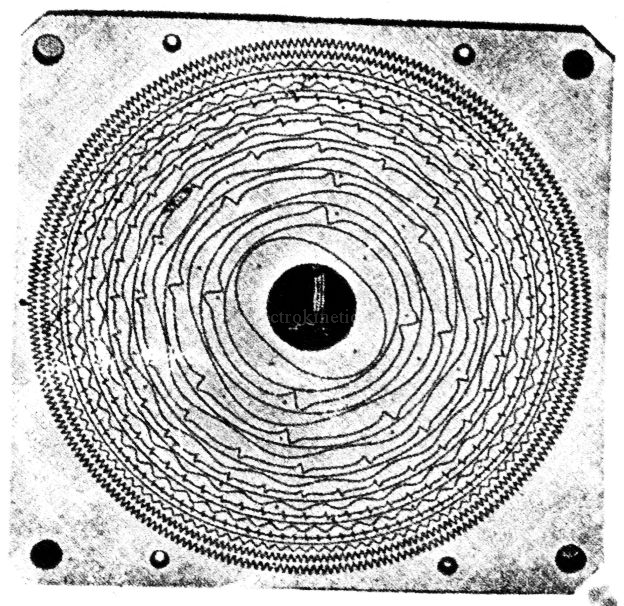
Since the 1920’s the Compton Organ Co had been the premier manufacturer of pipe organs for cinemas, churches and dance halls in the UK. In 1932 Compton developed their first electronic “pipe-less” organ the ‘Melotone’ intended as an add-on unit for conventional organs to extend their range. The Melotone’s sound was generated using the same tone-wheel technique as the Hammond Organ and the much earlier Telharmonium (1876), where a metal disc engraved with representations of sound waves spun within a magnetic field generating varying voltage tones. In this case two electrostatic tone wheels provided the sounds, amplified and fed to a large speaker horn in the organ loft. The Melotone was not intended as a complete instrument in itself and had it’s own ethereal synthetic character to contrast with a traditional pipe organ.
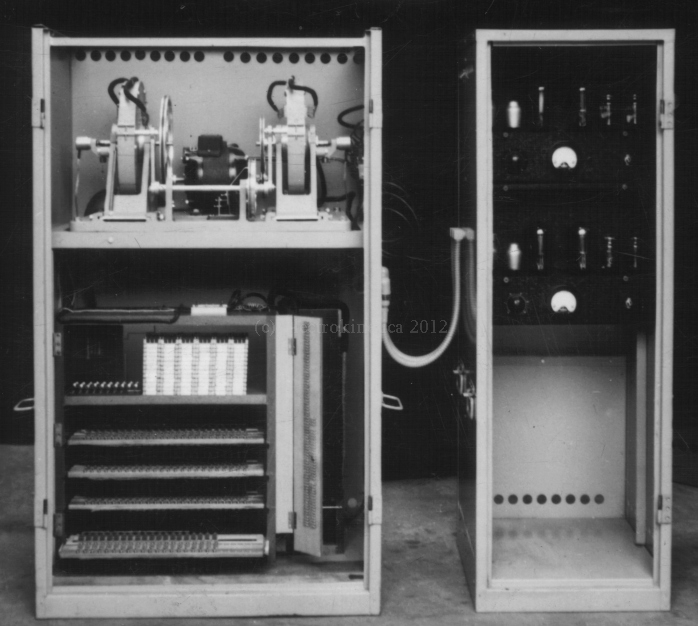
In 1938 Compton developed the Melotone concept into a stand-alone organ called the Electrone (or Theatrone) designed as a replacement for old pipe organs in churches and dance halls. This instrument had twelve tone generators and an organ-stop style range of voices. A post-war compact ‘economical’ version was brought out in 1952 also called the ‘Melotone’. Production of the organs continued until the 1960’s by which time tone-generator technology had become obsolete due to the arrival of cheaper and more dependable solid-state electronic circuitry.
Sources:
http://www.electrokinetica.org
What a blessed sound. It takes one back to yesteryears.
How can I share pics of Leslie Bourn .
He was my Grandfather.
I have some photos of the organ he built at home
I first met Leslie when I bough the Compton organ from the Astoria Cinema in Ashford near where he lived. When I first met him he introduces me to his Syndrone clock, and its workings, in the hallway first, then his wife. We met up every Sunday lunch time for a pint (or two) and discussed many aspects of the organ’s design and many other elecrtonic subjects. He was very bright and a very good friend. He invited my wife and I down to his holiday home in Seaford a few times. I still miss him with his humour and lively mind.
Hi Laurence. Thanks for posting this, I would be very keen to get in touch and hear about your recollections of Leslie Bourn. I have been researching the Compton Electrone / Theatrone / Melotone for many years but never had the opportunity to meet him.
Hi David, I would be very keen to get in touch and learn more about your Grandfather. I have been researching the Compton Electrone / Melotone / Theatrone for many years but never had a chance to meet him. I am now creating a new website on the subject and need to step up my research.
Dear Mr, David Marsden
Please, if possible, send me photos of the home organ made by your great-grandfather.
Regards Mr.T.L.Abonyi from Hungary
The Melotone does not use the same electromagnetic tonewheeel system as the Hammond organ. Leslie Bourn, for Compton, developed a system of stationary multi-tracked discs scanned by a rotating pick-up disc in an electrostatic field, thus generating an small induced alternating voltage which was amplified. Bourn had started developing a magnetic tonewheel system in the late 1920s, but he switched to the investigation of electrostatics after a couple of years or so.
Quite righ, also generated the wave forms at the end of the process instead at the beginning like Hammond. The later Theatrone using 12 disks produced 20 frequences per note instead of Hammond’s 8. Which is why a Hammond will always sound like a Hammond and the Theatrone more like an organ.
My Grandfather was Leslie Bourn.
I would love to share a few photos of the electrone organ he built at home
David – I would be delighted to get in touch and find out more from you about your grandfather and his work. I have been researching the Electrone and other Compton innovations for some years and have built up a nearly comprehensive collection of 21 different models from 1938 to 1970.
I bought a Compton Melotone in the early 80s. Thought it was a bit of history, a throwback to the days of cinema organs. It sure looked like one. I spent a ton of money on it. Worried that the strange lining in the speaker may be asbestos (it turned out to be wool). Cleaned the organ, got a specialist firm to re-work all the electrics and tonewheels. I took off the pedals, sanded every one by hand, rebuilt and repainted it. Relined the console with marquetry wood. Put in new lights. Gold leaf, the lot. She looked a million dollars. Turned it on. It was fucking shit. I gave the bastard away, glad to see the end of it. Don’t go near one. They stink.
Hello,
I have acquired a Compton Electrone 363 with a separate tone generator cabinet and am searching for as much information , circuit diagrams, descriptions etc, as I can get before beginning a full restoration. Can anyone help please?
Hello just seen your message. Although
3 years late did you obtain circuit diagrams.
This article misrepresents the waveform-based electrostatic tone-wheel as being the same as used in the Hammond and the 1876 Telharmonium. It is not the same at all. Those two had electromagnetic tonewheels that were more like a gear with teeth, and when the “teeth” passed by a pickup, sound was made. This is a good representation – https://nshos.com/TONE-WHEEL.gif.
When I read it, it didn’t make sense to me. How would an 1876 inventor be able to carve a sine wave into a metal plate when the phonograph didn’t even exist until 1877, and they certainly didn’t have something like an oscilloscope. And getting the electrostatic part to work requires high voltage and precision machining, which I don’t think was practical in 1876.
Perhaps a better description is a ‘similar’ technique was used in the Hammond and Telharmonium? i.e. a variable shaped plate rotating within a magnetic field creates an approximation of a sine wave. I think it can be demonstrated that there is a direct inspirational connection between Hammond – Cabot/Severy – Hugoniot and Cahill even though the techniques varied.
I worked with Leslie Bourne designing the transistor amplifier 1965 to 1966.