
Hugo Gernsback, perhaps better known as the ‘Father of Science Fiction’ (and currently eponymously celebrated in the ‘Hugos’ Science Fiction Awards), also invented and built, with Clyde J. Fitch, an early electronic instrument called the Staccatone in 1923, which he later, in 1926, developed into one of the first polyphonic instruments, the Pianorad. Gernsback played a significant role in the development and popularization of television, radio, and amateur electronics. His ventures included a variety of sometimes questionable businesses, such as early science fiction publishing, pulp fiction, self-help manuals, and DIY electronics magazines, along with his own contributions to science fiction writing.
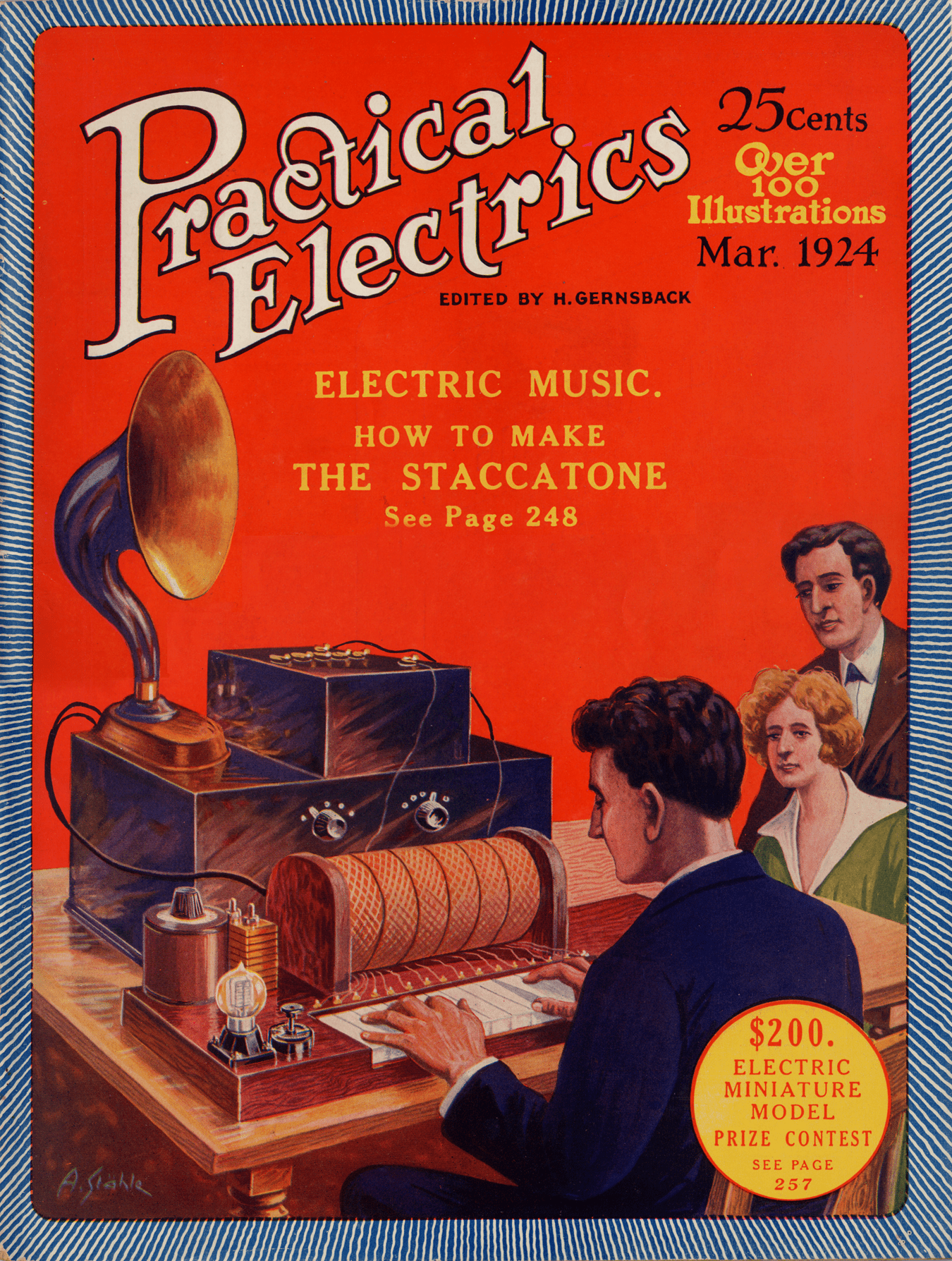
The Radio World (New York, USA) in 1924 described the instrument in a ‘Radio Music’ feature:
“Everyone who has played with circuits calling for an oscillating vacuum tube has noted the bothersome howls and squeals produced by its improper manipulation. Mr H. Gernsback, editor of Science and Invention, is the originator of a circuit in which these once annoying noises can be made to produce music, much like an organ, but with a flute-like note peculiar to itself and agreeably surprising. “In Practical Electrics, Mr Gernsback says: ‘The characteristic squeal rising in pitch from zero to a high note beyond the limit of audibility is familiar to us all. This range of frequencies runs much higher than can be obtained from any known musical instrument. If properly controlled we have a musical instrument that surpasses in tonal range any musical instrument. . . . With several vacuum tubes, harmonic chords can be developed.
This device makes use of the Hartley oscillator circuit. By means of correct capacities, inductances, and controlling keys, the full-scale range can be obtained, and the instrument can be played through a loudspeaker in the manner of a piano or an organ. ” This staccatone, as the device is called, is simple in arrangement, and any experimenter can build and operate one. At the present time, the inventor is installing a model in one of the moving-picture theaters with a view of demonstrating its usefulness in playing full orchestrations. “The circuit used is shown in the diagram. The inductances consist of six 1,500-turn honeycomb coils in series, clamped together. Care should be taken that their magnetic fields assist rather than oppose. The coils can be connected properly if the outside lead of one is connected with the inside lead of the other, and each coil is placed in the same position as regards the direction in which the wire runs. The negative of the B battery is connected to the end of the first coil. The filament of the tube is connected in between the first and second coils, at the connecting juncture. Taps are then brought out and connected to the keys, as shown.
About twenty mica condensers of .006 microfarads each are required, with a 43-plate variable condenser of high efficiency. The variable condenser is included for tuning the instrument. The fixed condensers are arranged in a double bank as shown. The switches which form the keyboard are connected at proper intervals so that one octave is covered, including all half notes. Cutting out the extra condensers increases the tonal frequency by one octave.
When everything is connected and the tube lighted, a loud howl which can be varied in pitch by varying the condenser should be produced. It is then necessary to tune the staccatone A piano is best for this purpose, or in a pinch a tuning-fork. The lowest switch key is connected to the end of the last coil. Con-densers are added until the desired note is produced. It will probably be necessary to vary the capacity of the variable condenser in order to get the exact tone frequency at this point. The next key is then tuned by tapping the next coil until G flat is obtained. In tapping this coil, do it near the end, rather than at the end turn. As there is no set method, it will simply have to be a matter of experiment. The remaining coils are tapped in the same manner so as to form the complete musical scale over one octave, from G to A flat. At this point, by manipulating the keys, any musical selection can be played.”

The Staccatone was conceived as a simple self-build DIY project for amateur electronics enthusiasts via Gernsback’s ‘Practical Electrics’ magazine rather than a commercial instrument. Designed in 1921, the first prototype was built by Clyde J. Fitch at New York’s Radio News Laboratories and presented on the air in November 1923 by Gernsback on WJZ, New York. The instrument was later connected to a clockwork timer and used its distinctive sound as a call-signal for the WRNY station. According to Gernsback “The same instrument was also used in a theater, in April, 1924, when I loaned it to Dr. Hugo Riesenfeld, who had one of his musicians play it in the Rialto Theater in New York.” 1 The Staccatone at WRNY, Radio News, September 1925, 284-5.

The instrument consisted of a single vacuum tube oscillator controlled by a crude switch-based 16-note ‘keyboard’. The switch-based control gave the note a staccato attack and decay – hence the ‘Staccatone’. Gernsback promoted the instrument through his many publications and on his own radio station,n WJZ, New York:
“The musical notes produced by the vacuum tubes in this manner have practically no overtones. For this reason the music produced on the Pianorad is of an exquisite pureness of tone not realised in any other musical instrument. The quality is better than that of a flute and much purer. the sound however does not resemble that of any known musical instrument. The notes are quite sharp and distinct, and the Pianorad can be readily distinguished by its music from any other musical instrument in existence.”2 Fitch, Clyde,(1924) The Staccatone, Practical Electrics, March 1924, 248-9.

Self-build instructions for the Staccatone from ‘Practical Electrics’ magazine 1924:

Gernsback’s Practical Electrics magazine March 1924 describing the Staccatone

Gernsback’s Practical Electrics magazine March 1924 describing the Staccatone
References:
- 1The Staccatone at WRNY, Radio News, September 1925, 284-5.
- 2Fitch, Clyde,(1924) The Staccatone, Practical Electrics, March 1924, 248-9.