The ‘Theremin’ or ‘Thereminvox’. Leon (or Lev) Sergeivitch Termen, Russia. 1922

Leon Termen plays the 'Theremin' or 'Thereminvox' . Paris, 1927
Leon Termen plays the ‘Theremin’ or ‘Thereminvox’ . Paris, 1927

The principles of beat frequency or heterodyning oscillators were discovered by chance during the first decades of the twentieth century by radio engineers experimenting with radio vacuum tubes. Heterodyning effect is created by two high radio frequency sound waves of similar but varying frequency combining and creating a lower audible frequency, equal to the difference between the two radio frequencies (approximately 20 Hz to 20,000 Hz). the musical potential of the effect was noted by several engineers and designers including Maurice MartenotNikolay ObukhovArmand Givelet and the Russian Cellist and electronic engineer, Leon (or Lev) Sergeivitch Termen .

One problem with utilising the heterodyning effect (heterodyning is the effect where two high frequency signals are added producing a third audible tone which is the difference of the two high frequencies. This effect was the basis of many vacuum tube based electronic instruments.”) for musical purposes was that as the body came near the vacuum tubes the capacitance of the body caused variations in frequency.

opera1929

Leon Termen realised that rather than being a problem, body capacitance could be used as a control mechanism for an instrument and finally freeing the performer from the keyboard and fixed intonation. Termen’s first machine, built in the USSR in 1917 was christened the “Theremin” (after himself) or the “Aetherophone” (sound from the ‘ether’) and was the first instrument to exploit the heterodyning principle.

The original Theremin used a foot pedal to control the volume and a switch mechanism to alter the pitch. This prototype evolved into a production model Theremin in 1920, this was a unique design, resembling a gramophone cabinet on 4 legs with a protruding metal antennae and a metal loop. The instrument was played by moving the hands around the metal loop for volume and around the antennae for pitch. The output was a monophonic continuous tone modulated by the performer. The timbre of the instrument was fixed and resembled a violin string sound. The sound was produced directly by the heterodyning combination of two radio-frequency oscillators: one operating at a fixed frequency of 170,000 Hz, the other with a variable frequency between 168,000 and 170,000 Hz. The frequency of the second oscillator being determined by the proximity of the musician’s hand to the pitch antenna. The difference of the fixed and variable radio frequencies results in an audible beat frequency between 0 and 2,000 Hz. The audible sound came from the oscillators, later models adding an amplifier and large triangular loudspeaker. This Theremin model was first shown to the public at the Moscow Industrial Fair in 1920 and was witnessed by Lenin who requested lessons on the instrument. Lenin later commissioned 600 models of the Theremin to be built and toured around the Soviet Union.


Termen left the Soviet Union in 1927 for the United States where he was granted a patent for the Theremin in 1928. The Theremin was marketed and distributed in the USA by RCA during the 1930’s as a DIY kit form or as a finished instrument ( later aficionados of the instrument included Robert Moog who made and sold transistorised Theremins in the 1950s). The heterodyning vacuum tube oscillator became the standard method of producing electronic sound until the advent of the transistor in the 1960’s and was widely used by electronic musical instrument designs of the period.

The Theremin became known in the USA as a home ‘novelty instrument’ and featured in many film soundtracks of the 1940-50’s, it also appeared in several pop records of the 1960’s but never overcame it’s novelty appeal; used for effect rather than as a ‘serious instrument’, most recordings employ the Theremin as a substitute string instrument rather than exploiting the microtonal and pitch characteristics of the instrument. Leon Sergeivitch Termen went on to develop variations on the original Theremin which included the “Terpsitone“, The “Rhythmicon“, the “keyboard Theremin” and the “Electronic Cello”.
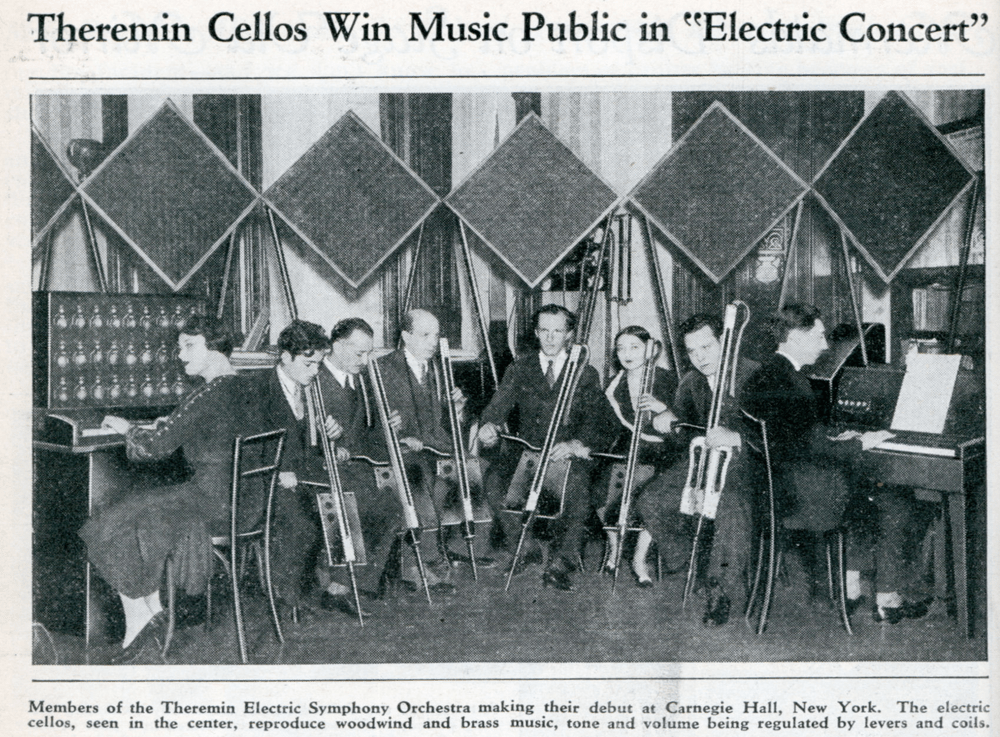
Theremin Orchestra, Carnegie Hall. C1930


Images of the Theremin

Promotional brochure for the RCA Theremin

Biographical Information: Leon Sergeivitch Termen. 1896 – 1993

The story of Lev Sergeivitch Termen is like some nightmarish John LeCarre novel. Prof. Termen was born in the Russian city of St Petersberg in 1896, he would become one of the most important pioneers in the development of electronic music through his instrument the Thereminvox (commonly referred to as the Theremin). Prof. Termen first invented a prototype Thereminvox in 1920, he worked upon his invention for the next few years, whilst also relocating from Russia to New York. A US patent was granted to Termen for the invention of the Thereminvox in 1928. Termen set up a studio there catering to high society patrons from whom he would extract the moneys he used to continue his experiments. His New York studio apparently was kitted out with a variety of devices, that in the late twenties must have seemed like pure science fiction: a variety of electronic audio devices; electronic lighting shows; an electronic dance platform; even a prototype colour television system.

Lev Termen and Theremin virtuoso Clara Rockmore

In 1938 Termen was rumoured to have been kidnapped in the New York apartment he shared with his American wife (the black ballet dancer, Iavana Williams) by the NKVD (forerunners of the KGB). Infact he returned to Russia for tax and financial problems in the USA as well as his concerns over the coming war.

“I left New York because at that time the war was coming. The military troops of the fascists were approaching Leningrad, and so on. I asked to be sent to the Soviet Union so as to make myself useful, I asked many times. For a whole year I asked to be sent back. The war had already started, and they didn’t send me, they didn’t send me. Then at last they permitted me. They assigned me to be an assistant to the captain of a large motor ship. So I went home, but they did not take my wife.”


Termen's American born second wife, the dancer Lavinia Willaims
Termen’s American born second wife, the dancer Lavinia Willaims

On his return He was accused of propagating anti-Soviet propaganda by Stalin. Meanwhile reports of his execution were widely circulated in the West. In fact Termen was not executed, but interned in Magadan, a notoriously brutal Siberian labour camp.

 “I was arrested, and I was taken prisoner. Not quite a prisoner, but they put me in a special lab in the Ministry of Internal Affairs. There I worked in this lab just as others worked. [Airplane designer] Andrei Tupolev was imprisoned in such a way too, if you know about that. He was considered to be a prisoner, and I was considered a prisoner too…At one time, on the way to the laboratory, I was sent to a camp, where they did road construction. I was assigned to be supervisor over the prisoners. From there, after eight months on road construction, I was sent with Tupolev to the Aviation Institute. Many important people worked there: [Missile designer] Sergei Korolyov worked there for me.”

Leon Termen interview By Olivia Mattis and Robert Moog 1992

Termen was put to work on top secret projects by the Soviet authorities  (together with Andrei Tupolev, Sergei Korolev, and other well-known scientists and engineers)  which culminated in his invention of the first “bug,” a sophisticated electronic eavesdropping device. Termen supervised the bugging of both the American embassy, (and perhaps, Stalin’s private apartment). For this ground-breaking work he was awarded the Stalin Prize (first Class), Russia very highest honour.

After his rehabilitation Termen took up a teaching position at the Moscow conservatory of music. However he was ejected for continuing his researches in the field of electronic music. Post war Soviet ideology decreed that modern music was pernicious. Termen was reportedly told that electricity should be reserved for the execution of traitors. After this episode Termen took up a technical position, and worked upon non-music related electronics . Ironically his invention the Thereminvox, was becoming vastly influential in America, a development of which he was completely unaware.Before his death in 1993 Prof. Termen made one final visit to America lecturing, and demonstrating his Thereminvox.

leo


Sources:

“PULLING MUSIC OUT OF THIN AIR: AN INTERVIEW WITH LEON THEREMIN”By Olivia Mattis and Robert Moog. February 1992 issue of Keyboard Magazine.

‘Electronic and Experimental Music: Technology, Music, and Culture’. 2008 by Thom Holmes

‘Sound in Z: Experiments in Sound and Electronic Music in Early 20th Century Russia’. 2013. by Andrey Smirnov.
‘Theremin: Ether Music and Espionage (Music in American Life)’. Feb 2005. Albert Glinsky

The ‘Staccatone’. Hugo Gernsback & C.J.Fitch. USA, 1923

Hugo Gernsback’s ‘Staccatone’ c 1923. Image: The Staccatone, Practical Electrics, March 1924, 248-9
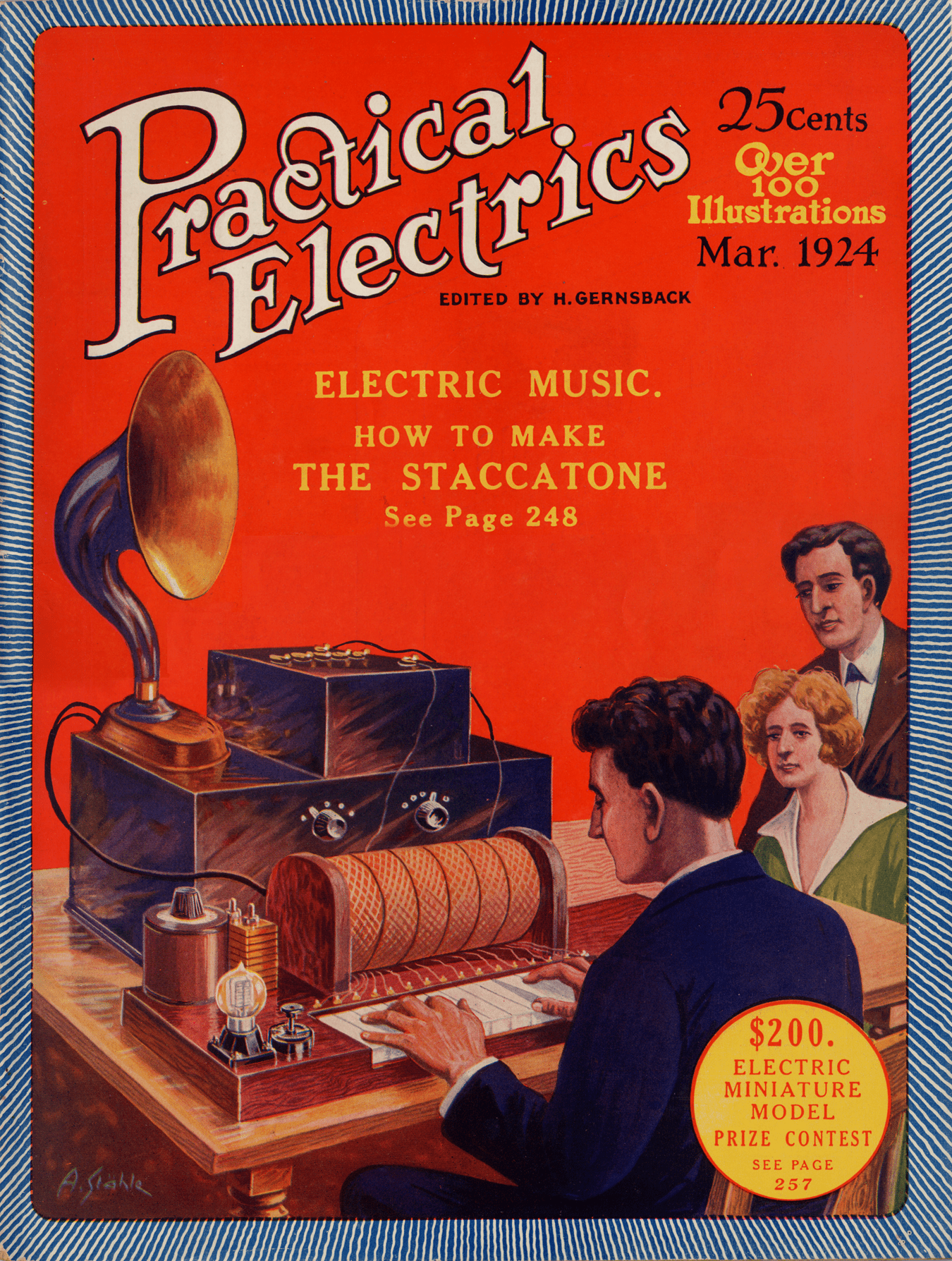
Hugo Gernsback, perhaps better known as the ‘Father of Science Fiction’  (and currently eponymously celebrated in the ‘Hugos’ Science Fiction Awards), also invented and built, with Clyde J. Fitch, an early electronic instrument called the Staccatone in 1923, which he later, in 1926, developed into one of the first polyphonic instruments, the Pianorad. Gernsback played a significant role in the development and popularization of television, radio, and amateur electronics. His ventures included a variety of sometimes questionable businesses, such as early science fiction publishing, pulp fiction, self-help manuals, and DIY electronics magazines, along with his own contributions to science fiction writing.
Practical_Electrics_Mar_1924_Cover
The Staccatone on the cover of Practical Electrics, March 1924, 248-9
The Radio World (New York, USA) in 1924 described the instrument in a ‘Radio Music’ feature:
“Everyone who has played with circuits calling for an oscillating vacuum tube has noted the bothersome howls and squeals produced by its improper manipulation. Mr H. Gernsback, editor of Science and Invention, is the originator of a circuit in which these once annoying noises can be made to produce music, much like an organ, but with a flute-like note peculiar to itself and agreeably surprising. “In Practical Electrics, Mr Gernsback says: ‘The characteristic squeal rising in pitch from zero to a high note beyond the limit of audibility is familiar to us all. This range of frequencies runs much higher than can be obtained from any known musical instrument. If properly controlled we have a musical instrument that surpasses in tonal range any musical instrument. . . . With several vacuum tubes, harmonic chords can be developed.
This device makes use of the Hartley oscillator circuit. By means of correct capacities, inductances, and controlling keys, the full-scale range can be obtained, and the instrument can be played through a loudspeaker in the manner of a piano or an organ. ” This staccatone, as the device is called, is simple in arrangement, and any experimenter can build and operate one. At the present time, the inventor is installing a model in one of the moving-picture theaters with a view of demonstrating its usefulness in playing full orchestrations. “The circuit used is shown in the diagram. The inductances consist of six 1,500-turn honeycomb coils in series, clamped together. Care should be taken that their magnetic fields assist rather than oppose. The coils can be connected properly if the outside lead of one is connected with the inside lead of the other, and each coil is placed in the same position as regards the direction in which the wire runs. The negative of the B battery is connected to the end of the first coil. The filament of the tube is connected in between the first and second coils, at the connecting juncture. Taps are then brought out and connected to the keys, as shown.
About twenty mica condensers of .006 microfarads each are required, with a 43-plate variable condenser of high efficiency. The variable condenser is included for tuning the instrument. The fixed condensers are arranged in a double bank as shown. The switches which form the keyboard are connected at proper intervals so that one octave is covered, including all half notes. Cutting out the extra condensers increases the tonal frequency by one octave.
When everything is connected and the tube lighted, a loud howl which can be varied in pitch by varying the condenser should be produced. It is then necessary to tune the staccatone A piano is best for this purpose, or in a pinch a tuning-fork. The lowest switch key is connected to the end of the last coil. Con-densers are added until the desired note is produced. It will probably be necessary to vary the capacity of the variable condenser in order to get the exact tone frequency at this point. The next key is then tuned by tapping the next coil until G flat is obtained. In tapping this coil, do it near the end, rather than at the end turn. As there is no set method, it will simply have to be a matter of experiment. The remaining coils are tapped in the same manner so as to form the complete musical scale over one octave, from G to A flat. At this point, by manipulating the keys, any musical selection can be played.”
The Staccatone controlled by a self-winding clock mechanism to broadcast regular call signals on the WJZR radio station.
The Staccatone was conceived as a simple self-build DIY project for amateur electronics enthusiasts via Gernsback’s ‘Practical Electrics’ magazine rather than a commercial instrument. Designed in 1921, the first prototype was built by Clyde J. Fitch at New York’s Radio News Laboratories and presented on the air in November 1923 by Gernsback on WJZ, New York. The instrument was later connected to a clockwork timer and used its distinctive sound as a call-signal for the WRNY station. According to Gernsback “The same instrument was also used in a theater, in April, 1924, when I loaned it to Dr. Hugo Riesenfeld, who had one of his musicians play it in the Rialto Theater in New York.” 1 The Staccatone at WRNY, Radio News, September 1925, 284-5.
Clyde Fitch’s self-build schematic of the Staccatone. Image: Practical Electrics, March 1924, 248-9
The instrument consisted of a single vacuum tube oscillator controlled by a crude switch-based 16-note ‘keyboard’. The switch-based control gave the note a staccato attack and decay – hence the ‘Staccatone’. Gernsback promoted the instrument through his many publications and on his own radio station,n WJZ, New York:
“The musical notes produced by the vacuum tubes in this manner have practically no overtones. For this reason the music produced on the Pianorad is of an exquisite pureness of tone not realised in any other musical instrument. The quality is better than that of a flute and much purer. the sound however does not resemble that of any known musical instrument. The notes are quite sharp and distinct, and the Pianorad can be readily distinguished by its music from any other musical instrument in existence.”2 Fitch, Clyde,(1924) The Staccatone, Practical Electrics, March 1924, 248-9.
Hugo Gernsback. Image: Life Magazine 1963. © Time Inc.
Self-build instructions for the Staccatone from ‘Practical Electrics’ magazine 1924:

References:

  • 1
    The Staccatone at WRNY, Radio News, September 1925, 284-5. ↩︎
  • 2
    Fitch, Clyde,(1924) The Staccatone, Practical Electrics, March 1924, 248-9. ↩︎

The ‘Pianorad’, Hugo Gernsback & Clyde.J.Fitch, USA, 1926.

Gernsback’s ‘Pianorad’ at the WRNY radio studio, New York, USA in 1926. Image: Radio News, vol. 8, no. 5, November 1926

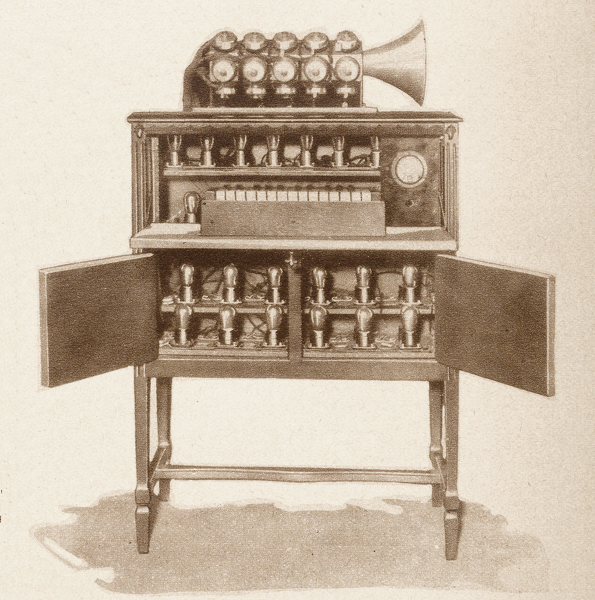
The Pianorad, (‘Piano-radio’) designed by Hugo Gernsback and built by Clyde Finch at the Radio News Laboratories in New York was a development of Gernsback’s Staccatone of 1923. the Pianorad had 25 single vacuum tube oscillators, one for every key for its two octave keyboard making the instrument the first valve based electronic instrument to achieve full polyphony. 1The Telharmonium at the beginning of the 20th century earlier was a polyphonic electronic instrument but, because it generated sound using tone-wheels, it can be considered an eletro-acoustic instrument. The sound from the tubes was passed through a rudimentary mechanical filter that removed harmonic distortion producing virtually pure sine tones. The instrument played sound through a top mounted speaker or could be connected directly into a transmitter for radio broadcast.

Hugo Gernsbacks' Pianorad
Hugo Gernsbacks’ Pianorad’ showing the cabinet containing 25 vacuum tubes – one for each note. Image: Radio News, vol. 8, no. 5, November 1926, 495.

Theory of the Instrument

The Pianorad has a keyboard like an ordinary piano, and there is a radio vacuum tube for each one of the piano keys. Every time a key is depressed, there is energized a radio-oscillator circuit which gives rise to a pure, flutelike note through the loud-speaker connected to the device. It is possible to connect any number of loud-speakers to the Pianorad if it is desired to flood an auditorium with its tones. Also, by arranging suitable outlets for loud-speakers on different floors or different rooms, the sounds of the Pianorad can be heard all over any large building.

The musical notes produced by the vacuum tubes in this manner have practically no overtones. For this reason the music produced on the Pianorad is of an exquisite pureness of tone not realised in any other musical instrument. The quality is better than that of a flute and much purer. the sound however does not resemble that of any known musical instrument. The notes are quite sharp and distinct, and the Pianorad can be readily distinguished by its music from any other musical instrument in existence.

Electric, Not Sound Waves

The loud-speaker arrangement makes it possible for an artist to play the keyboard while the music emerges, perhaps miles away from the Pianorad. It is thus possible for the pianist to play the instrument in absolute silence while the music is produced at a distance. This requires simply that a wire line must connect the output end of the Pianorad instrument with the loud-speaker at some distance away. It is quite feasible for the Pianorad to be played in New York while the music will be heard at the Chicago end, with any number of loudspeakers connected by amplifiers to a long-distance telephone wire line.

A novel idea is the connection of the Pianorad direct to the broadcast-station transmitter. In this case, instead of using a loud-speaker in the studio, the Pianorad is connected electrically to the broadcast transmitter. The artist now plays the Pianorad in the studio in absolute silence. No sound is heard. The radio audience, however, will enjoy the music, although no one in the studio can hear it. In order that the pianist may hear what he is playing, he will wear a set of head receivers attached to an ordinary radio set. The music, therefore, is picked out from the air by the receiver and thus only the artist hears it. In the studio itself, no sound is audible for the Pianorad itself is silent.

Developments Still Continuing

The Pianorad has as yet not entered the commercial stage. The instrument illustrated in this article has 25 keys and therefore, 25 notes. A full 88-note Pianorad has as yet not been constructed, but will be built in a short time. The larger instrument could have been built at once, but it would occupy almost as much space as a piano; and as this amount of room was not then available in the studio of WRNY, for which the first Pianorad was especially constructed, the smaller instrument was built instead.

The Pianorad at WRNY is usually accompanied by piano or violin or both; very pleasing combinations are produced in this manner. At present it uses a single stage of amplification, giving volume enough, in connection with one loud-speaker, to more than fill a fair sized room. By adding several stages of audio-frequency amplification, sufficient volume can be obtained to fill a large church or auditorium.

The Pianorad was first demonstrated publicly Saturday, June 12 at 9 P.M., with a number of brilliant selections played on it by Mr. Ralph Christman; the concert being broadcast over WRNY at The Roosevelt, New York.

The principle embodied in this instrument was first demonstrated in 1915 by Dr. Lee de Forest, inventor of the Audion. At that time Dr. de Forest was able to produce musical tones by means of vacuum tubes, but the radio art at that time had not progressed sufficiently to make possible the Pianorad.2Gernsback, Hugo, (1926) The “Pianorad” a New Musical Instrument which combines Piano and Radio Principles, Radio News, vol. 8, no. 5, November 1926, 493.

Each one of the twenty five oscillators had its own independent speaker, mounted in a large loudspeaker horn on top of the keyboard and the whole ensemble was housed in a housing resembling a harmonium. A larger 88 non keyboard version was planned but not put into production. The Pianorad was first demonstrated on June 12, 1926 at Gernsback’s own radio station WRNY in New York City performed by Ralph Christman. The Pianorad continued to be used at the radio station for some time, accompanying piano and violin concerts.

Pianorad’s 25 units designed to eliminate harmonics.Image: Radio News, vol. 8, no. 5, November 1926,.

Clyde Fitch gave instructions on how to build the Pianorad in radio News, 1926:

Image: “How to build the Pianorad, Clyde Fitch, Radio News December 1926, 655.

References:

  • 1
    The Telharmonium at the beginning of the 20th century earlier was a polyphonic electronic instrument but, because it generated sound using tone-wheels, it can be considered an eletro-acoustic instrument. ↩︎
  • 2
    Gernsback, Hugo, (1926) The “Pianorad” a New Musical Instrument which combines Piano and Radio Principles, Radio News, vol. 8, no. 5, November 1926, 493. ↩︎

The ‘Dynaphone’, René Bertrand, France, 1927.

René Bertrand (r) and Msr Nadal with their Dynaphone. Image: journal de la semaine. 1928-03-28, 45.

The French electrical engineer, mechanic and doll modeller, René Bertrand, who had been experimenting with electronic instruments as early as 1914, was a long time friend and collaborator with Edgard Varèse and with his support Bertrand developed the electronic instrument called the “Dynaphone” (not to be confused with Cahill’s “Dynamophone” or “Telharmonium“).

Promotional photograph of Bertrand and the Dynamophone. iImage: ‘future Music/ Zukunft Musik’ in Die Buhne, 1928.
Le-Petit-Parisien---journal-quotidien-du-soir-1928-04-24
A review of a Dynaphone concert ‘Angelic Music’ . Image: Le Petit Parisien, 14-04-1928.

The Dynaphone was a portable, monophonic instrument controlled not with a keyboard but played with a pitch-lever and volume switch. The instrument was semi-circular in shape with a diameter 0f 30 cm played on top of a table. The Dynaphone belonged to a family of dial-operated non keyboard electronic instruments developed around the 1930’s such as Mager’s ‘Spharaphon. The right hand controlled the pitch using a circular dial on a calibrated disc. Bertrand added a hemispherical cardboard template that allowed the inexperienced user to follow the music by tracing the lines by hand:

“I would also like to point out a new form of recorded music which was inserted into by Mr. Bertrand into the “dial” of his device. A hand operated lever moves on this dial forming a half-disc. The cardboard [form] follows the shape, and on this cardboard Mr. Bertrand has drawn a graph, the performer only has to follow the lines and the points to reconstruct the melody. The cardboard [template] can be changed for each piece.” 1 Gratia,L.E. (1928) La Musique des Ondes éthérées, Les Ménestrel, 48, 1928-11-30, 501.

The total rotation of the dial was equal to seven octaves but only the five highest or lowest could be selected at any one time by the means of a switch, giving an overlap of three octaves common to both ranges.

René Bertrand,
René Bertrand and the Dynaphone in 1928. Image : ‘L’Afrique du Nord illustrée’ 1928-05-05.

Additional vibrato effects could be added by moving the right hand to and fro slightly and the machine also included a push button for articulating the sound. The left hand controlled the volume and timbre – described as similar to a cello, low flute, saxophone or french horn. The Dynaphone generated sound by the by-now standard method of a heterodyning vacuum tube pair, originally used in Leon Termen’s ‘Theremin‘.

Dynaphone

A later development of the Dynaphone (which became known as the ” Radio-electric-organ”) used a five octave keyboard on which the note played could be doubled at the fifth and octave. The first public demonstration of the instrument in 1928 was a performance of Ernest Fromaigeat’s Variations Caractéristiques for six Dynophones and later in ‘Roses de Metal’ a ballet by the swiss composer Arthur Honegger.2 Gratia,L.E. (1928) La Musique des Ondes éthérées, Les Ménestrel, 48, 1928-11-30, 501-3.

After having moved to Neew York, In 1932 Varèse applied to the Guggenheim memorial fund for a grant towards continuing the development of the Dynaphone:

“…..The Dynaphone (invented 1927-28) is a musical instrument of electrical oscillations similar to the Theremin, Givelet and Martenot electrical instruments. But its principal and operation are entirely different, the resemblance being only superficial. The technical results i look for are as follows:

          • To obtain pure fundamentals
          • By means of loading the fundamentals with certain series of harmonics to obtain timbres which will produce new sounds.
          • To speculate on the new sounds that the combination of two or more interfering Dynaphones would create if combined as one instrument.
          • To increase the range of the instrument to reach the highest frequencies which no other instrument can give, together with adequate intensity.

The practical result of our work will be a new instrument which will be adequate to the creative needs of musician and musicologist…” 3 Chadabe J. (1997). Electric sound : the past and promise of electronic music. Prentice Hall,59.

Despite Varèse’s assertions, the Dynaphone was not distinctly different from its close competitors and the Guggenheim Foundation did not sponsor Bertrands work despite several further attempts by Varèse.
dynaphone_02

In 1941, Edgard Varèse, in the hope to resume his collaboration with Léon Theremin, wrote him the letter reported below (courtesy of Olivia Mattis ), but the inventor wasn’t able to read it until 1989, when musicologist Olivia Mattis, during an interview with Theremin (first emerged from Russia after 51 years), presented a copy of it. The letter is dated May 5, 1941.

Dear Professor Theremin,

On my return from the West in October I tried to get in touch with you. I wanted very much to see you again and to learn of the progress of your work. I was sorry – on my account – that you had left New York. I hope that you have been able to go on with your experiments in sound and that new discoveries have rewarded your efforts.

I have just begun a work in which an important part is given to a large chorus and with it I want to use several of your instruments – augmenting their range as in those I used for my Equatorial – especially in the high range. Would you be so kind as to let me know if it is possible to procure these and where … and in case of modifications in what they consist. Also if you have conceived or constructed new ones would you let me have a detailed description of their character and use. I don’t want to write any more for the old Man-power instruments and am handicapped by the lack of adequate electrical instruments for which I now conceive my music.

Mr. Fediushine has kindly offered to forward this letter to you. Please let me hear rom you as soon as possible. With cordial greetings and best wishes in which my wife joins me,

Sincerely, Edgard Varese

P.S. If any of your assistants or collaborators are continuing your work in New York would you kindly put me in touch with them. 4 mattis, (). An Interview with Leon Theremin – October 4, 2002, Therminvox.xom https://www.thereminvox.com/stories/history/an-interview-with-leon-theremin/3/ retrieved 27/11/23

Review from 'Numéro Le Gaulois' February 12th 1982.
Review of a concert of six Dynaphones. Image: Numéro Le Gaulois, February 12th 1982.


Ref:erences

  • 1
    Gratia,L.E. (1928) La Musique des Ondes éthérées, Les Ménestrel, 48, 1928-11-30, 501. ↩︎
  • 2
    Gratia,L.E. (1928) La Musique des Ondes éthérées, Les Ménestrel, 48, 1928-11-30, 501-3. ↩︎
  • 3
    Chadabe J. (1997). Electric sound : the past and promise of electronic music. Prentice Hall,59. ↩︎
  • 4
    mattis, (). An Interview with Leon Theremin – October 4, 2002, Therminvox.xom https://www.thereminvox.com/stories/history/an-interview-with-leon-theremin/3/ retrieved 27/11/23 ↩︎

The ‘Ondes-Martenot’. Maurice Martenot, France, 1928

The 3rd Model Ondes Martenot circa 1929. Image: © Claude Germain. Philharmonie de Paris: Musée de la musique, Fonds Martenot, E.982.9.1.
The 3rd Model Ondes Martenot, circa 1929. Image: © Claude Germain. Philharmonie de Paris: Musée de la musique, Fonds Martenot, E.982.9.1.

The Ondes Martenot, also known as the Ondes Musicale Martenot or simply the “Ondes,” is an early monophonic electronic musical instrument created by Maurice Martenot (1898-1980), a cellist and former World War I radio operator. Martenot’s instrument became one of the few early electronic musical instruments to enter commercial production and gain recognition in the canon of 20th and 21st-century music, particularly within the French new music movement of the 1930s and 1940s.

The Ondes was one of several electronic instruments developed after the First World War that utilised the heterodyning vacuum-tube effect to produce audible tones. Notable examples include Lev Termen’s Theremin (patented in 1928), Friedrich Trautwein’s Trautonium (patented in 1930), and Jorg Mager’s Elektrophon (patented in 1921), all of which were based on similar military radio technology. This method of electronically generating sound remained the predominant technique until the advent of integrated circuits in the 1960s.

While serving as a radio operator in the French army during the final years of World War I, Martenot began to realise the potential of electronic sound. By manipulating the radio feedback howl that plagued early radio transmitters and receivers, Martenot was able to play simple tunes 1 such as Debussy’s “Clair de Lune.” Laurendeau, Jean. (1990) Maurice Martenot, Luthier de l’électronique, Dervy-Livres, 48. —a trick he referred to as the “Mexican singing dog”— much to the amusement of his fellow troops. Once demobilised, Martenot put this experience into practice and began experimenting with designs for his new electronic instrument.

Maurice Martenot plays the 1928 Ondes no 1. Image Philharmonie de Paris: Musée de la musique, Fonds Martenot,  E_2019_9_1_6_1_82_P0001
Close-up of the 1928 Ondes Martenot. Image Philharmonie de Paris: Musée de la musique, Fonds Martenot, E_2019_9_1_6_1_81_P0001.

The first versions bore little resemblance to later production models and consisted of two table-mounted units in which the machine’s pitch was controlled by body capacitance, in a manner very similar to the Theremin. Based on a pair of heterodyning vacuum tubes, the Ondes produced a single, continuous monophonic tone similar to a sine tone but with added harmonic distortion from the vacuum tubes. The second model, known as the Ondes-Martenot, was patented on the 2nd of April 1928 under the title Perfectionnements aux instruments de musique électriques (improvements to electronic musical instruments). 2French patent FR666807A , in this model, the player, in a standing position, controlled the pitch with a string attached to a ring held in the performer’s hand, giving a continuous tonal glissando. Martenot first demonstrated the Ondes Martenot on April 20, 1928, as a soloist performing Dimitrios Levidis’s Poème symphonique at the Paris Opera. This model was quickly succeeded by the third model in 1929, which had a fixed, non-functioning printed 7 octave keyboard to guide the player to the relevant pitch using either the string controller or a finger-guard device held in the player’s hand. This third model, created in collaboration with the engineer Maurice du Breuil, featured a dual-speaker set housed in a framed box and a set of expression controls accessed via a left-hand sliding drawer.

The 1929 model 2 Ondes Martenot showing the ribbon controller placed above a fixed wooden keyboard marker.Close-up of the 1928 Ondes Martenot. Image Philharmonie de Paris: Musée de la musique, Fonds Martenot, E_2019_9_1_6_1_10_P0001.
The 1929 model 2 Ondes Martenot showing the ribbon controller placed above a fixed wooden keyboard marker. Image: Philharmonie de Paris: Musée de la musique, Fonds Martenot, E_2019_9_1_6_1_10_P0001.

The Ondes Martenot underwent several design improvements throughout the 1920s, ultimately stabilising with the modèle 37, which was introduced in 1931. Maurice Martenot aimed to create a versatile electronic instrument that would be familiar to orchestral musicians while distinguishing it from competitors, such as the Trautonium and the Theremin

The 1931 modèle 37 Ondes. Image: Philharmonie de Paris: Musée de la musique, Fonds Martenot,E_2019_9_1_6_1_8_P0001-medium

The modèle 37 was the first to feature a standard keyboard that could be played alongside a string controller known as the ‘ruban,’ which allowed for pitch glissandi. This new model incorporated features that would shape the design direction for subsequent versions. These features included two left-hand pitch controllers: a suspended vibrato device called the clavier and the aforementioned ruban, which runs parallel to the keyboard and allows for tonal and timbral glissandi. Additionally, it had a left-hand-controlled prismatic touche d’expression, which modulated the sound envelope.3Asimov, Peter. (2018) Une invention ‘essentiellement française’:  seeing and hearing the Ondes Martenot in 1937, MUSIQUE – IMAGES – INSTRUMENTS N° 17, BNF, Paris, 107.  

After a world tour promoting his instrument, Maurice Martenot developed an interest in the timbres of non-Western music, particularly the metallic sounds of the Javanese and Balinese gamelan. To replicate these sounds, Martenot dedicated the next decade to introducing various acoustically resonant loudspeakers, known as Diffuseurs, which enhanced the tonal richness of the instrument’s output. These include:

Principal: A standard, large loudspeaker.
Résonance: A loudspeaker that utilises springs to create a mechanical reverb effect.
Métallique: A small gong serves as the diaphragm of this loudspeaker, producing a ‘halo’ effect rich in harmonics – introduced in the 1937 model.
Palme: An iconic lotus-shaped loudspeaker that uses tuenable strings to generate sympathetic resonances – introduced in 1948 models.

The 1937 microtonal Ondes  designed for Rabindranath Tagore. Image Philharmonie de Paris: Musée de la musique, Fonds Martenot

Martenot also collaborated with the Indologist Alain Danielou to create a microtonal version of the instrument, designed for the renowned Hindu poet Rabindranath Tagore. This microtonal ondes of 1937 (Patent 841.128 February 1939) was shorter than the standard version and featured a 5-octave keyboard. According to Laurendeau, it included a set of control discs placed above the keyboard, allowing simultaneous tuning of notes such as C and D to the twelfth. This setup ensured that the overall keyboard tuning corresponded to the raga mode. Laurendeau, Jean. (1990) Maurice Martenot, Luthier de l’électronique, Dervy-Livres, 100.[/mfn]

The range of resonant loudspeakers or Diffuseurs of the 1931 Ondes Martenot: (L-R) the Métallique (1937) , the Palme (1948) and the Principal.

The modèle 37 Ondes-Martenot was unveiled at the 1937 Paris Expo, an exhibition of art and industry held from May to October 1937. A key feature of the expo was a program of 46 musical events featuring prominent French and European composers, including Milhaud, Messiaen, Vellones, Honegger, Ibert, Schmitt, Koechlin, and others. These performances were broadcast throughout the event via loudspeakers positioned along the Seine River, attached to the Eiffel Tower, and even from aeroplanes flying over the city. The ondes-martenot gained a certain cult status during the Expo, being described in the event catalogue as “a new source of infinite artistic joy” and “the most sensational musical and scientific achievement of the 1937 exposition.” Eleven out of the eighteen composers commissioned to create works for the Expo wrote compositions specifically for the ondes. Among these was Ginette Martenot’s all-female electronic ondes orchestra, which frequently performed Messiaen’s commissioned piece, Fête des belles eaux. This performance was enhanced by a spectacular display of illuminated fountains and coloured lights, choreographed and synchronised to the music.

Geneviève “Ginette” Martenot’s electronic ondes orchestra at the 1937 Paris Expo. Image: Philharmonie de Paris: Musée de la musique, Fonds Martenot E_2019_9_1_6_1_96_P0001

During the 1930s, Martenot enhanced the instrument by introducing features such as the ability to modify and simultaneously combine different sound waveforms using a set of control sliders in the left-hand sliding drawer. The later models of the Ondes included pre-set sounds that were:

      • Onde (O): A simple sine wave. Similar in sound to the flute or ocarina.
      • Creux (C):  A peak-limited triangle wave. Similar in sound to a clarinet in high registers.
      • Gambe (G):  A timbre somewhat resembling a square wave. Intended to be similar in sound to string instruments, as the French title would suggest.
      • Petit Gambe (g): A similar but less harmonically-rich timbre than Gambe. The player can control the number of harmonics in the signal using a slider in the control drawer.
      • Nasillard (N): A timbre resembling a pulse wave. Similar in sound to a bassoon in low registers.
      • Octaviant (8): A timbre with a reinforced first harmonic whose intensity in the signal can be controlled by using a slider. This setting is analogous to the 4-foot stop in organ terminology.
      • Souffle (S): A timbre often described as white noise, but in fact pink noise of indefinite pitch.

With the introduction of transistors in the 1960s, Martenot developed an integrated circuit version of the instrument, followed by a digital version in the 1980s.

The Ondes Martenot is one of the few electronic musical instruments that have been embraced by the classical music world. It boasts a wide repertoire of works composed for it by prominent composers such as Edgard Varèse, Olivier Messiaen (including Turangalîla-Symphonie and Trois Petites Liturgies de la Présence Divine), Darius Milhaud, Arthur Honegger, Maurice Jarre, André Jolivet, Pierre Boulez, and many others.


Sources:

  • 1
    such as Debussy’s “Clair de Lune.” Laurendeau, Jean. (1990) Maurice Martenot, Luthier de l’électronique, Dervy-Livres, 48. ↩︎
  • 2
    French patent FR666807A ↩︎
  • 3
    Asimov, Peter. (2018) Une invention ‘essentiellement française’:  seeing and hearing the Ondes Martenot in 1937, MUSIQUE – IMAGES – INSTRUMENTS N° 17, BNF, Paris, 107. ↩︎

The ‘Trautonium’ Dr Freidrich Trautwein. Germany, 1930

Dr Friedrich Adolf Trautwein (b Würzburg 1888, Germany; d Düsseldorf 1956)

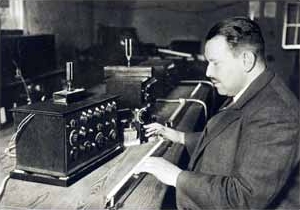
The Trautonium was an important electronic musical instrument developed by the electrical engineer Friedrich Trautwein in Germany in 1930. Trautwein designed the first version of the instrument with the aim of freeing the performer from the restrictions of fixed (Piano) intonation. To achieve this, he removed the usual piano-style manual and replaced it with a fingerboard consisting of a metal wire stretched over a rail, marked with a chromatic scale. By pressing the wire, the performer touches the rail below and completes a circuit, generating a tone. A similar technique, copied by Trautwein, was a feature of Bruno Hellberger’s Hellertion in 1929 and some time later in the Ondes Martenot.

Trautwein demostrating the early Trautonium, showing the pressure sensitive resistant finger-wire controller.
Trautwein demostrating the early Trautonium c1933, showing the pressure sensitive resistant finger-wire controller.

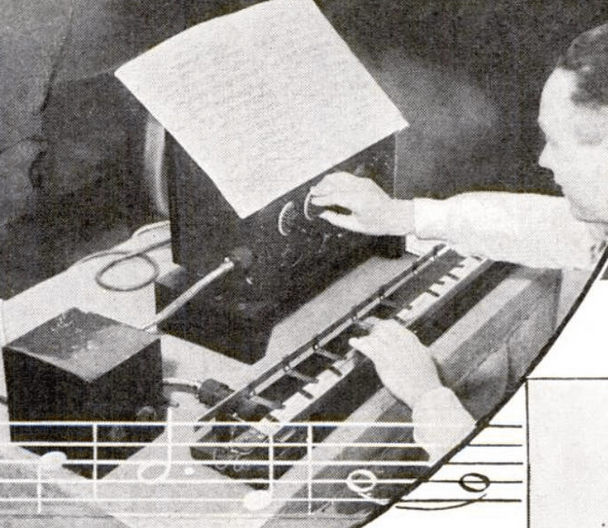
The position of the player’s finger on the wire determines the wire’s resistance, which in turn controls the oscillator’s pitch. This unusual approach allowed a great deal of expressive flexibility; by pressing harder on the wire, the player could subtly change the volume, and by moving the finger from side to side, the instrument could produce violin-like glissandi or more subtle vibrato effects. Overall volume was controlled by a foot pedal, allowing the performer to vary the volume and envelope of the notes.

Early version of the Trautonium
An early 1930’s version of the Trautonium at the Deutsches Museum, Munich.
The first Trautonium was a fairly simple monophonic vacuum tube ‘synthesiser’  generating sound from a single thyratron RK1 tube oscillator. However, by passing this tone through a series of resonant filters, this simple sawtooth waveform could be coloured with a wide range of timbre characteristics. This unique form of subtractive synthesis (i.e. filtering down an existing complex waveform rather than creating a complex waveform from combinations of simple sine waves) produced a tone that was distinctive and unusual when compared to the rather plain sound of other valve instruments in the 1920-30’s.
advert
Telefunken advert of the 1930 version of the Trautonium
Telefunken
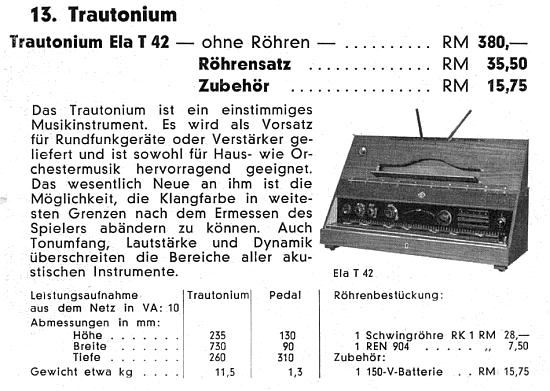
Advert of the Telefunken Volkstrautonium model Ela T42 showing the 380 Reichsmark price

The commercial version of the Trautonium or ‘Volkstrautonium’ was manufactured and marketed by Telefunken in 1932. But, probably due to the unpopularity of a new, somewhat complicated keyboard-less instrument and high purchase price (c400 Reichsmarks; equivalent of two and a half months of a worker’s salary or more than five times the price of a radio), only around thirteen items were sold, and by 1938 it was discontinued. Despite the lack of domestic commercial interest, a number of composers wrote works for the instrument including Paul Hindemith ( who, switching allegiances from Jörg Mager’s Sphäraphon, learnt to play the Trautonium)  ‘Concertina for Trautonium and Orchestra’ , Höffer, Genzmer, Julius Weismann and most notably Oskar Sala. Sala became a virtuoso on the machine and eventually took over the development of the Trautonium, producing his own variations- the ‘Mixtur-Trautonium’, the ‘Concert-Trautonium ‘, and the ‘Radio – Trautonium’. After the instrument’s commercial failure, Trautwein left further development to Oskar Sala, who continued to work with the Trautonium until his death in 2002. Trautwein also produced an ‘Amplified Harpsichord’ in 1936 and ‘Electronic Bells’ in 1947.

Trautwein (L) and Oskar Sala with the Trautonium Berlin, c 1933
Trautwein (L), Paul Hindemith and Oskar Sala playing the Trautonium. Berlin, c 1933
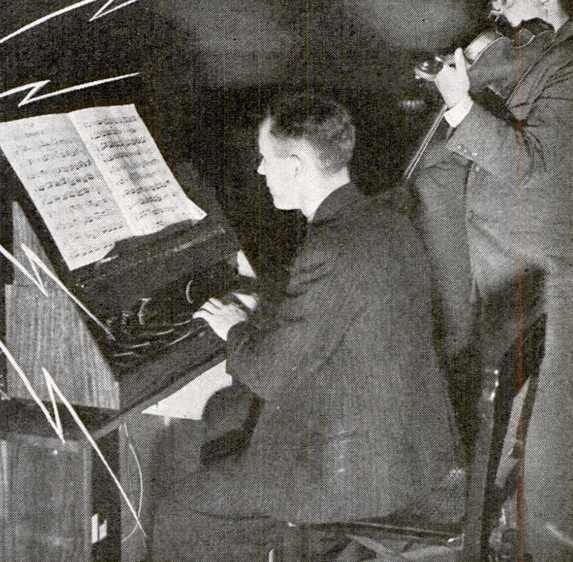
The Trautonium in 'Popular Mechanics' magazine USA 1939
The Trautonium in ‘Popular Mechanics’ magazine, USA, 1939
The Trautonium in 'Popular Mechanics' magazine USA 1939
The Trautonium in ‘Popular Mechanics’ magazine, USA, 1939


trautwein_1930
Dr Freidrich Adolf Trautwein (b Würzburg 1888, Germany; d Düsseldorf 1956) seen here in 1930.

Biographical notes: Dr Freidrich Adolf Trautwein (b Würzburg 1888, Germany; d Düsseldorf 1956)

Trautwein studied electrical engineering at the Technical University of Karlsruhe and later, law in Berlin. In the First World War he was a lieutenant in the German Army and led a mounted radio squad. After the war in 1919, he studied Physics in Heidelberg and Karlsruhe, where he received his PhD in engineering. The following year, he began working for the State Telegraph Service, where he helped establish the first German radio station in Berlin.

In 1929, he took a teaching position at the Berlin State Music Academy, where he began developing the Trautonium with the patronage and guidance of composer Paul Hindemith. The first version of the Trautonium was completed in 1930, and a commercial version was produced in 1933 by Telefunken: the Telefunken Volkstrautonium model Ela T42. After the commercial failure of his invention, Trautwein abandoned the instrument to the composer and Trautonium virtuoso, Oskar Sala

The Trautonium played by Oskar Sala, incorporated into the 'Das Orchester der Zukunft (The Future Orchestra), alongside a Hellertion, Thereminvox and Elektrochord.
The Trautonium played by Oskar Sala, incorporated into ‘Das Orchester der Zukunft (The Orchestra of the Future), alongside a Hellertion, Thereminvox and Elektrochord c 1932

In 1949 Trautwein worked briefly at the Bikla School for Photography and Film in Düsseldorf and then established the sound engineering course at the Düsseldorf Conservatory (now the Robert-Schumann-Hochschule in Düsseldorf), which still forms the basis of the current sound engineering training unit. In 1952, Trautwein developed an evolved version of the Trautonium for the WDR Electronic Music Studio, the Electronic Monochord. Trautwein died in Düsseldorf in 1956.


Sources:

Peter Donhauser: Electric sound machines, Böhlau, Vienna 2007.

Donhauser, P.: “Technical gimmick or fantastic reality: Telefunken and the first electronic instruments in Germany?”, Lecture at the DTM Berlin, 03.11.2006

Peter Badge, “Oskar Sala: Pionier der elektronischen Musik”, edited by Peter Friess, Foreword by Florian Schneider, Satzwerk Verlag. ISBN 3-930333-34-1

“Oskar Sala – Die vergangene Zukunft des Klanges” A film by Oliver Rauch and Ingo Rudloff. Upstart Filmproduktion Wiesbaden

http://www.radiomuseum.org/r/telefunken_trautonium_ela_t_42_t42vo.html

The ‘Ondium Péchadre’, Henri Camille Robert Péchadre. France, 1929.

The Ondium Péchadre played by it's inventor Msr Péchadre in 1930 (from 'Un appareil de musique radioélectrique; l'ondium Péchadre' by E.-WEISS.)
The Ondium Péchadre played by it’s inventor Msr Péchadre in 1930. Image: ‘Un appareil de musique radioélectrique; l’ondium Péchadre’ by E.-WEISS.

The Ondium Péchadre was created in France by  Henri Camille Robert Péchadre in 1929. The instrument was a monophonic heterodyning vacuum tube oscillator based instrument built into a light and portable heart shaped box, in performance the base of the instrument rested on the players knees and the instrument was supported against a table. The seven octave range of the instrument was controlled – in a way similar to Jorg Mager’s Sphäraphon of 1924 or  Krug & Bass’ Cellulophone of 1927– by moving a pointer around a circular calibrated dial while the left hand controlled the volume of the sound with a velocity sensitive push button device. This playing method allowed the instrument to create a continuous pitch similar to a violin or cello, or, by using the volume control, the sound-wave’s envelope could be altered to give a more staccato effect.

L'Ouest-Éclair_29_10_1931
Gaston Wiener playing the Ondium. L’Ouest-Éclair_29_10_1931
1 Un Nouvel Instrument Radio-Electrique: L’Ondium, L’Ouest-Éclair : journal quotidien d’informations, politique, littéraire, commercial,29/10/1931, 6
The indium described in 'Le Menestrel' in 1933
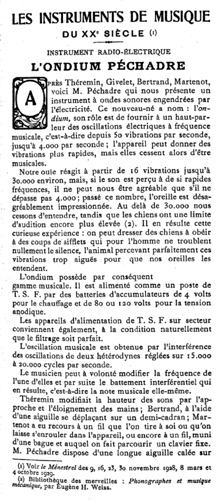
The Ondium as described in ‘Le Menestrel’ in 1931
2Gratia, L.E, (1931), LES INSTRUMENTS DE MUSIQUE DU XXe SIÈCLE. INSTRUMENT RADIO-ÉLECTRIQUE – L’ONDIUM PÉCHADRE, Le Ménestrel : journal de musique, 06/02/1931, 53-4

As with other similar instruments, The Ondium output sound to an amplifier and loudspeaker but, uniquely, was also able to transmit sounds directly via radio waves to a radio receiver or network.

“The Ondium we can report, is of the family of radio-electronic instruments similar to developments by Martenot and others. It differs however in by some points, in particular by this one; The Ondium is the only device of this kind that can be picked up  by radio.”
Gaston Wiener quoted in L’Ouest-Éclai’, 1935. 3 Un Nouvel Instrument Electrique:L’ondium, L’Ouest-Éclair : journal quotidien d’informations, politique, littéraire, commercial, Oct 29, 1931, 6.

Péchadre toured with the Ondium throughout France in the 1930s where, accompanied by an orchestra, he commissioned well known musicians (Gaston Wiener, pianist, Jacques Serres, cellist and Georges Hugo, pianist)  to perform popular classical works by Saint-Saëns, Mozart, Delibes and others as well as surprising the audience with the instruments versatility by imitating bird song.

E.H Weiss describes the instrument in Phonographs et Musique Mechanique (1931):

“This recent device is in the category of radio-electric interference instruments. The inventor’s goal was to establish a reduced format with very easy-to-handle organs that did not impose any fatigue on the musician. The complete installation includes the “ondium” itself, which contains the oscillating circuits, the amplifiers; the playing organs: pitch control needle, sound volume adjustment button, etc. ; the power supply which includes a 4 volt battery and an 80 volt battery, finally one or more speakers.

The ondium appears in the form of a flat case which has a dial on the top and which is traversed by a 25 centimeter long needle; the needle is adjusted on the axis of a variable capacitor and constitutes the organ for controlling the frequency of the oscillations, and consequently the pitch of the sound. A board cut along an arc of a circle with the same center as the dial, but with a smaller radius, forms a protective bridge above the needle, only the tip of which protrudes.

In these conditions, the musician holds the instrument inclined in front of him, places it on the one hand on his knees and on the other hand on the edge of a piece of furniture. The instrumentalist therefore has a music stand which then supports his elbow and forearm; the hand can direct the needle by means of a lever near the tip. The end of the elbow plays the role of a center of rotation for the forearm, and the right hand thus describes an arc of a circle merging with the dial of the device. High notes are produced towards the top of the dial, and lower notes towards the bottom.

Given the position of the operator, the precision obtained is very great, as is the virtuosity, because to control the volume of sounds we act on a rod ending in a flat button placed on the side of the device and controlling a rheostat . When you press the button, the rod sinks in; the stroke does not exceed 3 centimeters and a return spring whose resistance is progressive returns the rod to the outside when we no longer act on it. When you press lightly, the resistance decreases, and the sound begins to be heard. By pressing harder and harder, the sound power gradually increases. Handling this organ is easy, because instinctively we press lightly to have a weak sound and strongly to have a powerful sound.

There are still various other accessory controls which are available to the left hand: An adjustment screw acts on a booster capacitor, which allows the instrument to be tuned to the pitch before playing. A special circuit switch imitates plucked or percussed string instruments such as mandolin, harp, piano, Hawaiian guitar; contactors vary the tone or the attack, etc. As the principle of the device is based on the beat which results from the interference of the vibrations of two insulating circuits whose average frequency is 20,000 per second, there is a certain difficulty here, since it is a device that is touched by the hand and held on the knees, therefore susceptible to being influenced by the movement of the body of the operator, who acts by his capacity electric. This assembly, which is very sensitive to capacitance effects, is however the lightest device, capable of being enclosed in an instrument of reduced dimensions and also capable of covering a very wide range which can reach seven octaves .4 WEISS. E.H,(1930), Phonographes et musique mécanique / par Eugène-H. Weiss, Hachette (Paris), June 1930 edition,135-9

The Ondium with back cover removed showing control levers and tone generators. (from 'Un appareil de musique radioélectrique; l'ondium Péchadre' by E. WEISS.)
The Ondium with back cover removed showing control levers and tone generators. Image: ‘Un appareil de musique radioélectrique; l’ondium Péchadre’ by E.-WEISS.

ondium_02_lejournaljuif_1935


ondium_02_revue_du_vrai_et_du_beau_1933_c_balleroy

Minister
Telecoms Minister M. Mallarmé in front of boxed commercial versions of the Ondium at the ’21st Radio Salon’ Paris, 1934. Image: ‘Paris Soir’ September 1934.

References:

  • 1
    Un Nouvel Instrument Radio-Electrique: L’Ondium, L’Ouest-Éclair : journal quotidien d’informations, politique, littéraire, commercial,29/10/1931, 6 ↩︎
  • 2
    Gratia, L.E, (1931), LES INSTRUMENTS DE MUSIQUE DU XXe SIÈCLE. INSTRUMENT RADIO-ÉLECTRIQUE – L’ONDIUM PÉCHADRE, Le Ménestrel : journal de musique, 06/02/1931, 53-4 ↩︎
  • 3
    Un Nouvel Instrument Electrique:L’ondium, L’Ouest-Éclair : journal quotidien d’informations, politique, littéraire, commercial, Oct 29, 1931, 6. ↩︎
  • 4
    WEISS. E.H,(1930), Phonographes et musique mécanique / par Eugène-H. Weiss, Hachette (Paris), June 1930 edition,135-9 ↩︎

The ‘Rhythmicon’ Henry Cowell & Leon Termen. USA, 1930

Henry Cowell and the Rhythmicon
The composer Joseph Schillinger and the Rhythmicon. Image (c)

In 1916 the American Avant-Garde composer Henry Cowell was working with ideas of controlling cross rhythms and tonal sequences with a keyboard, he wrote several quartet type pieces that used combinations of rhythms and overtones that were not possible to play apart from using some kind of mechanical control- “un-performable by any known human agency and I thought of them as purely fanciful”(Henry Cowell) 1Cowell, H. . In 1930 Cowell introduced his idea to Leon Termen, the inventor of the Theremin, and commissioned him – for the fee of $200 –  to build a machine capable of transforming harmonic data into rhythmic data and vice versa.2 According to Mead “Even though Theremin was at the time receiving offers as high as $10,000 from Hollywood studios for work with his earlier instrument, the Theremin, he only charged Cowell $200 for the Rhythmicon because, according to Mrs Cowell, he always enjoyed Cowell and was glad to help him”  – Mead, Rita H,(1981) Henry Cowell’s New Music, 1925-1936 : the Society, the music editions, and the recordings, Ann Arbor, Mich. : UMI Research Press,188-9. 

“My part in its invention was to invent the idea that such a rhythmic instrument was a necessity to further rhythmic development, which has reached a limit more or less, in performance by hand, an needed the application of mechanical aid. The which the instrument was to accomplish and what rhythms it should do and the pitch it should have and the relation between the pitch and rhythms are my ideas. I also conceived that the principle of broken up light playing on a photo-electric cell would be the best means of making it practical. With this idea I went to Theremin who did the rest – he invented the method by which the light would be cut, did the electrical calculations and built the instrument.” Henry Cowell 3 Henly, H (1932) Music: New Futures for Rhythms, Argonaut, CX/2846 (May 20, 1932), 10.

“The rhythmic control possible in playing and imparting exactitudes in cross rhythms are bewildering to contemplate and the potentialities of the instrument should be multifarious… Mr. Cowell used his rythmicon to accompany a set of violin movements which he had written for the occasion…. The accompaniment was a strange complexity of rhythmical interweavings and cross currents of a cunning and precision as never before fell on the ears of man and the sound pattern was as uncanny as the motion… The write believes that the pure genius of Henry Cowell has put forward a principle which will strongly influence the face of all future music.4 Henly, H (1932) Music: New Futures for Rhythms, Argonaut, CX/2846 (May 20, 1932), 10. Homer Henly, May 20, 1932.
Rhythmicon Discs
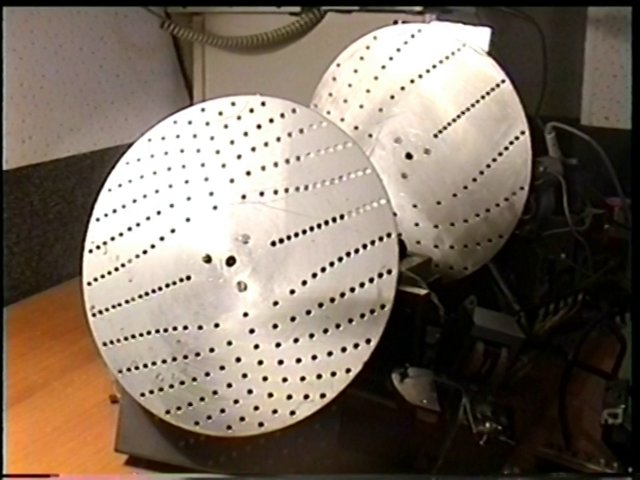
Optical rhythm discs of the Rhythmicon. Image (o)

Termen and Cowell christened their machine the Rythmicon or Polyrhythmophone (or sometime the Theremin-Cowell Rythmicon) and it can be seen as the first electronic rhythm machine. The 17 key polyphonic keyboard produced a single note repeated in periodic rhythm for as long as it was held down, the rhythmic content being generated using a photo-electrical technique: rotating perforated disks interrupted light beams that triggered photo-electric cells which in turn generated a rhythmical electronic pulse. The keyboard was laid out in a non-standard fashion arranged in a regular sequence of black
and white – the lowest note produced a unit of rhythm; white keys produced even divisions of it; black keys produced odd-numbered divisions up to a fifteenth of that basic pulse.5Sachs, Joel,(2012), Henry Cowell: A Man Made of Music, Oxford University Press, Inc, 223. . The transposable keyboard was tuned to an unusual pitch, based on the rhythmic speed of the sequences and the basic pitch and tempo – essentially each separate rhythm had its own pitch which was combined into a polyrhythmic-melodic piece.

Henry Cowell playing the Rhythmicon c 1932. Image: (c) the Imogen Cunningham Trust

The instrument was first unveiled at The New School New York on January 19, 1932, with the assistance of Clara Reisenberg (the famed Theremin virtuoso Clara Rockmore) and with Lev termen who demonstrated his Theremin Cello and keyboard Harmonium, and later at the same location on March 10th where termen also demonstrated his dance-performance instrument, the Terpsitone where Clara Reisenberg’s movements controlled the instruments pitch. The Rhythmicon never lived up to Cowell’s musical ambitious expectations and generally received a negative reception from critics who, focussing on the instruments harmonic shortcomings, disregarded Cowell’s rhythmic-melodic ideas.6Sachs, Joel,(2012), Henry Cowell: A Man Made of Music, Oxford University Press, Inc, 225. .

The sound of the Rhythmicon, produced by an array of six vacuum tubes was characteristically thin and was often described as unimpressive: “The melodic possibilities of the instrument seem small, though its theoretical interest is high. The sound is like that of a reed organ.” 7 Mead, Rita H,(1981) Henry Cowell’s New Music, 1925-1936 : the Society, the music editions, and the recordings, Ann Arbor, Mich. : UMI Research Press,189.) or in another review by the music journalist Alfred Metzger in the San Francisco Chronicle (May, 1932) “like a cross between a grunt and a snort in the low ‘tones’ and like an Indian war whoop in the high tones”8 Metzger, A, (1932), Newest invention in music makes debut in SF, San Francisco Chronicle, May 16th 1932.

Cowell wrote two works for the Rythmicon; Rythmicana (renamed Concerto for Rhythmicon and Orchestra 1931 9 Mead, Rita H,(1981) Henry Cowell’s New Music, 1925-1936 : the Society, the music editions, and the recordings, Ann Arbor, Mich. : UMI Research Press,189.) and Music for Violin and Rythmicon (now lost, 1931 – a computer simulation of this work was reproduced in 1972). Cowell, however, discouraged by the instruments negative reception, eventually lost interest in the machine, transferring his interest to ethnic music and the machine was mothballed.

“In 1934, realizing that he [musicologist and financer of the Rhythmicon Nicolas Slonimsky] never could bring the instrument to Boston because, in those days of unstandardized electric service, the predominant DC current required a costly converter for the AC Rhythmicon, he offered it to Henry or the New School for half the original price. 108 In the end Slonimsky sold it for $90 to [US Composer] Joseph Schillinger, who used it in his teaching and eventually gave it to the Smithsonian. The second Rhythmicon was stored by Henry at Stanford, where it eventually fell apart and was scrapped.” 10Sachs, Joel,(2012), Henry Cowell: A Man Made of Music, Oxford University Press, Inc, 222. .

The remaining existing version of the Rhythmicon is a model created by Termen on his return to the USSR in the 1960s and resides at the Theremin Institute in Moscow (as of 2020).

The 1960s Rhythmicon at the Theremin Institute Moscow. Image: Theremin Institute/Andrei Smirnov

References:

  • 1
    Cowell, H. ↩︎
  • 2
    According to Mead “Even though Theremin was at the time receiving offers as high as $10,000 from Hollywood studios for work with his earlier instrument, the Theremin, he only charged Cowell $200 for the Rhythmicon because, according to Mrs Cowell, he always enjoyed Cowell and was glad to help him”  – Mead, Rita H,(1981) Henry Cowell’s New Music, 1925-1936 : the Society, the music editions, and the recordings, Ann Arbor, Mich. : UMI Research Press,188-9.  ↩︎
  • 3
    Henly, H (1932) Music: New Futures for Rhythms, Argonaut, CX/2846 (May 20, 1932), 10. ↩︎
  • 4
    Henly, H (1932) Music: New Futures for Rhythms, Argonaut, CX/2846 (May 20, 1932), 10. ↩︎
  • 5
    Sachs, Joel,(2012), Henry Cowell: A Man Made of Music, Oxford University Press, Inc, 223. ↩︎
  • 6
    Sachs, Joel,(2012), Henry Cowell: A Man Made of Music, Oxford University Press, Inc, 225. ↩︎
  • 7
    Mead, Rita H,(1981) Henry Cowell’s New Music, 1925-1936 : the Society, the music editions, and the recordings, Ann Arbor, Mich. : UMI Research Press,189. ↩︎
  • 8
    Metzger, A, (1932), Newest invention in music makes debut in SF, San Francisco Chronicle, May 16th 1932. ↩︎
  • 9
    Mead, Rita H,(1981) Henry Cowell’s New Music, 1925-1936 : the Society, the music editions, and the recordings, Ann Arbor, Mich. : UMI Research Press,189. ↩︎
  • 10
    Sachs, Joel,(2012), Henry Cowell: A Man Made of Music, Oxford University Press, Inc, 222. ↩︎

The ‘Terpsitone’, Leon Termen, USA & Russia,1932.

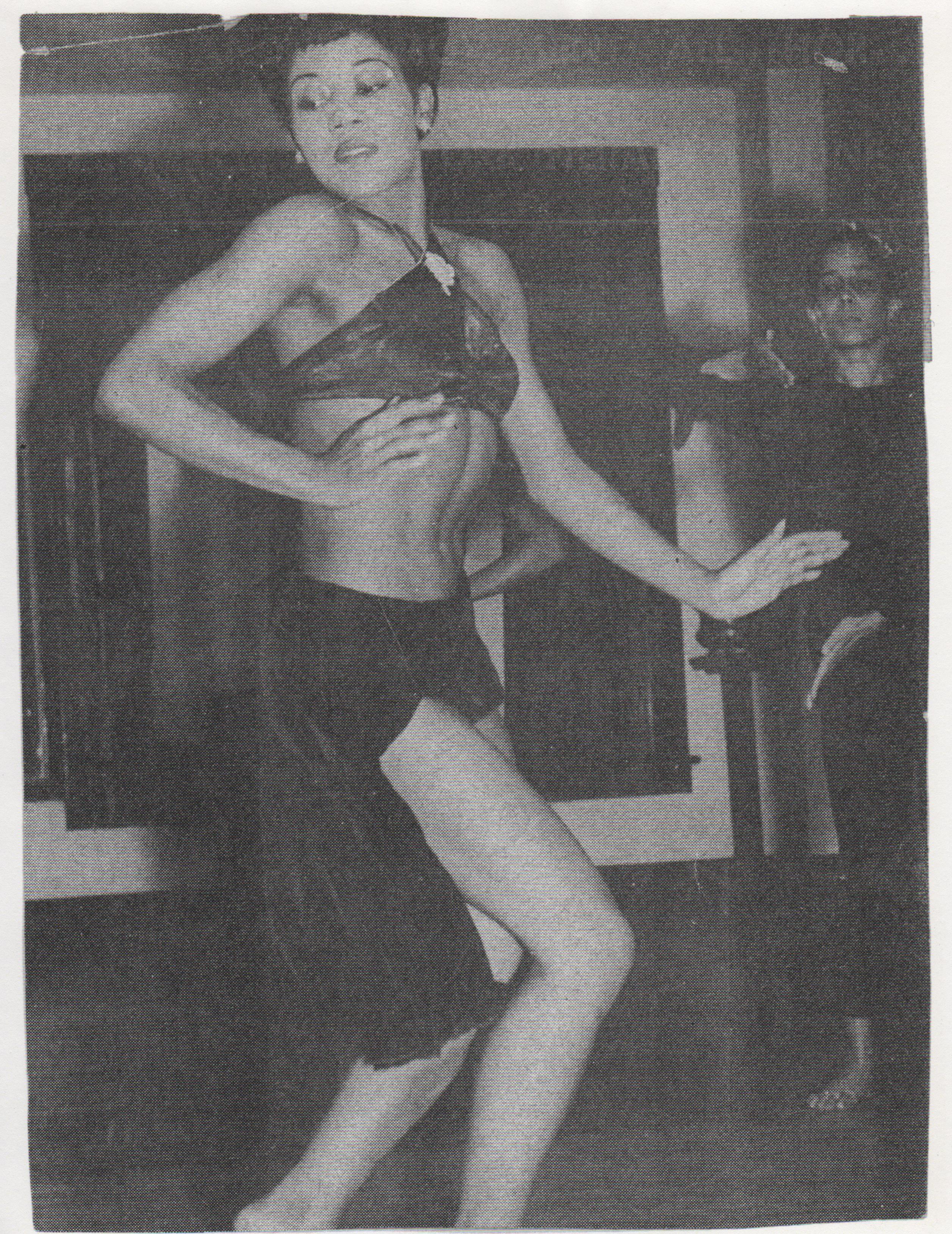
Termen’s Terpsitone 1936. Clara Rockmore, Theremin virtuoso dances with the Terpsitone at Carnegie Hall, March 10th, 1933. Image Popular Science 1933.

The Ether-wave Dance Platform later named the Terpsitone, named after the muse of dance Terpsichorè, was a movement controlled instrument using the same capacitance principles of the Theremin.1Sachs, Joel, (2012) Henry Cowell : a man made of music, New York : Oxford University Press, 224. The Terpsitone was designed built by Leon Termen for his wife the US dancer Lavinia Williams.2 Mattis, Olivia, (1989) Interview of Leon Theremin (Lev Sergeyevich Termen), Bourges, France, 16 June 1989, http://www.vasulka.org/, retrieved 21-01-202. The Terpsitone removed the control antenna of the Theremin and replaced it with a large metal sheet hidden under the floor. Movements of the dancer in the area above the sheet caused variations in pitch of the Terpsitone’s oscillators due to the capacitance of the dancer’s bodies. This instrument was used for several ‘exotic’ dance, music and light shows throughout the 1930’s. As Termen described it:

“This is a platform that a person dances on. When the dancer’s body is low, you hear the lowest pitch. When the dancer raises her body, the pitch also goes up. It’s also possible to dance without changing the sound. For instance, if the dancer raises one arm and lowers the other, there will be no change in pitch. But if the dancer raises both arms, then the pitch will go up. […] If the dancer goes more forward, it pets louder. When she steps back, the sound gets quieter. I had a Terpsitone dance studio in New York. I had many pupils dancing there.”3 Mattis, Olivia, (1989) Interview of Leon Theremin (Lev Sergeyevich Termen), Bourges, France, 16 June 1989, http://www.vasulka.org/, retrieved 21-01-202.

The Terpsitone at the Theremin Institute, Moscow. Image: Theremin Institute,/Andrey Smirnov.

Gimazutdinov describes the Terpsitone in the Prometheus journal:

“During his long and bright life, Leo Sergeyevich Termen made numerous discoveries and inventions. Among the different kind of brilliant inventions was the Terpsitone – which makes it possible for dancers to combine movement of body with music and light. Idea of the Terpsitone occurred to L.Termen at the beginning of the 20th century, probably, immediately after the creation of Thereminvox. But as opposed to the Thereminvox where the pitch of tone and loudness depends on the position of the hands of the musician, the Terpsitone frequency and amplitude of sound are determined by a change in the position of entire body of a dancer. The operating principle of the Terpsitone is very similar to the operating principle Thereminvox, based on obtaining audio beat-frequencies, formed by the interaction of high-frequency fluctuations of two oscillators. One has frequency rigidly fixed, while in the second is variable. In the second oscillator the frequency depends on a change in the distance between the capacitor plates of oscillatory circuit. One of the capacitor plates is an isolated, metallic plate placed on the floor of dancing hall, and second facing the body of the dancer. By moving through the space the dancer affects a change in the capacity of oscillatory circuit and, correspondingly, a change in the difference audio frequency. This signal is amplified and sent to the loudspeaker. Thus the motions of the dancer is converted into sound, which change synchronously with a change in the position of body. The possibility of adding automated colour is an additional special feature of the invention. The “visual sound display” is a panel with  lamps, painted in different colours where the lamps light up to the motion of the dancer, moreover lamps with the specific colour corresponds to each note. However, this is ensured partially mechanically.

The Terpsitone in the acoustic laboratory, Moscow, 1966 consists of:

1) the electronic-music block, which works on the principle of Thereminvox with heterodyning high frequencies, with the device for vibrato and by a change in the loudness of sounding loudspeaker

2) An  electrical capacitance dancing platform with the size of 2 X of 1,8 X of 0.2 meters with that placed under it along entire its length and width by the electrode, connected through the resonance involving system with one of the high-frequency generators of musical block;

3) A dynamic loud-speaker with control of intensity and timbre. A Range-tool for the performance of melody by the motions of arms, head and legs of the dancer who stands on the platform – 2 octaves. More low-pitched sounds correspond to the locked position of hands and housing of that dancing, high to a maximally opened position, with the large external overall sizes. This experimental device adapts for training the executors of this new form of choreographic- musical skill. Are developed also the electrical circuits of the additional devices:

3.1) movement of executor forward gives audio gain, and its presence in the background ceases sound by means of the electrical capacitance influence on the electrode, fastened on the rear wall of dancing platform

3.2) the invariability of the pitch of tone with the displacement of that dancing and the appearance of that corresponding to the position of the executor of the new height of sounding with the cessations of motion.

Executors: Heads by the laboratory of acoustics and sound recording – Yurchenko A.D, the supervisor of sector – Termen L.CH., engineer – Rudakov YE.A., engineer – Matveyev V.N., technician.”

4Gimazutdinov K.N. (1966) Termen’s “Terpsitone”, Kazan, NII – SCIENTIFIC RESEARCH INSTITUTE “Prometheus”.

References:

  • 1
    Sachs, Joel, (2012) Henry Cowell : a man made of music, New York : Oxford University Press, 224. ↩︎
  • 2
    Mattis, Olivia, (1989) Interview of Leon Theremin (Lev Sergeyevich Termen), Bourges, France, 16 June 1989, http://www.vasulka.org/, retrieved 21-01-202. ↩︎
  • 3
    Mattis, Olivia, (1989) Interview of Leon Theremin (Lev Sergeyevich Termen), Bourges, France, 16 June 1989, http://www.vasulka.org/, retrieved 21-01-202. ↩︎
  • 4
    Gimazutdinov K.N. (1966) Termen’s “Terpsitone”, Kazan, NII – SCIENTIFIC RESEARCH INSTITUTE “Prometheus”. ↩︎

The ‘Sonar’, Nikolai Anan’yev , Russia,1933.

The Sonar 1933. Image: Sound in Z, Experiments in Sound and Electronic Music in Early 20th Century Russia, Koenig, 95.

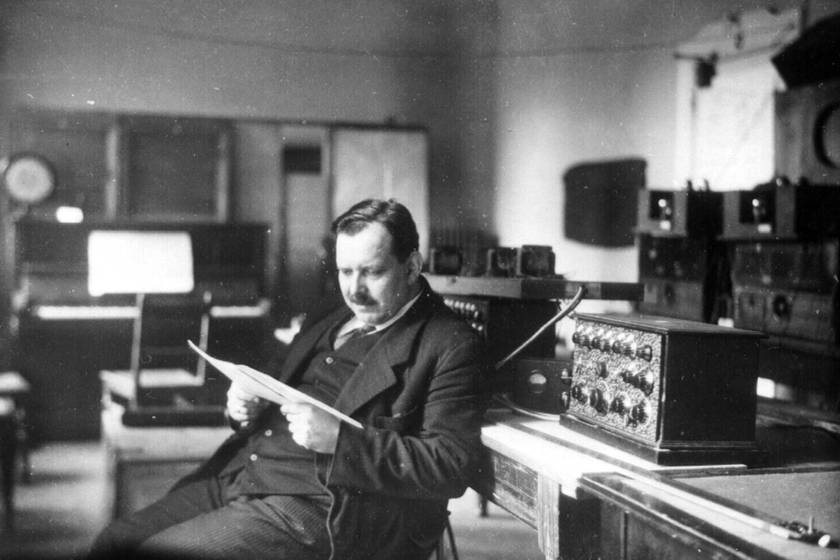
The Sonar was a monophonic vacuum tube instrument developed by Nikolai Anan’yev at the GIMN Acoustic Laboratory in the USSR from 1930. The Sonar used the same  heterodyning principles of Termen’s Thereminvox but with the addition of a fretted fingerboard made from a long, narrow conductive strip to vary the pitch of the oscillator – a technology used in several other instruments of the ear including the Trautonium, Hellertion and Ondes Martenot. Anan’yev considered the Sonar to be an improvement of the Thereminvox and the addition of a fingerboard made the Sonar more popular (at the time in the early Soviet period) with musicians due to it’s familiarity and playability.1Smirnov, Andrey, (2013) Sound in Z, Experiments in Sound and Electronic Music in Early 20th Century Russia, Koenig, 95.
Later versions of the instrument had a timbre and volume pedal control that meant the Sonar was said to have been able to reproduce violin like timbres – Anan’yev competed for realism with a well-known violinist and the audience was said to favour the Sonar– as well as simple speech phrases such as “mama”, “papa” as well as conventional instrumental sounds and became known for it’s use in ‘proletarian’ outdoor events. In the 1930s a course for Sonar performers was established at the Saratov Conservatory and Anan’yev  gave over six hundred concerts to around five hundred thousand people with the Sonar during his lifetime.2 Davies, Hugh & Smirnov, Andrey (2014), The Sonar, The Grove dictionary of musical instruments, New York : Oxford University Press, 480.


References:

  • 1
    Smirnov, Andrey, (2013) Sound in Z, Experiments in Sound and Electronic Music in Early 20th Century Russia, Koenig, 95. ↩︎
  • 2
    Davies, Hugh & Smirnov, Andrey (2014), The Sonar, The Grove dictionary of musical instruments, New York : Oxford University Press, 480. ↩︎