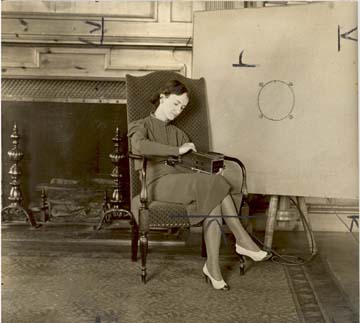
The Oscillon was a one-off vacuum tube instrument created by Dr. W.E. Danforth to play the wind instrument parts for his local amateur Swarthmore Symphony Orchestra. The instrument was played by sliding the finger over the metal box to produce French Horn or Bass Clarinet tones from the loudspeaker:
When he is not experimenting on cosmic rays, high-haired Director William Francis Gray Swann of Franklin Institute’s Bartol Research Foundation, plays a cello. Young William Edgar Danforth, his assistant, plays a cello too. Both are mainstays of the Swarthmore (Pa.) Symphony Orchestra, a volunteer organization of about 40 men and women who play good music free. Because nobody in the orchestra can handle a French horn or a bass clarinet, Drs. Swann and Danforth built an electrical “oscillion” so ingenious that it can be made to sound like either, so simple that a child can master it. Last week at a Swarthmore concert the oscillion made its world debut, playing the long clarinet passages in Cesar Franck’s D Minor Symphony without a mishap. Listeners thought the oscillion lacked color, was a little twangier in tone, otherwise indistinguishable from the woodwind it replaced.
The Danforth & Swann Oscillion is a simple-looking oblong wooden box with an electrical circuit inside. Current flows through a resistance, is stored up in a condenser, spills into a neon tube, becomes a series of electrical “pulses.” A loud speaker translates the pulses into sound.
To play music the oscillionist presses down on a keyboard and changes the resistance. This alters the frequency, thereby the pitch. As now constructed the oscillion has a range of five octaves which can easily be increased to eight. Inventors Danforth & Swann deplore the oscillion’s higher ranges, expect it will be most useful pinch-hitting for bass clarinet, bassoon, tuba and string bass.”1Time Magazine, Monday, May 31, 1937
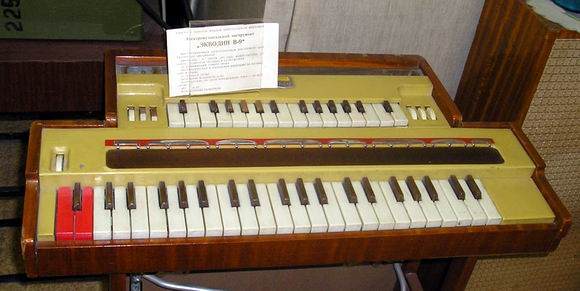
1960s version of the Ekvodin V11 at the Museum of Music, Moscow. Image: (c) Moscow Ministry of Culture of the Russian Federation
The Ekvodin was a pioneering electronic synthesiser designed by the Russian engineer and acoustician Andrei Volodin with the Thereminvirtuoso Kovalski Konstantin and Yevgeny Murzin (later to invent the ANS synthesiser) and became a well known and successful commercial electronic instrument in the Soviet Union. The first versions of the Ekvodin V1 – built around 1935 at the Moscow Research Institute for Musical Science (NIMI) – were duophonic prototypes controlled by a ribbon controller (a similar design to the Hellertionand Trautoniumof the same period) and were used for acoustic and psychoacoustic research at the institute. The V2 Ekvodin included a chromatic fingerboard as well as a ribbon controller. The post WWII V8 Ekvodin augmented the ribbon controller with two conventional 45 note transposable keyboards and a larger range of timbre and envelope controls and won gold medals at the 1958 World Fair in Brussels and the Exhibition of Achievements of the National Economy in Moscow.1 Zvorykin, A.A.(1970) Soviet Cultural Policy, UNESCO, 43.
1950s Ekvodin V9. Image: Museum of Soviet Synthesisers: http://www.ruskeys.netEkvodin V9 promotional brochure, Image: Zhurnalko.net
Ekvodin V11 Promotional Brochure
Musicians of the world are now provided with an exiting opportunity to refine their emotional art. EKVODIN is an excellent instrument for any orchestra, ensemble or for solo with piano accompaniment. The singing keyboard of small EKVODIN may fill every home with fascinating melodies. Modern composers will be surprised to find EKVODIN produces unprecedented clarity and variety of tones. Performers, conductors or teachers of music will be satisfied with the great abilities of expression by EKVODIN. EKVODIN opens cosmic horizons in music for everybody.
Technical data (Type «B-ll»):
Keyboard range: 3.33 octaves (41 keys, by “C” to “e”). Full sound range: 7.33 octaves. Accuracy of frequency is not worse them 3 cents. Tuning control for full range and for every key. Means for finger and automatic frequency vibrato and for glissando in full keyboard range. Highest quality of sound. 660 combination of sound colour switching. Sustained and percussion sounds. Fine expression control. Music power output: 12 watts. Net: 110—235 volts 50—60 c.p.s. Weight: 39 kilograms. Dimensions: 0,78х0,82х0,38 metre. Patents: Canada, England, French, German, Italian, USA.
Designed and manufactured in USSR.
Table of the presets
The EKVODIN is a professional musical instrument intended for universal use in various ensembles and orchestras and for solo performances including concerts with the accompaniment of piano and other instruments. The EKVODIN is suitable for different musical genres. The sound is produced in the EKVODIN on purely electrical principle.
The instrument is noted for wide variety and brightness of timbres, broad range and high limit) power of the sound, and also for rational and highly-developed system of reproduction means (vibrating keyboard, loudness pedals, portamento, etc.). This ensures expressiveness and accuracy of performance. The profession of a piano player is closest to that of a man playing the EKVODIN. This similarity, however, does not determine the application of the EKVODIN which is, first of all, an ensemble and orchestra instrument.
The EKVODIN comes in two design versions: one-voice and two-voice versions. A thoroughly developed system of timbres, varied with the aid of a special switch (and also depending upon the methods of performance), makes it possible to obtain an expressive and pleasant sound. The EKVODIN imitates quite fully the sound of symphonic orchestra instruments (bow, wood and brass groups, as well as certain percussion and pizzicato instruments) and also folk instruments. The EKVODIN allows to obtain sound personality in new timbres of modern style. The instrument can be used in mixed ensembles and orchestras for supporting and emphasizing different groups of solo parts performed on the usual (mostly string and brass) instruments, when their natural power is not quite sufficient for overruling the orchestra and for creation of new sounds. In incomplete orchestras and ensembles the EKVODIN can handle practically any part (the two-voice will handle two parts) of the bow, wood or brass groups.
A special ensemble consisting of EKVODINS allows to obtain, for a very small number of instruments (sextet or octet), a multifarious, fluent and high – power sound in original and common timbres. Both design versions of the instrument come in semi-stationary (dismountable-transportable) construction and high-class finish. The extension loudspeaker unit, supplied with the instrument, can be located independently up to a distance of 5 m. The loudspeaker unit is installed depending upon the location of listeners. When carried or transported from place to place, the instrument is packed in two units of suitcase type. For operation the instrument is connected to alternating current mains (127 or 220 V). The EKVODIN is not sensitive to fluctuations of the mains voltage. The one-voice version weighs about 35 kg, and its power consumption does not exceed 90 VA. The output power of the sound channel reaches 10 \V. The two-voice version weighs about 65 kg, and its power consumption does not exceed 200 VA. The output power is up to 10 Win each channel, the timbre setting being independent for each voice. To double the. power of solo parts and timbre effects the voices can merge in unison, octave and two octaves.
Ekvodin B9 1950’s Model. Image: Museum of Soviet Synthesisers: http://www.ruskeys.net
The 1958 V11 Ekvodin model was a monophonic instrument was controlled via a six and a half octave, velocity sensitive keyboard which allowed the player to add vibrato by applying sideways movement to the key, plus a foot controlled volume pedal was included to add expression. Sound was generated from vacuum tubes and passed through a number of pre-set filter banks and octave dividers that could be combined to a total of 660 settings. The instrument was a significant evolution of the B9 and won the gold medal at the Brussels exhibition in 1958 (The V11 impressed Ikaturo Kakehashi with its ‘pleasant reed and string voices’ and inspired him to found the Roland Corporation in Japan).2 Kakehashi, Ikaturo .(2002) I believe in music : life experiences and thoughts on the future of electronic music by the founder of the Roland Corporation, Milwaukee, WI : Hal Leonard Corp, 32.Ekvodin V11 was said to be “capable of imitating almost any symphony orchestra instrument, including percussion”3 Davies, Hugh. (2014) Ekvodin, The Grove dictionary of musical instruments Volume 2, New York : Oxford University Press, 142. [/mf]
Informational Record for the Electromusical Instrument Ekvodin”, All-Union Recording Studio label (Всесоюзная Студия Грамзаписи)
Track List:
A1. Introduction – Waltz, composed by Viktor Sams. Two Ekvodins (one single-voiced, one dual-voiced), accompanied by piano.
A2. Basic explanation of Ekvodin and timbre variation. (Note, the rest of side A is single two-voice Ekvodin either solo or accompanied by piano)
A3. Demonstration of “violoncello” timbre.
A4. Interpretation of one of Dvořák’s dances by two-voiced Ekvodin.
A5. Demonstration of “clarinet” timbre. A6. Demonstration of “oboe” timbre. A7. Demonstration of “bassoon” timbre. A8. Demonstration of “piccolo” timbre.
A9. Demonstration of “double bassoon” timbre.
A10. Demonstration of “trumpet” timbre.
A11. Demonstration of “muted trumpet” timbre.
A12. Demonstration of “french horn” timbre.
A13. Demonstration of various strings.
A14. Demonstration of “guitar” timbre.
A15. Demonstration of “duduk” timbre. A16. Demonstration of “zurna” timbre.
A17. Demonstration of “balalaika” timbre.
A18. Demonstration of “vocal” timbre.
A19. Ravel’s “Bolero”, used to demonstrate two-octave range of Ekvodin.
A20. Demonstration of “bell” timbre.
The Ekvodin was often played on stage – famously by an orchestra of five Ekvodins that claimed the musical capabilities corresponding to an orchestra of 27 ordinary instruments – and used by Soviet composers, especially in scores for movies and theatrical productions: the Ekvodin can be heard in the underwater scenes of the 1961 Soviet science fiction film Amphibian Man ( Gennadi Kazansky
Vladimir Chebotaryov 1962), The Tale of the Siberian Land ( Ivan Pyryev 1948) and Walking the Streets of Moscow ( Georgiy Daneliya 1964) but is probably best remembered for Vyacheslav Mescherin’s Electromusical Instrument Orchestra’s soundtracks for the long running soviet period cartoon Ну, погоди! :
Andrei Aleksandrovich Volodin playing the Ekvodin c1960. Image: Ekvodin V11 Brochure
Andrei Volodin – Biographical Information:
Andrei Aleksandrovich Volodin was born in 1914 in Moscow into a family of artists. In 1940 he graduated from the Moscow Institute of Communications Engineers with a specialization in electroacoustics and radio broadcasting. While still a student, he began working at the film factory in the field of sound recording and in the acoustic laboratory of the Moscow State Conservatory for musical acoustics under the guidance of prof. N. A. Garbuzova, intensively replenishing her knowledge in musical and theoretical disciplines.
After graduating from the institute, he worked on the development of electronic musical instruments. His inventions were used in concert practice and sound recording, exhibited at many foreign exhibitions, and were patented in the USA, Canada, France, Italy, Germany, and Japan. Volodin was awarded the Gold Medal for the Ekvodin electric musical instrument at the World Exhibition in Brussels in 1958 and had more than 40 copyright certificates and patents for inventions.
In addition to practical and inventive work, A. A. Volodin during these years
was also engaged in the theory of electromusic and musical acoustics. On these problems, he published a monograph and numerous articles in the magazines “Radio”, “Radio-tekhnika”, “Problems of Radio Electronics”, etc. Solving the problem of sound synthesis in electronic musical instruments, A.A. Volodin came to the conclusion that sound synthesis is possible only with the comprehensive development and combination of the achievements of musicology, physics and psychology for a holistic presentation in the final sound. This prompted him to study musical sounds from the point of view of their psychological structure and aesthetic content. The perception of musical sounds became the central problem of his research. Studying the issues of perception of sound synthesis from the psychological side, he became a chief specialist in musical psychology, the author of many works on the theory of electromusic, and a doctor of psychological sciences. In 1975, A. A. Volodin began working at the Moscow State Conservatory, where he organized the Problem Laboratory of Music Theory and Music Education. For a set of works on special equipment, A. A. Volodin was awarded the Order of the Red Banner of Labor, as well as a number of medals, such as the title of labour veteran. A man of deep and original mind, broad and versatile knowledge, Andrei Aleksandrovich Volodin was full of creative ideas. His premature death represents a great loss for science.3 Shishlev, Mark. (2024) 1937 Andrey Volodin – Invention of the Ekvodin synthesizer, Cantroll, http://cuntroll.ru/article15/ retrieved 25/02/2024.
References:
1
Zvorykin, A.A.(1970) Soviet Cultural Policy, UNESCO, 43. ↩︎
2
Kakehashi, Ikaturo .(2002) I believe in music : life experiences and thoughts on the future of electronic music by the founder of the Roland Corporation, Milwaukee, WI : Hal Leonard Corp, 32. ↩︎
Davies, Hugh. (2014) Ekvodin, The Grove dictionary of musical instruments Volume 2, New York : Oxford University Press, 142. [/mf]
Informational Record for the Electromusical Instrument Ekvodin”, All-Union Recording Studio label (Всесоюзная Студия Грамзаписи)
Track List:
A1. Introduction – Waltz, composed by Viktor Sams. Two Ekvodins (one single-voiced, one dual-voiced), accompanied by piano.
A2. Basic explanation of Ekvodin and timbre variation. (Note, the rest of side A is single two-voice Ekvodin either solo or accompanied by piano)
A3. Demonstration of “violoncello” timbre.
A4. Interpretation of one of Dvořák’s dances by two-voiced Ekvodin.
A5. Demonstration of “clarinet” timbre. A6. Demonstration of “oboe” timbre. A7. Demonstration of “bassoon” timbre. A8. Demonstration of “piccolo” timbre.
A9. Demonstration of “double bassoon” timbre.
A10. Demonstration of “trumpet” timbre.
A11. Demonstration of “muted trumpet” timbre.
A12. Demonstration of “french horn” timbre.
A13. Demonstration of various strings.
A14. Demonstration of “guitar” timbre.
A15. Demonstration of “duduk” timbre. A16. Demonstration of “zurna” timbre.
A17. Demonstration of “balalaika” timbre.
A18. Demonstration of “vocal” timbre.
A19. Ravel’s “Bolero”, used to demonstrate two-octave range of Ekvodin.
A20. Demonstration of “bell” timbre.
The Ekvodin was often played on stage – famously by an orchestra of five Ekvodins that claimed the musical capabilities corresponding to an orchestra of 27 ordinary instruments – and used by Soviet composers, especially in scores for movies and theatrical productions: the Ekvodin can be heard in the underwater scenes of the 1961 Soviet science fiction film Amphibian Man ( Gennadi Kazansky
Vladimir Chebotaryov 1962), The Tale of the Siberian Land ( Ivan Pyryev 1948) and Walking the Streets of Moscow ( Georgiy Daneliya 1964) but is probably best remembered for Vyacheslav Mescherin’s Electromusical Instrument Orchestra’s soundtracks for the long running soviet period cartoon Ну, погоди! :
Andrei Aleksandrovich Volodin playing the Ekvodin c1960. Image: Ekvodin V11 Brochure
Andrei Volodin – Biographical Information:
Andrei Aleksandrovich Volodin was born in 1914 in Moscow into a family of artists. In 1940 he graduated from the Moscow Institute of Communications Engineers with a specialization in electroacoustics and radio broadcasting. While still a student, he began working at the film factory in the field of sound recording and in the acoustic laboratory of the Moscow State Conservatory for musical acoustics under the guidance of prof. N. A. Garbuzova, intensively replenishing her knowledge in musical and theoretical disciplines.
After graduating from the institute, he worked on the development of electronic musical instruments. His inventions were used in concert practice and sound recording, exhibited at many foreign exhibitions, and were patented in the USA, Canada, France, Italy, Germany, and Japan. Volodin was awarded the Gold Medal for the Ekvodin electric musical instrument at the World Exhibition in Brussels in 1958 and had more than 40 copyright certificates and patents for inventions.
In addition to practical and inventive work, A. A. Volodin during these years
was also engaged in the theory of electromusic and musical acoustics. On these problems, he published a monograph and numerous articles in the magazines “Radio”, “Radio-tekhnika”, “Problems of Radio Electronics”, etc. Solving the problem of sound synthesis in electronic musical instruments, A.A. Volodin came to the conclusion that sound synthesis is possible only with the comprehensive development and combination of the achievements of musicology, physics and psychology for a holistic presentation in the final sound. This prompted him to study musical sounds from the point of view of their psychological structure and aesthetic content. The perception of musical sounds became the central problem of his research. Studying the issues of perception of sound synthesis from the psychological side, he became a chief specialist in musical psychology, the author of many works on the theory of electromusic, and a doctor of psychological sciences. In 1975, A. A. Volodin began working at the Moscow State Conservatory, where he organized the Problem Laboratory of Music Theory and Music Education. For a set of works on special equipment, A. A. Volodin was awarded the Order of the Red Banner of Labor, as well as a number of medals, such as the title of labour veteran. A man of deep and original mind, broad and versatile knowledge, Andrei Aleksandrovich Volodin was full of creative ideas. His premature death represents a great loss for science.3 Shishlev, Mark. (2024) 1937 Andrey Volodin – Invention of the Ekvodin synthesizer, Cantroll, http://cuntroll.ru/article15/ retrieved 25/02/2024. ↩︎
Martin Taubman play “Cinderella, Stay in My Arms.” on the Electronde in 1938. “Amazing act where Martin Taubman literally plucks a tune from the air by putting his hand before the electric waves coming out of his Electronde machine. It sounds something like a Hawaiian-style electric guitar. Martin uses some foot pedals to control the sound of the machine.” Video: British Pathé 12/12/1938 .
The Electronde was one of many developments of Lev Termen’s Theremin , in this case, a design by the Frankfurt inventor and showman, Martin Taubman. Taubman added a hand held switch for adding staccato envelope and a foot pedal for volume control. This allowed the Electronde to be able to produce notes with a sharp ‘plucked’ attack which was a significant advantage over the Theremin1 Galpin, F. W. (1937). The Music of Electricity: A Sketch of Its Origin and Development. Proceedings of the Musical Association, 64, 71-83.
Taubman toured Europe with the Electronde during the 1930s.
References:
1
Galpin, F. W. (1937). The Music of Electricity: A Sketch of Its Origin and Development. Proceedings of the Musical Association, 64, 71-83. ↩︎
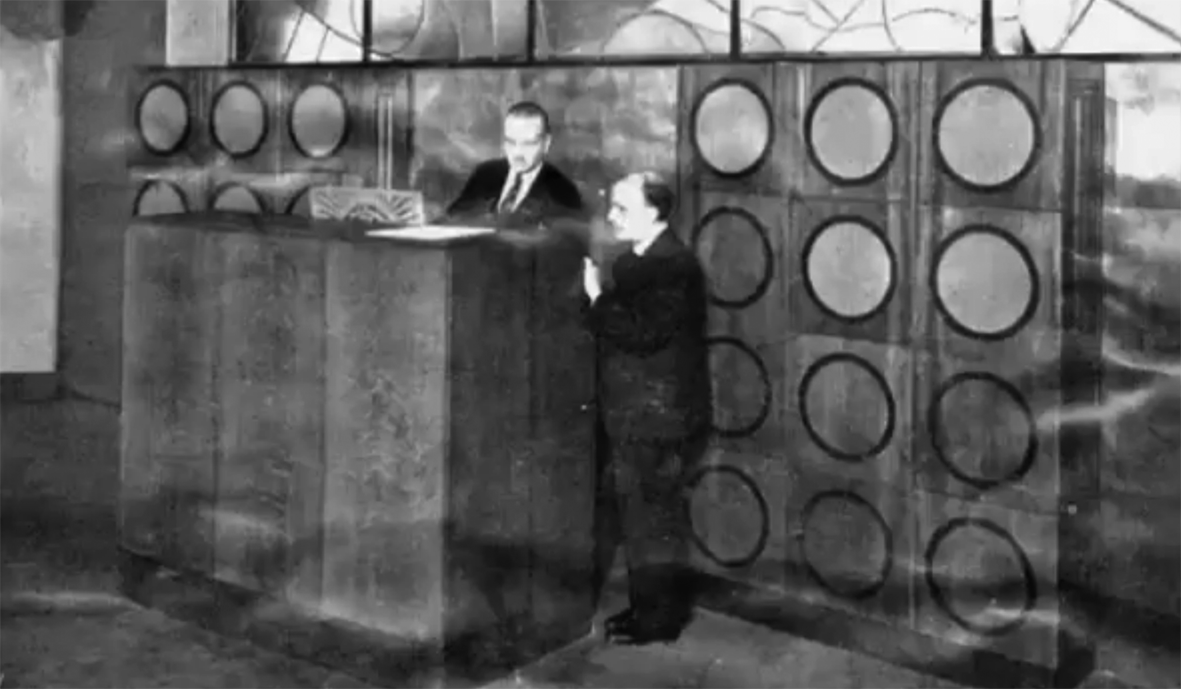
Organist Charles Tournemire at the Orgue Des Ondes in the église de Villemomble 1931 (Image: 1931 / A. Boukelion)
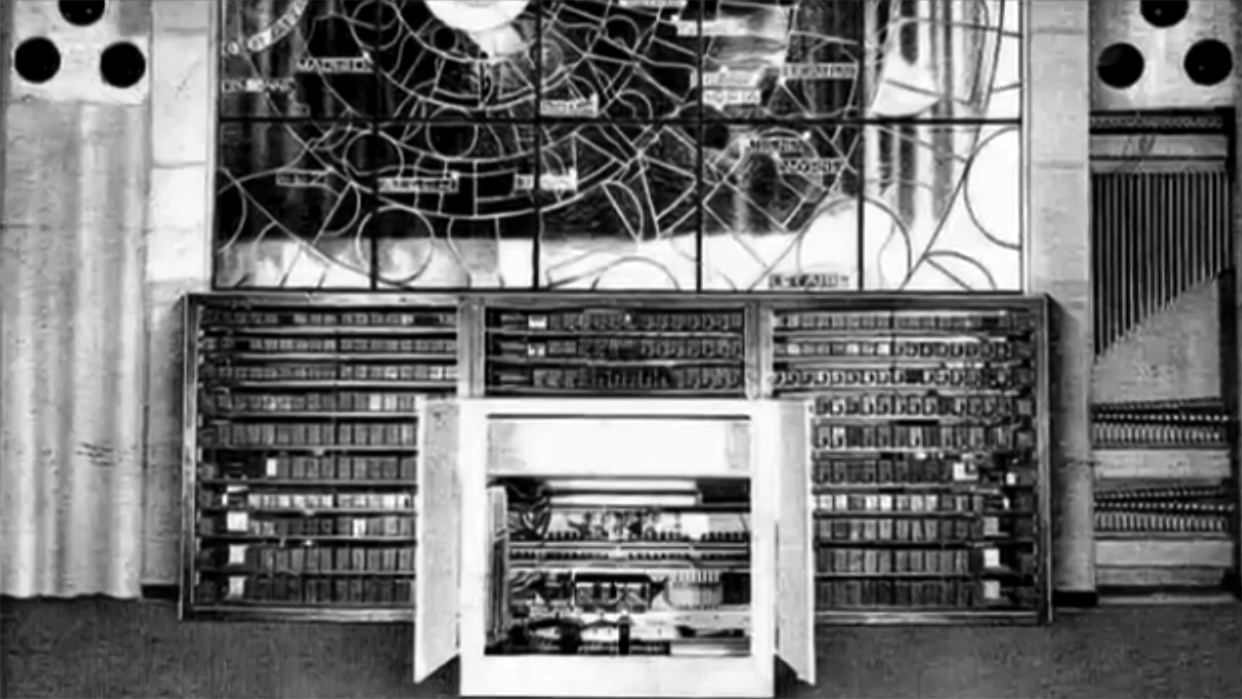
In 1929 the radio engineer Armand Givelet began a long collaboration with the organ builder Edouard Eloi Coupleux with the ambition to build on his experience with the Clavier à Lampe to create a popular electronic organ for use in churches, cinemas and concert halls. The resulting instrument, the Orgue des Ondes or ‘Wave Organ’ was based on vacuum tube technology but implemented the RC oscillator design rather than the heterodyne principle of the the Theremin, Ondes-Martenot and others. Uniquely for its time, the Orgue des Ondes had an oscillator for each key therefore the instrument was polyphonic, a distinct advantage over its rivals – despite the amount of room needed to house the huge machine.
The Orgue Des Ondes installed at the Poste Parisien radio station, Paris, France c 1928
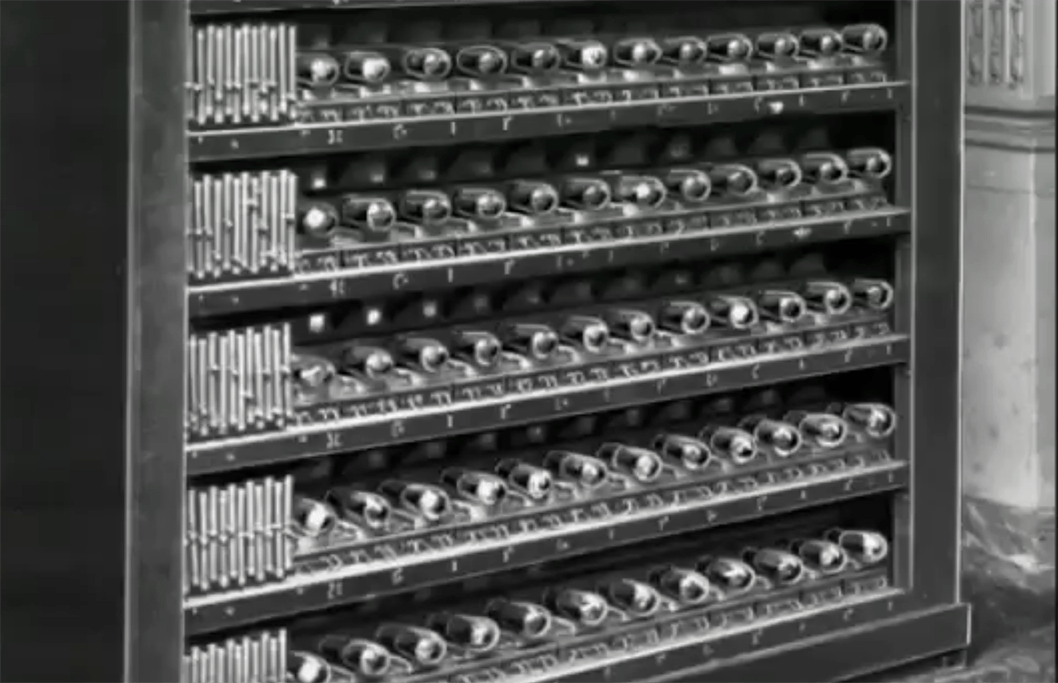
The organ had over 700 vacuum oscillator tubes to give it a pitch range of 70 notes and ten different timbres – for each different timbre a different set of tubes was used. The Organ may have used as many as 1,000 tubes in total for oscillators and amplifiers. These tubes were housed in a separate rack ten feet long and six feet wide, out of sight of any audience.
Multiple vacuum tubes of the Orgue Des Ondes
The sound of the organ was said to be particularly rich due to small variations in the tuning between each note creating a chorus like effect – in fact, the organ was capable of an early type of additive (addition of sine or simple waveforms) and subtractive (filtering complex waveforms) synthesis due to its number of oscillators and distortion of the sine waves produced by the LC oscillators.
Marshal Pétain reviews the inauguration of the Orgue Des Ondes at the Poste Parisien radio station. Image; ‘Le Petit Parisien’ 27 October 1932.
Le Petit Parisien 27th October 1932
Le Post Parisien soon to inaugurate the “Wave Organ”
The organ which has been installed at the Post Parisien will be inaugurated in a few days, on 26 October. The organ, not a typical orchestral instrument used by numerous radio broadcasters, is the result of the latest perfections of technology. This organ, whose powerful voice will soon be broadcast on the waves, has little resemblance to the monumental organs of Notre Dame, Saint-Eustache and Saint-Etienne du Mont. One searches in vain for the forest of pipes which previously would show the instrument’s personality. Instead, two mahogany chests flank the organ, which, pierced with loudspeakers resembling portholes, replace the hundreds of slender colonnades of pipes, evoking the appearance of a harmonium.
This revolution however is not just decorative. The ‘Orgue Des Ondes’, which has just been installed in the large auditorium of the Post Parisien on the Champs Elysees, can be considered one of the most remarkable contributions of current science.
Eloy Coupleux, its inventor and manufacturer (with Armand Givelet) gave me a description of the instrument which, today can rival the the most venerable consecrated instruments. To establish his instrument, Mr. Coupleux started from the principle that every note was to be a transmitter, creating an oscillation at the same frequency of each note. Each of these positions corresponds to a key keyboards or pedal which when pressed trigger an oscillating circuit corresponding to an oscillating frequency of the note and the sound – thus creating all the vibrations of the musical scale. As for sounds, which in the classical organ, are dependent on the shape, length and mouth of the pipes, they are here created by and electrical circuit. The instrument, which has many advantages (over a classical organ. ed ), has three keyboards, pedals and seventy-six stops. The organ is insensible to temperature changes – unlike a classical organ – and is perfectly flexible, offering the possibility of indefinite virtuoso repetitions of high-speed lines. Similarly, the sound can, thanks to the amplified speakers, reach everywhere at the same time – and with radio transmissions of the movement of the keys, at a speed of 300,000 kilometers per second, an organist could play the organ of the Poste Parisien perfectly to the borders of Japan.
Rejuvenated by the miracle of the waves, the instrument will generate new interest in organs due to the vast increase in it’s abilities.
Maurice Bourdet.
1 Le Petit Parisien : journal quotidien du soir, 27 Octobre 1932,1.
The organ was controlled in the usual way with two manual keyboards, drawbars or stops and foot pedal controls for volume and expression. The instrument was said to accurately reproduce the sound of a large pipe organ as well as flutes, brass, and woodwind. The amplified sound from the organ was fed into a large array of thirty loudspeakers spaced around the performance room.2La Nature 1930, ‘Nouveaux instruments de musique Radio électriques, piano et orgue radioélectriques Givelet-Coupleux’, Cinquante huitième année, deuxième semestre – n. 2836-2847, 258-262.
The Orgue Des Ondes installed at the Poste Parisien radio station, Paris, France, 1932
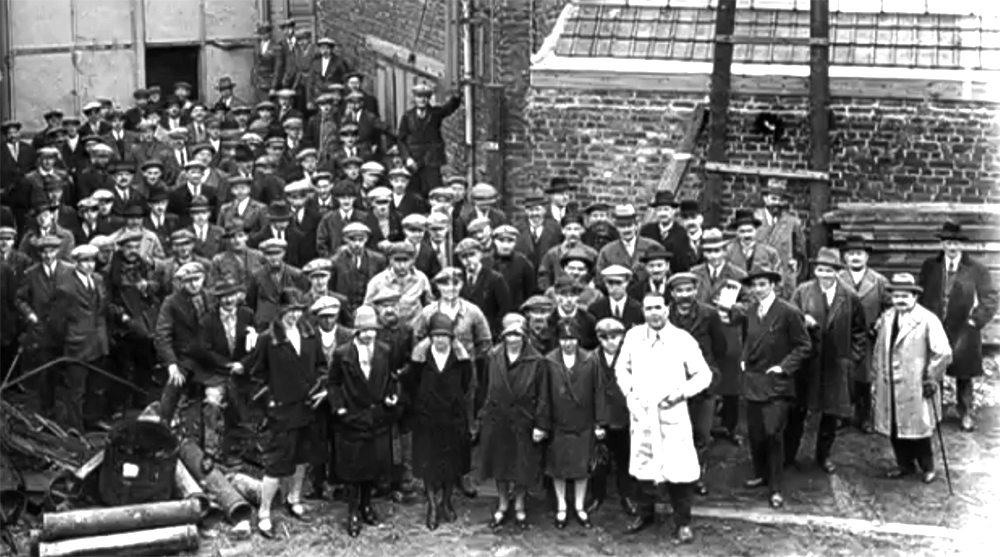
It is unclear how many of the instruments were built – sources put the number at four or perhaps eight, however, the first Orgues Des Ondes was installed at thrÉglise de Villemomble in the Parisian suburbs of Saint-Denis – inaugurated by the famous organist Charles Tournemire on the 6th December 1931. The second and more famous instrument was installed at the Poste Parisien radio station and auditorium on the Champs Elysees, Paris, inaugurated on 25th of October 1932.3Science et monde : tout pour tous : des idées, des faits.1932-11-17, 8. The high-profile inauguration event was lead by the famous organist and composer Maurice Duruflé who’s repertoire of the evening included:
Mendelssohn: ‘6th Sonata’
Bach: ‘I cry to you Lord’
Buxtehude: ‘modal Fugue in C’
Vierne: ‘Allegrro perennial of the 1st Symphony ‘
Duruflé: ‘Sicilian’
Gigout: ‘Toccata ‘
Franck: ‘Pastorale’ Schumann ‘Canon in B Minor’
Duruflé thereafter performed every Sunday from August 1932 to January 1933. Both instruments seem to have later been removed and replaced with more modern organs.
The Orgue Des Ondes was met with praise from the scientific community and some musicians – including a young Olivier Messiaen – but also came under fierce criticism as being a frivolous invention or ‘fairground toy’ competing in the serious world of religious music (even the President of the Republic, Albert Lebrun joined in the critical affray). Part of the problem was that Coupleux and Givelet had created a futuristic instrument but placed it in a ‘traditional’ and conservative environment unwilling to countenance the replacement of the ‘sacred’ and timeless pipe organ with a synthetic newcomer. For example, it was only in the 1960s that The Second Vatican Council of the Roman Catholic Church admitted the use of electronic organs in sacred music but emphasised the preeminence of the pipe organ;
“with the knowledge and consent of the competent territorial authority, provided that the instruments are suitable for sacred use.”4 Bush, Douglas and Kassel, Richard, The Organ, An Encyclopedia, Taylor & Francis, 2004, 165.
Despite its initial warm reception, the Orgue Des Ondes eventually succumbed to the practicality and portability of the American built Hammond Organ which also targeted the religious market as well as domestic music making. This competition bankrupted the Givelet-Coupleux partnership in 1935.
Images of the Orgue Des Ondes and othe Coupleux-Givelet instruments.
Eiffel Tower and home of the Orgue D’es Ondes and France’s first radio station
The Télépiano c1922
Loudspeakers and valves of the ‘Piano Radio Èlectrique’
The Givelet-Coupleux Organ of 1930 played by Armand Givelet
Eloi Coiupleaux at the keyboard of the Orgue Des Ondes
Multiple vacuum tubes of the The Orgue Des Ondes installed at the église de Villemomble, Paris, France c 1928
Eloi Coiupleaux at the keyboard of the Orgue Des Ondes
Multiple vacuum tubes of the The Orgue Des Ondes installed at the église de Villemomble, Paris, France c 1928
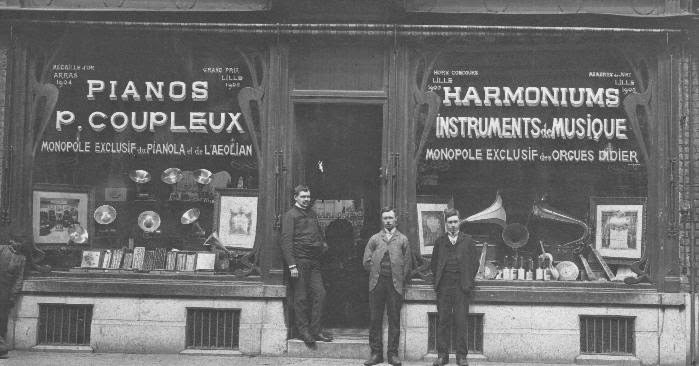
The Coupleux shop at 24 bis, rue Esquermoise, Lille France c 1920
Multiple vacuum tubes of the The Orgue Des Ondes installed at the église de Villemomble, Paris, France c 1928
Multiple vacuum tubes of the The Orgue Des Ondes installed at the église de Villemomble, Paris, France c 1928
Multiple vacuum tubes of the The Orgue Des Ondes installed at the église de Villemomble, Paris, France c 1928
Multiple vacuum tubes of the The Orgue Des Ondes installed at the église de Villemomble, Paris, France c 1928
Coupleaux watch workshop
Paul Coupleaux as a school student
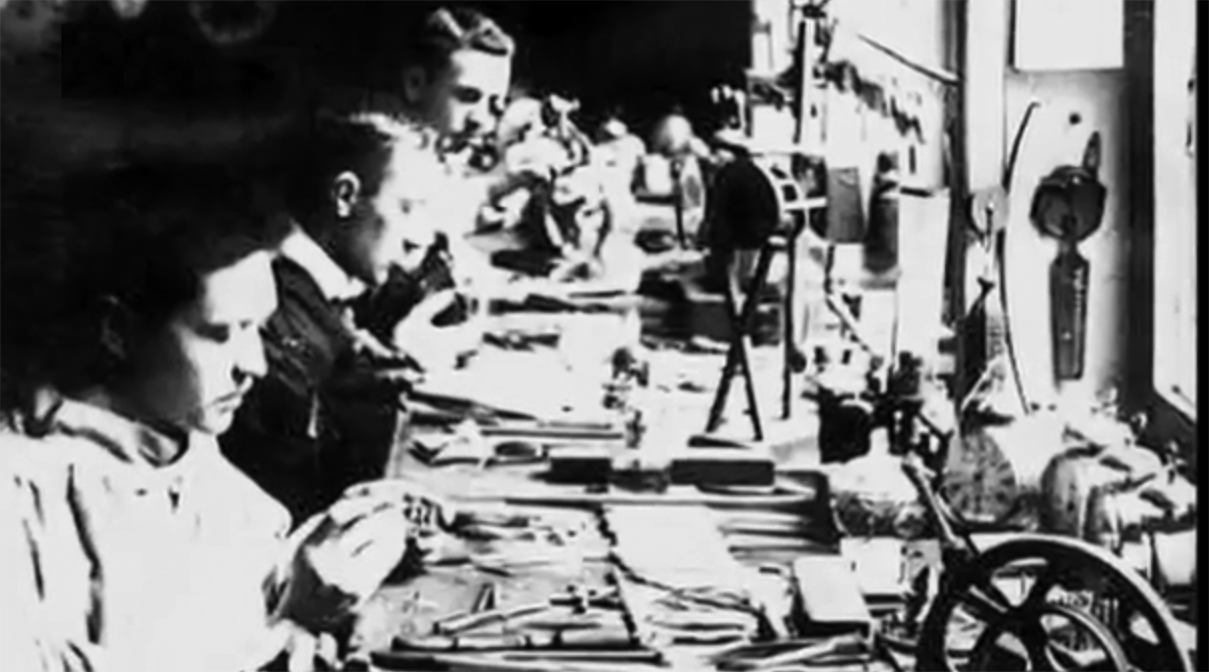
Workers at the Coupleux frères piano and organ workshop at 100 rue du Moulin-Fagot, Tourcoing, Lillle, France c1920
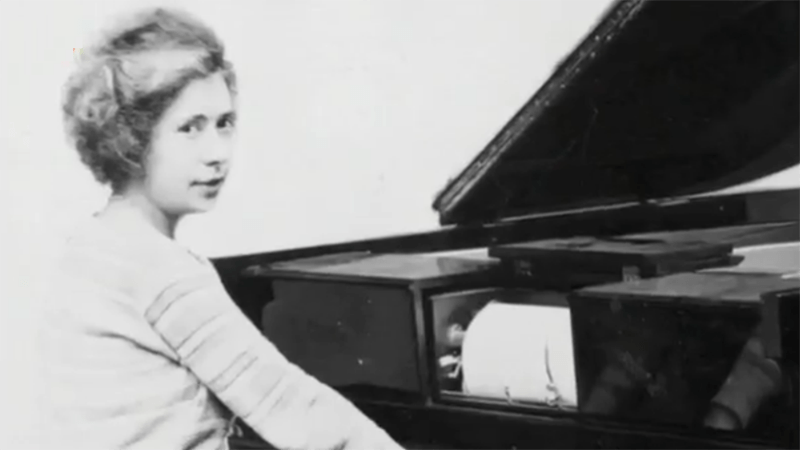
Louise Coupleux (sister of Eloi) playing an amplified Télépiano in c1922
Coupleaux watch workshop
Eloi Coiupleaux at the keyboard of the Orgue Des Ondes
Pierre Coupleux – Coupleaux Frere
Eloi Coiupleaux at the keyboard of the Orgue Des Ondes
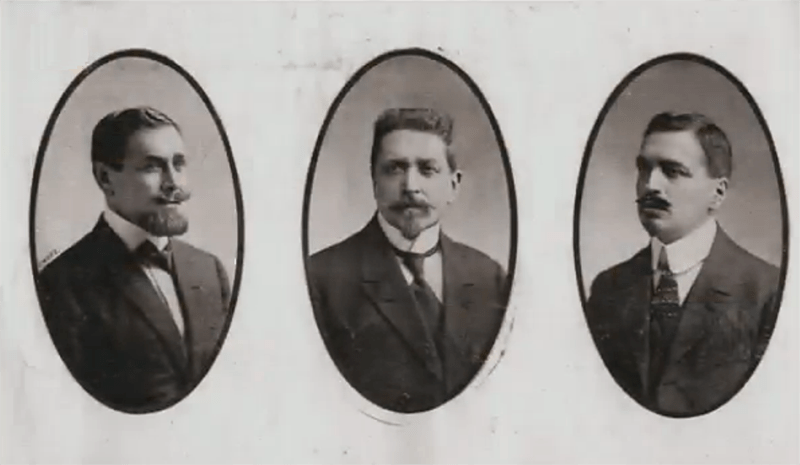
The Coupleux brothers, Paul, Leon and Eloi
Eloi Coupleux Biographical notes
The Coupleux piano manufacturing business was founded in 1865 originally as a modest watchmaking workshop based in Rue Carnot, Tourcoing, Lille, France by Pierre Coupleux . On Pierre’s death in 1904 the Coupleux sons – Eloi, Paul and Leon took over the business and, extending their knowledge of watchmaking, they began to manufacture music boxes, phonographs, devices for optical illusions, fairground equipment and early cinema equipment. The Coupleux’s soon began selling Pianos and other stringed instruments fired by the new middle class demand for the instrument. The Coupleux fuelled this fire by giving promotional concerts around France and Europe, recording their own records and eventually launching their own radio station ‘Radio Flanders’ in 1923 – five years before the existence of French national state radio.
Coupleux brothers working at their fathers watchmaking shop c1900
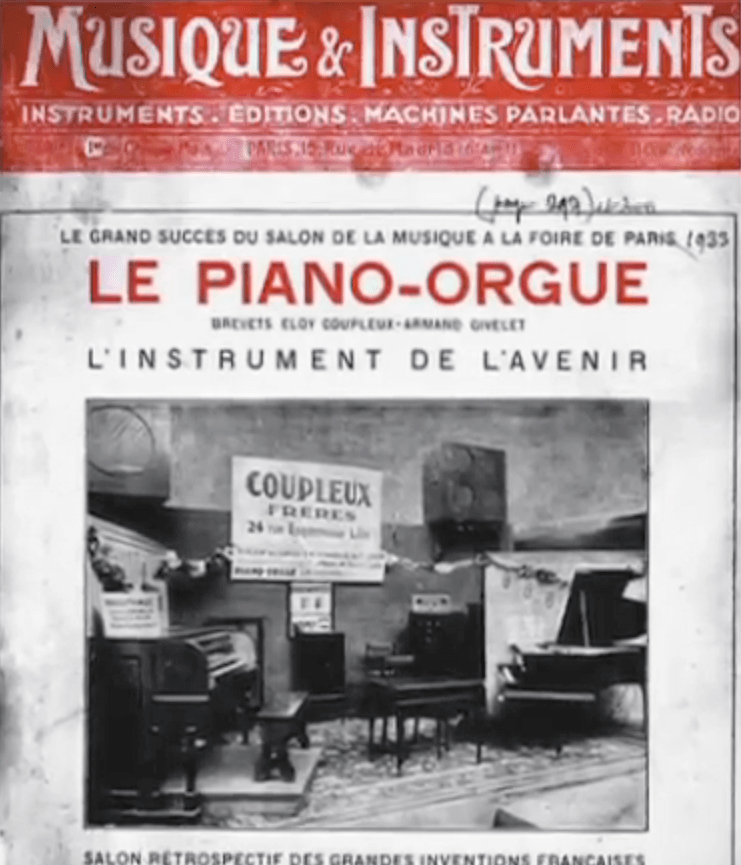
In 1908, having secured the French monopoly of imported American Pianolas, Paul Coupleux, by then an established piano dealer and tuner, opened a second shop in one of Lille’s most affluent shopping street 24 bis, rue Esquermoise, Lille selling their own manufactured pianos.
The Coupleux shop at 24 bis, Rue Esquermoise, Lille France c 1920
During the First World War Lille was occupied by the Germans and much of the Coupleux brothers shop and warehouse was destroyed. However in 1919 they realised that there was a new demand for church organs; most of the churches of Northern France and Belgium had been destroyed or damaged and soon their order books were full due to the demand for Coupleux pipe Organs. By 1923 the business was thriving with 150 staff and a production of 150 pianos per month.
The Coupleux company continued to thrive until 1935 when the simultaneous and combined forces of the commercial failure of their electronic musical instrument and the economic crisis of the 1930s closed the business. The rue Esquermoise shop continued as a music store until 1997 long after the closure of the instrument manufacturing business.
Workers at the Coupleux frères piano and organ workshop at 100 rue du Moulin-Fagot, Tourcoing, Lillle, France c1920
Eloi Coupleux was a self taught engineer, he had left school at fifteen and began working in his father’s watchmaking shop where he soon discovered his mechanical talent. His inventions included a dual disk phonograph for stereo audio, the Télépiano (1922) – a device for transmitting piano vibration magnetically down a telephone wire and numerous audio reproduction machines. And it was this obsession with new technology that lead him to meet the physicist and engineer Armand Givelet in 1927.
Louise Coupleux (sister of Eloi) playing an amplified Télépiano in c1922
This meeting was the beginning of a long collaboration between the duo designing new electronic musical instruments. Their first device was a larger, polyphonic version of Givelet’s ‘Clavier à lampe designed for use as a large church organ. The resulting instrument the Orgue Des Ondes was premiered at the 1929 exhibition in Paris and was one of the first electronic organs. Despite international publicity only four of the huge instruments were sold – all to churches in Northern France. 5 Carpentier, Oliver. L’Aventure industrielle des frères Coupleux, 1900-1935, Préface de Douglas Heffer, éditions de l’Inoui, 2004.
Sheet music book and the Orgue Des Ondes
References
1
Le Petit Parisien : journal quotidien du soir, 27 Octobre 1932,1. ↩︎
2
La Nature 1930, ‘Nouveaux instruments de musique Radio électriques, piano et orgue radioélectriques Givelet-Coupleux’, Cinquante huitième année, deuxième semestre – n. 2836-2847, 258-262. ↩︎
3
Science et monde : tout pour tous : des idées, des faits.1932-11-17, 8. ↩︎
4
Bush, Douglas and Kassel, Richard, The Organ, An Encyclopedia, Taylor & Francis, 2004, 165. ↩︎
5
Carpentier, Oliver. L’Aventure industrielle des frères Coupleux, 1900-1935, Préface de Douglas Heffer, éditions de l’Inoui, 2004. ↩︎
Armand Givelet behind the early monophonic Clavier a Lampe: “Les premiers essais de musique radio-électrique avec clavier ont été faits par Givelet qui construisit, avec des moyens plus que rudimentaires, un appareil fonctionnant parfaitement.” Image from: Phonographes et Musique Mécanique, Eugène-H. WEISS. Bibliothèque des Merveilles, Librairie Hachette. 1930.(édition de juin 1930), 16.
Armand Givelet was one of several post ww1 military radio operators who coincidentally discovered the musical possibilities of body capacitance to control the radio howl generated by vacuum tube radio feedback – in essence using the body as a variable capacitor to change the pitch of an audio oscillator. Alongside Maurice Martenot (The Ondes Martenot), Leon Termen (The Theremin) and others, Givelet exploited the feedback howl effect to generate a controllable sine pitch for an electronic instrument. Givelet’s instrument christened the Clavier à Lampe. This instrument was a simple a battery powered, monophonic, single oscillator device controlled by a two octave keyboard which Givelet designed to circumnavigate the poor audio fidelity of 1920s microphone technology by directly connecting the output of the instrument into a radio transmitter – the ‘direct injection’ method. The Clavier à Lampe premiered at the Trocadero Theatre, Paris in 1927 1 Hischak claims, probably in error, that Givelet took the Piano Radio Èlectrique on a promotional tour to the United States starting with a performance at the Trocadero Theatre in Philadelphia on June 9th 1927: Hischak. Thomas, S. A Day-by-Day Chronicle of the Jazz Age’s Greatest Year, Rowman & Littlefield Publishers, 127.. The first broadcast using Givelet’s direct injection method was made on the 27th March 1928 at the “Société des Ingénieurs Civils, Paris.
Givelet’s ultimate ambition, however, was to create a multi-tube polyphonic organ for use in radio broadcasts and liturgical music. To achieve this, Givelet began a lengthy collaboration with Eloi Coupleux of Coupleux Frerès – organ manufacturer and distributor based in Tourcing near Lille. The first fruit of this collaboration was the prototype Automatic radio-electric piano – essentially a five note polyphonic version of the Clavier à Lampe combined with a pianola style punch-paper controller (Coupleux Frerès had the monopoly for the distribution of Aeolian player-pianos in France). The coupleux-Givelet Automatic radio-electric piano was successfully demonstrated to an enthusiastic audience at the Congrès de la Radiodiffusion at the Salle Pleyel (252 Rue du Faubourg Saint-Honoré, 75008 Paris) on 16 November 1929:
The 1929 version of the ‘Automatic Radio Electric Piano’: Eloi Coupleaux on the Left and Armand Givelet on the right. Image from: Phonographes et Musique Mécanique, Eugène-H. WEISS. Bibliothèque des Merveilles, Librairie Hachette. 1930. (édition de juin 1930), 14.
“After the remarkable speeches of M M. Mantoux and Ricard, organizers of the Congress were vigorously applauded by more than two thousand spectators, MM. Eloi Coupleux and A. Givelet, presented a musical wave (‘ondes musicales’) device of their own invention which automatically produces orchestral polyphony thanks to the unwinding of a perforated roller. […]
Eloi Coupleux and A. Givelet have succeeded in producing simultaneous notes thanks to several oscillating circuits operating at the same time with the help of a piano keyboard. From there to associating the automatic control of a piano, there was only one step: the strip (or the perforated cardboard) acts on a pan flute and controls the operation of the keys with more precision and accuracy using its electrical contacts instead of the ‘sledgehammers’ (of an organ or piano).
The extremely ingenious combinations of the device make it possible to obtain tremolo and other variable characteristics of the oscillating circuit of the corresponding note. Timbral variations are also created by the actions of filters, or superimposed oscillations. We also have at will a hard or soft, progressive attack of the note.
The re-creation of a piano or a radio organ obviously requires a large number of oscillating circuits and lamps but this number is considerably reduced by bringing in frequency doublers, for example, which make it possible to immediately obtain the notes of the upper scale.”2Lallemant, Paul, ‘En Marge De La Profession’ , Le Moniteur des architectes : organe… de la Société nationale des architectes de France, Paris, 01/04/1933, 66-70.
A third prototype from the Givelet-Coupleux collaboration was a was a fully polyphonic organ with 2 manuals and pedals known as the Orgue radio-électrique which was shown at the Académie des Sciences, Paris on October 6th, 1930. This instrument was developed into what became the final instrument from the Givelet–Coupleux team, a huge multi-oscillator polyphonic organ christened the Orgue des Ondes.
Armand Givelet Biographical notes
Armand Givelet (born: 21 07 1889 Reims France – died: 09 11 1963 La Varenne St-Hilaire, St-Maur-des-Fossés) was originally an engineer in the French military during the First World War but soon recognised the potential of Lee De Forest’s triode technology. He founded and became president of the Radio-Club de France (1921) and the T.S.F. (‘Transmission sans fil’ or Wireless) engineering school. Givelet became a recognised authority on radio technology and an inventor who held many patents for radio and broadcast equipment as well as his work with electromechanical (tone-wheel) and valve based electronic musical instruments; His particular contribution was a stabilised audio oscillator that used much less power than previous triode circuitry.
Givelet’s first complete instrument was the The monophonic Piano Radio-électrique unveiled in 1927. In early 1929 Givelet began a lengthy collaboration with the organ Builder Eloi Coupleux and the Coupleux-frères company that produced some of the earliest polyphonic electronic organs – designed primarily for the church and religious music market. The largest of the Coupleux-Givelet instruments was the Orgue des Ondes built initially for Le Poste Parisien – a huge instrument which comprised of 200 oscillator tubes producing 70 different timbres or stops. Despite their unique features, The Coupleux-Givelet organs were rapidly made obsolete by much smaller and cheaper organs such as the Hammond Organ. Only four Orgue des Ondes were sold by Coupleux-frères to churches in France.
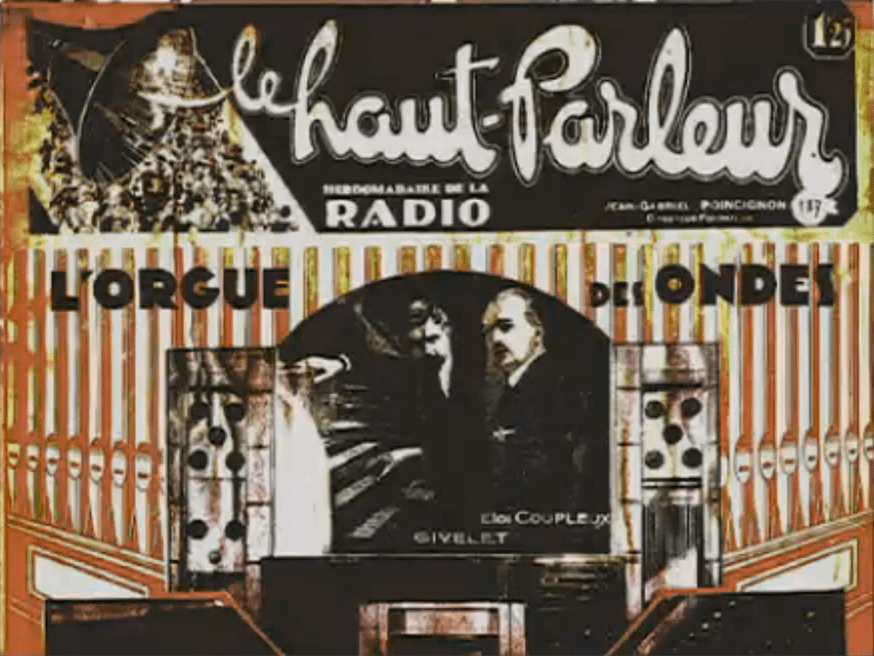
Givelet also wrote radio plays under the pseudonym Charles de Puymordant.3 Poincignon, Jean-Gabriel , La Renaissance du Radio Club de France, Le Haut-Parleur, N° 820, Juillet 1948, 359. and published a number of books on physics and music.
An article in Parole Libre (29-10-1927) describes the character and appearance of Armand Givelet:
“Mr. Armand Givelet has produced a number of inventions, including some outside the the wireless industry. As early as 1917 he built a spark-gap transmitter without valves and the first commercial amplifier in 1918 . The silhouette of M. Givelet is amusing: very long, dry, a little bent. Author of magazines on the T.S.F., he always appears smiling. Very short-sighted, with wrinkled eyelids, he is constantly browsing. Very dark, he has a thick goatee, short mustache, high hair. He is gesticulating, active, endearing. Vice President short mustache, high hair. It is wide, overflowing, a little diffuse. At 38, he not only has a magnificent past, but the whole future of the most knowledgeable, most disinterested and most deserving scientist, despite being… French!”
Caricature of Armand Givelet: Armand Givelet Inventeur. La Parole libre : supplément du Journal parlé…. 10-29-1927, 2.
Sources
Carpentier, Olivier .’L’ Aventure industrielle des frères Coupleux, 1900-1935′ Préface de Douglas Heffer, éditions de l’ Inoui, 2004.
La Vie et les ondes : l’oeuvre de Georges Lakhovsky / Michel Adam et Armand Givelet, 1936.
Givelet, A. ‘L’Orgue Electronique Système Coupleux-Givelet de l’église de Villemomble, près Paris, Le Genie Civil: revue générale des industries françaises et étrangères, 1932-03-05. 244-246.
‘Instrument de Musique synthétique (Piano Radioélectrique), Le Genie Civil: revue générale des industries françaises et étrangères, 18/02/1928. 175.
Le Monde, 1989-07-21, 23.
References:
1
Hischak claims, probably in error, that Givelet took the Piano Radio Èlectrique on a promotional tour to the United States starting with a performance at the Trocadero Theatre in Philadelphia on June 9th 1927: Hischak. Thomas, S. A Day-by-Day Chronicle of the Jazz Age’s Greatest Year, Rowman & Littlefield Publishers, 127. ↩︎
2
Lallemant, Paul, ‘En Marge De La Profession’ , Le Moniteur des architectes : organe… de la Société nationale des architectes de France, Paris, 01/04/1933, 66-70. ↩︎
3
Poincignon, Jean-Gabriel , La Renaissance du Radio Club de France, Le Haut-Parleur, N° 820, Juillet 1948, 359. ↩︎
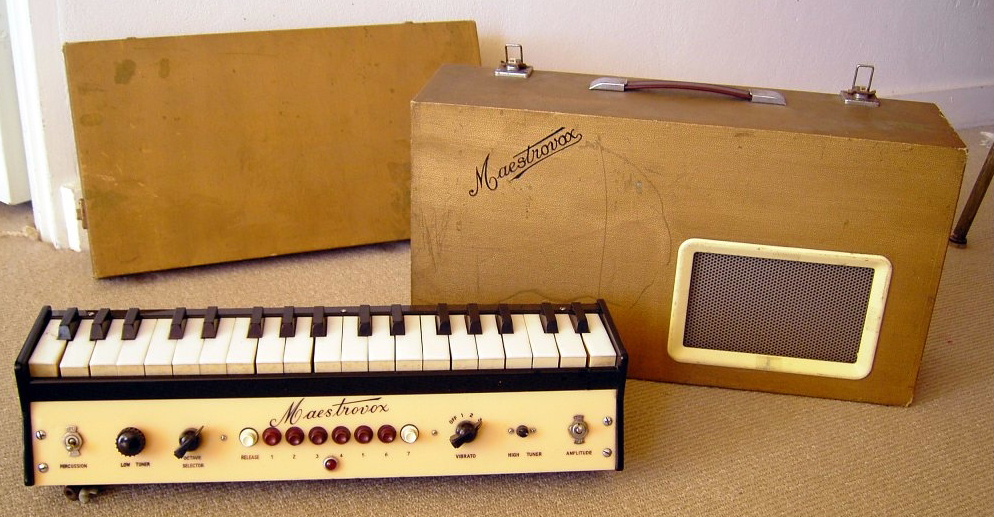
The Maestrovox was a monophonic portable vacuum tube organ built by Maestrovox Electronic Organs in Middlesex, UK. The instrument was one of the many designs similar to the Clavioline, Tuttivox and Univox and intended as a piano attachment instrument for dance bands and light orchestras of the day. The Maestrovox was produced from 1952 onwards and came in a number of models, the Consort, Consort De-Luxe, Coronation and a later version that mechanically triggered notes from a Piano keyboard, the Orchestrain.
Maestrovox Consort
Maestrovox – By Charles Hayward of ‘This Heat’
I used a Maestrovox keyboard with This Heat, set up just to the left of my drum kit (alongside a Bontempi electronic organ with about 3 sounds). It can be heard throughout This Heat’s recordings and was used onstage for most of the group’s gigs.
The Maestrovox was a fascinating instrument, it was advertised second-hand in the Evening News small-ads, maybe 1966 or 68, I didn’t really know what it was that I was going to see, just that I wanted to use an electronic keyboard in conjunction with domestic tape machines and this was going fairly cheap, £15 or so. I persuaded my brother to go half although in truth he never really used it. When we got it back home the unusual qualities of the instrument slowly became clear.
Firstly it was monophonic, with priority given to the highest note played; this was heavenly, you could ‘yodel’ between notes, sometimes using the lower note as a drone, sometimes playing contrary lines in 2 hands with only 1 note being heard at any time, sort of ‘strobing’ between 2 places. The keys were highly sprung, so that on the black notes, if played very quickly, the springs would activate even faster and the rate of change between the higher played note and a sustained lower sound would be very distinctive. This sound was used at the beginning and end of the 1st This Heat album and also played very quietly for about 20 minutes immediately before a gig, a bit like a distant alarm.
Tuning was an unsolvable problem that became a fantastic strength and the predominant reason for using the keyboard with the group. There were a couple of little tuning knobs on the console of filters that were changed with a screwdriver. No matter how I tried I could not find the place where the keyboard was in tune with itself, the nearest I could get was the low D to have its octave on the E 9 notes higher, in other words a 14 note octave (instead of the usual 12). Consequently every note was slightly flat or sharp. This meant that melodies had to be re-learnt when using the Maestrovox so that the tuning would bend in and out with other ‘orthodox’ tuned instruments. When played at the ‘back’ of the group’s sound the result would be to inexplicably ‘widen’ the sound.
The 4-step vibrato didn’t seem to work properly and had the effect of flattening the tuning by very small amounts, a little more than a quarter tone at the fullest extent. A series of filters changed the sound, 5 or 6 little buttons that could be engaged in different permutations. A 2- page pamphlet had a list of filter combinations that imitated ‘real’ instruments (always a doomed idea). I seem to remember that 13 was bassoon in the lower register (a particular favourite) and oboe in the higher register. These sound filters also effected the tuning. Another row of 3 buttons changed the attack parameters, without a little ‘slope’ it was kind of ‘clicky’, like the sound was being switched on.
The keyboard was about the size of a PSS Yamaha (which is sometimes confusingly described as a ’midi’ keyboard), and had a range of perhaps 3 octaves. The Maestrovox was designed to sit under a piano keyboard as a sort of addition to the acoustic instrument, although the tuning must have made any orthodox use hilarious. There was a sort of tripod that was supposed to hold it up against the underneath of the piano keyboard, this looked very shaky and unreliable, so my dad knocked up a stand, something like a shrunken Hammond. Valves glowed inside the keyboard which was connected via a multi-pin plug and lead to an amplifier that also served as a box for transportation. Both mains electricity and sound signal were conveyed by this lead. To boost the signal I connected a pair of crocodile clips to the speaker and this was then plugged in to a larger amplifier. I’m not sure if a connection socket was fixed for ease and reliability when This Heat started touring more regularly. The volume was controlled by a knee-operated lever (I remember harmoniums used this method too), I found a way of holding this in place and used a foot swell pedal instead.
It blew up sometime before This Heat began and it was quite a problem getting replacement valves. During the recording of ‘Cenotaph’ on the Deceit album it blew up again, in fact the track starts out with 2 tracks of Maestrovox and by the end there’s only 1 because it stopped working during the overdub. Getting replacement parts was time consuming, perhaps impossible, and then other things meant that a lot of equipment held in our rehearsal studio Cold Storage got lost, including the Maestrovox. By this time This Heat had split and it’s sound was so much part of that group that I was both sad and pleased to see it go.
Harald Bode’s Warbo Formant Orgel of 1937. Image ZKM | Karlsruhe, Harald Bode Estate.
Harald Bode was an important figure in the development of electronic musical instruments in Germany during the late 1930s and later in the USA in the post WWII era. He had a major role in the designs of polyphonic electronic organs and after moving to the USA, went on to influence the designs of commercial synthesisers with his concepts of modular synthesis and one volt per octave controls adopted by Robert Moog and Donald Buchla in the 1960s.
Harald Bode’s first commercial design was the wonderfully named Warbo Formant Orgel, a partially polyphonic electronic organ built in Hamburg in 1937. The Warbo Formant Orgel was designed and built with the musical input from the, at the time, well known commercial music composer and band-leader Christian Warnke (hence ‘War- Bo’ Warnke/Bode); 1 Abocab, Caspar .(2010) Instruments and Sound Devices of Harald Bode, eContact! 13.4. , https://econtact.ca/13_4/abocab_bode_instruments.html, retrieved 21/04/2024.
“Christian made the contribution of a musician — that means he told me what to do as far as all the features the instrument should have. I’ll have to go into more detail. Christian Warnke was a composer and musician, a bandleader with a fine ear for music, and he was an excellent violinist. He wasn’t involved in the design per se, just the specifications of the Warbo. And he sponsored the project on a minimum budget. Mind you this was in the second part of the 30s, which had still terrible after-effects of the depression. But the Warbo was my first major contribution in the field.” 2Finch, James. (1980) Interview with Harald Bode, Syne Magazine, International Electronic Music Association (IEMA).
Warnke and Bode’s new instrument was presented at a cinema in Hamburg and at Bode’s own studio in September 1937 and received a great deal of interest from the local press:
A contemporary description of the The Warbo Formant Orgel from the Hamburger Anzeiger. 21 September 1937.
Music of the future? Electricity as a sound source. Pioneering work in the field of electroacoustic musical instruments.
John W. R. Hellmann. Hamburger Tageblatt, 3 December 1937.
[…] This is where the shape development work of a young Hamburg electro acoustician comes in. Harald B0DE found the solution in his “Warbo-Formant Orgel” which allows the polyphonic playing on a manual. For each voice, only one tube is needed to produce the fundamental vibrations. The fundamental vibrations, which are amplified in the usual way are reproduced in the speaker, but still have no sound character. This sound character is achieved [in the Warbo Formant Orgel] by adding certain overtone groups or “formants” (hence the name!).
A large number of levers and knobs allow the synthetic production of any desired sound effect, both for imitating known sounds and to bring about completely new sound effects. Another new feature of Bode’s experimental instrument is the controllability of the “transient processes” by means of additional tubes, which also makes it possible to achieve the sound effects of beaten, rattling, and plucked tones with an arbitrarily long decay time.
An interesting feature of the “Formant organ” is that each voice can be coloured, highlighted and swelled for itself while playing on a manual, whereby auxiliary buttons also allow for voice crossovers. Thus, the possibilities of these devices, which are reminiscent of the “melody coupling” of individual organs, are much greater. Further, the instrument allows a pitch tremolo in addition to a dynamic tremolo and a sliding tone colour change during the playing.
Whether it has a future, whether it can gain a fine place alongside conventional instruments, or even – as optimists say – revolutionise our past music practice, that certainly can not be denied. The prerequisite for this is certainly that our composers must be prepared to create a new compositions for these new sound possibilities. 3J Hellmann, ohn W. R. (1937) Musik der Zukunft? Elektrizität als KlangqueIle.” Pionierarbeit auf dem Gebiet der elektroakustischen Musikinstrumente, Hamburger Tageblatt, 3 December 1937.
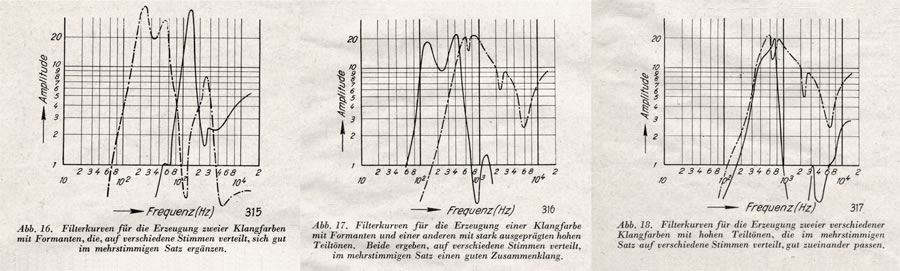
Description of the Formant filter operation of the Warbo Formant Orgel
Diagram illustrating the 4 note polyphony of the Warbo Formant Orgel. European Electronic Music Instrument Design—Harald Bode, Journal of the AUDIO ENGINEERING SOCIETY, October 1961, Volume 9, NUMBER 4268, 268
European Electronic Music Instrument Design—Harald Bode, Journal of the AUDIO ENGINEERING SOCIETY, October 1961
A different and unique approach for a multitone instrument with a minimum of tone generators has been tried by the author in the Warbo Formant Organ (Fig. 3). In this experimentally built instrument, four relaxation-type oscillators were correlated to a 44-note keyboard by a switching system which coordinates the first oscillator O, to the highest note, the second oscillator Oz, to the note next to the highest, and so forth. The oscillator outputs were connected to gates (G, through G,), which were opened for the played notes only by an additional switching system. This instrument also comprised envelope control means for percussive tones and two sets of filters, one of which could be correlated at will to one group of voices (for instance, Ist and 3rd) and the other to the remaining ones (for instance, 2nd and 4th). Although this instrument was capable of producing interesting effects, the stability with the employed tone generating system was not sufficient, and the switching device was too expensive.
Two versions of the instrument were made and later stored at the Heinrich-Hertz Institute (HHI) in Charlottenburg, Berlin. The institute’s building was completely destroyed during the war and with it the Warbo Formant Orgel. No recording of the Warbo Formant have been found. As with many other instruments designed by Bode the Warbo Formant Orgel pioneered aspects of electronics that became standard in later instruments. The Warbo Formant Orgel was a partially polyphonic (high note priority) four-voice, single keyboard instrument with 2 formant filters and key assigned dynamic envelope wave shaping allowing for variable wave shapes and percussive effects – features that were later used on Bode’s postwar instruments. With the assistance of Oskar Vierling at the HHI, between 1938 and 1939 Bode created a two monophonic manual and 30 note pedalboard version of the Warbo Formant Orgel he called the Melodium .4Davies, Hugh. (2001) The Warbo Formant Orgel, The new Grove dictionary of music and musicians, New York : Grove, 74-5.
“… It [The Warbo Formant Orgel] was built with a relaxation type of oscillator. Four oscillators actually, that were selected for the 44-note keyboard. The major problem being the stability of the oscillators, which is critical when comparing one with the other, especially with four. So I dropped the idea of a four-note organ at that time and went on to the Melodium, which was created in 1938 and used in many large performances with the Berlin Philharmonic as a solo instrument. It was also used in some significant motion pictures of that era.” 5 Bode, Harald. (1980) Interview, Syne Magazine
Harald Bode. Biographical notes
Harald Bode; October 19, 1909 Hamburg Germany – January 15, 1987 New York USA.
Harald Bode (Born: Hamburg October 19, 1909 – Died: New York, January 15, 1987) studied mathematics, physics and natural philosophy at Hamburg University, graduating in 1934. In 1937, with funding support provided by the composer and band-leader, Christian Warnke, Bode produced his first instrument the Warbo-Formant Orgel (‘Warbo’ being a combination of the names Warnke and Bode). Bode moved to Berlin in 1938 to complete a postgraduate course at the Heinrich Hertz Institute where he collaborated with Oskar Vierling and the light music composer, organist and Trautonium virtuoso, Fekko von Ompteda. During this period Bode developed the Melodium ; a unique monophonic touch-sensitive, multi-timbral instrument used extensively in film scores of the period.
When WWII started in 1939 Bode worked on military submarine sound and wireless communication projects “…We had the only choice in Germany, to go to military service or do work for the government. I praise myself lucky, that I was able to go to the electronic industry” 6Finch, James. (1980) Interview with Harald Bode, Syne Magazine, International Electronic Music Association (IEMA). and moved to the small village Neubeuern in southern Germany, where in 1947 Bode built the first European post-war electronic instrument, the Melochord. In 1949 Bode joined the AWB company where he created the Polychorda simpler, polyphonic version of the Melochordwhich was followed by the Polychord III in 1951 and the Bode Organ, a commercial organ which became the prototype for the famous Estey Electronic Organ. After leaving AWB, Bode’s designs included the Tuttivox, a miniature electronic organ and collaborated on a version of George Jenny’s Clavioline, both big sellers throughout Europe.
In 1954 Bode moved to the USA, settling in Brattleboro, Vermont where he lead the development team (and later, became Vice President) at the Estey Organ Corporation. In 1958, while still working at Estey, Bode set up the Bode Electronics Company where in March 1960 he created another unique instrument; a modular synthesiser “A New Tool for the Exploration of Unknown Electronic Music Instrument Performances” known as the ‘Audio System Synthesiser’ which Robert Moog used as the basis for his line of new Moog synthesisers.
After the Estey Organ Company foundered in 1960, Bode joined the Wurlitzer Organ Co and moved to Buffalo, New York where he was one of the first engineers to recognise the significance of transistor based technology in electronic music. Bode’s concepts of modular and miniature self-contained transistor based machines was taken up and developed in the early 1960’s by Robert Moog and Donald Buchla amongst others. 1962 saw the beginning of a long collaboration between Bode and the composer Vladimir Ussachevsky at the Columbia Princeton Center for Electronic Music which lead to the development of innovative studio equipment designs such as the ‘Bode Ring Modulator’ and ‘Bode Frequency Shifter’. The commercial versions of these inventions were produced under the Bode Sound Co and under license Moog Synthesisers.
Harald Bode retired in 1974 but continued to pursue his own research. In 1977 he created the ‘Bode Vocoder’ (licensed as the ‘Moog Vocoder’). In 1981 he developed his last instrument, the ‘Bode Barber Pole Phaser’.
References:
1
Abocab, Caspar .(2010) Instruments and Sound Devices of Harald Bode, eContact! 13.4. , https://econtact.ca/13_4/abocab_bode_instruments.html, retrieved 21/04/2024. ↩︎
2
Finch, James. (1980) Interview with Harald Bode, Syne Magazine, International Electronic Music Association (IEMA). ↩︎
3
J Hellmann, ohn W. R. (1937) Musik der Zukunft? Elektrizität als KlangqueIle.” Pionierarbeit auf dem Gebiet der elektroakustischen Musikinstrumente, Hamburger Tageblatt, 3 December 1937. ↩︎
4
Davies, Hugh. (2001) The Warbo Formant Orgel, The new Grove dictionary of music and musicians, New York : Grove, 74-5. ↩︎
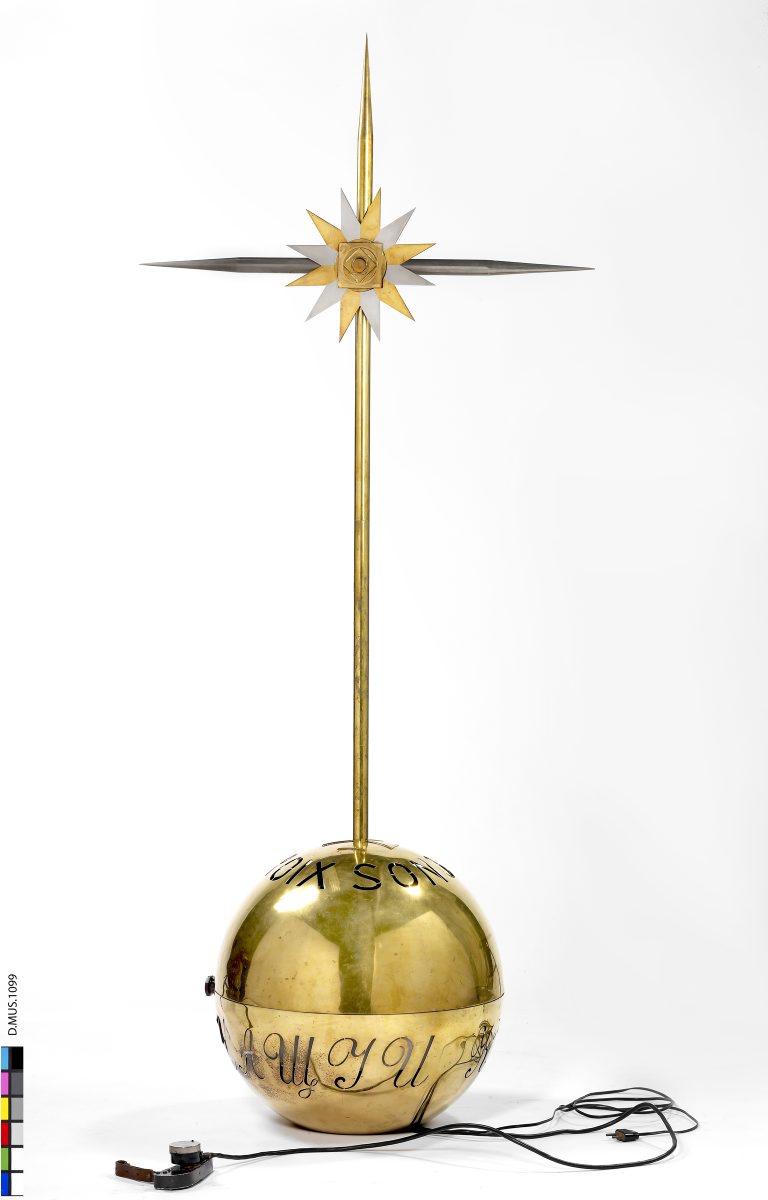
Modern reconstruction of the Croix Sonore at the musée de L’Opéra, Paris.
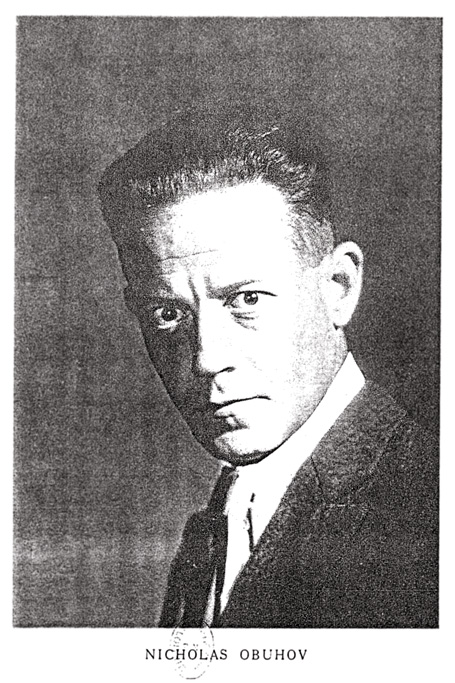
Nicolai Obukhov was a Russian composer who, after studying at the Moscow and St. Petersburg Conservatories with Maximilian Steinberg and Nikolai Tcherepnin, left Russia on the eve of the Bolshevik revolution in 1918. Obukhov settled in Paris in 1919 where he studied orchestration with Maurice Ravel and Marcel Orban while supporting his new family by working as a bricklayer.
Marie-Antionette Aussenac-Broglie plays the Croix Sonore. Image; ‘Comoedia’ Paris 5th March 1934.
Obukhov, who signed his name “Nicolas l’illuminé” (Nicholas the visionary), was a deeply religious mystical Christian and profoundly influenced by the new theosophical cult of the Salon de la Rose + Croix which became popular with artists and musicians in the early 1920s. These beliefs were expressed in his compositions which, like his fellow countryman Alexander Scriabin, were intended as a means of attaining a transcendent state and a bridge to the world of the spirit – rather than just an aesthetic creation – Obukhov was driven by the idea that there was a higher reality to which art could reach. He attempted to achieve this spiritual goal through, for the time, unconventional means; a “total harmony” of 12 tone composition, unusual rhythm, experimental methods of notation, new invented instruments and expressive vocal directions –Obukhov was probably the first composer to require a singer to make ‘non musical’ vocal sounds:
‘I forbid myself any repetition: my harmony is based on twelve notes of which none must be repeated. Repetition produces an impression of force without clarity; it disturbs the harmony, dirties it.’1 Schloezer op. cit, p 47.
“…music enjoys decided advantages which endow it with possibilities of insinuation into the depths of the soul, and the mind, of emotions inaccessible to other arts. This faculty resides in the fact that music is hindered less than any other art in the realisation of its aims by material conditions.” 2Manuscript MS 15226, music department, Bibliothèque Nationale de France, Paris.
In order to achieve this musical ‘insinuation’ Obukhov supplemented the traditional orchestra with new instruments of his own invention. These included the “Crystal” a piano type instruments where hammers hit a row of crystal spheres and the “Éther” an electronically powered instruments where a large rotating paddle wheel created various, apparently inaudible infra- and ultra-sonic humming sounds that ranged from approximately five octaves below to five octaves above human hearing. This sound was intended to have a mystical effect on the listener – though the effect was probably physiological, depending on the volume and frequency of the instruments sound. Low frequency infra-sound is known to have a physical effect on the human nervous system causing disorientation, anxiety, panic, bowel spasms, nausea, vomiting and eventually unconsciousness (supposedly 7-8 hz is the most effective being the same frequency as the average brain alpha wave). The effect is unintentionally generated by the extreme low frequencies in church pipe organ music, instilling religious feelings and causing sensations of “extreme sense sorrow, coldness, anxiety, and even shivers down the spine.” 3‘Organ Music Instills Religious Feelings’ by Jonathan Amos, 9/8/2003 http://news.bbc.co.uk/1/hi/sci/tech/3087674.stm
The film actor Georges Colin presents the “Le Chant Des Spheres” with the Croix Sonore. Photo; L’Ouest-Éclair_03_06_1936_02
Obukhov’s only purely electronic instrument was “La Croix Sonore” or “Sonorous Cross” which was essentially one of several Theremin type instruments developed in Europe after Leon Termens departure to the USA in 1927 (others included the “Elektronische Zaubergeige” and the “Elektronde“). The Croix Sonore was designed and built in Paris by Michel Billaudot and Pierre Duvalier to Obukhov’s instructions in 1929 and was the result of several years experimenting with beat frequency/heterodyning oscillators probably after witnessing Termen’s demonstration of the Theremin while on tour around Europe. As with theTheremin the Croix Sonore was based on body capacitance controlling heterodyning vacuum tube oscillators. To suit Obukhov’s mystical and theatrical style, the circuitry and oscillators were built into a 44 cm diameter brass orb and the antennae disguised by a large 175 cm high crucifix adorned with a central star.
The Sonorous Cross was played in the same way as the Theremin – using the bodies capacitance to control the oscillators frequency, in this case moving the hands out from the central star on the crucifix altered the pitch and volume of the instrument. The ritualistic gestures made while playing this most unusual looking of instruments complemented the occult and mystical nature of Obukhov’s music and life.Obukhov continued to develop the instrument and produced an improved version, completed in 1934.
Nikolay Obukhov composed numerous pieces using his instrument as well as several using the Ondes-Martenot, culminating in his major work; “Le Livre De Vie” which exploited the glissando effects the Sonorous Cross could produce. The performances of these pieces were intended to be more like an occult church ceremony rather than an orchestral performance; Obukhov insisted that here were no spectators at his concerts – everyone would play their part in the mystical ritual which would take place in a circular ‘temple’:
“When the ‘Book of Life’ is performed, by which I mean when it is lived, the spectators, the participants will be arranged in spirals, in the interior of a circular and raised scene. The ‘terrestrial’ orchestra will be coiled up around the scene. A dome will contain the ‘celestial’ orchestra. Lighting changes will intervene in the ‘Sacred Action’, a synthesis of cult and orgy (the latter meant symbolically). Such is the ritual where science and religion are married.4‘Music of the Repressed Russian Avant-Garde, 1900-1929 p. 107. By Larry Sitsky, .Greenwood Press, Westport Connecticut and London, 1994.
“…some like priests will take part directly in the action, the others witness it, participating mentally like the faithful in church.” 5 ‘ de Schloezer, Boris , “Nicolas Obukhoff”, La Revue Musicale, 1, part 3, Nov. 1921, pp 38-56.
These performances received mixed reviews from the puzzled critics:
A Paris concert audience was stirred. and while it squirmed and tittered. tonight when Nicholas Obouhoff’ presented parts of his “Book of Life” and hitherto unknown “Annunciation of the Last Judgement.” to the accompaniment of the new electric musical instrument, the croix sonore.
Henry Prunieres introduced the concert. warning the audience that it was going to hear chords played on the piano. notes sung by a human voice and sounds drawn from an instrument such as it had never heard before. Even this warning. however. did not prepare the listeners for the sudden “shriek” – there is no other word for it-of Suzanne Balguerie on the opening note of one of Obouhoff‘s liturgic poems. There was no warning, either. when the singer suddenly began to whistle instead of sing. Some members of the audience thought it was one of their number expostulating in the classic manner and began to cry, “Hush! hush!“
Prunieres had praised the courage of the singers, Mme. Balguerie and Louise Matha. in attempting music so new, and as they produced strange note after strange note many felt that this praise was well merited. if only because their mastery of their effects prevented the audience from tittering more loudly.6‘Titters Greet Music of Obouhoff in Paris: Singers’ Strange Performance Accompanied by Electrical Instrument, Causes Stir’, 1. New York Times, May 16, 1934, p. 23.
“In “Annunciation of the Last Judgement” the singers stood together, one gowned in white. the other in red. while Obouhoff and Arthur Scholossberg played two pianos. and Princess Marie Antoinette Aussenac de Broglie, apart and sacramentally gowned in black, blue and orange, drew from the croix sonore notes that throbbed like twenty violins or at times sang like a human voice. In all this, it was the instrument that had the most success. Obuhoff’, it is said, dreamed of it long before the invention of the radio made application of the principle possible. He wrote music for it, calling it “the etherphone.” Out of it, by moving the hand back and forth, the Princess de Broglie drew an amazing sweetness or the most dreadful note, like the knocking of fate, to give Obouhofifs strange religious music far more power than his two pianos or even the distortions of his singers’ voices could produce.”7SHAW – MILLER, S. (2002). Visible Deeds of Music: Art and Music from Wagner to Cage. Yale University Press, p81
Nicolas or Nicolai Obukhov ( also Obouchov, Obuchov, Obouhow, Obuchow), Born April 22, 1892 in Ol’shanka, Kursk, Moscow – died, June 13, 1954 in St. Cloud, France
Nikolay Obukhov studied counterpoint at the Moscow Conservatory from 1911 and later at the St Petersburg Conservatory in 1913 (with Kalafati, Maksimilian Steinberg and Nikolay Tcherepnin). His first published works date from this period, and were published as ‘Quatre mélodies’ by Rouart et Lerolle in Paris in 1921.
In 1915 Obukhov developed his own idiosyncratic form of musical notation (similar to one invented in Russia by Golïshev during the same period) using a 12-tone chromatic language highly influenced by the mystical Russian composer Alexander Scriabin. The only performances of his music in Russia took place at this time. A report of the performance describes Obukhov as ‘a pale young man, with gazing eyes’ who ‘confused the audience’. Obukhov left Russia during the revolution with his wife and two children; they eventually settled near Paris a year later. In Paris he encountered financial hardship until helped by Maurice Ravel who found Obukhov a publisher allowing him to devote his time to his music.
The 1920s saw a handful of performances, most notably that of the ‘Predisloviye knigi zhizni’ (‘Introduction to the Book of Life’) under Kussevitzsky. During this and the next decade he put into practice ideas for electronic instruments Obukhov had conceived as early as 1917: the ‘efir’ and ‘kristal’ (‘ether’ and ‘crystal’) he had described in Russia eventually gave rise to the croix sonore, and even though he built and wrote for the ether, it was with the croix sonore that he gained most attention. He found an exponent of the instrument in his pupil Marie-Antoinette Aussenac-Broglie who had also performed some of his piano music; she demonstrated the instrument around France and Belgium. Similar to both the theremin and the ondes martenot in that pitch production is reliant upon the distance of the performer’s arm from the instrument, the croix sonore was the subject of a film of 1934. During the mid-1940s his notation again provoked heated discussion, this time in Paris; a book containing works from the 18th to the 20th centuries in Obukhov’s notation was published by Durand. In 1947, his ‘Traité d’harmonie tonale, atonale et totale’ ‚ which had already interested Honegger ‚ was published, while a year later he lectured on this subject in the Russian Conservatory in Paris. Obukhov spent his last years incapacitated by a mugging in 1949 where the final version of ‘the Book of Life’ was stolen; he composed only a few works after this incident.
Commentary on Obukhov’s work by Jonathan Powell8https://www.planettree.org/2000/crussian.html
Obukhov’s output is dominated by vast works of which the most notorious ‚ notwithstanding the gargantuan ‘Troisième et dernier testament’ and ‘La toute puissance’ ‚ is the ‘Kniga zhizni’ (‘The Book of Life’) on which he worked from around the time he left Russia until at least the mid-1920s. Described by the composer as ‘l’action sacrée du pasteur tout-puissant regnant’ it was intended to be performed (or ‘accomplished’) uninterruptedly every year on the night of the first and on the day of the second resurrection of Christ. Obukhov did not consider himself the composer of this work; instead, he saw himself as the person permitted, by divine forces, to ‘show’ it. Parts of the score, one version of which is nearly 2000 pages in length, are marked in the composer’s blood.9 Powell: “This is now regarded as not true (see Pol’dyaeva, 2006)” The music is preceded by a lengthy exposition in archaic Russian, while the work concludes with one section the score of which unfolds into the form of a cross and another, taking the shape of a circle, which is fixed onto a golden and silver box decorated with rubies and red silk. (Nicholas Slonimsky, in his memoir ‘Perfect Pitch’ relates that the composer’s wife, driven to despair by Obukhov’s obsessive behaviour regarding this piece, attempted to burn ‚ or ‘immolate’, in the composer’s terminology ‚ the manuscript but was interrupted in her crime.) Much of the instrumental writing is characterized by the alternation of chorale-like material (often ornamented by filigree arppegiation) with tolling patterns, building to textures of considerable rhythmic and contrapuntal complexity. The vocal parts ‚ as with his writing for the voice in most of his other works ‚ have huge tessituras and are bespattered with glissandi and instructions for screaming or whispering. The style which is consistently applied in this magnum opus is prevalent in all of his mature works and has its roots in the songs and piano miniatures written in Russia.
Taking as a starting point the language employed by Skriabin in his mid- and late-period works, Obukhov evolved a harmonic technique based on the systematic configuration and manipulation of 12-note chords or harmonic areas. The sonorities resulting from this ‘total harmony’ are often broadly octatonic and frequently have a quasi-dominant character due to the prevalence of diminished fifths in the lower elements. Although longer structures appear to unfold in a schematized yet organic manner, the detail of musical procedure is curiously static. Obukhov saw his work as a musical articulation of his strongly-held religious beliefs and would sometimes sign his manuscripts ‘Nicolas l’illuminé’ or ‘Nicolas l’extasié’. Possibly inspired by Vladimir Solov´yov’s idea of ‘sobornost´’ (collective spiritual or artistic experience), Obukhov sought to abolish the traditional performer-audience polarity in favour of a merging of these previously mutually exclusive groups into one of participants. Obukhov mostly used his own texts which are frequently inspired by the Book of the Revelation or the Apocrypha. It is thus no coincidence that the only poets whose work appealed to him spiritually and compositionally were Solov´yov and Bal´mont, since it was the former’s orthodox mysticism that significantly informed the apocalyptic vision of the latter. In addition to these sources, mention should be made of Obukhov’s use of two verses by Musorgsky; it is between his work and that of Messiaen that Obukhov’s visionary language can be placed.
Manuscript MS 15226, music department, Bibliothèque Nationale de France, Paris. ↩︎
3
‘Organ Music Instills Religious Feelings’ by Jonathan Amos, 9/8/2003 http://news.bbc.co.uk/1/hi/sci/tech/3087674.stm ↩︎
4
‘Music of the Repressed Russian Avant-Garde, 1900-1929 p. 107. By Larry Sitsky, .Greenwood Press, Westport Connecticut and London, 1994. ↩︎
5
‘ de Schloezer, Boris , “Nicolas Obukhoff”, La Revue Musicale, 1, part 3, Nov. 1921, pp 38-56. ↩︎
6
‘Titters Greet Music of Obouhoff in Paris: Singers’ Strange Performance Accompanied by Electrical Instrument, Causes Stir’, 1. New York Times, May 16, 1934, p. 23.↩︎
7
SHAW – MILLER, S. (2002). Visible Deeds of Music: Art and Music from Wagner to Cage. Yale University Press, p81↩︎
Powell: “This is now regarded as not true (see Pol’dyaeva, 2006)” ↩︎
Further Reading:
Hugh Davies. “Croix sonore.” In Grove Music Online. Oxford Music Online
E.Ludwig: “La Croix Sonore” ReM, nos 158-9(935),96 ReM,nos 290-91 (1972-73)
Consciousness, Literature and the Arts. Archive. Volume 1 Number 3, December 2000 “Skriabin and Obukhov: Mysterium & La livre de vie The concept of artistic synthesis”. By Simon Shaw-Miller
‘Nikolay Obukhov and the Croix Sonore’ Rahma Khazam. From: Leonardo Music Journal,Volume 19, 2009, pp. 11-12
“The Audion Piano May Entertain Us in the Near Future With Music Purer Than That Obtainable With Any Instrument Now Available. Also it will Imitate Faithfully Any Orchestral Piece.” from “Audion Bulbs as Producers of Pure Musical Tones” by Lee de Forest, Electrical Experimenter, December 1915.
Lee de Forest , The self styled “Father Of Radio” inventor and holder of over 300 patents, invented the triode electronic valve or ‘Audion valve’ (a portmanteau of ‘Audio’ and ‘Ionise’) in 1906 – a much more sensitive development of John A. Fleming’s diode valve. The immediate application of de Forest’s triode valve was as a more efficient signal detector and amplifier in the emerging radio technology of which de Forest was a tenacious promoter. In 1915 de Forest discovered that the Audion could be used to generate simple audio tones and constructed a rudimentary electronic instrument – The ‘Audion Piano’. de Forest’s instrument was the the first true electronic musical instrument in that it generated sound from electrical oscillations (rather than, say, the electro-mechanical generation of sound by the Telharmonium) – and as such it was the precursor for all the future developments in electronic musical instruments design. The Audion Piano is described in de Forest’s patent of April 24th 1915 ‘Electrical Means for the Production of Musical Notes’:
de Forest’s 1915 patent ‘Electrical Means for Producing Musical Notes.’
The innovations of the Audion Piano were that, as described above, it created sounds through electronic means using a beat frequency or heterodyning effect (a way of creating audible sounds by combining two high frequency signals to create a composite lower frequency within audible range – a technique that was used by Leon Termen in his Theremin and Maurice Martenot in the Ondes Martenot some years later) and that it used electrical capacitance to control the pitch of these tones – techniques used in all electronic instrument designs until vacuum tubes began to be replaced by transistors in the 1960s. The instrument was able to produce eight separate pitches from each bulb and allowed the player to feed variable amounts of the output back into the circuit creating harmonic distortion and timbral effects. The output of the instrument were audible, in this pre-amplifier age, through the sound produced by the bulbs themselves – for public performance the tones were ‘amplified’ using acoustic horns or, like the Telharmonium, distributed over the telephone network. The pitch and relative tuning of the Audio Piano’s bulbs could be adjusted using simple condensers which could also be manipulated to produce constant glissandi or “siren notes” 1 de Forest, Lee (1915), Electrical Means of Producing Musical Notes, United States Patent Office, June 30th 1925 (Filed April 24th 1915) Pat# 1,543,990.. de Forest, realising that he was able to vary the pitch of the Audion bulbs by touching the circuitry also experimented with body capacitance and claimed that his instrument was the precursor to the Theremin (1922) and the Hammond Novachord (1939). de Forest later in 1931 sued the RCA corporation – manufacturer of the Victor Theremin – and “all other instruments employing vacuum tubes in the synthetic reproduction of music” for transgression of the Audion patent. de Forest’s successful petition resulted in a $6,000 award for damages from RCA to the de Forest Co. Although this was not a damaging award, it brought RCA’s production of the Theremin to a halt and had the a long term effect of supressing the commercial development of vacuum tube instruments in the USA. 2 de Forest, Lee,(1950) Father of Radio – THE autobiography OF Lee de Forest, Wilcox & Follet Co, Chicago ILL, 331-2 and 386..
Lee de Forest’s Triode Valve of 1906
The Audion Piano, controlled by a single keyboard manual, used a single triode valve per octave, controlled by a set of keys allowing one monophonic note to be played per octave. This audio signal could be processed by a series of capacitors and resistors to produce variable and complex timbres and the output of the instrument could be sent to a set of speakers placed around a room giving the sound a novel spatial effect. de Forest planned a later version of the instrument that would have separate valves per key allowing full polyphony- it is not known if this instrument was ever constructed. de Forest described the Audio Piano as capable of producing:
“Sounds resembling a violin, Cello, Woodwind, muted brass and other sounds resembling nothing ever heard from an orchestra or by the human ear up to that time – of the sort now often heard in nerve racking maniacal cacophonies of a lunatic swing band. Such tones led me to dub my new instrument the ‘Squawk-a-phone’….The Pitch of the notes is very easily regulated by changing the capacity or the inductance in the circuits, which can be easily effected by a sliding contact or simply by turning the knob of a condenser. In fact, the pitch of the notes can be changed by merely putting the finger on certain parts of the circuit. In this way very weird and beautiful effects can easily be obtained.” 3de Forest, Lee (1950) Father Of Radio – THE autobiography OF Lee de Forest , Wilcox & Follett Co., Chicago, 331-2
And From a 1915 news story on a concert held for the National Electric Light Association
“Not only does de Forest detect with the Audion musical sounds silently sent by wireless from great distances, but he creates the music of a flute, a violin or the singing of a bird by pressing button. The tune quality and the intensity are regulated by the resistors and by induction coils…You have doubtless heard the peculiar, plaintive notes of the Hawaiian ukulele, produced by the players sliding their fingers along the strings after they have been put in vibration. Now, this same effect, which can be weirdly pleasing when skilfully made, can he obtained with the musical Audion.”4de Forest, lee (1915), Audion Bulbs as Producers of Pure Musical Tones, The Electrical Experimenter, Experimenter Publishing Company, Inc. New York, December 1915, 394.
“Diagram of Connections for Creating Pure Musical Tones with Any Audion Bulb.” Electrical Experimenter 1915, New York.
de Forest argued that the Audion Piano was the natural successor to Thaddeus Cahill’s huge Telharmonium instrument that had for the previous ten years transmitted electronically generated music to subscribers across the country:
“Several years ago, as the public of New York remembers, a very elaborate undertaking was started for producing music by gigantic electric dynamos mixing the tones from WC or more machines in accordance with the wishes of the skilled performer who in that way produced musical tones of large volume, and which simulated almost those of every instrument in an orchestra. This instrument was termed the telharmonium. The idea was to generate this music at a central station, where highly trained organists were constantly at the keyboard, and distribute it through telephone wires throughout the city to hotels, restaurants, lobbies, concert halls and private residences. This was a most meritorious idea and deserved great success. However, the extraordinary heavy cost of the original plant, the maintenance of the wire cables, etc., rendered it commercially a failure.
Now, with the audion or incandescent lamp as a generator of musical tones, we have on a small scale all of the possibilities of the large telharmonium. Now, this same little bulb which I have just described, in addition to being a receiver of wireless messages and an amplifier for long distance wire telephones (in which use it is now employed on the transcontinental lines of the American Telephone & Telegraph Company), can be made to actually generate alternating current. It receives the energy which is expended in these currents from the dry battery or dynamo. The audion is, in other words, a transformer of energy. The alternating current, if of low frequency, can actuate the telephone diaphragm and make musical notes which the ear can hear, and this is the germ idea involved in the musical instrument which I have just described. The bulbs for musical purposes which I have thus far used are not larger than three inches in diameter.”5de Forest, lee (1915), Audion Bulbs as Producers of Pure Musical Tones, The Electrical Experimenter, Experimenter Publishing Company, Inc. New York, December 1915, 395.
Advert for de Forest radio telephone & telegraph Co. wireless equipment – New York, 1916
de Forest, the tireless promoter, demonstrated his electronic instrument around the New York area at public events alongside fund raising spectacles of his radio technology. These events were often criticised and ridiculed by his peers and led to a famous trial wherede Forest was accused of misleading the public for his own ends:
“de Forest has said in many newspapers and over his signature that it would be possible to transmit human voice across the Atlantic before many years. Based on these absurd and deliberately misleading statements, the misguided public… has been persuaded to purchase stock in his company. “6(Not Credited), 2001, I Wish I’d Never Said That. Everlasting Gaffes of the Famous, Past Times, Oxford, 2001, 61..
Lee de Forest – Born August 26, 1873, Council Bluffs, Iowa. Died June 30, 1961
de Forest collaborated with a sceptical Thaddeus Cahill in broadcasting early concerts of the Telharmonium using his radio transmitters (1907) – these transmissions were the first broadcast of music using radio and therefore the first musical radio broadcasts were not of live or recorded music but electronic music:7Adams, Mike, (2012) Lee de Forest: King of Radio, Television, and Film, Copernicus, 111.
“Also I had carried a little arc transmitter to the office of the Cahill Telharmonium Company, Broadway and 45th Street, and there energized it from the powerful music currents which they were generating for exhibition and distribution by wire to various halls and restaurants around the city. From my transmitter circuit in their offices a single antenna wire ran up to a flagpole on the roof. By these means I was hoping to show the Cahill brothers that their fine, synthetic, electric music could be widely distributed without wires.”8de Forest, Lee,(1950) Father of Radio – THE autobiography OF Lee de Forest, Wilcox & Follet Co, Chicago ILL, 225.
The New York Tribune reported on the unexpected range of de Forest’s early Telharmonic broadcasts:
“There is music in the air about the roof of the Hotel Normandy these days. A good deal of it is being collected by Lee de Forest’s wireless telephone, ready for distribution to possible purchasers. The power used to transmit the music from the sending apparatus on Telharmonic Hall to the Hotel Normandy was the same used to light an incandescent lamp. Dr. de Forest thought that this would not transmit the music more than a mile at most, but was astonished on Tuesday night when George Davis, chief of the United States Wireless Staff at the Navy Yard, telephoned Telharmonic Hall that the strains of “William Tell” were being mixed up with Naval orders at the Navy Yard five miles away. Yesterday when Dr. de Forest was demonstrating the telephone apparatus, messages from an incoming steamer were intercepted and heard distinctly.”9 New York Tribune, May 15, 1907
Despite this successful proof of concept, Cahill rejected wireless transmission of his instrument – Cahill’s insistence on using the telephone wire network to broadcast his electronic music was a major factor in the demise of the Telharmonium. Vacuum tube technology was to dominate electronic instrument design until the invention of transistors in the 1960’s. The Triode amplifier also freed electronic instruments from having to use the telephone system as a means of amplifying the signal.
References:
1
de Forest, Lee (1915), Electrical Means of Producing Musical Notes, United States Patent Office, June 30th 1925 (Filed April 24th 1915) Pat# 1,543,990. ↩︎
2
de Forest, Lee,(1950) Father of Radio – THE autobiography OF Lee de Forest, Wilcox & Follet Co, Chicago ILL, 331-2 and 386. ↩︎
3
de Forest, Lee (1950) Father Of Radio – THE autobiography OF Lee de Forest , Wilcox & Follett Co., Chicago, 331-2 ↩︎
4
de Forest, lee (1915), Audion Bulbs as Producers of Pure Musical Tones, The Electrical Experimenter, Experimenter Publishing Company, Inc. New York, December 1915, 394. ↩︎
5
de Forest, lee (1915), Audion Bulbs as Producers of Pure Musical Tones, The Electrical Experimenter, Experimenter Publishing Company, Inc. New York, December 1915, 395. ↩︎
6
(Not Credited), 2001, I Wish I’d Never Said That. Everlasting Gaffes of the Famous, Past Times, Oxford, 2001, 61.. ↩︎
7
Adams, Mike, (2012) Lee de Forest: King of Radio, Television, and Film, Copernicus, 111. ↩︎
8
de Forest, Lee,(1950) Father of Radio – THE autobiography OF Lee de Forest, Wilcox & Follet Co, Chicago ILL, 225. ↩︎
Adams, Mike, (2012) Lee de Forest: King of Radio, Television, and Film, Copernicus.
Collins, N., Schedel, M., & Wilson, S. (2013). Electronic Music (Cambridge Introductions to Music). Cambridge: Cambridge University Press.
de Forest, Lee,(1950) Father of Radio – THE autobiography OF Lee de Forest, Wilcox & Follet Co, Chicago ILL. ( free pdf version here.)
Glinsky, Albert, (2005) Theremin: Ether Music and Espionage, University of Illinois press.
Gurevich, Vladimir, (2005) Electric Relays: Principles and Applications, CRC Press.
Hong, Sungook, (2001) Wireless: From Marconi’s Black-Box to the Audion, Transformations: Studies in the History of Science and Technology, Cambridge, MA: MIT Press.
Niebisch, Arndt, (2012) Media Parasites in the Early Avant-Garde: On the Abuse of Technology and Communication, Palgrave Macmillan New York.
The Optophonic Piano was a one-off electronic optical instrument created by the Russian Futurist painter Vladimir Baranoff Rossiné (Born in 1888 at Kherson , Ukraine – Russia, died Paris, France 1944). Rossiné started working on his instrument c1916. The Optophonic Piano was used at exhibitions of his own paintings and revolutionary artistic events in the new Soviet Union, Rossiné later gave two concerts with his instrument (with his wife Pauline Boukour), at the Meyerhold and Bolchoi theatres in 1924. Rossiné was influenced by the ideas of Alexander Scriabin who connected sound and colour with music to produce a aesthetic synthesis – this current formed an important, almost mystical theme within Russian electronic music; through the photo-audio experiments of the 1930’s until the ANS Synthesiser (itself named after Alexander Nikolayevich Scriabin- ANS) in the 1940s.
Painted glass disk of The Optophonic Piano
Detail of painted disk
Vladimir Rossiné left the Soviet Union in 1925, emigrated to Paris where he continued to hold exhibitions of paintings and concerts of his instrument.The Optophonic Piano generated sounds and projected revolving patterns onto a wall or ceiling by directing a bright light through a series revolving painted glass disks (painted by Rossiné), filters, mirrors and lenses. The keyboard controlled the combination of the various filters and disks. The variations in opacity of the painted disk and filters were picked up by a photo-electric cell controlling the pitch of a single oscillator. The instrument produced a continuous varying tone which, accompanied by the rotating kaleidoscopic projections was used by Vladimir Rossiné at exhibitions and public events: