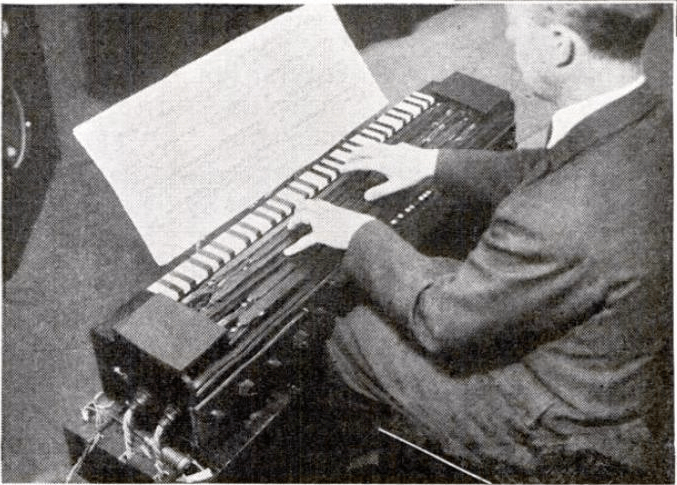
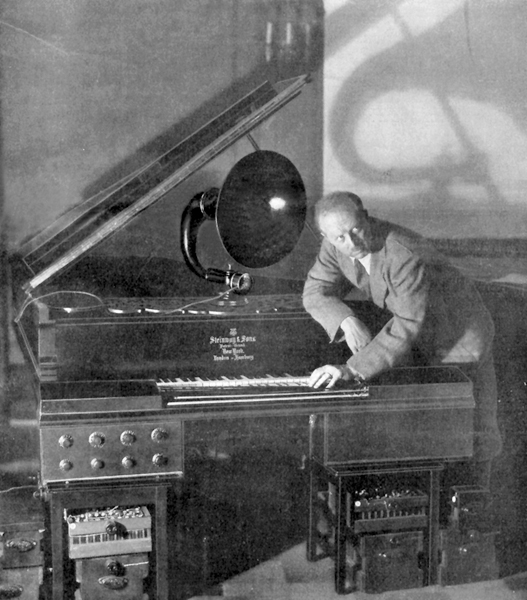
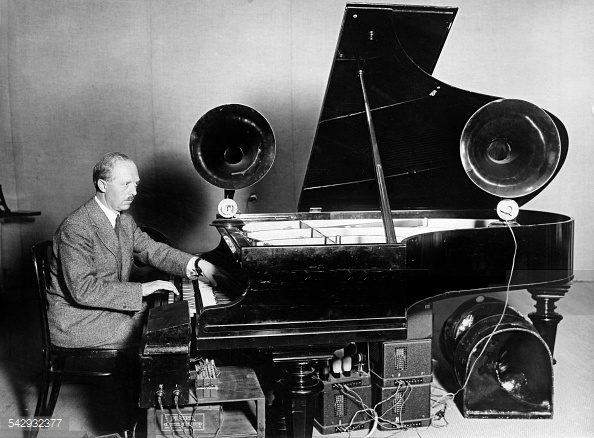
Lesti (L) and Tiedemann’s (R) Trillion Tone Organ of 1931. Image: Radio Craft, January 1931.
The Radio Organ of a Trillion Tones (1931)
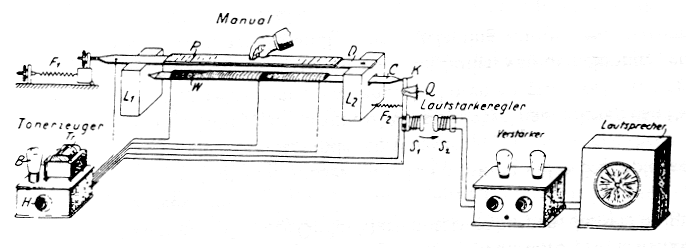
The Radio Organ of a Trillion Tones was created and developed by the Italian born electronic engineer Arnold Lesti and US inventor, F. Sammis in Hollywood, USA around 1931. The Radio Organ used a similar photo-electrical technique as the Celluphone, Superpiano and other variants and in Lesti’s later instruments – The Polytone(1934) and Singing Keyboard (1936) the designed with Frederick Sammis at RCA’s Phototone studios in Hollywood. 1Lesti, Arnold,(1931)Radio Organ of a Trillion Tones, radio Craft, january 1931, 402-3, 430.The The Radio Organ. however used a technique to generate more complex timbres than it’s rivals by projecting the light beam through two sets of glass disks – a ‘Pitch disk’ generating a pitched fundamental plus it’s ascending harmonics and a Timbre disk modifying the tone using a drawn representation of the sound wave of a real instrument (horn, violin, clarinet, oboe and a human voice). The principle was improved in Lesti and Sammis’ development of the Trillion Tone Organ called the Polytone. 2 Davies, Hugh, (2014), Radio Organ of a Trillion Tones, Grove Dictionary of Musical Instruments, Oxford University Press, 216.
Radio Craft Magazine’s impression of the Trillion Tone Organ. Image: Radio Craft, January 1931.Diagram of the photo-electrical technique of the Trillion Tone Organ. Image: Radio Craft, January 1931.
References:
1
Lesti, Arnold,(1931)Radio Organ of a Trillion Tones, radio Craft, january 1931, 402-3, 430. ↩︎
2
Davies, Hugh, (2014), Radio Organ of a Trillion Tones, Grove Dictionary of Musical Instruments, Oxford University Press, 216. ↩︎
The original Hammond Organ was Designed and built by the ex-watchmaker Laurens Hammond and John M Hanert in April 1935. Hammond set up his ‘Hammond Organ Company’ in Evanston, Illinois to produce electronic organs for the ‘leisure market’ and in doing so created one of the most popular and enduring electronic instruments ever built.
Hammond’s machine was designed using technology that relates directly to Cahill’s ‘Telharmonium’ of 1900, but, on a much smaller scale. The Hammond organ generated sounds in the same way as the Telharmonium, the tone wheel – The tone generator assembly consisted of an AC synchronous motor connected to a gear train which drove a series of tone wheels, each of which rotated adjacent to a magnet and coil assembly. The number of bumps on each wheel in combination with the rotational speed determined the pitch produced by a particular tone wheel assembly. The pitches approximate even-tempered tuning.
This method of creating tones was maintained until the mid 1960’s when transistors replaced tone wheels
The Hammond had a unique drawbar system of additive timbre synthesis (again a development of the Telharmonium) and stable intonation – a perennial problem with electronic instruments of the time. A note on the organ consisted of the fundamental and a number of harmonics, or multiples of that frequency. In the Hammond organ, the fundamental and up to eight harmonics were available and were controlled by means of drawbars and preset keys or buttons.A Hammond console organ included two 61-key manuals; the lower, or Great, and upper, or Swell, and a pedal board consisting of 25 keys. The concert models had a 32-key pedalboard. Hammond also patented an electromechanical reverb device using the helical torsion of a coiled spring, widely copied in later electronic instruments.
As well as being a successful home entertainment instrument, The Hammond Organ became popular with Jazz, Blues and Rock musicians up until the late 1970’s and was also used by ‘serious’ musicians such as Karlheinz Stockhausen in “Mikrophonie II”
Léonce Lavallée’s Sonothèque or ‘sound library’ was a “coded performance electronic instrument using photo-electric translation of engraved grooves”. The instrument was capable of reading music and sounds encoded graphically with conductive ink sensed by a set of electrically charged brushes – a graphic encoding method that was used a decade later by John Hanert with theHanert Electric Orchestra. 1Rhea, Thomas La Mar (1972) The Evolution of Electronic Musical Instruments in the United States. PhD Dissertation, George Peabody College for Teachers.
The instrument was patented (FR806076) in 1936 as Dispositif pour la reproduction sonore d’une partition de musique avec utilisation d’enregistrement de sons élémentaires or ‘Device for the sound reproduction of a musical score using the recording of elementary sounds’ and, according to Le Caine was demonstrated in Paris in 1929:
“The first public demonstration of “synthetic music” made by electronic devices was at the Paris Exposition of 1929, where a roll-operated device consisting of four monophonic electronic oscillators was shown with great success. Following the basic patent covering this device,*” there are other similar French patents. In one of these,“ a number of different devices are described, that allow the composer or arranger to draw by hand the sound envelope. In one form of the invention, the arranger engraves a groove in a suitable support which varies either in depth or in position at right angles to the time axis. When the music is reproduced, a needle following the groove operates an optical wedge to control the light passing through a sound-on-film recording to a photocell. In another form of the invention, the arranger draws by hand in conductive ink, a mark of varying width or position which is read by a series of brushes to set up the sound envelope. As a sound source, the inventor uses a “sound library” (sonothéque) consisting of suitable supports on which are recorded by any known method the various notes of the various instruments, in addition to vocal sounds and other noises. As an alternative, synthesis from pure tones is mentioned.”2Le Caine, Hugh (1956) Electronic Music, Proceedings of the IRE, 44, 457–78.
References:
1
Rhea, Thomas La Mar (1972) The Evolution of Electronic Musical Instruments in the United States. PhD Dissertation, George Peabody College for Teachers. ↩︎
2
Le Caine, Hugh (1956) Electronic Music, Proceedings of the IRE, 44, 457–78. ↩︎
Bruno Helberger playing the two-voice version of the Hellertion
The Hellertion (1929)
The Hellertion, (sometimes Helertion ) christened after the combination of the inventor’s names, was a monophonic vacuum tube instrument developed collaboratively by Peter Lertes, an electrical engineer in Leipzig and Bruno Helberger from Frankfurt, a well-known pianist of his time. Helberger was inspired to build the instrument after witnessing Termen’s Theremin– possibly at the Neue Frankfurt exhibition in 1927. 1 Donhauser, Peter, Elektrische Klangmaschinen. Die Pionierzeit in Deutschland und Österreich, Böhlau, Wien, 2007, 46. Several variants of the instrument were constructed and promoted through a licensing arrangement with the Schneider-Opel AG radio company in Frankfurt, who positioned the new instrument as ‘a portable, multi-voice instrument that can be connected to any radio with record amplification’. Although the deal eventually fell through with the collapse of Schneider-Opel in 1932, the Hellertion can be seen as the world’s first commercially produced electronic musical instrument.
Bruno Helberger with an early version of a single voice the Hellertion designed as a grand piano attachment.
The Hellertion was the first electronic instruments to use a fingerboard / continuous controller instead of a keyboard manual a feature that was to influence the design of later electronic instruments particularly Trautwein’s Trautonium (essentially a licensed derivation of the Hellertion, a fact confirmed by the backplate of the 1930 version of the Trautonium recognising Lertes & Helberger’s patent) and the soviet instrument called the Sonar.
The Helberger-Lertes patent acknowledgment on the back of the Trautonium ELA T42
The fingerboard consisted of a flat metal resistance strip covered in leather which when pressed completed a circuit. Depending on where the strip is pressed, a different resistance in the circuit is created altering the voltage sent to the oscillator and thereby producing different pitches. The force of the pressure controlled the volume of the output signal. The fingerboard was marked to help the performer find the correct pitch on the strip and had a range of approximately five octaves.
The wire manual of the Hellertion with an added key reference guide. (image; Radio Wien. 1932)
Helberger and Lertes at the 4 voice version of the Hellertion 1932. (image; Radio Wien. 1932)
The original instrument had just one fingerboard strip which was gradually increased to four and then on the later models, six aligned in parallel horizontally at the height of a piano keyboard. The four and six strip models allowed four and six voice polyphony when the strip could be played simultaneously with fingers and thumbs. The Hellertion was occasionally used in concerts as a piano addition, the melody being played with one hand on the Hellertion and the accompaniment being played with the other hand on the piano. A version of the Hellertion was produced in 1931 microtonally tuned to 10 divisions of an octave.
Diagram showing the sliding control of an early model of the Hellertion.
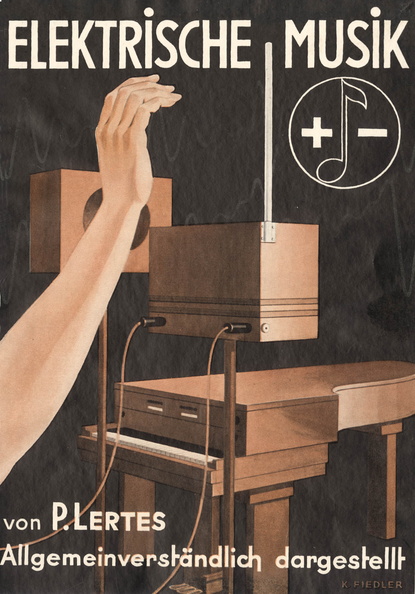
Peter Lertes’ book on Electronic Music “Elektrische Musik. Eine gemeinverständliche Darstellung ihrer Grundlagen, des heutigen Standes der Technik und ihrer Zukunftsmöglichkeiten, etc” 1933.2“Elektrische Musik: Ein gemeinverständliche Darstellung ihrer Grundlagen, des heutigen Standes der Technik und ihre Zukunftsmöglickkeiten”, Theodor-Steinkopff-Verlag, Dresden & Leipzig, 1933
The Hellertion premiered at a broadcast at Südwestdeutsche Rundfunk (SDR) on 20 November 1930 with where it was described as a new electro-acoustic instrument could be used ‘not just for Hausmusik (domestic music ensembles) but also for soundtracks for films’ and ‘a serious competitor to the cinema organ’.3 “Das Hellertion, ein neues electrisches Musikinstrument,” Funkbastler, July 3, (1931). However the tone quality of the instrument was criticised especially the tone-slip of the player on the wire-controller ‘could be tormenting for the ear’.4 Donhauser, Peter, Elektrische Klangmaschinen. Die Pionierzeit in Deutschland und Österreich, Böhlau, Wien, 2007, 49.
Patent documents of the Hellertion
The Heliophon (1936)
Bruno Helberger’s ‘Heliophon’
At the outbreak of war where around 1940 began constructing an enhanced version of the Hellertion he called the Heliophon. Helberger continued the development of the Hellertion creating an enhanced keyboard version of the Hellertion he called the Heliophon. The first version of the Heliophon was completed in Berlin, 1936, but destroyed during WW2. Helberger moved to Hörzendorf in Austria where he constructed a second model Heliophon in 1947 and continued the development of the instrument until his death in Vienna in 1951 (subsequent development was taken over by Wolfgang Wehrmann).
A later 1950s (?) version of the Heliophon From the collection of Technisches Museum Wien. Image: (c) Technisches Museum Wien
The sound of Heliophon was produced, as with the Hellertion, by heterodyning vacuum tube oscillators but with the Heliophon the sound was controlled by two 58 note pressure sensitive keyboard manuals instead of a series of fingerboard strips. Each keyboard had the ability to be split into three different pitches and timbres simultaneously, the output volume being controlled by foot pedals with a knee lever to add vibrato. Each keyboard had a Hellertion style fingerboard to add glissando and timbre variations which gave the instrument a remarkable versatility, apparently capable of producing realistic imitations of orchestral instruments as well as imitate human vocal sounds. The Heliophon was used by Helberger throughout the 1940s and ’50s for theatrical, film and musical productions.
The Heliophon on the soundtrack to Leopold Rudolf’s Der Rabe 1951
Helberger’s patent documents for the Heliophon
Sources:
1
Donhauser, Peter, Elektrische Klangmaschinen. Die Pionierzeit in Deutschland und Österreich, Böhlau, Wien, 2007, 46. ↩︎
2
“Elektrische Musik: Ein gemeinverständliche Darstellung ihrer Grundlagen, des heutigen Standes der Technik und ihre Zukunftsmöglickkeiten”, Theodor-Steinkopff-Verlag, Dresden & Leipzig, 1933 ↩︎
3
“Das Hellertion, ein neues electrisches Musikinstrument,” Funkbastler, July 3, (1931). ↩︎
4
Donhauser, Peter, Elektrische Klangmaschinen. Die Pionierzeit in Deutschland und Österreich, Böhlau, Wien, 2007, 49. ↩︎
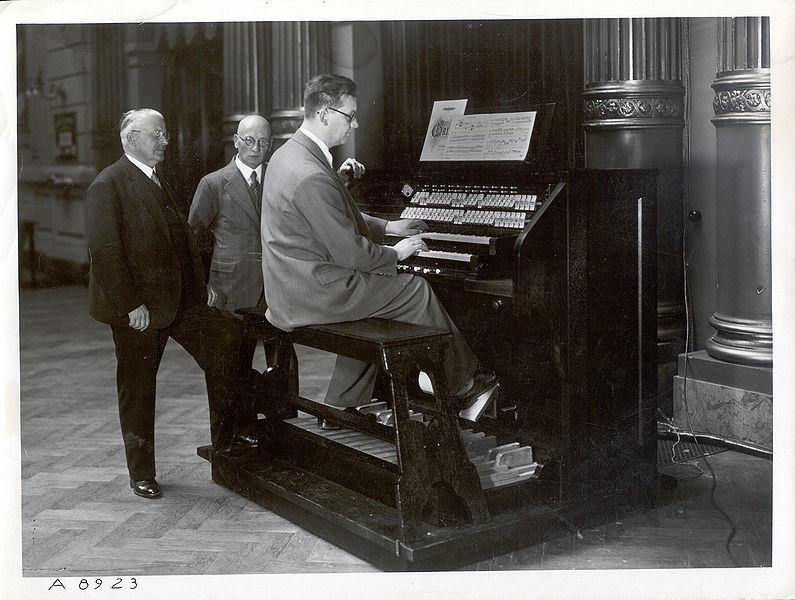
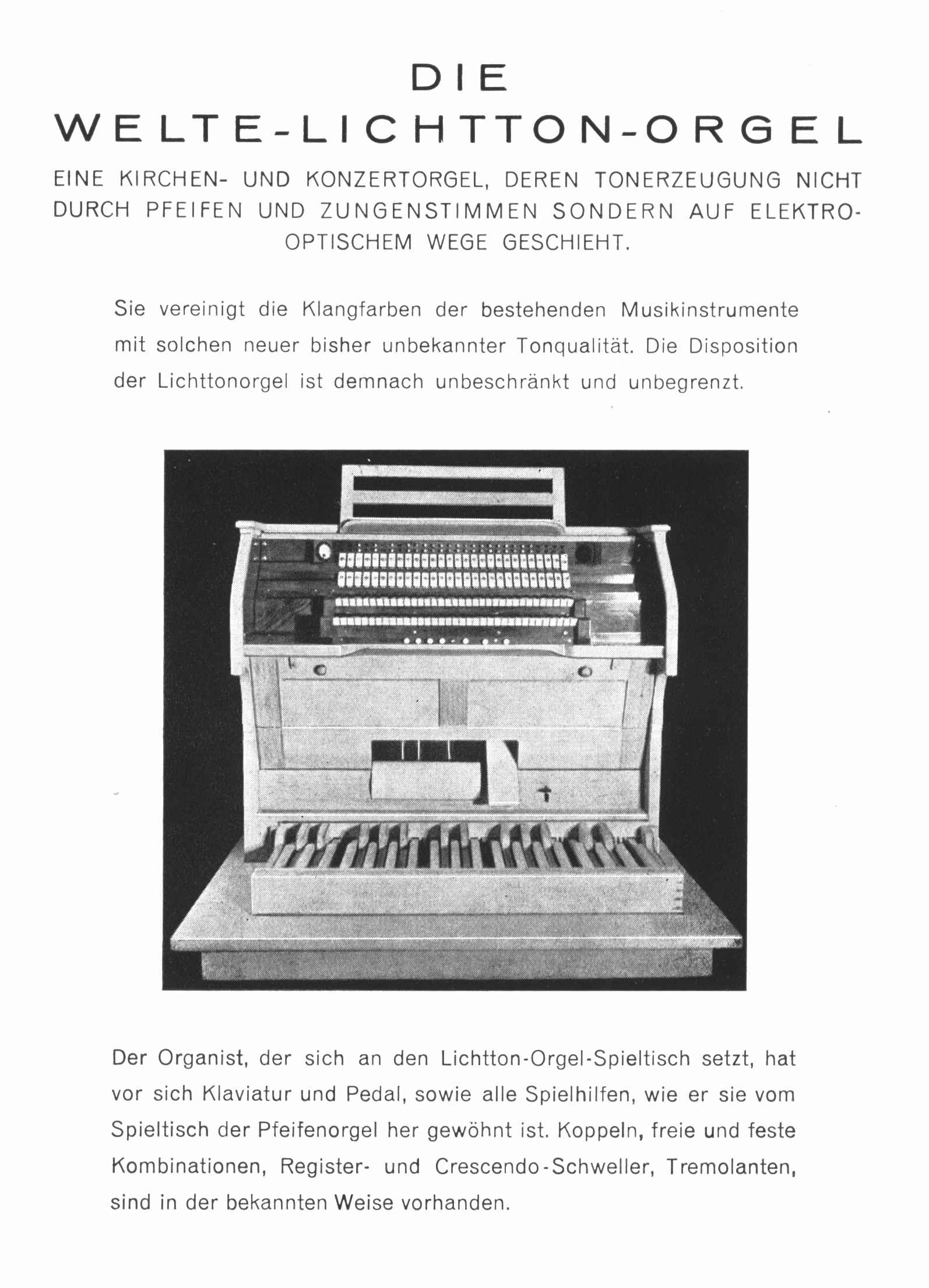
L-R Edwin Welte, technical consultant Wilhelm Faass and the Organist Richard Neumann at a Telefunken press presentation of the “Welte Licht-Ton Orgel” in 1936. Image: Augustinermuseum Freiburg.
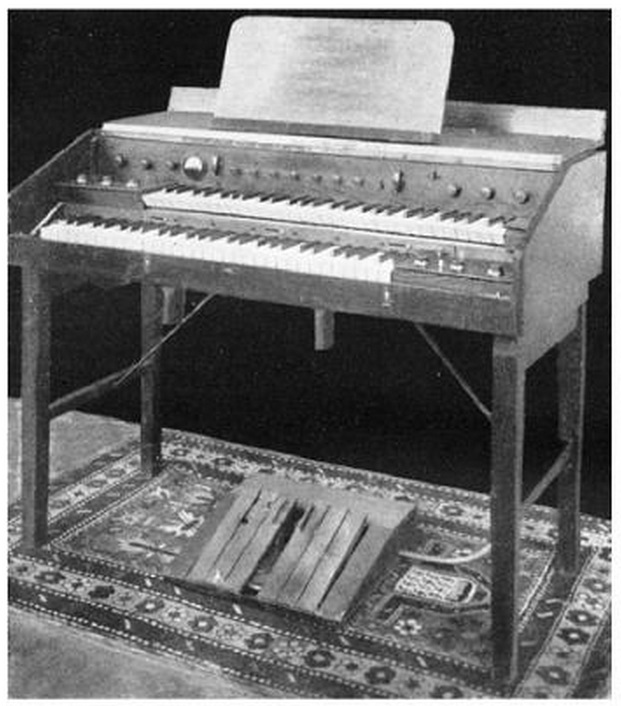
The Welte Licht-Ton-Orgel (Welte Light-Tone organ) was one of the last instruments designed by Edwin Welte (1876-1958), the famous founder of the Welte-Mignon mechanical instrument manufacturer. Welte had become fascinated with the possibility of using optical disks since 1925 and produced a number of prototypes using clay optical disks before completing the glass-disk-based production version of the Licht-Ton-Orgel. The sounds of the Licht-Ton-Orgel consisted of photographically drawn ‘recordings’ of different models of famous organs of the day, but in theory could play back any recording of any instrument.
Welte working on an early prototype of the disc reading mechanism of the Light-ton orgel. Image:Donhauser, Peter (2007) Elektrische Klangmaschine, Die Pionierzeit in Deutschland und Österreich, Böhlau Verlag, 171.
The organ premiered on November 6th 1936 at the Berlin philharmonic played by the virtuoso German organist Kurt Grosse and received enthusiastic review from the National Socialist newspaper the Völkische Beobachter (9. November 1936) “ A unique miracle, perfection in the entire realm of concert instruments” and speculated that it would be a perfect instrument for National Socialist rallies – on the strength of this endorsment, The German Telefunken comany negotiated a production deal. Any potential the instrument had was destroyed by the Nazi’s discovery of Welte’s marriage to a German Jew and Telefunken’s immediate withdrawal of their contract. After the war, Welte continued to try to make the instrument a commercial success, but eventually foundered due to the complexity of the photoelectric system and increasing competition from cheaper, more efficient instruments such as the Hammond Organ. Welte. Only three production models of the Licht-Ton-Orgel were completed.
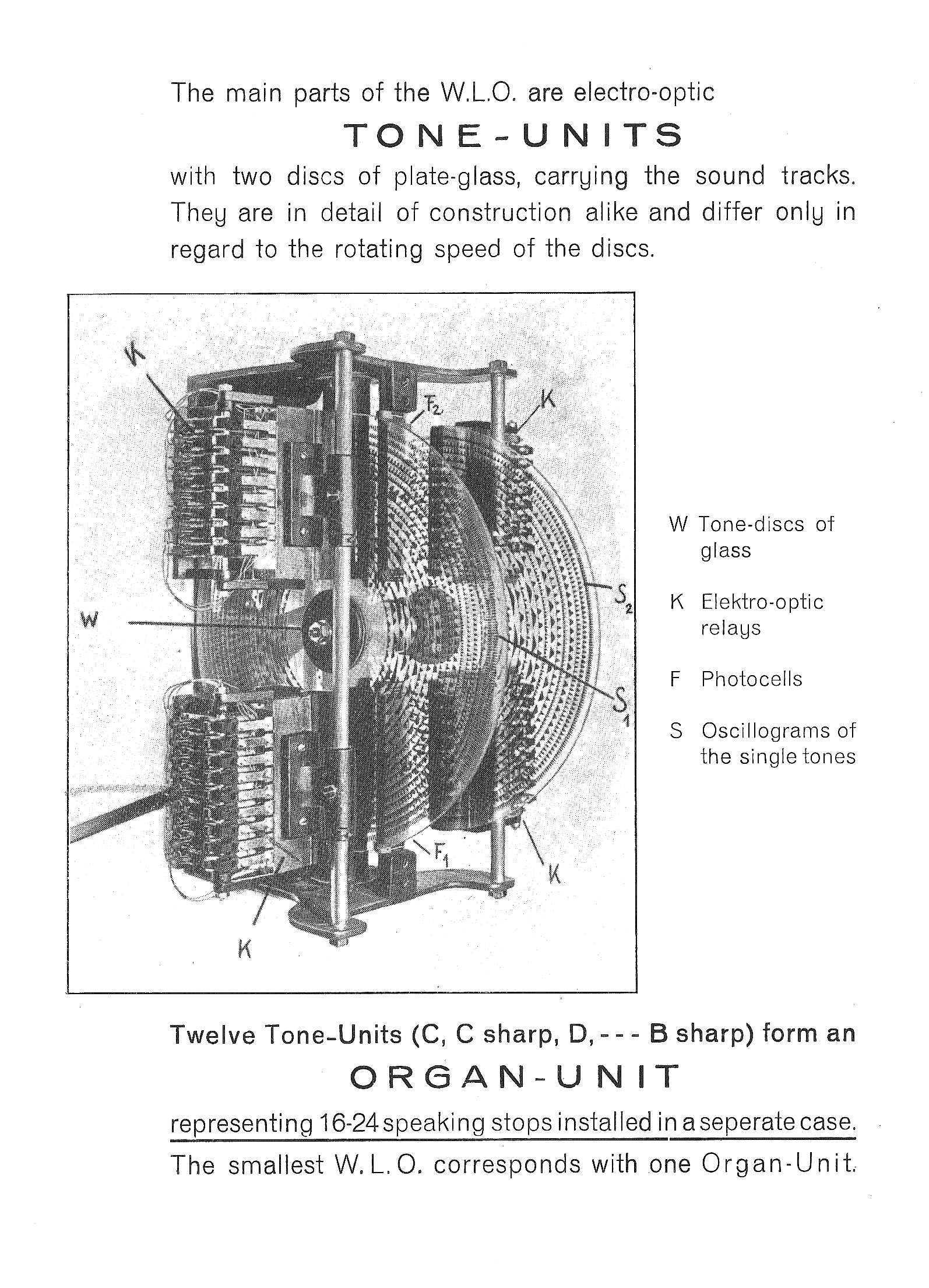
A detail of one of the Light Tone Organ’s glass disks. Image: Edwin Welte schuf die ideale Orgel. Funkshau, 1936, Nr. 48, S. 377-378.
The instrument’s sound-generating unit consisted of 12 glass disks, each printed with 18 different looped waveforms arranged in concentric rings. These glass “tone wheel” disks rotated over a series of photoelectric cells, which filtered a light beam to control the sound’s timbre and pitch. The resulting combinations of tones yielded three different timbres across all octave registers for each note on the keyboard. Unfortunately, the German branch of the Welte-Mignon company in Freiburg was completely destroyed by Allied bombing in 1944, resulting in the permanent loss of all the company’s closely guarded secret designs.1 Donhauser, Peter (2007) Elektrische Klangmaschine. Die PIonierzeit in Deutschland und Österreich, Böhlau Verlag, 169–184.
Light beam disk of the Licht-ton OrgelThe disc reading mechanism of the Licht-ton Orgel
Promotional brochure of Welte’s Licht-Ton-Orgel
Edwin Welte. March 28 1876 in Freiburg im Breisgau , † January 4 1958 in Freiburg im Breisgau
Biographical Information
Edwin Welte (1876-1958) and his brother-in-law, Karl Bockish, developed the Welte-Mignon reproducing piano in 1904 for M. Welte & Söhne of Freiburg, Germany. Music roll recording began in 1905. The recording piano and the reproducing system were entirely new inventions that astonished musicians and fans across Europe. In 1906, Welte established “The Welte Artistic Player Piano Company” in a showroom in New York, where he soon began producing pianos and music rolls for American customers.
The Welte Company
The Welte Company was a German organ manufacturer founded in 1832 in Vörenbach, located in the Black Forest, by automata designer Michael Welte (1807-1880). In 1865, he relocated the company to Freiburg/Breisgau, where it was registered under the name M. Welte & Söhne. Throughout the remainder of the 19th century, the company expanded significantly and became particularly renowned for its orchestrions.
Welte’s “Cabinet Player,” a reproducing piano without a keyboard that carried the Mignon label, was patented in 1904 while Edwin Welte (1876-1958), the founder’s grandson, was in charge. The prototype was showcased in Leipzig in late 1904 and became commercially available by early 1905. The Vorsetzer, another innovation, was introduced in 1908.
In 1909, the Mignon technology was integrated into their upright pianos, and in 1913, it was incorporated into their grand pianos. In 1908, the technology was also adapted for the Welte “Philharmonic Autograph Organ,” which served as a precursor to the “Welte-Philharmonie Organ.” This organ was first publicly displayed at the Turin Exhibition of 1911. The company successfully marketed player organs, cinema organs, and, in response to a contracting market during the 1930s, church organs.
Simultaneously, they produced rolls of performances by some of the era’s greatest organists and sold them with significant commercial success. From 1865 to 1917, they also operated a branch in New York called M. Welte & Sons, led by Emil Welte (1841-1923), the founder’s eldest son. However, this branch was closed during World War I as it was considered an “alien enterprise.”
Welte factory in Freiburg, Germany
Welte’s instruments became status symbols and represented the pinnacle of entertainment during their time. They were installed in grand residences, palaces, schools, department stores (including Harrods in London), yachts, and ships—one instrument was even manufactured justtoo late to be aboard the Titanic. Additionally, they found their way into a “house of pleasure,” specifically the Atlantic Garden orchestrion. Welte’s creations were distributed globally, with a market that extended beyond Europe and the USA to Istanbul, Russia, China, and Sumatra.
At the top of Welte’s orchestrion and player-organ range was the Welte-Philharmonie. Very few of the full-sized models were ever manufactured. However, starting around 1926, Welte began to face threats from the rapidly growing radio and recording industry. This led to a significant decline in business, and by 1932, the company narrowly avoided bankruptcy. During this period, Welte also collaborated with the Telefunken Company to develop electronic organs. This partnership was ultimately terminated due to the circumstances surrounding Edwin Welte’s first wife, Betty Dreyfuss, who was Jewish.2 The History of M. Welte & Sons, Freiburg and New York, https://www.welte-mignon.de/ retrieved: 22-02-2026]
The stalled collaboration aimed to create electronic organs using (analogue) sampling and photo-cells—truly innovative concepts for that time. Had Welte succeeded, they might have eliminated the Hammond organ from history. However, it was World War II that ultimately led to the company’s downfall. In November 1944, the British bombing annihilated the Freiburg premises, including all stock, instruments, and historical documents. The bombed-out factory remained a landmark near the Freiburg railway station for almost a decade, until the mid-1950s. 3 https://www.musikautomaten.ch/ retrieved 02/22/2026
Sources
1
Donhauser, Peter (2007) Elektrische Klangmaschine. Die PIonierzeit in Deutschland und Österreich, Böhlau Verlag, 169–184. ↩︎
2
The History of M. Welte & Sons, Freiburg and New York, https://www.welte-mignon.de/ retrieved: 22-02-2026] ↩︎
Harald Bode was an important figure in the development of electronic musical instruments in Germany during the late 1930s and later in the USA in the post WWII era. He had a major role in the designs of polyphonic electronic organs and after moving to the USA, went on to influence the designs of commercial synthesisers with his concepts of modular synthesis and one volt per octave controls adopted by Robert Moog and Donald Buchla in the 1960s.
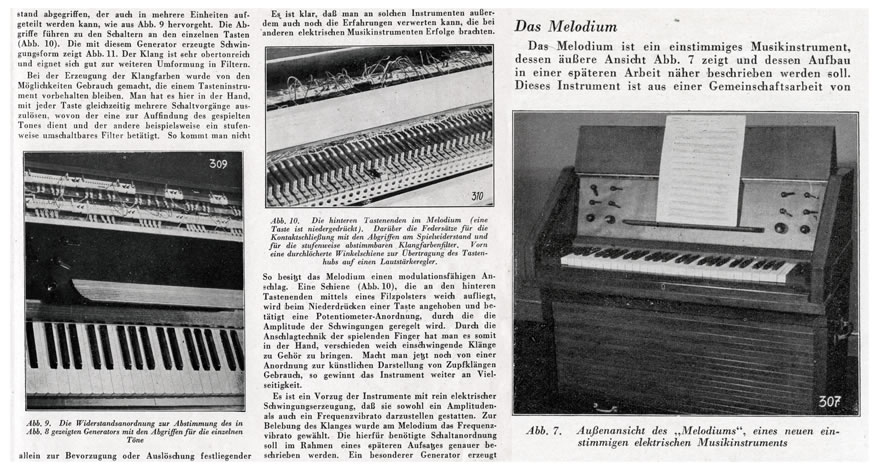
Bode’s second instrument built with the help of Oskar Vierling and Fekko von Ompteda after his studies at the Hienrich Herz Institut Berlin, was a simplified version of the 1937 Warbo Formant Orgel which dispensed with the complexities and cost of the original instruments four note polyphony and replaced it with a monophonic capability that focussed on timbre and sound shape:
“Its monophonic design arose from a technical liability of the Warbo Formant Organ. [He] realized that a monophonic instrument would present far fewer tuning problems than the radical Formant Organ.” (1 Rhea, Thomas L. (1980) Electronic Perspectives: Bode’s Melodium and Melochord, Contemporary Keyboard , January 1980), 68.
Launched in 1938 the instrument was used extensively for film music and ‘light music’ during the 1940’s.
Bode had designed oscillators with good pitch stability given the technology of the time, but he realized that a monophonic instrument would present far fewer tuning problems than his radical Warbo Organ. Like all good designers, Bode understood the necessity for providing increased nuance capability in a solo instrument; hence, touch sensitivity. The Melodium had a 49-note keyboard (low-note priority). But unlike traditional keyboards, each key had a fulcrum, or pivot point, not at the rear of the key, but at its midpoint. Each key was an individual little teeter-totter; when the performer depressed any key, he or she could seesaw a long aluminium rail located at the rear of all keys up and down. This rail made contact with a strip of felt soaked in glycerine — a so-called “liquid potentiometer.” Depression of the felt altered the electrical resistance between two electrodes, providing loudness control. This was a direct keying system that should not be confused with modern force-sensitive keyboards found on certain synthesizers. On the Melodium, the actual onset of sound was begun like it is on most acoustic instruments: as a function of the performer’s continuously variable mechanical effort. This is unlike most of today’s synthesizers; they have electronic envelope generators with fixed time constants for attack and release. Even when a synthesizer is force-sensitive, this sensitivity is usually in conjunction with the unvarying envelope generator attack and release. 2Rhea, Thomas L. (1980) Contemporary Keyboard magazine, January 1980, 68.
The articulation on the Melodium has been likened to that of Franklin’s Glass Harmonica, an instrument having rotating glass disks that are played with moistened fingers. This characteristic singing (slow) attack, and the tone colours produced by formant filters borrowed from the earlier four-note Warbo Formant Orgel, made the Melodium an expressive and colourful instrument that found public acceptance. Bode said:
.”[.. ]It was a very responsive instrument to the playing of the artist, although it didn’t have these automatic — or maybe because it didn’t have these automatic [envelope] — controls.” 3Rhea, Thomas L. (1980) Contemporary Keyboard magazine, January 1980, 68.
Due to its unorthodox design, the Melodium was not suitable for mass production, however, it enjoyed a considerable vogue with German film score composers and was used in stage plays and on German radio. The brief career of the Melodium ended in 1941 due to the war and eventually Bode cannibalized the instrument due to the scarcity of electronic components for his new instrument the Melochord.
The “Melodium” (1938)
Harald Bode. Biographical notes
Harald Bode; October 19, 1909 Hamburg Germany – January 15, 1987 New York USA.
Harald Bode (Born: Hamburg October 19, 1909 – Died: New York, January 15, 1987) studied mathematics, physics and natural philosophy at Hamburg University, graduating in 1934. In 1937, with funding support provided by the composer and band-leader, Christian Warnke, Bode produced his first instrument the Warbo-Formant Orgel (‘Warbo’ being a combination of the names Warnke and Bode). Bode moved to Berlin in 1938 to complete a postgraduate course at the Heinrich Hertz Institute where he collaborated with Oskar Vierling and the light music composer, organist and Trautonium virtuoso, Fekko von Ompteda. During this period Bode developed the Melodium ; a unique monophonic touch-sensitive, multi-timbral instrument used extensively in film scores of the period.
When WWII started in 1939 Bode worked on military submarine sound and wireless communication projects “…We had the only choice in Germany, to go to military service or do work for the government. I praise myself lucky, that I was able to go to the electronic industry” 4Finch, James. (1980) Interview with Harald Bode, Syne Magazine, International Electronic Music Association (IEMA). and moved to the small village Neubeuern in southern Germany, where in 1947 Bode built the first European post-war electronic instrument, the Melochord. In 1949 Bode joined the AWB company where he created the Polychorda simpler, polyphonic version of the Melochordwhich was followed by the Polychord III in 1951 and the Bode Organ, a commercial organ which became the prototype for the famous Estey Electronic Organ. After leaving AWB, Bode’s designs included the Tuttivox, a miniature electronic organ and collaborated on a version of George Jenny’s Clavioline, both big sellers throughout Europe.
In 1954 Bode moved to the USA, settling in Brattleboro, Vermont where he lead the development team (and later, became Vice President) at the Estey Organ Corporation. In 1958, while still working at Estey, Bode set up the Bode Electronics Company where in March 1960 he created another unique instrument; a modular synthesiser “A New Tool for the Exploration of Unknown Electronic Music Instrument Performances” known as the ‘Audio System Synthesiser’ which Robert Moog used as the basis for his line of new Moog synthesisers.
After the Estey Organ Company foundered in 1960, Bode joined the Wurlitzer Organ Co and moved to Buffalo, New York where he was one of the first engineers to recognise the significance of transistor based technology in electronic music. Bode’s concepts of modular and miniature self-contained transistor based machines was taken up and developed in the early 1960’s by Robert Moog and Donald Buchla amongst others. 1962 saw the beginning of a long collaboration between Bode and the composer Vladimir Ussachevsky at the Columbia Princeton Center for Electronic Music which lead to the development of innovative studio equipment designs such as the ‘Bode Ring Modulator’ and ‘Bode Frequency Shifter’. The commercial versions of these inventions were produced under the Bode Sound Co and under license Moog Synthesisers.
Harald Bode retired in 1974 but continued to pursue his own research. In 1977 he created the ‘Bode Vocoder’ (licensed as the ‘Moog Vocoder’). In 1981 he developed his last instrument, the ‘Bode Barber Pole Phaser’.
References
1
Rhea, Thomas L. (1980) Electronic Perspectives: Bode’s Melodium and Melochord, Contemporary Keyboard , January 1980), 68. ↩︎
2
Rhea, Thomas L. (1980) Contemporary Keyboard magazine, January 1980, 68. ↩︎
3
Rhea, Thomas L. (1980) Contemporary Keyboard magazine, January 1980, 68. ↩︎
4
Finch, James. (1980) Interview with Harald Bode, Syne Magazine, International Electronic Music Association (IEMA). ↩︎
Jörg (Georg Adam) Eichstätt Mager born November 6, 1880 Aschaffenburg, Bavaria, Died Aschaffenburg 1939
Little information survives of Jörg Mager’s last instrument the ‘Kaleidophon’ which he completed in 1939. The instrument was probably destroyed by allied bombing of Mager’s Darmstadt headquarters. The only references survives as notess “…a monophonic electronic instrument with kaleidoscopic sound mixtures following the tonal precepts of Arnold Schoenberg and Ferruccio Busoni.”
The Hammond Novachord was manufactured by the Hammond Organ Co in the USA from 1939 to 1942, designed by Laurens Hammond, John Hanert and C.N.Williams. A total of 1096 models were built.The Novachord was a polyphonic electronic organ and was Hammonds first electronic tube based instrument – a departure from his usual tone-wheel designs. The Novachord was a much more complex instrument than the Solovox Hammond’s other electronic tube-based instrument. The Novachord had 169 vacuum tubes to control and generate sound and was played on a seventy two note keyboard with a simple pressure sensitive system that allowed control over the attack and timbre of the note. The sound was produced by a series of 12 oscillators that gave a six octave range using a frequency division technique; the Novachord was one of the first electronic instruments to use this technique which was later became standard in electronic keyboard instruments.
Novachord fron panel
The front panel of the instrument had a series of 14 switch-able rotary knobs to set the timbre, volume, ‘resonance’,bass/treble, vibrato (six modulation oscillators were used) and ‘brightness’ of the sound. A set of 3 foot operated pedals controlled sustain,and volume the third pedal allowing control of the sustain by either foot. The final signal was passed to a pre-amplifier and then to a set of internal speakers. The Novachord was able to produce a range of sounds imitating orchestral instruments such as the piano, harpsichord, stringed and woodwind instruments as well as a range of it’s own new sounds. In May 1939 ‘The Novachord Orchestra’ of Ferde Grofé performed daily at the Ford stand at the New York World Fair with four Novachords and a Hammond Organ and in Adrian Cracraft’s ‘All Electronic Orchestra’, the Novachord also featured in several film scores (Hans Eisler’s “Kammersinfonie” 1940) but seems to have fallen from favour due to the instability of it’s multiple tube oscillators and playing technique. The Novachord was discontinued in 1942. A Hammond employee comments:
“The Novachord made beautiful music if played well, but it was not well adapted either to either an organists style or a pianists style. Thus it required development of a specific style, which not many musicians were prepared to do. it also had technical problems, requiring frequency adjustments to keep it operating chiefly because the frequency dividers and electronic components before the war were not nearly as good as those available in later years. The hammond Organ Company could have revived it after the war, and could have made it better in light of available technology at the time, but sales had been disappointing ad so it was not considered a good commercial product”
The Hammond Novachord from a 1940s promotional brochure. Image :Dan Wilson, Hideaway Studio (www.hideawaystudio.co.uk)
Laurens Hammond and the Novachord in ‘Popular Mechanics’ magazine USA 1939The Novachord in ‘Popular Mechanics’ magazine USA 1939
Hammond Novachord in “New Horizons” 1940
A restored Novachord
Novachord Orchestra: Introduction of The Hammond Novachord at the New York World’s Fair 1939 – 1940.
Sources:
F.D.Merril jr: “The Novachord”, Electronics,xii/11 (1939),16