
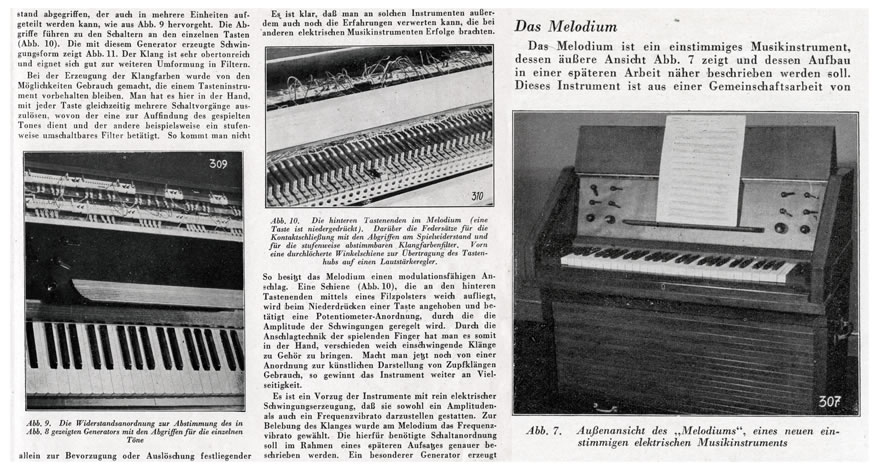
The articulation on the Melodium has been likened to that of Franklin’s Glass Harmonica, an instrument having rotating glass disks that are played with moistened fingers. This characteristic singing (slow) attack, and the tone colours produced by formant filters borrowed from the earlier four-note Warbo Formant Orgel , made the Melodium an expressive and colourful instrument that found public acceptance. Bode said:
.”[.. ]It was a very responsive instrument to the playing of the artist, although it didn’t have these automatic — or maybe because it didn’t have these automatic [envelope] — controls.” 3Rhea, Thomas L. (1980) Contemporary Keyboard magazine, January 1980, 68.
Due to its unorthodox design, the Melodium was not suitable for mass production, however, it enjoyed a considerable vogue with German film score composers and was used in stage plays and on German radio. The brief career of the Melodium ended in 1941 due to the war and eventually Bode cannibalized the instrument due to the scarcity of electronic components for his new instrument the Melochord.
Harald Bode. Biographical notes

Harald Bode (Born: Hamburg October 19, 1909 – Died: New York, January 15, 1987) studied mathematics, physics and natural philosophy at Hamburg University, graduating in 1934. In 1937, with funding support provided by the composer and band-leader, Christian Warnke, Bode produced his first instrument the Warbo-Formant Orgel (‘Warbo’ being a combination of the names Warnke and Bode). Bode moved to Berlin in 1938 to complete a postgraduate course at the Heinrich Hertz Institute where he collaborated with Oskar Vierling and the light music composer, organist and Trautonium virtuoso, Fekko von Ompteda. During this period Bode developed the Melodium ; a unique monophonic touch-sensitive, multi-timbral instrument used extensively in film scores of the period.
When WWII started in 1939 Bode worked on military submarine sound and wireless communication projects “…We had the only choice in Germany, to go to military service or do work for the government. I praise myself lucky, that I was able to go to the electronic industry” 4Finch, James. (1980) Interview with Harald Bode, Syne Magazine, International Electronic Music Association (IEMA). and moved to the small village Neubeuern in southern Germany, where in 1947 Bode built the first European post-war electronic instrument, the Melochord. In 1949 Bode joined the AWB company where he created the Polychord a simpler, polyphonic version of the Melochord which was followed by the Polychord III in 1951 and the Bode Organ, a commercial organ which became the prototype for the famous Estey Electronic Organ. After leaving AWB, Bode’s designs included the Tuttivox, a miniature electronic organ and collaborated on a version of George Jenny’s Clavioline, both big sellers throughout Europe.
In 1954 Bode moved to the USA, settling in Brattleboro, Vermont where he lead the development team (and later, became Vice President) at the Estey Organ Corporation. In 1958, while still working at Estey, Bode set up the Bode Electronics Company where in March 1960 he created another unique instrument; a modular synthesiser “A New Tool for the Exploration of Unknown Electronic Music Instrument Performances” known as the ‘Audio System Synthesiser’ which Robert Moog used as the basis for his line of new Moog synthesisers.
After the Estey Organ Company foundered in 1960, Bode joined the Wurlitzer Organ Co and moved to Buffalo, New York where he was one of the first engineers to recognise the significance of transistor based technology in electronic music. Bode’s concepts of modular and miniature self-contained transistor based machines was taken up and developed in the early 1960’s by Robert Moog and Donald Buchla amongst others. 1962 saw the beginning of a long collaboration between Bode and the composer Vladimir Ussachevsky at the Columbia Princeton Center for Electronic Music which lead to the development of innovative studio equipment designs such as the ‘Bode Ring Modulator’ and ‘Bode Frequency Shifter’. The commercial versions of these inventions were produced under the Bode Sound Co and under license Moog Synthesisers.
Harald Bode retired in 1974 but continued to pursue his own research. In 1977 he created the ‘Bode Vocoder’ (licensed as the ‘Moog Vocoder’). In 1981 he developed his last instrument, the ‘Bode Barber Pole Phaser’.
References
- 1Rhea, Thomas L. (1980) Electronic Perspectives: Bode’s Melodium and Melochord, Contemporary Keyboard , January 1980), 68.
- 2Rhea, Thomas L. (1980) Contemporary Keyboard magazine, January 1980, 68.
- 3Rhea, Thomas L. (1980) Contemporary Keyboard magazine, January 1980, 68.
- 4Finch, James. (1980) Interview with Harald Bode, Syne Magazine, International Electronic Music Association (IEMA).