Operation of the Singing Keyboard. Image: Radio Craft may 1936
Wurlitzer employee James Nutall and RCA engineer Frederick Sammis created the Singing Keyboard in 1936, a precursor of modern samplers, the instrument played electro-optical recordings of audio waves stored on strips of 35mm film. The Singing Keyboard was designed for use in film studios to create and preview sound effects and music before the final edit:
“Let us suppose that we are to use this machine as a special-purpose instrument for making “talkie” cartoons. At once it will be evident that we have a machine with which the composer may try out various combinations of words and music and learn at once just how they will sound in the finished work. The instrument will probably have ten or more sound tracks recorded side by side on a strip of film and featuring such words as “quack” for a duck, “meow” for a cat, “moo” for a cow. . . . It could as well be the bark of a dog or the hum of a human voice at the proper pitch.”1 Sammis, F,(1936) The Singing Keyboard, Radio Craft, May 1936, 617.
Sammis had moved to Hollywood in 1929 to lead RCA Phototone into the era of film sound. Sammis was already familiar with the Moviola, a sound- and film editing table that incorporated photoelectric cells. This photo-electrical technique was used by Sammis in a number of musical instruments – the Polytone, the Radio Organ of a Trillion Tones and here with the Singing Keyboard. Using methods that were being developed for the new ‘talkies’, he recorded sung and spoken words onto individual strips of film. He then attached the resulting strips to the keyboard in such a way that a specific strip would be drawn across the optical cell when he depressed a corresponding key.
Operation of the Singing Keyboard. Image: Radio Craft, May 1936. 617
The Singing Keyboard had a variable amount of keys depending on the model design and its intended use – film studio or home/office use:
“It will be noted that there is nothing unusual about the appearance for, in fact, it is simply an orthodox 5- octave organ keyboard with the usual electrically connected stop keys. The form of the console may be whatever taste dictates: this model was designed for the home of a “cliff dweller” in a New York City apartment, hence, the keys telescope into the cabinet when not in use. In a cabinet no larger than the one shown. as many as 3 manuals may be accommodated with all the necessary stops, couplers. etc.”
which each controlled a pre-recorded film soundtrack – sound, speech, music – which played back when the key was pressed and silently returned to the beginning of the recording when the key was released – a technique used in later analogue sample instruments such as the Mellotron and Chamberlin.2Davies, Hugh, (2014), The Singing Keyboard, Grove Dictionary of Musical Instruments, Oxford University Press, 523.
Biography: Frederick Minturn Sammis.
Born: 23-05-1877 Lexington, Greene, New York, United States – Died:1953 Santa Barbara, Ventura, California.
Frederick Minturn Sammis. Image: American Organist 02-1939, 50.
Sammis joined the Marconi Wireless Telegraph Company of America in 1902 and eventually promoted to Chief Engineer in 1910 – which at that time was mainly focussed on radio connections between shipping and land stations. in 1915, Sammis resigned from Marconi and joined The American Radio and Research Association (AMRAD) where he specialised in making radio receivers for the U.S. Navy and the domestic US market. Following the war, Sammis moved to Hollywood in order to work for RCA Photophone as their Pacific Coast Manager. RCA Photophone Inc. was a subsidiary of RCA, set up in 1928 in order to exploit the Photophone sound-on-film system. During this period, Sammis experimented with the musical aspects of sound film and created three musical instruments: the Radio Organ of a Trillion Tones (1930), the Polytone (1933) the Singing Keyboard (1936) and Electrone (1939). In 1940 he joined the Overseas Trading Corp, as resident agent in charge of the LA office. Sammis died in 1953 in Santa Barbara, Ventura, California.
3 The life and career of Frederick Minturn Sammis, Irelands Eye, https://irelandseye.ie/the-life-and-career-of-frederick-minturn-sammis, retrieved: 19-01-24.
References
1
Sammis, F,(1936) The Singing Keyboard, Radio Craft, May 1936, 617. ↩︎
2
Davies, Hugh, (2014), The Singing Keyboard, Grove Dictionary of Musical Instruments, Oxford University Press, 523. ↩︎
3
The life and career of Frederick Minturn Sammis, Irelands Eye, https://irelandseye.ie/the-life-and-career-of-frederick-minturn-sammis, retrieved: 19-01-24.↩︎
Leon Termen plays the ‘Theremin’ or ‘Thereminvox’ . Paris, 1927
The principles of beat frequency or heterodyning oscillators were discovered by chance during the first decades of the twentieth century by radio engineers experimenting with radio vacuum tubes. Heterodyning effect is created by two high radio frequency sound waves of similar but varying frequency combining and creating a lower audible frequency, equal to the difference between the two radio frequencies (approximately 20 Hz to 20,000 Hz). the musical potential of the effect was noted by several engineers and designers including Maurice Martenot, Nikolay Obukhov, Armand Givelet and the Russian Cellist and electronic engineer, Leon (or Lev) Sergeivitch Termen .
One problem with utilising the heterodyning effect (heterodyning is the effect where two high frequency signals are added producing a third audible tone which is the difference of the two high frequencies. This effect was the basis of many vacuum tube based electronic instruments.”) for musical purposes was that as the body came near the vacuum tubes the capacitance of the body caused variations in frequency.
Leon Termen realised that rather than being a problem, body capacitance could be used as a control mechanism for an instrument and finally freeing the performer from the keyboard and fixed intonation. Termen’s first machine, built in the USSR in 1917 was christened the “Theremin” (after himself) or the “Aetherophone” (sound from the ‘ether’) and was the first instrument to exploit the heterodyning principle.
The original Theremin used a foot pedal to control the volume and a switch mechanism to alter the pitch. This prototype evolved into a production model Theremin in 1920, this was a unique design, resembling a gramophone cabinet on 4 legs with a protruding metal antennae and a metal loop. The instrument was played by moving the hands around the metal loop for volume and around the antennae for pitch. The output was a monophonic continuous tone modulated by the performer. The timbre of the instrument was fixed and resembled a violin string sound. The sound was produced directly by the heterodyning combination of two radio-frequency oscillators: one operating at a fixed frequency of 170,000 Hz, the other with a variable frequency between 168,000 and 170,000 Hz. The frequency of the second oscillator being determined by the proximity of the musician’s hand to the pitch antenna. The difference of the fixed and variable radio frequencies results in an audible beat frequency between 0 and 2,000 Hz. The audible sound came from the oscillators, later models adding an amplifier and large triangular loudspeaker. This Theremin model was first shown to the public at the Moscow Industrial Fair in 1920 and was witnessed by Lenin who requested lessons on the instrument. Lenin later commissioned 600 models of the Theremin to be built and toured around the Soviet Union.
Termen left the Soviet Union in 1927 for the United States where he was granted a patent for the Theremin in 1928. The Theremin was marketed and distributed in the USA by RCA during the 1930’s as a DIY kit form or as a finished instrument ( later aficionados of the instrument included Robert Moog who made and sold transistorised Theremins in the 1950s). The heterodyning vacuum tube oscillator became the standard method of producing electronic sound until the advent of the transistor in the 1960’s and was widely used by electronic musical instrument designs of the period.
The Theremin became known in the USA as a home ‘novelty instrument’ and featured in many film soundtracks of the 1940-50’s, it also appeared in several pop records of the 1960’s but never overcame it’s novelty appeal; used for effect rather than as a ‘serious instrument’, most recordings employ the Theremin as a substitute string instrument rather than exploiting the microtonal and pitch characteristics of the instrument. Leon Sergeivitch Termen went on to develop variations on the original Theremin which included the “Terpsitone“, The “Rhythmicon“, the “keyboard Theremin” and the “Electronic Cello”.
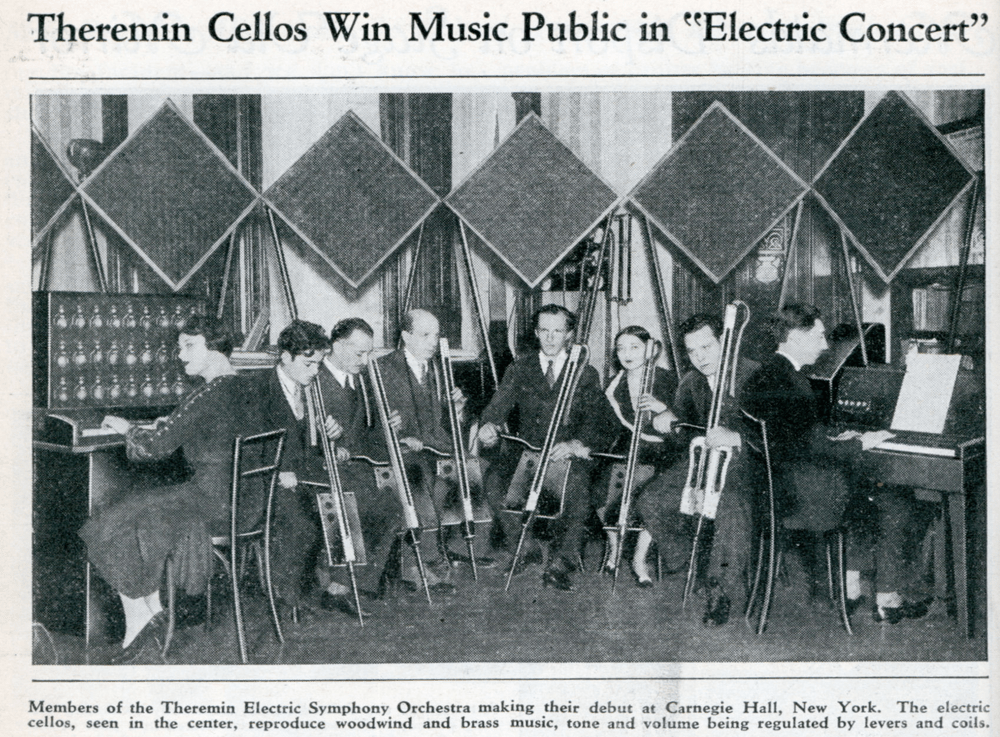
Theremin Orchestra, Carnegie Hall. C1930
Images of the Theremin
Lev Termen and Theremin virtuoso Clara Rockmore
Leon Sergeivitch Termen. 1896 – 1993
Theremin Orchestra, Carnegie Hall. C1930
Leon Termen plays the ‘Theremin’ or ‘Thereminvox’ . Paris, 1927
Promotional brochure for the RCA Theremin
1930s Promotional brochure for the RCA Theremin. Images: FTL Design, History of Technology – https://ftldesign.com/Theremin/
1930s Promotional brochure for the RCA Theremin. Images: FTL Design, History of Technology – https://ftldesign.com/Theremin/
1930s Promotional brochure for the RCA Theremin. Images: FTL Design, History of Technology – https://ftldesign.com/Theremin/
1930s Promotional brochure for the RCA Theremin. Images: FTL Design, History of Technology – https://ftldesign.com/Theremin/
1930s Promotional brochure for the RCA Theremin. Images: FTL Design, History of Technology – https://ftldesign.com/Theremin/
1930s Promotional brochure for the RCA Theremin. Images: FTL Design, History of Technology – https://ftldesign.com/Theremin/
Biographical Information: Leon Sergeivitch Termen. 1896 – 1993
The story of Lev Sergeivitch Termen is like some nightmarish John LeCarre novel. Prof. Termen was born in the Russian city of St Petersberg in 1896, he would become one of the most important pioneers in the development of electronic music through his instrument the Thereminvox (commonly referred to as the Theremin). Prof. Termen first invented a prototype Thereminvox in 1920, he worked upon his invention for the next few years, whilst also relocating from Russia to New York. A US patent was granted to Termen for the invention of the Thereminvox in 1928. Termen set up a studio there catering to high society patrons from whom he would extract the moneys he used to continue his experiments. His New York studio apparently was kitted out with a variety of devices, that in the late twenties must have seemed like pure science fiction: a variety of electronic audio devices; electronic lighting shows; an electronic dance platform; even a prototype colour television system.
Lev Termen and Theremin virtuoso Clara Rockmore
In 1938 Termen was rumoured to have been kidnapped in the New York apartment he shared with his American wife (the black ballet dancer, Iavana Williams) by the NKVD (forerunners of the KGB). Infact he returned to Russia for tax and financial problems in the USA as well as his concerns over the coming war.
“I left New York because at that time the war was coming. The military troops of the fascists were approaching Leningrad, and so on. I asked to be sent to the Soviet Union so as to make myself useful, I asked many times. For a whole year I asked to be sent back. The war had already started, and they didn’t send me, they didn’t send me. Then at last they permitted me. They assigned me to be an assistant to the captain of a large motor ship. So I went home, but they did not take my wife.”
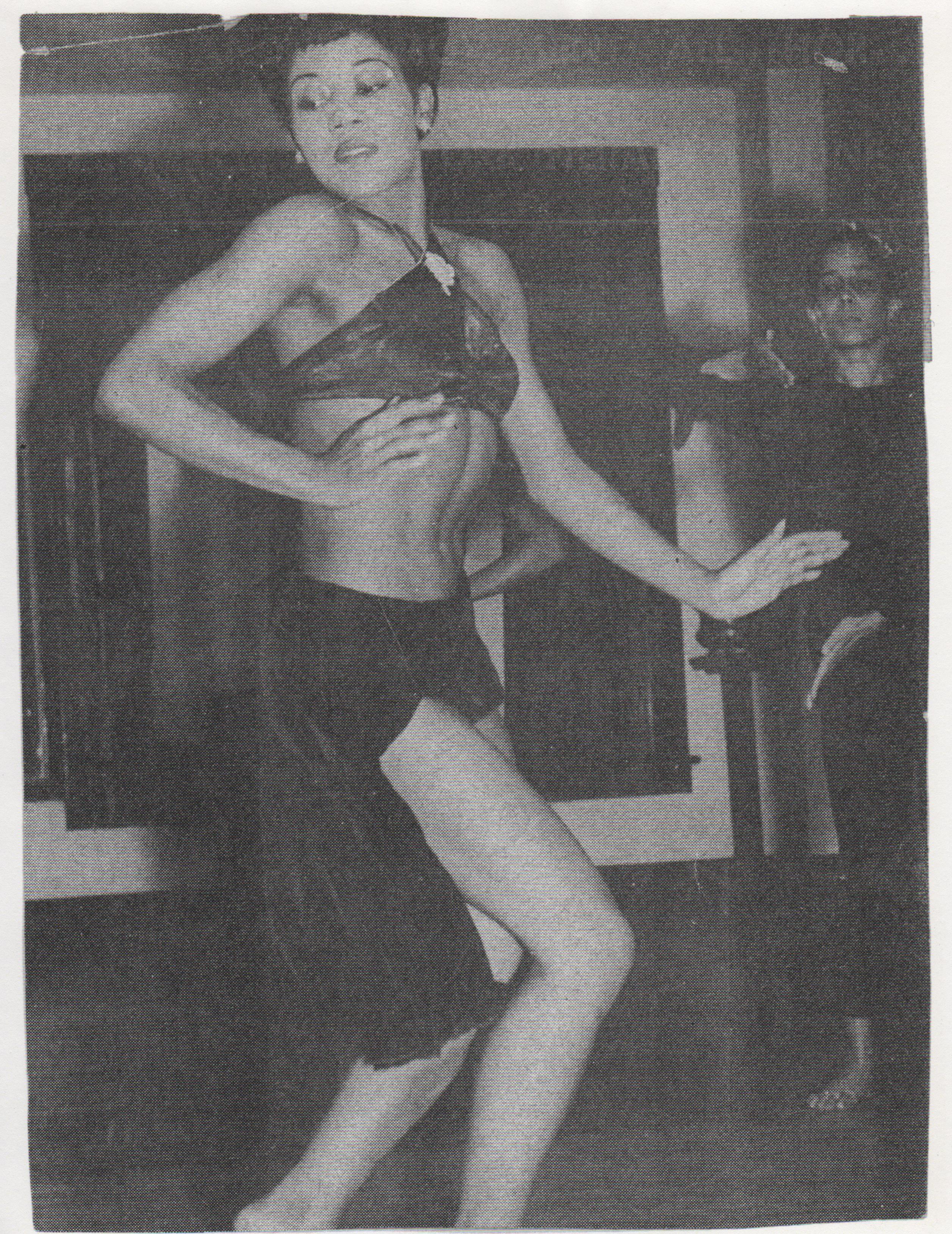
Termen’s American born second wife, the dancer Lavinia Willaims
On his return He was accused of propagating anti-Soviet propaganda by Stalin. Meanwhile reports of his execution were widely circulated in the West. In fact Termen was not executed, but interned in Magadan, a notoriously brutal Siberian labour camp.
“I was arrested, and I was taken prisoner. Not quite a prisoner, but they put me in a special lab in the Ministry of Internal Affairs. There I worked in this lab just as others worked. [Airplane designer] Andrei Tupolev was imprisoned in such a way too, if you know about that. He was considered to be a prisoner, and I was considered a prisoner too…At one time, on the way to the laboratory, I was sent to a camp, where they did road construction. I was assigned to be supervisor over the prisoners. From there, after eight months on road construction, I was sent with Tupolev to the Aviation Institute. Many important people worked there: [Missile designer] Sergei Korolyov worked there for me.”
Leon Termen interview By Olivia Mattis and Robert Moog 1992
Termen was put to work on top secret projects by the Soviet authorities (together with Andrei Tupolev, Sergei Korolev, and other well-known scientists and engineers) which culminated in his invention of the first “bug,” a sophisticated electronic eavesdropping device. Termen supervised the bugging of both the American embassy, (and perhaps, Stalin’s private apartment). For this ground-breaking work he was awarded the Stalin Prize (first Class), Russia very highest honour.
After his rehabilitation Termen took up a teaching position at the Moscow conservatory of music. However he was ejected for continuing his researches in the field of electronic music. Post war Soviet ideology decreed that modern music was pernicious. Termen was reportedly told that electricity should be reserved for the execution of traitors. After this episode Termen took up a technical position, and worked upon non-music related electronics . Ironically his invention the Thereminvox, was becoming vastly influential in America, a development of which he was completely unaware.Before his death in 1993 Prof. Termen made one final visit to America lecturing, and demonstrating his Thereminvox.
Sources:
“PULLING MUSIC OUT OF THIN AIR: AN INTERVIEW WITH LEON THEREMIN”By Olivia Mattis and Robert Moog. February 1992 issue of Keyboard Magazine.
‘Electronic and Experimental Music: Technology, Music, and Culture’. 2008 by Thom Holmes
‘Sound in Z: Experiments in Sound and Electronic Music in Early 20th Century Russia’. 2013. by Andrey Smirnov.
‘Theremin: Ether Music and Espionage (Music in American Life)’. Feb 2005. Albert Glinsky