The ‘Syn-ket’ (or ‘Synthesiser-Ketoff’). Paolo Ketoff & John Eaton, Italy. 1963.

The Syn-Ket
Paul Ketoff’s  ‘Syn-Ket’ c 1965

With the debut of affordable transistors in the late 1950s, several electronic engineers, inspired by the ideas of Harald Bode, realised the potential for creating lightweight, affordable and durable electronic instruments. Bode’s proposal for voltage controlled transistor based instruments ( “European Electronic Music Instrument Design”, Journal of the Audio Engineering Society (JAES) ix (1961): 267) inspired Robert Moog, Donald Buchla and Paul Ketoff amongst others to put Bode’s ideas into practice.

Syn-Ket
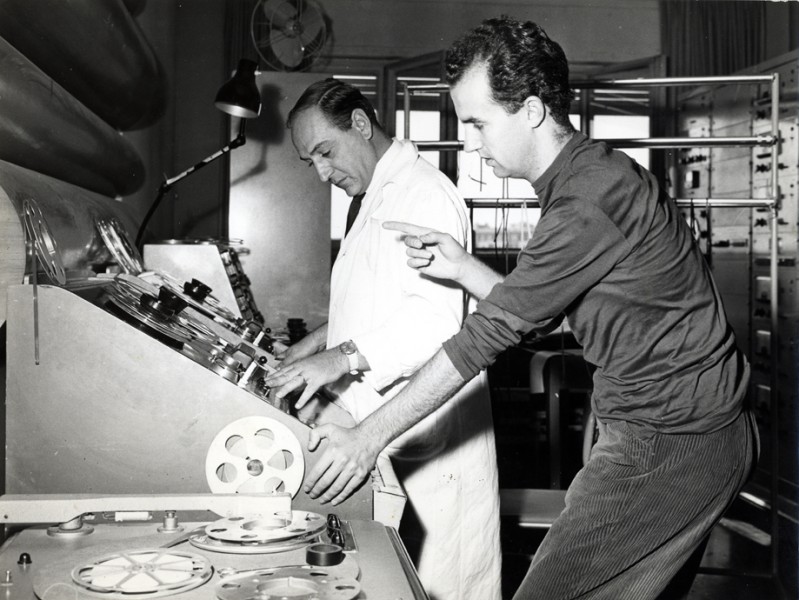
Paul Ketoff (L) and John Eaton (R) demonstrating the Syn-Ket. Rome, circa 1963

Paul Ketoff was an American- Polish-Italian sound engineer working for RCA based at the Cinecittà film studios in Rome. In the summer of 1956, Ketoff was invited by the composers Otto Leuning and George Balch Wilson to design a new electronic music studio at the American Academy in Rome– Otto Leuning was the composer in residence at the Academy and organised finance for the project via Columbia Princeton’s Alice M. Ditson fund.

Ketoff built a tape-based studio in the basement of the Academy at Via Angelo Masina (comprising of: three sine wave oscillators, a spring reverberation unit, a microphone, an Ampex stereo portable tape recorder,a mixing console, 350 Series Ampex mono tape recorder and a radio/record player) and then went on to develop the ‘Fonosynth’ in 1958; a large studio synthesiser with musical direction from Leuning, Gino Marinuzzi jr and other composers at the academy.

“But, Paul.  This is not just a group of components of a classical tape studio; this is an instrument!”

John Eaton 1963 – Interview  2012

Inspired by Harald Bode‘s ideas proposed in the 1961 JAES Journal, Paul Ketoff designed a new, much smaller, voltage controlled transistor based synthesiser to replace the Fonosynth (and again, indirectly funded by Colombia Princeton). Ketoff presented his new instrument christened the ‘Syn–Ket’ (Synthesiser-Ketoff) to the American composer John Eaton at the American Academy, who quickly recognised the possibilities of using the synthesiser for live performances; that is, performances without any tape recorders – electronic music performances of that period usually relied on recorded sound because ‘synthesisers’ were huge, stationary, multi component, studio based devices and far too big to move to a live performance space.

“I immediately began writing short pieces that could be played on it, without any pre-recording and asked him to build me one that could be modified for better use as an instrument.  At my suggestion, he modified the three keyboards so they would respond to velocity, like a piano, and sideways motion, as in a clavichord’s bisbigliando.  Over the next few years, he added an overall volume pedal, a white or pink noise generator, alternate basic sonic material, a spring reverberation unit, and other various types of modulation. “

John Eaton – Interview  2012

Syn-Ket
Paul Ketoff (right) and John Eaton (playing) performing with the Syn-Ket in Italy, 1963.
The Synket at the Philharmonie de Paris (musical instrument museum). Image ©Philharmonie de Paris

The Syn-ket comprised of three sound modules or “sound-combiner” as Ketoff called them – essentially three separate synthesisers built using a mix of solid state and vacuum  technology. Each module was independently controllable and interconnectable and mixable into a single output.

Each “sound-combiner” module consisted of:

  • 1 square wave frequency-controllable oscillator.
  • A button controlled series of frequency dividers which allowed division of the incoming  pitch by factors of 2, 3, 4,  5 and 8 to produce differing harmonics
  • 3 complex filters with a frequency range of 40 Hz – 20 kHz.
  • 1 amplitude control.
  • 3 modulators each controlled by a low frequency oscillator: The first allowed control of the square wave oscillator’s frequency, The second controlled the frequency of the filter and the third controlled audio amplitude.

Later versions were equipped with white and pink noise generators and a spring reverberation unit.

The Syn-ket was equipped with three small two octave keyboards, each corresponding to a module. Each key could be individually tuned allowing the musician to play and compose microtonal music. The keyboard was velocity sensitive and uniquely allowed the player to bend the note with a sideways finger action. The second version of the Synket allowed the player to control amplitude and filters through key velocity.

the art of electronic music_0002
Ketoff and Eaton with the Syn-Ket 1963 (image copyright ‘the art of electronic music’)

The Syn-ket was adopted by John Eaton as his concert instrument and he made over a thousand performances from 1966 to 1974 and used the Syn-ket in several of his recorded compositions, such as “Piece concert is Synket and Symphony Orchestra” (1967), “Blind Mans Cry” (1960), “Mass” (1970).

The Syn–ket was not conceived as a commercial product – Ketoff built only about a dozen variations on the Syn-ket theme  between 1963 and 1977 – and notwithstanding it’s innovative and unique features remained a one-off custom made instrument. Despite this, the Syn-ket was widely used by composers other than Eaton and found itself almost ubiquitous on Cinecittà soundtracks for Spaghetti westerns (Ennio Morricone used the Syn-ket on many of his soundtrack scores ), Italian horror and science fiction films.

One of the few surviving Syn-kets can be seen at the Philharmonie de Paris (previously know as the ‘musical instrument museum’) Paris, France.

Images of the Syn-ket

Eaton went on to collaborate with Bob Moog on an a controller keyboard called the ‘Eaton-Moog Multiple-Touch-Sensitive Keyboard’. Moog and Eaton had initially met when Eaton asked Moog to repair an ailing Syn-ket during a 1966 US tour. They immediately began collaborating on a new keyboard controller based on Ketoff’s triple keyboard of the Syn-ket. The final controller was straightforwardly named the ‘Eaton-Moog Multiple-Touch-Sensitive Keyboard’ or ‘MTS’

Ketoff
John Eaton playing the Syn-ket

Biographical Notes Paul Ketoff/Paolo Ketoff.

Polish-Italian Electronic and sound engineer. Born 1921 died 1996. Ketoff became the chief sound technician at RCA Italiana/Cinecittà film studios, Roma, in 1964 and the Fonolux post production company, between 1957 and 1965. Ketoff designed many devices for film music production including dynamic sound compressors and ring modulators, reverb chambers and plates, and established a new standard of sound post-production.

Film credits for sound production and effects from this period include (1966) ‘Africa Adido” , (1966) ‘La Traviata’ (1965) ‘Terrore Nello Spazio’, (1960) ‘L’ avventura’ (1953) ‘Pane, amore e fantasia’ (1965) ‘Planet of the Vampires’, (1959) ‘Hercules Unchained’

Commisioned to design and build the Electronic Music Studio at the American Academy in Rome, Ketoff finished his first synthesiser, the ‘Fonosynth’ in 1958 and then designed a much more compact voltage controlled performance instrument called the Syn-ket in 1963 which was presented at the conference of the Audio Engineering Society (AES) in 1964,

Ketoff was a lifelong friend and collaborator with the Italian composer Gino Marinuzzi jr. Paolo Ketoff was married to Landa Ketoff, the well known musical critic for La Repubblica Newspaper.

eaton-j
John Eaton

John Eaton Biographical Notes:

Born: March 30, 1935 in Bryn Mawr (Pennsylvania, USA)
The composer John Eaton began his musical career as a child, taking piano lessons at the age of nine and his first concert, playing Beethoven sonatas. In 1957, at age 22.
Eaton graduated in Princeton University. In 1959 he moved to Rome (Italy) and lived there in the following years. There he began a long time partnership with clarinetist Bill Smith – Their band recorded two albums and made several concerts in Europe and in the United States. In Rome John Eaton met the electronic engineer Paul Ketoff, inventor of the famous and legendary Syn-Ket, in 1964. With the Syn-Ket, John Eaton performed more than a thousand concerts around the world. Eaton later collaborated with Robert Moog to develop the ‘Eaton-Moog Multiple-Touch Sensitive Keyboard’.


Sources

 “The Synthesizer.” Vail, Mark.

Interview with John Eaton: http://astronautapinguim.blogspot.co.uk/

Electronic Music Review. No. 4 October 1967

Interview with John Eaton NAMM.  January 23, 2010. https://www.namm.org/library/oral-history/john-eaton

‘Electronic Music’ By Nick Collins, Margaret Schedel, Scott Wilson

‘Electronic and Computer Music’ Peter Manning. Oxford University Press p130

A History of the Rome Prize in Music Composition * 1947 – 2006 * Richard Trythall .Music Liaison. American Academy in Rome January 1, 2007

‘Music and Musical Composition at the American Academy in Rome’. Martin Brody. University of Rochester Press. 2014.

‘In The Workshop’. John Eaton. http://moogfoundation.org/about/humble-visionary/in-the-workshop/

The ‘Fonosynth’. Paul Ketoff (Paolo Ketoff), Julian Strini & Gino Marinuzzi jr, Italy. 1958.

The Fonosynth at the Musical Instrument Museum (photo: suonoelettronico.com)
The ‘Fonosynth’ now at the Musical Instrument Museum, Munich, Germany. (photo: suonoelettronico.com)

The Fonosynth was a large analogue valve and transistor based studio synthesiser designed and built by the Polish-Italian sound engineer Paul Ketoff (with musical input from the Italian composer Gino Marinuzzi jr) and was created specifically for the new electronic music studio at the American Academy in Rome.

This studio had been founded by the American composer and co-founder of the Columbia-Princeton Electronic Music Center  (CPEMC in 1959 – the first studio for electronic music in the USA and home to the  RCA Synthesiser) Otto Luening (June 15, 1900 Milwaukee, Wisconsin USA – September 2, 1996 New York City, NY, USA) – who was at that time Composer in Residence on a one year secondment from Columbia Princeton at the American Academy:

“During his first residency in the Spring and Summer of 1958, Luening tapped Columbia’s Alice M. Ditson fund to purchase a library of contemporary music recordings for the composers’ use. Then, when he returned for a 6 week summer visit in 1961, he converted the composers’ “listening room” (located in the basement of the Academy) into a rudimentary “electronic music studio”. This studio eventually contained three sine wave oscillators, a spring reverberation unit, a microphone, an Ampex stereo portable tape recorder and a mixing console. Added to the listening room’s professional 350 Series Ampex mono tape recorder and a radio/record player, this equipment became a laboratory for sound research. In 1964-65 when Luening returned for a second, year long stay as Composer-in-Residence, the Ditson fund ( Columbia University’s Alice M. Ditson Fund) covered the purchase of one of the first portable electronic music synthesizers in existence, the Synket (nb; the ‘Synket’ here is probably confused with the Fonosynth), invented and constructed by Paul Ketoff – a brilliant Roman audio engineer involved with Rome’s Cinecittà. It was Ketoff, in fact, who had designed the original studio room and mixing 8 console and whose guidance and unflagging enthusiasm had been a key element in making the fledgling studio operable. With the Synket installed, the listening room became a fairly advanced electronic studio for the time and it served as such for many of the Fellows. The studio was also used by a number of visiting American (Larry Austin, Alvin Curran, etc.) and Italian (Aldo Clementi, Mauro Bortolotti) composers.”

Richard Trythall ‘A History of the Rome Prize in Music Composition’

There were numerous American Avant-Garde composers and musicians passing through Rome at this time (1950-60s) usually on some kind of study grant. This was in-part because of a postwar initiative set up by the US government to promote American culture and regenerate the cultural life of Rome:

 “an international showcase idea which went along with lots of neon signs and skyscrapers – to shout down communism”

(Alvin Curran. Soundings No. 10, Soundings Press, Santa Fe, 1976).

Artists involved with the American Academy, Rome included  flutist Fritz Kraber, clarinettist Jerry Kirkbride, sopranos Joan Logue and Carol Plantamura, violist Joan Kalisch, pianists Joe Rollino and Paul Sheftel and composers such as William O. Smith, John Eaton, Richard Trythall, John Heineman, Alvin Curran, Frederick Rzewski, Richard Teitelbaum, Allen Bryant, Jeffrey Levine, Joel Chadabe, Jerome Rosen and Larry Moss, Larry Austin.

Detail of the Fonosynth

The Fonosynth was completed in 1958 and was used throughout the late fifties and mid sixties by a number of expat American electronic musicians and composers (including Otto Luening, William O. Smith, and George Balch Wilson, Richard Trythall, Alvin Curran amongst others) as well as for film soundtrack sound effects for the Italian film industry. The Fonosynth now resides at the at the Museum of Musical Instruments in Munich, Germany.

The Fonosynth’s sound was generated by twelve sine wave oscillators and six square wave oscillators (each matched with individual band-pass filters). This audio signal could be modulated and coloured using audio filters (2 octave filters, 2 selective resonant filters, 1 self oscillating filter, 1 threshold filter) two LFOs, an impulse generator and white noise generator, two ring modulators and a wave shape generator to determine the ADSR of each sound. The resulting output was fed into an 18 channel mixing console and amplified to a stereo or mono audio output.

The whole instrument was controlled by an unusual  keyboard made up of 6 rows of 24 keys allowing for Enharmonic, microtonal performance and composition.

Soon after, Ketoff built a successor to the Fonosynth in 1963 called the Syn-ket (Synthesiser – Ketoff) which was designed as a portable performance instrument – with musical input from John Eaton (and others).

Paul Ketoff
Paul Ketoff (at the Syn-ket) c 1963

Biographical Notes Paul Ketoff/Paolo Ketoff.

Polish-Italian Electronic and sound engineer. Born 1921 died 1996. Ketoff became the chief sound technician at RCA Italiana/Cinecittà film studios, Roma, in 1964 and the Fonolux post production company, between 1957 and 1965. Ketoff designed many devices for film music production including dynamic sound compressors and ring modulators, reverb chambers and plates, and established a new standard of sound post-production.

Film credits for sound production and effects from this period include (1966) ‘Africa Adido” , (1966) ‘La Traviata’ (1965) ‘Terrore Nello Spazio’, (1960) ‘L’ avventura’ (1953) ‘Pane, amore e fantasia’ (1965) ‘Planet of the Vampires’, (1959) ‘Hercules Unchained’

Commisioned to design and build the Electronic Music Studio at the American Academy in Rome, Ketoff finished his first synthesiser, the ‘Fonosynth’ in 1958 and then designed a much more compact voltage controlled performance ins trument called the Syn-ket in 1963 which was presented at the conference of the Audio Engineering Society (AES) in 1964,

Ketoff was a lifelong friend and collaborator with the Italian composer Gino Marinuzzi jr. Paolo Ketoff was married to Landa Ketoff, the well known musical critic for La Repubblica Newspaper.

Gino Marinuzzi Jr
Gino Marinuzzi Jr

Biographical Notes Gino Marinuzzi Jr.

Born 07/04/1920 – New York (U.S.A.), Died: (age 76) in Rome, Lazio, Italy

Gino Marinuzzi jr. was the Son of the conductor Gino Marinuzzi and was born in 1920 in New York, USA,  while  his father was touring in the United States. He studied piano and composition at the Milan Conservatory. Before graduating in composition, piano and conducting. Marinuzzi jr wrote his first early work: Concertino (piano chamber orchestra) and various compositions for piano at the age of sixteen.

Marinuzzi became the assistant conductor at the Teatro dell’Opera in Rome from 1946 to 1951. He made his debut as a conductor in Spain in 1947, during a tour of the Ballet of the Roman theatre; then chooses to devote himself exclusively to composition. Marinuzzi  made the numerous film soundtracks during this period and was very active in the field of electronic music. In 1956 he founded the ‘Studio of phonology  for the Roman Philharmonic Academy’ and later was a founding member of the experimental study group R7 with Paolo Ketoff, Walter Flocks, Franco Evangelisti, Domenico Guaccero, Guido Guiducci and Egisto Macchi.

Marinuzzi spent two years – 1943 to 1945 – in a Nazi concentration camp, (prisoner 50914 Stalag XII F) an experience from which he created the ‘Lager lieder’, in which he elaborated on popular Russian, Ukrainian and Gypsy themes learned from his fellow prisoners.

In 1956 the composer opened the first laboratory of electronic music in Rome at the ‘Accademia Filarmonica Romana’ and constructed one of the first modular synthesiser for the production of electronic music called the ‘Fonosynth’. The device, made by the engineer Julian Strini and the sound engineer Paolo Ketoff in collaboration with Marinuzzi was completed in 1958,

In the 1960s and 70s Marinuzzi devoted himself mainly to film scores, theatre, radio and television, and only resumed composing for orchestra in the 1980s. He was particularly involved  and played a pioneering role in research and musical experimentation in the field of electronic music since the 1950s.

He is the father of the singer and guitarist Joan Marinuzzi.

Marinuzzi’s film works include:  ‘Romanzo d’amore’ (1950),  Jean Renoir’s ‘Le Carrosse d’or’ (1952) and Vittorio Cottafavi’s Ercole alla conquista di Atlantide (1961). ‘I castrati’ (1964),Mario Bava ‘s ‘Terrore nello spazio’ (aka Planet of the Vampires, (1965), ‘ Matchless’ (1967). ‘La piovra’ (1984)  (aka The Octopus).


 Sources

http://www.suonoelettronico.com/synket_fonosynth_ketoff.htm

Exhibition of the ‘RAI Studio Of Phonology’, Milan, Italy

‘Music and Musical Composition at the American Academy in Rome’ edited by Martin Brody

A History of the Rome Prize in Music Composition * 1947 – 2006 * Richard Trythall Music Liaison American Academy in Rome January 1, 2007

‘Gino Marinuzzi Jr: Electronics and Early Multimedia Mentality in Italy’. Maurizio Corbella, Università degli Studi di Milano

L. Pizzaleo, Il liutaio elettronico: Paolo Ketoff e l’invenzione del Synket, Aracne Editrice, Roma 2014 (Immota harmonia, 20), pp. 31-38.

P. Ketoff, Synket, generatore elettronico di suoni sintetici

Paolo Ketoff e l’invenzione del Synket, Aracne Editrice, Roma 2014 (Immota harmonia, 20), pp. 31-38.

‘Milan Electronic Music Studio’ or ”RAI Studio of Phonology’ , Marino Zuccheri & Alfredo Lietti. Italy, 1955

MIlan Electronic Music Studio
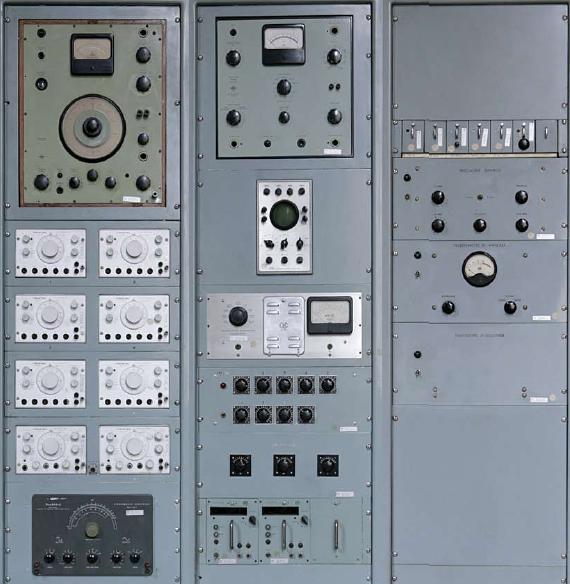
Oscillator bank at the Milan Electronic Music Studio

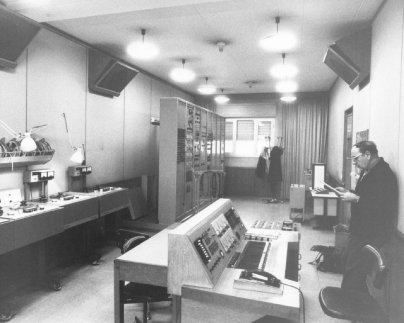
The Milan Electronic Music Studio or  ‘RAI Studio of  Phonology’ was designed by Alfredo Lietti in 1955 with the guidance of the musicians Luciano Berio and Bruno Maderna, and remained in use until 1983. In 2011 the entire studio was archived at the Municipal Collections of the Castello Sforzesco, Milan. The studio was constructed at a time (1950s-60s) when electronic music studios were seen as an example of ‘national modernity’ and cultural progress and sprung up around Europe and globally – initially with NDR/WDR in Germany, GRM/Ircam in Paris followed by studios in Finland, Netherlands, Italy, East Berlin, Japan, Israel. Strangely the UK had no state funded electronic music studio – the BBC Radiophonic Workshop being the closest example.

'RAI Studio of Phonology
Marino Zuccheri at RAI Studio of Phonology

The studio was primarily created to produce experimental electronic music but also to create effects and soundtracks for film and TV (and the model for the 2012 film Berberian Sound Studio). Berio drew inspiration from the working methods of American serialist composers Ussachevsky and Otto Luening at the Columbia University Computer Music Center and from GRMC in Paris through his friendship with Pierre Schaeffer and the Club d’Essai. Maderna’s somewhat contrasting influences originated from his time studying at the Darmstadt summer school with Stockhausen and Meyer-Eppler.

protagonisti_in-piedi-berio-zuccheri-maderna-seduti-lietti-castelnuovo
Berio, Zuccheri, Maderna, Lietti, Castelnuovo at the RAI Phonology Studio Milan

At the beginning in 1955 the Milan studio consisted of a few variable speed tape recorder, some filters, an oscillator and an Ondes Martenot. This soon changed with the acquisition of eight sine and square wave oscillators, pulse and white noise generators – the ‘tenth oscillator’ it was joked, was the voice of  the singer Cathy Berberian (Luciano Berio’s works of this period with Cathy Berberian include Thema (Omaggio a Joyce) and Visage)1David Osmond-Smith, & Cathy Berberian. (2004). The Tenth Oscillator: The Work of Cathy Berberian 1958-1966, p4.. These simple sound generators were patched manually through a bank of processors that included modulators such as the  ‘Tempophon’ –a tape device with rotating heads that allowed to vary the duration of the playback of a previously recorded sound, while maintaining the original pitch – frequency shifters, filters and various types of echo and reverberation units. The output from the studio was monitored on a system of five speakers and recorded to a four-track tape recorder.

Mixer and tape recorder at the Studio di Fonologia Musicale della Rai di Milano,1968. Image Archivio NoMus, Fondo Zuccheri.

Musicians and composers who worked at the studio include Berio, Maderna, Nono, Castiglioni, Clementi, Donatoni , Gentilucci, Manzoni , Marinuzzi Jr., Paccagnini Sciarrino, Sinopoli, Togni , Cage and Pousseur.

Marino Zuccheri and Luigi Nono - courtesy of Fondazione Archivio LN
Marino Zuccheri and Luigi Nono – courtesy of Fondazione Archivio LN
“… I like remembering Marino in his Phonology Studio, master among masters, master of sound among masters of music, because sound for him did not have any secrets, since he was trained in auditoriums while working for the Radio together with the most famous directors of the time. He would always recall how he begun working in Phonology by chance, but it is certain that it wasn’t because of chance that he continued during the years, considering he’s been the only holder of the Studio from when it was created (1955) until it closed down (1983).”2Giovanni Belletti, “Marino Zuccheri in Fonologia”, 2008


References:

  • 1
    David Osmond-Smith, & Cathy Berberian. (2004). The Tenth Oscillator: The Work of Cathy Berberian 1958-1966, p4. ↩︎
  • 2
    Giovanni Belletti, “Marino Zuccheri in Fonologia”, 2008 ↩︎