The Klaviatursphäraphon (1928) & Partiturophon (1930). Jörg Mager, Germany.


The Klaviatursphäraphon

The Klaviatursphäraphon or Klaviatur-Sphärophon was a keyboard-controlled variant of the Kaleidophon, designed and built by the pioneer of German electronic music, Jörg Mager, in 1928.

By the late 1920s, Mager’s position as the leading pioneer of electronic musical instruments was increasingly challenged by other designers developing instruments for a growing commercial market focused on home music and entertainment. The debut of the large, multi-vacuum-tube polyphonic Orgue des Ondes in Paris in 1928 spurred efforts in Germany, motivated by both national pride and commercial prospects, to create a comparable instrument. Friedrich Trautwein’s Trautonium, originally conceived as a ‘beautiful polyphonic organ,’ emerged in 1929 and was based on the design of the Hellertion. In France, Maurice Martenot received significant media attention for his Ondes Martenot in 1928. Simultaneously, Mager’s utopian vision of electronic microtonal music as a catalyst for a new and just society became increasingly unlikely and irrelevant as the National Socialist movement in Germany gained influence. In response to these sociopolitical changes, Mager abandoned the lever-driven, semi-circular, microtonal glissando-focused designs of the earlier Sphärophon in in favour of multiple keyboard controllers, aiming to produce a more user-friendly, familiar, and perhaps marketable instrument.

The instrument known as the Klaviatursphäraphon incorporated two, and later three, short monophonic keyboards that replaced the sliding pitch levers of earlier models. This design enabled more precise and convenient control of pitch and timbre. The shorter keys allowed simultaneous performance on both keyboards, producing a duophonic tone. Using a feature originally developed for the Kaleidophon, it was also possible to adjust the intervals between keys using a device Mager called the musikalischer Storchschnabel or ‘musical cranesbill’. This innovation enabled modification of the keyboard’s acoustic length. Consequently, established keyboard playing techniques could be applied to an electrically modified pitch space – this meant that Mager’s instrument could. 1Patteson, Thomas. (2016) Instruments for New Music, University of California Press, 76. Additional tone colour was added by passing the output through a series of filters – the formant filters developed for the Kaleidophon and specially formed acoustic resonant loudspeakers.
Mager’s studio in Darmstadt, with a collection of resonant objects used to add tonal colour to the sound of the Klaviatursphäraphon. Image: PIX magazine VOL 3, No. 2, JANUARY 14,1939.
Mager presented his new instrument with a demonstration of ‘Electronic Music’ at the annual convention of the Reich Association of German Musicians and Music Teachers in Darmstadt on October 6, 1928, with the hope that his new ‘commercial’ instrument would attract financial support to allow its continued development. 2 This is possibly the first time the description Electronic/Electric Music has been used – previously, music produced by electronic music was called ‘Ether-wave Music’ or ‘Radio-electric Music’. Playing to the sensibilities of the new era of German nationalism, Mager stressed the need to support German ‘Electronic Music’ in the face of foreign competition, particularly the French Ondes des Orgues – even going so far as pointing out the Jewishness of  Theremin’s manager, Julius Goldberg, as a threat.3 Donhauser, Peter. (2007) Elektrische Klangmaschinen; Die Pionierzeit in Deutschland und Österreich, Brill, 212.


According to Mager’s friend and biographer Emil Schenck, the sound of the Klaviatursphäraphon was impressive:


“The sound and modulation capabilities of the rudimentary instrument were surprising. The audience was particularly impressed by the ability to swell the volume from the barely audible, whispering pianissimo to the most powerful fortissimo, even in the timbre of the wind instruments. Equally fascinating was the rich array of timbres, most of which cannot be produced by our most familiar instruments. The effect on the audience was overwhelming.”4 Schenck, Emil. (1952) Jörg Mager: Dem deutschen Pionier der Elektromusikforschung, herausgegeben von der Städtischen Kulturverwaltung Darmstadt, 11.


In January 1929, a consortium of Darmstadt industrialists and businessmen established the Gesellschaft für elektro-akustische Musik (‘Society for Electroacoustic Music’) to promote the electronic production of music with Mager as its head, probably the first electronic music studio of its kind. The studio’s board, comprising Emil Schenck, Louis Merck, and Dr August Roesener, financed the operation and offered Mager a three-year contract along with several technical assistants, including research and technical engineer Friedrich Wamboldt, mechanic Wend, engineer Christensen, and engineer Dr Jankovsky. The city of Darmstadt provided the Rococo Prinz-Emil-Schlößchen castle free of charge for the society’s use.5 Schenck, Emil. (1952) Jörg Mager: Dem deutschen Pionier der Elektromusikforschung, herausgegeben von der Städtischen Kulturverwaltung Darmstadt, 14.

The Pariturophon

On August 25, 1930, Mager presented the results of his work and the latest version of his instrument, which performed arrangements of works by Bach, Beethoven, Wagner, and Mendelssohn, to an invited audience. He named the instrument the Partiturophon, with ‘Paritur’ meaning ‘musical score’ in German, to highlight its capacity to perform conventional music. Aware that the monophonic nature of each keyboard represented a limitation, which other instrument designers were addressing at the time, Mager emphasised the instrument’s connection to the multi-timbral fugue scores of J.S. Bach:


“One is forced to treat this monophonic line individually, so that—as in the polyphony of Bach, for example—each voice can be brought out as in a three-dimensional relief. In addition, each keyboard, being independent, can maintain its own appropriate timbre, which makes possible mixtures and contrasts of tone colour of an almost orchestral quality.”6Mager, Jörg. (1934) “Das ‘Partiturophon—Eine Hausmusik Lösung, Zeitschrift für Instrumentenbau 54, no. 21 (1934): 329
The Partiturophon was an expanded version of the Klaviatursphäraphon, featuring three manuals and a pedalboard, which provided a total of four voices.
Jörg Mager’s early version of the Pariturophon c 1930.
The local Darmstädter Tagblatt of August 26, 1930, noted that:


“Mager demonstrated today a richly registered organ on which two-part playing is possible. The only difficulty at present is that each part must have its own keyboard, meaning that the four-part texture must be played on three manuals and the pedal. For this reason, the manuals are positioned so close together, and their keys so short, that one can comfortably play several manuals with one hand; for this reason, too, the scale of the keyboard is somewhat narrower than on a standard piano or organ keyboard. Apart from these difficulties, which require a special approach to playing the new instrument, it astonishes with its endless variety of tonal colours, its rich dynamic shading, and the expressiveness of its tone.”7Prof. Dr Noack states in the Darmstädter Tagblatt of August 26, 1930


Jörg Mager working on the Pariturophon at the Prinz-Emil-Schlößchen, Darmstadt, 1930. Image: PIX magazine VOL 3, No. 2, JANUARY 14,1939.Jörg Mager working on the Pariturophon at the Prinz-Emil-Schlößchen, Darmstadt, 1930. Image: PIX magazine VOL 3, No. 2, JANUARY 14,1939.

Playing technique
Playing technique used to produce three-note polyphony on a three-keyboard, one-voice-per-keyboard Partiturophon.
The prominent conductor and advocate of modern music, Hermann Scherchen, authored a comprehensive report on Mager’s new instrument. He acknowledged its limitations, such as the absence of convincing brass and string timbres and a degree of tonal monotony across its registers, yet he strongly endorsed the instrument as “entirely ready for artistic musical purposes” and ready for mass production8Patteson, Thomas. (2016) Instruments for New Music, University of California Press, 79. Scherchen was particularly interested in the application of the instrument for Klangfarbenmusik, or ‘tone colour music’, as it allowed for the use of distinct timbres on each keyboard that could be continuously varied throughout a composition.
Mager playing the Partiturophon, showing the unusual and difficult fingering technique needed to play four-note (or three note in this model) polyphony across the multiple keyboards.
Mager playing the Partiturophon, showing the unusual and difficult fingering technique needed to play four-note (or three-note in this model) polyphony across the multiple keyboards. Image: Schenck, Emil. (1952) Jörg Mager: Dem deutschen Pionier der Elektromusikforschung, herausgegeben von der Städtischen Kulturverwaltung Darmstadt, 1.

A later version of the Partiturophon added a fourth manual and a pedal board, thereby achieving five-voice capability. According to Schenck, Mager added what he called a “Bauchschweller” or ‘Belly Swell’ mechanism, where the proximity of the player’s body could alter the volume of the instrument, allowing the player to effect a crescendo without interrupting playing, and, with the domestic market in mind It was designed to be easily disassembled for portability.

The only known surviving recording of Jörg Mager’s Partiturophon broadcast by Herbert Eimert during a 1952, NWDR Nachtsprogramme

Eimerts’ translated commentary to the radio broadcast:

“Even before the First World War, Jörg Mager was exploring mechanical methods for dividing pitches. He soon realised that the problem of pitch division could only be solved with electrical aids, and from then on, he was determined to acquire a suitable electrical medium. He heard, for the first time, a continuously gliding pitch scale, albeit in a manner usually described as common feedback whistling. In this respect, the first radios, while unpleasant and involuntary, were nonetheless the first electronic sound instruments. Jörg Mager, however, was delighted by this whistling sound and, based on this principle, built his Spharophone, the first musical instrument ever on which all audible vibrations could be musically utilised in unison by means of a lever. With the support of K.W. Wagner and especially the Study Society for Electric Music in Darmstadt, Jörg Mager succeeded in the 1930s in penetrating almost all previously inaccessible areas of the musical sound sphere and proving that Busoni, Schoenberg, Hindemith, Max von Schillings, and others were right in their prophecies that promised new artistic possibilities through electric sound generation. Jörg Mager’s subsequent work consisted of demonstrating that the three foundations of musical art—vibration, sound structure, and dynamics—open new artistic horizons through the new technology of electric sound generation…And now the only remaining original recording of the Mager organ.”

In the early 1930s, Jörg Mager’s reputation was at its zenith and was widely recognised as a leading figure in electronic music. The Gesellschaft attracted numerous distinguished visitors who sought to witness the “sorcerer of sound” and the Zauberorgel, or ‘Magic Organ.’ Notable guests included Grand Duke Ernst Ludwig of Hesse, who contributed a valuable silver plate to serve as a loudspeaker resonator; General Tietgen; Wilhelm Furtwängler; Arturo Toscanini; Rudolf Kelterborn; Karl Böhm; Hermann Scherchen; Hermann von Keyserling; and Jonathan Zenneck, among others. Winnifred Wagner’s visit resulted in a commission to create electronically generated bell effects for the 1931 production of Richard Wagner’s Parsifal in Bayreuth, conducted by Toscanini – the ultimate seal of approval from the German musical establishment. Mager also brought to Bayreuth a ‘sound generator,’ where Mager’s noise-modulation function was used to create ‘thunder and collapsing sounds’ in Wagner’s Die Walküre, Siegfried, and Götterdämmerung.9 Schenck, Emil. (1952) Jörg Mager: Dem deutschen Pionier der Elektromusikforschung, herausgegeben von der Städtischen Kulturverwaltung Darmstadt, 19.


mager_parsifal_orgel_die_buhne_1936_pp415_416
Mager’s ‘Parsifal Organ’ of 1931, which probably used electronically generated sounds modified through the resonant strings of a piano. Image: die Buhne, 1936, 415_416.
Despite achieving both fame and financial stability, Mager declined to participate in commercial contracts. For instance, he rejected an offer of collaboration from Siemens & Halske, a leading industrial electronics company, due to concerns about the security of his intellectual property.  Mager’s already abrasive personality worsened as he became increasingly ill with diabetes, and this, coupled with his unwillingness to commercially exploit his works as agreed by the Gesellschaft, led the board to terminate his contract in 1932. Mager remained at the Prinz-Emil-Schlößchen, working on his instrument, until 1935, even as the water supply and, finally, the electricity supply were cut off. Mager returned to Berlin, where he made a few poorly attended ‘electronic music’ performances and performed a score by Rudolf Perak for the UFA film Stärker als Paragraphen on the Partituraphon in 1936.
Final four-keyboard version of Jörg Mager’s Partiturophon. Image: Zeitschrift für Instrumentenbau, Bd. 55, 1934-35, Leipzig 1935, 01.
__________________________________________________

Jörg Mager: Biography

Born 6 November 1880, Eichstätt, Bavaria, Germany. Died 5 April 1939. Aschaffenburg, Bavaria, 

Bust of Jorg Mager by Heinrich Johst 1935. Image: Das Mager Buch 1935.
Bust of Jörg Mager by Heinrich Jobst, Darmstadt, 1932. Image: Das Mager Buch 1935.

Jörg Mager was a German inventor and self-proclaimed ‘Father of German Electronic Music’, who became a significant figure in the early development of electronic musical instruments.  From around 1921 until his death in 1939, he created a family of electronic instruments that included the Elektrophon (1921), Sphäraphon (1924), Kurbelsphärophon (1926), Klaviatursphäraphon (1928), Partiturophon (1930) and Kaleidophon (1939). Central to Mager’s design concept was the pursuit of a utopian perfect musical instrument, one that could deliver on the microtonal promises outlined in Ferruccio Busoni’s influential text Entwurf einer neuen Ästhetik der Tonkunst (Sketch of a New Esthetic of Music, published in Germany in 1907 and 1917, and in English translation in New York in 1911).[MFN] Busoni, Ferruccio. (1911) Sketch of a New Esthetic of Music, New York (State): G. Schirmer, 23. [/MFN] Busoni argued that music needed new instruments to provide a new sonic palette – instruments that had a wider tonal and timbral range than the classical instrumentarium: “So narrow has our tonal range become, so stereotyped its form of expression”.

Mager was one of ten children born to watchmaker Edward and Cäcilia Mager in Eichstätt, a rural town in Bavaria, in 1880. After attending elementary and high school, Mager graduated from the Eichstätt teacher training college and, from December 1906, worked as a teacher and organist in Aschaffenburg, where he was also one of the founders of the adult education centre. Jörg Mager’s lifelong fascination with microtonal music began unexpectedly during the hot summer of 1911, when he heard an overheated, out-of-tune organ playing notes beyond the fixed tempered scale. Intrigued by the instrument’s strange sounds, he started exploring the concepts of half- and quarter-tone music, eventually self-publishing his work, Vierteltonmusik, in 1915. During this time, he also began designing an instrument capable of delivering microtonal and quarter-tone scales. The first of these was an acoustic harmonium called the Vierteltonharmonium (Quarter-Tone Harmonium), created in 1912.

Jörg Mager as a military nurse in Wurzburg 1915 during the First World War.
Jörg Mager during World War I, serving as a nurse in Würzburg in 1915. Image: Das Mager Buch, 1935.

Mager served as a nurse in the First World War, stationed in Wurzburg. After the war, he became involved in the short-lived Bavarian Soviet Republic. When the Republic was violently suppressed by the Freikorps in 1919, Mager fled to Berlin and, in 1921, found a part-time job at the Lorenz radio factory in Tempelhofer Hafen. At the same time, he joined a small group of young international composers interested in microtonal and quarter-tone composition (Viertelton or sometimes just ‘VT’), including Ivan Wyschnegradsky, Alois Hába, Willi Möllendorf, Richard Stein, Julián Carillo, Arthur Lourié, under the guidance of the renowned composer and prominent champion of microtonality, Ferruccio Busoni. The group embarked on several ultimately unsuccessful attempts to create acoustic microtonal pianos and harmoniums to be able to perform their microtonal work: Hába’s microtonal organ, constructed by the August Förster company in 1923, and Wyschnegradsky’s quarter-tone piano are two examples. However, it was Jörg Mager who, taking inspiration from Busoni’s evangelism of electronic instruments and his mystical description of the Telharmonium, decided that the problem of microtonality could only be solved through electricity. Mager was a typical utopian in an age of utopians: a ‘disciple’ of Tolstoy, Strindberg, Schopenhauer, and Gandhi, and a devoted champion of radical teaching reforms, Pacifism, Teetotalism, Esperanto, and Socialism. Mager had an unshakeable belief in the inherent transformative power of music alone, capable of bringing about a revolutionary new society of harmony and brotherhood. Mager inherited Busoni’s mystical belief in the socially transformational power of music, but, unlike Busoni, Mager attempted to put these utopian ideas into practice. Rather than adapting existing instruments, Mager decided to create an entirely new instrument based on emerging radio technology. This first instrument was named the Elektrophon, and after further development at a small studio provided by the Berlin Telegraphentechnische Reichsamt (the state radio research technical institute), it was renamed the Sphäraphon in 1924.


“The music of the future will be attained by radio instruments! Of course, not with radio transmission, but rather direct generation of musical tones by means of cathode instruments! […] Indeed, the cathode-music will be far superior to previous music, in that it can generate a much finer, more highly developed, richly coloured music than all our known musical instruments! ”

Jörg Mager: „Eine neue Epoche der Musik durch Radio“ (Berlin 1924)


In 1924, Mager published Eine Neue Epoch Der Musik Durch Radio, a short pamphlet that detailed his radical vision of electronic music and promoted his new instrument, the Sphäraphon (‘Sphere-o-phone’), as the ideal, universal instrument capable of ushering in his vision of a new utopian society. The name Sphäraphon referred to the semi-circular dial used to control the instruments, and it also emphasised the relationship with Pythagoras’s idea of ‘Music of the Spheres’ and echoed both Helmholtz’s and Busoni’s earlier writings. Invoking Pythagoras was not just a classical embellishment; Mager’s declared aim – following Busoni’s previous suggestions – was to create what he called the ‘Omnitonium’, an ideal universal instrument, able to play any pitch and any tone – an instrument that would supersede all other instruments, recreating the timeless Pythagorean dream of celestial music: ‘Absolute music! The pan-tonal circle lay before me! The ocean of tone in its immeasurability! The omnitonium, the musical ideal of all times!’

To achieve his utopian dream of socially transformative music, Mager planned to build ‘Sphäraphon Towers’ in which his microtonal electronic music would be amplified and projected across Berlin, inspiring a mass communal awakening. Mager describes this vision in his 1924 booklet Eine neue Epoche der Musik durch Radio:

“A spring day in Treptower Volkspark. In the middle of the park, a tower, the Sphärophon tower, higher than the [Treptower park] observatory. The instrument, operated by music engineers and Sphärophonmusikern, starts to sound. Tone-colour cascades spray over thousands of people, transforming the spring blossom splendour into tonal splendour. All the feelings evoked in the human soul by the miracle of spring – cheers and jubilation, affectionate intimacy and a childlike loftiness, the Sphäraphon sounds out to them from the distance, brings them together and raises them to the effervescent ecstasy of spring joy! A utopia! But how long will [it take for this] Utopia?! …”

10Mager, Jörg. (1924) Eine neue Epoche der Musik durch Radio, Berlin-Neukölln, Selbstverlag des Verfassers, 5.

Despite enthusiastic endorsements from musical luminaries such as Paul Hindemith, Georgy Rimsky-Korsakov, and Ferruccio Busoni, the Sphäraphon received a lukewarm reception when it was unveiled to the public in 1926. This was particularly evident when Mager’s performances of his rather austere microtonal music were showcased alongside Leon Termen’s flashy yet kitschy renditions of popular classical hits. Mager sought to address the shortcomings of the Sphäraphon with a new model called the Kurbelsphäraphon – ‘Kurbel’ being ‘crank’ or ‘handle’. This updated instrument featured a second manual dial, allowing players to interrupt the continuous output and avoid the Sphärophon’s characteristic endless glissando. Additionally, it included two pedals for controlling the volume and envelope of each note. The Kurbelsphäraphon was unveiled at the 1926 Donaueschingen summer music festival, once again to Mager’s frustration, alongside Leon Termen’s Theremin.

Mager and his assistant working on the Sphäraphon 1927. Image: Das Neue Frankfurt 1926-27, 145.

Jörg Mager’s complete dependence on wealthy patrons left him in constant financial distress; however, his tireless efforts to secure funding eventually bore fruit. In 1929, chaired by manufacturer Emil Schenck with assistance from the city of Darmstadt, the Heinrich Hertz Institute for Vibration Research (HHI), and the Reichsrundfunkgesellschaft (RRG – the state radio service), Mager established the Studiengesellschaft für Elektroakustische Musik (Society for Electro-acoustic Music) to develop and promote his work. The new workshop was located in the grand Prinz-Emil-Schlößchen castle in Darmstadt and was staffed by skilled technicians, including the future electronic instrument designer Oskar Vierling, known for creating the Elektrochordand Grosstonorgel, among other instruments.

Jörg Mager's
Jörg Mager playing the dual controller 1926 Kurbelsphäraphon at the 1926 Donaueschingen summer music festival. Image: Die Musik 20, no. 1 (1927): 41.

With this resource at his disposal, Mager continued to develop his instrument design and created the Klaviatursphäraphon in 1928. In this model, he replaced the handles of the Kurbelsphäraphon with two short, keyed monophonic keyboards. The shorter keys allowed the player to play both keyboards simultaneously, producing a duophonic tone. By adjusting the capacitance of the sound-generating circuit, it was possible to alter the intervals between keys and scale the keyboard’s acoustic length. An octave could be compressed to as small as a major second, meaning that each successive step represented an interval of a 12th tone. Additional tonal colours were achieved through acoustic resonators, a series of filters, and specially designed resonant speakers – similar to the diffuseurs developed by Maurice Martenot in Paris for the Ondes Martenot.

Jörg Mager’s four manual Partiturophon of 1930. Visible behind the instrument is a row of gongs used to create harmonic overtones from the instrument.
Mager and a three-manual version of the Partiturophon at the Studiengesellschaft für elektroakustische Musik in Darmstadt.

Despite being free from financial concerns, Mager now faced pressure to deliver more commercially viable instrument designs. This required him to abandon his obsessive interest in microtonal music, which had by then become unfashionable and, during the Nazi period, dangerously reminiscent of Weimar-era modernism. Mager began to focus on timbre with the goal of creating a complex, polyphonic electronic organ. He developed two instruments: the Klaviatursphäraphon in 1928 and the Partiturophon in 1930. The name “Partiturophon,” derived from the word “partitur,” meaning musical score, reflected his aim of capturing the diverse combinations of orchestral timbre. The Partiturophon featured a four-keyboard (later five-keyboard) design. This arrangement required the player to learn a difficult bent-finger technique to produce four or five voices simultaneously, with one voice assigned to each keyboard. Additionally, it included a foot pedal that enabled transposition of the voices up or down by one octave. Mager claimed that the instrument could imitate the sounds of wind, string, and percussion instruments, as well as church bells, using a blend of electronic and electroacoustic techniques.

Mager playing the Partiturophon, showing the unusual and difficult fingering technique needed to play four-note (or three note in this model) polyphony across the multiple keyboards.
Mager playing the Partiturophon, showing the unusual and difficult fingering technique needed to play four-note (or three-note in this model) polyphony across the multiple keyboards. Image: Schenck, Emil. (1952) Jörg Mager: Dem deutschen Pionier der Elektromusikforschung, herausgegeben von der Städtischen Kulturverwaltung Darmstadt.

The instruments produced at the Studiengesellschaft für Elektroakustische Musik, though groundbreaking for their time, never achieved production readiness because Mager repeatedly rejected the constraints imposed on the economic use of his inventions. As a result, his abrasive personality, combined with his loss of support from the society’s board, led him to leave Darmstadt in 1936. Mager moved to Berlin and returned to semi-nomadic penury while seeking financial support for his ongoing work. By the mid-1930s, technological advances and techniques had outpaced Mager’s self-taught technical skills, leading to the emergence of more efficient and cost-effective alternatives in Germany and across Europe and the USA. Notable examples include the Mixtur Trautonium, developed by Friedrich Trautwein and Oskar Sala, and the KdF Grosstonorgel, designed by Mager’s former student, Oskar Vierling. Both of these instruments received support from the Nazi regime.  His health deteriorated due to diabetes, accompanied by increasing disorientation and mental confusion. His daughter, Sofie, brought him back to Aschaffenburg, where he died on April 5, 1939, at the age of 59.

None of Mager’s instruments is known to have survived the Second World War. The castle in Darmstadt was heavily bombed by the Allies, destroying the last remnants of the Partiturophon and its predecessors. Mager’s son, Siegfried, became the heir and protector of Jörg Mager’s legacy. After the war, he actively, though unsuccessfully, attempted to restore his father’s reputation as the “Father of German Electronic Music.”

‘The first pioneer of ether-wave music’ A postcard produced by Jörg Mager in 1935 to promote his work.

References

  • 1
    Patteson, Thomas. (2016) Instruments for New Music, University of California Press, 76. ↩︎
  • 2
    This is possibly the first time the description Electronic/Electric Music has been used – previously, music produced by electronic music was called ‘Ether-wave Music’ or ‘Radio-electric Music’. ↩︎
  • 3
    Donhauser, Peter. (2007) Elektrische Klangmaschinen; Die Pionierzeit in Deutschland und Österreich, Brill, 212. ↩︎
  • 4
    Schenck, Emil. (1952) Jörg Mager: Dem deutschen Pionier der Elektromusikforschung, herausgegeben von der Städtischen Kulturverwaltung Darmstadt, 11. ↩︎
  • 5
    Schenck, Emil. (1952) Jörg Mager: Dem deutschen Pionier der Elektromusikforschung, herausgegeben von der Städtischen Kulturverwaltung Darmstadt, 14. ↩︎
  • 6
    Mager, Jörg. (1934) “Das ‘Partiturophon—Eine Hausmusik Lösung, Zeitschrift für Instrumentenbau 54, no. 21 (1934): 329 ↩︎
  • 7
    Prof. Dr Noack states in the Darmstädter Tagblatt of August 26, 1930 ↩︎
  • 8
    Patteson, Thomas. (2016) Instruments for New Music, University of California Press, 79. ↩︎
  • 9
    Schenck, Emil. (1952) Jörg Mager: Dem deutschen Pionier der Elektromusikforschung, herausgegeben von der Städtischen Kulturverwaltung Darmstadt, 19. ↩︎
  • 10
    Mager, Jörg. (1924) Eine neue Epoche der Musik durch Radio, Berlin-Neukölln, Selbstverlag des Verfassers, 5. ↩︎

The ‘Elektrophon’ (1921), Sphäraphon (1924) & Kurbelsphärophon (1926). Jörg Mager, Germany.

Mager and his assistant – possibly Oskar Vierling –  working on the Sphäraphon at the Berlin Telegraphentechnische Reichsamt in 1926. Image: Das Neue Frankfurt 1926-27, 145.

The Sphäraphon family of electronic instruments was a series of modifications to the original concept of the Elektrophon, a monophonic vacuum-tube instrument designed and built by the German pioneer of electronic musical instruments, Jörg Mager, in 1921. Despite Mager’s names for the subsequent new variants – the Sphäraphon (1924) and Kurbelsphärophon (1926) – they were all generally referred to as “Sphärophons” in the media of the time.

The original concept for the Sphäraphon originated with the Italian/German composer and theoretician Ferruccio Busoni, who mentored a group of Berlin composers exploring microtonal and quarter-tone music in the early 1920s. This group included Ivan Wyschnegradsky, Alois Hába, Willi Möllendorf, Richard Stein, Julián Carrillo, Arthur Lourié and Jörg Mager. Busoni’s 1911 publication, Sketch of a New Esthetic of Music, had by then become a popular and highly influential manifesto in which he called on young musicians to create a new form of utopian, free music liberated from the tyranny of the fixed tonal scale. However, to achieve this revolution, it was necessary to create new instruments capable of producing sound of any pitch and timbre.

“Suddenly, one day, it became clear to me: the development of music is impeded by our instruments. [. . .] In their scope, their sound, and their performative possibilities, our instruments are constrained, and their hundred chains shackle the would-be creator as well.”1 Busoni, Entwurf einer neuen Ästhetik der Tonkunst, 2nd Ed., 41.

Busoni found what he thought would be the technological solution for this musical revolution in Thaddeus Cahill’s new electronic instrument: the 200-ton dynamo-powered Telharmonium, which at the time of writing (1911) was the only electronic instrument in existence. Busoni, having never seen the instrument, erroneously described the Telharmonium as being able to produce ‘infinite gradation of the octave’ by ‘merely moving a lever corresponding to the pointer of a quadrant’, a description entirely based, it seems, on Busoni’s own hopes rather than the abilities of the fixed-tone Telharmonium. [MFN] Busoni, Ferruccio. (1911) Sketch of a New Esthetic of Music, New York (State): G. Schirmer, 23. [/MFN] However, it was Busoni’s description of the Telharmonium that formed the basis of Mager’s design for the Elektrophon, and for Mager, the start of a lifelong obsession to create, through ‘radio-electricity’, a perfect, ideal, universal instrument, unrestricted by the 12-note scale.2Mager, Edwart. (1933) Das Mager-Buch, Freiburg i.B., self-published, 105–7.

Mager’s technical drawing of Spharaphon for his 1931 US patent – US1829099-2

The Elektrophon was a one-off design constructed from discarded spare parts while Mager was employed at the Lorenz radio factory, Berlin, sometime after 1921. The instrument was a rather crude monophonic device based on the same heterodyne principle as that of the Theremin; a method by which two frequencies are combined within the radio frequency spectrum (not perceptible by the human ear) to produce a third frequency that is equal to the difference between the latter two frequencies and that itself is within the audible spectrum of humans. In the case of Elektrophon, two 50 Khz frequency oscillators were used. The novel feature of the Elektrophon and all subsequent Sphäraphon designs was that, rather than being controlled by a conventional fixed-tone manual keyboard, the pitch of the note was controlled by rotating a metal handle, creating a glissando effect on a continuous glissando tone, or at least 72 divisions of an octave. 3 Stange-Elbe, Joachim. (1994) Elektronische Musikinstrumente. Ein historischer Rückblick mit zeitgenössischen Dokumenten, 5.Teil: Sphärenklänge, Jörg Magers: “Neue Epoche der Musik durch Radio”, ZeM-Mitteilungsheft Nr. 14 – April 1994. Under the handle was a semicircular plate marked with chromatic scale intervals. The Hungarian composer Alois Hába wrote several short pieces for the Elektrophon in 1922 – none of which survive.4Davies, Hugh. (1984) Sphärophon, The New Grove dictionary of music and musicians, London: Macmillan Press, 436.

In 1924, Mager renamed the Elektrophon to Sphärophon, a name that referred to the instrument’s semicircular dial and highlighted its symbolic connection to Pythagoras’s concept of the “Music of the Spheres.” For Mager, his instrument was the ideal device, uniquely capable of recreating the original, perfect form of universal music. In 1924, Mager published a small booklet, Eine Neue Epoch Der Musik Durch Radio, outlining his work. He described his new discovery: “The pan-tonal circle lay before me! The ocean of tone in its immeasurability! The omnitonium, the musical ideal of all times!” 5Mager, Jörg. (1924) Eine neue Epoche der Musik durch Radio, Berlin-Neukölln, Selbstverlag des Verfassers, 5.

Jörg Mager's
Jörg Mager’s dual dial Kurbelsphärophon of 1926. Image: Die Musik 20jg, 1hj 1927-1928, 37.

Mager had always planned to create a polyphonic Sphärophon instrument, but this ambition was hindered by the financial crises of the Weimar Republic and by a shortage of parts caused by the industrial blockades imposed by the Versailles Treaty.  For this reason, the 1926 version of the instrument, known as the Kurbelsphärophon, or ‘handle Sphärophon’, remained monophonic but added a filter (most likely the formant filters developed by Karl Willy Wagner at the Telegraphentechnische Reichsamt, where Mager had a small studio) to alter the instrument’s timbre and a second tuning handle freeing it from a continuous glissando. The instrument also had foot pedals to control the sound’s volume and envelope. Arno Huth in Die Musik 1927 describes the playing technique:

“The instruments are operated from a console. In Types I and II, a semicircular plate is positioned in front of the player, displaying the pitches as a scale. Type I is adjusted using two levers, operated alternately by the left and right hands. Each lever has a contact button on its handle to close the electrical circuit. After adjusting the lever, the same hand presses the contact button. While the note is sounding, the other hand adjusts the second lever to the same pitch, freeing the first lever for further adjustment. This alternating action allows for seamless legato, a smooth glide from one note to the next. Type II has a similar mechanism, but instead of levers, it uses contact buttons and is designed for playing multiple notes” 6Huth, Arno. (1927)”Elektrische Tonerzeugung,” Die Musik XX/1 (October 1927), 43.

 Emil Schenck Mager’s friend and biographer described the instrument in his book Jörg Mager: Dem deutschen Pionier der Elektromusikforschung, written in 1952:

“A lever device, by means of which, by exciting and changing the vibrations in the vacuum electron tubes and by transmitting these vibrations to a [loudspeaker] membrane, it was possible to produce continuous tones of any pitch and with almost any volume. By using filters that control the overtone structure of the sound, it was also possible to influence the timbre.”7Schenck, Emil. (1952) Jörg Mager: Dem deutschen Pionier der Elektromusikforschung, herausgegeben von der Städtischen Kulturverwaltung Darmstadt, 8.

This new version of the Sphärophon was unveiled to the public in 1926 at the Donaueschingen summer festival and again at the Neue Frankfurt Festival in 1927. In Frankfurt, Mager also demonstrated three distinct types of instruments: the ‘melody’ version – the Kurbelsphärophon, a ‘chord’ version consisting of a panel with an array of buttons that sounded various harmonic intervals, and a ‘timbre’ version that became known as the Kaleidophon. 8 Patteson, Thomas. (2016) Instruments for New Music, University of California Press, 76. The Russian composer Georgi Mikhailovich Rimsky-Korsakov (1901–1965) wrote a number of pieces for the Kurbelsphärophon – none of which are known to have survived.

References

  • 1
    Busoni, Entwurf einer neuen Ästhetik der Tonkunst, 2nd Ed., 41. ↩︎
  • 2
    Mager, Edwart. (1933) Das Mager-Buch, Freiburg i.B., self-published, 105–7. ↩︎
  • 3
    Stange-Elbe, Joachim. (1994) Elektronische Musikinstrumente. Ein historischer Rückblick mit zeitgenössischen Dokumenten, 5.Teil: Sphärenklänge, Jörg Magers: “Neue Epoche der Musik durch Radio”, ZeM-Mitteilungsheft Nr. 14 – April 1994. ↩︎
  • 4
    Davies, Hugh. (1984) Sphärophon, The New Grove dictionary of music and musicians, London: Macmillan Press, 436. ↩︎
  • 5
    Mager, Jörg. (1924) Eine neue Epoche der Musik durch Radio, Berlin-Neukölln, Selbstverlag des Verfassers, 5. ↩︎
  • 6
    Huth, Arno. (1927)”Elektrische Tonerzeugung,” Die Musik XX/1 (October 1927), 43. ↩︎
  • 7
    Schenck, Emil. (1952) Jörg Mager: Dem deutschen Pionier der Elektromusikforschung, herausgegeben von der Städtischen Kulturverwaltung Darmstadt, 8. ↩︎
  • 8
    Patteson, Thomas. (2016) Instruments for New Music, University of California Press, 76. ↩︎
  • 9
    Busoni, Ferruccio. (1911) Sketch of a New Esthetic of Music, New York (State): G. Schirmer, 23. ↩︎
  • 10
    Mager, Jörg. (1924) Eine neue Epoche der Musik durch Radio, Berlin-Neukölln, Selbstverlag des Verfassers, 5. ↩︎


Bust of Jorg Mager by Heinrich Johst 1935. Image: Das Mager Buch 1935.
Bust of Jorg Mager by Heinrich Jobst, Darmstadt, 1932. Image: Das Mager Buch 1935.

Jörg Mager: Biography

Born 6 November 1880, Eichstätt, Bavaria, Germany. Died 5 April 1939. Aschaffenburg, Bavaria, 

Jörg Mager was a German inventor and self-proclaimed ‘Father of German Electronic Music’, who became a significant figure in the early development of electronic musical instruments.  From around 1921 until his death in 1939, he created a family of electronic instruments that included the Elektrophon (1921), Sphäraphon (1924), Kurbelsphärophon (1926), Kaleidophon (1926), Klaviatursphäraphon (1928), and Partiturophon (1930). Central to Mager’s design concept was the pursuit of a utopian perfect musical instrument, one that could deliver on the microtonal promises outlined in Ferruccio Busoni’s influential text Entwurf einer neuen Ästhetik der Tonkunst (Sketch of a New Esthetic of Music, published in Germany in 1907 and 1917, and in English translation in New York in 1911).9 Busoni, Ferruccio. (1911) Sketch of a New Esthetic of Music, New York (State): G. Schirmer, 23. Busoni argued that music needed new instruments to provide a new sonic palette – instruments that had a wider tonal and timbral range than the classical instrumentarium: “So narrow has our tonal range become, so stereotyped its form of expression”.

Mager was one of ten children born to watchmaker Edward and Cäcilia Mager in Eichstätt, a rural town in Bavaria, in 1880. After attending elementary and high school, Mager graduated from the Eichstätt teacher training college and, from December 1906, worked as a teacher and organist in Aschaffenburg, where he was also one of the founders of the adult education centre. Jörg Mager’s lifelong fascination with microtonal music began unexpectedly during the hot summer of 1911, when he heard an overheated, out-of-tune organ playing notes beyond the fixed tempered scale. Intrigued by the instrument’s strange sounds, he started exploring the concepts of half- and quarter-tone music, eventually self-publishing his work, Vierteltonmusik, in 1915. During this time, he also began designing an instrument capable of delivering microtonal and quarter-tone scales. The first of these was an acoustic harmonium called the Vierteltonharmonium (Quarter-Tone Harmonium), created in 1912.

Jörg Mager as a military nurse in Wurzburg 1915 during the First World War.
Jörg Mager during WW1 military service as a nurse in Wurzburg in 1915. Image: Das Mager Buch, 1935.

Mager served as a nurse in the First World War, stationed in Wurzburg. After the war, he became involved in the short-lived Bavarian Soviet Republic. When the Republic was violently suppressed by the Freikorps in 1919, Mager fled to Berlin and, in 1921, found a part-time job at the Lorenz radio factory in Tempelhofer Hafen. At the same time, he joined a small group of young international composers interested in microtonal and quarter-tone composition (Viertelton or sometimes just ‘VT’), including Ivan Wyschnegradsky, Alois Hába, Willi Möllendorf, Richard Stein, Julián Carillo, Arthur Lourié, under the guidance of the renowned composer and prominent champion of microtonality, Ferruccio Busoni. The group embarked on several ultimately unsuccessful attempts to create acoustic microtonal pianos and harmoniums to be able to perform their microtonal work: Hába’s microtonal organ, constructed by the August Förster company in 1923, and Wyschnegradsky’s quarter-tone piano are two examples. However, it was Jörg Mager who, taking inspiration from Busoni’s evangelism of electronic instruments and his mystical description of the Telharmonium, decided that the problem of microtonality could only be solved through electricity. Mager was a typical utopian in an age of utopians: a ‘disciple’ of Tolstoy, Strindberg, Schopenhauer, and Gandhi, and a devoted champion of radical teaching reforms, Pacifism, Teetotalism, Esperanto, and Socialism. Mager had an unshakeable belief in the inherent transformative power of music alone, capable of bringing about a revolutionary new society of harmony and brotherhood. Mager inherited Busoni’s mystical belief in the socially transformational power of music, but, unlike Busoni, Mager attempted to put these utopian ideas into practice. Rather than adapting existing instruments, Mager decided to create an entirely new instrument based on emerging radio technology. This first instrument was named the Elektrophon, and after further development at a small studio provided by the Berlin Telegraphentechnische Reichsamt (the state radio research technical institute), it was renamed the Sphäraphon in 1924.


“The music of the future will be attained by radio instruments! Of course, not with radio transmission, but rather direct generation of musical tones by means of cathode instruments! […] Indeed, the cathode-music will be far superior to previous music, in that it can generate a much finer, more highly developed, richly coloured music than all our known musical instruments! ”

Jörg Mager: „Eine neue Epoche der Musik durch Radio“ (Berlin 1924)


Mager’s 1924 publication, ‘A New Epoch of Music Through Radio’, in which he outlined his ideas for electronic microtonal (quarter-tone) music.

In 1924, Mager published Eine Neue Epoch Der Musik Durch Radio, a short pamphlet that detailed his radical vision of electronic music and promoted his new instrument, the Sphäraphon (‘Sphere-o-phone’), as the ideal, universal instrument capable of ushering in his vision of a new utopian society. The name Sphäraphon referred to the semi-circular dial used to control the instruments, and it also emphasised the relationship with Pythagoras’s idea of ‘Music of the Spheres’ and echoed both Helmholtz’s and Busoni’s earlier writings. Invoking Pythagoras was not just a classical embellishment; Mager’s declared aim – following Busoni’s previous suggestions – was to create what he called the ‘Omnitonium’, an ideal universal instrument, able to play any pitch and any tone – an instrument that would supersede all other instruments, recreating the timeless Pythagorean dream of celestial music: ‘Absolute music! The pan-tonal circle lay before me! The ocean of tone in its immeasurability! The omnitonium, the musical ideal of all times!’

To achieve his utopian dream of socially transformative music, Mager planned to build ‘Sphäraphon Towers’ in which his microtonal electronic music would be amplified and projected across Berlin, inspiring a mass communal awakening. Mager describes this vision in his 1924 booklet Eine neue Epoche der Musik durch Radio:

“A spring day in Treptower Volkspark. In the middle of the park, a tower, the Sphärophon tower, higher than the [Treptower park] observatory. The instrument, operated by music engineers and Sphärophonmusikern, starts to sound. Tone-colour cascades spray over thousands of people, transforming the spring blossom splendour into tonal splendour. All the feelings evoked in the human soul by the miracle of spring – cheers and jubilation, affectionate intimacy and a childlike loftiness, the Sphäraphon sounds out to them from the distance, brings them together and raises them to the effervescent ecstasy of spring joy! A utopia! But how long will this Utopia take?! …”10Mager, Jörg. (1924) Eine neue Epoche der Musik durch Radio, Berlin-Neukölln, Selbstverlag des Verfassers, 5.

Despite enthusiastic endorsements from musical luminaries such as Paul Hindemith, Georgy Rimsky-Korsakov, and Ferruccio Busoni, the Sphäraphon received a lukewarm reception when it was unveiled to the public in 1926. This was particularly evident when Mager’s performances of his rather austere microtonal music were showcased alongside Leon Termen’s flashy yet kitschy renditions of popular classical hits. Mager sought to address the shortcomings of the Sphäraphon with a new model called the Kurbelsphäraphon – ‘Kurbel’ being ‘crank’ or ‘handle’. This updated instrument featured a second manual dial, allowing players to interrupt the continuous output and avoid the Sphärophon’s characteristic endless glissando. Additionally, it included two pedals for controlling the volume and envelope of each note. The Kurbelsphäraphon was unveiled at the 1926 Donaueschingen summer music festival, once again to Mager’s frustration, alongside Leon Termen’s Theremin.

Jörg Mager’s complete dependence on wealthy patrons left him in constant financial distress; however, his tireless efforts to secure funding eventually bore fruit. In 1929, chaired by manufacturer Emil Schenck with assistance from the city of Darmstadt, the Heinrich Hertz Institute for Vibration Research (HHI), and the Reichsrundfunkgesellschaft (RRG – the state radio service), Mager established the Studiengesellschaft für Elektroakustische Musik (Society for Electro-acoustic Music) to develop and promote his work. The new workshop was located in the grand Prinz-Emil-Schlößchen castle in Darmstadt and was staffed by skilled technicians, including the future electronic instrument designer Oskar Vierling, known for creating the Elektrochordand Grosstonorgel, among other instruments.

Jörg Mager's
Jörg Mager playing the dual controller 1926 Kurbelsphäraphon at the 1926 Donaueschingen summer music festival. Image: Die Musik 20, no. 1 (1927): 41.

With this resource at his disposal, Mager continued to develop his instrument design and created the Klaviatursphäraphon in 1928. In this model, he replaced the handles of the Kurbelsphäraphon with two short, keyed monophonic keyboards. The shorter keys allowed the player to play both keyboards simultaneously, producing a duophonic tone. By adjusting the capacitance of the sound-generating circuit, it was possible to alter the intervals between keys and scale the keyboard’s acoustic length. An octave could be compressed to as small as a major second, meaning that each successive step represented an interval of a 12th tone. Additional tonal colours were achieved through acoustic resonators, a series of filters, and specially designed resonant speakers – similar to the diffuseurs developed by Maurice Martenot in Paris for the Ondes Martenot.

Jörg Mager’s four manual Partiturophon of 1930. Visible behind the instrument is a row of gongs used to create harmonic overtones from the instrument.
Mager and a three-manual version of the Partiturophon at the Studiengesellschaft für elektroakustische Musik in Darmstadt.

Despite being free from financial concerns, Mager now faced pressure to deliver more commercially viable instrument designs. This required him to abandon his obsessive interest in microtonal music, which had by then become unfashionable and, during the Nazi period, dangerously reminiscent of Weimar-era modernism. Mager began to focus on timbre with the goal of creating a complex, polyphonic electronic organ. He developed two instruments: the Klaviatursphäraphon in 1928 and the Partiturophon in 1930. The name “Partiturophon,” derived from the word “partitur,” meaning musical score, reflected his aim of capturing the diverse combinations of orchestral timbre. The Partiturophon featured a four-keyboard (later five-keyboard) design. This arrangement required the player to learn a difficult bent-finger technique to produce four or five voices simultaneously, with one voice assigned to each keyboard. Additionally, it included a foot pedal that enabled transposition of the voices up or down by one octave. Mager claimed that the instrument could imitate the sounds of wind, string, and percussion instruments, as well as church bells, using a blend of electronic and electroacoustic techniques.

Mager playing the Partiturophon, showing the unusual and difficult fingering technique needed to play four-note (or three note in this model) polyphony across the multiple keyboards.
Mager playing the Partiturophon, showing the unusual and difficult fingering technique needed to play four-note (or three-note in this model) polyphony across the multiple keyboards. Image: Schenck, Emil. (1952) Jörg Mager: Dem deutschen Pionier der Elektromusikforschung, herausgegeben von der Städtischen Kulturverwaltung Darmstadt.

The instruments produced at the Studiengesellschaft für Elektroakustische Musik, though groundbreaking for their time, never achieved production readiness because Mager repeatedly rejected the constraints imposed on the economic use of his inventions. As a result, his abrasive personality, combined with his loss of support from the society’s board, led him to leave Darmstadt in 1936. Mager moved to Berlin and returned to semi-nomadic penury while seeking financial support for his ongoing work. By the mid-1930s, technological advances and techniques had outpaced Mager’s self-taught technical skills, leading to the emergence of more efficient and cost-effective alternatives in Germany and across Europe and the USA. Notable examples include the Mixtur Trautonium, developed by Friedrich Trautwein and Oskar Sala, and the KdF Grosstonorgel, designed by Mager’s former student, Oskar Vierling. Both of these instruments received support from the Nazi regime. After he left Darmstadt, Mager’s health began to deteriorate due to diabetes, accompanied by increasing disorientation and mental confusion. His daughter, Sofie, brought him back to Aschaffenburg, where he died on April 5, 1939, at the age of 59.

Throughout his life, Mager maintained that he independently conceived the use of radio vacuum tubes to generate electronic sounds before Leon Termen developed his more famous Etherphone (later known as the Theremin). The Elektrophone was among the earliest electronic musical instruments, and Mager asserted that he was its true inventor and a pioneer of electronic music. However, the reality is that the domestic radio-howl effect, which underpinned sound generation in all vacuum-tube instruments, was already well known by that time. This effect inspired many designs of electronic musical instruments during that period and remained the primary method for generating tones until the introduction of transistors in the 1960s.

None of Mager’s instruments is known to have survived the Second World War. Despite Mager’s ambition to create a universal, ideal instrument, only one of each model was ever built. During the Weimar era, which was marked by hyperinflation and financial hardship, Mager often repurposed components from earlier instruments to create new variants. As a result, only one updated version of each model exists. In 1944, the castle in Darmstadt was heavily bombed by the Allies, destroying the last remnants of the Partiturophon and its predecessors. Mager’s son, Siegfried, became the heir and protector of Jörg Mager’s legacy. After the war, he actively, though unsuccessfully, attempted to restore his father’s reputation as the “Father of German Electronic Music.”

‘The first pioneer of ether-wave music’ A postcard produced by Jörg Mager in 1935 to promote his work.

The Kaleidophon (1926). Jörg Mager, Germany.

Kaleidophon
Jörg Mager’s Kaleidophon and loudspeaker of 1926

The Kaleidophon was a unique and little-documented musical instrument created by German pioneer Jörg Mager in 1926. Like Mager’s other inventions, the Kaleidophon evolved from his original concept, the Sphärophon. However, this particular instrument was designed to produce complex tone colours rather than microtonal notes. Mager described the Kaleidophon as “a monophonic electronic instrument with kaleidoscopic sound mixtures that follow the tonal principles of Arnold Schoenberg and Ferruccio Busoni.” Based on the limited documentation available, it appears that the Kaleidophon was a keyboard-controlled, monophonic instrument tuned in semitones. Its tuning could be modified by turning a lever that adjusted the basic intervals. Additionally, the instrument could generate the equivalent of chords by combining overtones in controllable mixtures, controlled via a touch-sensitive feature on the keyboard. According to Mager, it was also capable of producing “glissandos, vibrato, and timbre trills.” 1Davies, Hugh. (1984) Sphärophon, The New Grove dictionary of music and musicians, London: Macmillan Press, 436.

Mager first demonstrated the Kaleidophon in his own Sphärophon  room at the Internationalen Ausstellung Musik im Leben der Völker in Frankfurt – 11.Juni – 28. August 1927. According to the critic and journalist Arno Huth, who had witnessed the still unfinished version of the instrument, the Kaleidophon was a “piano-like keyboard instrument that could alter the sound tone using types of organ stops, as well as the volume by connecting loudspeakers of any number and combination. Although not yet fully exploitable today due to their complexity, the instruments can produce all timbres, intervals, and dynamic levels” 2Huth, Arno. (1927) “Elektrische Tonerzeugung,” Die Musik XX/1 (October 1927), 43).

It is likely that Mager used the formant filters developed by Karl Willy Wagner at the Telegraphentechnische Reichsamt, where Mager had a small studio, to alter the instrument’s timbre through subtractive synthesis. He also passed the instrument’s audio output through a series of acoustically resonant surfaces – metal sheets, steel springs, glass, etc., attached to loudspeakers to give the tone additional colour – a technique similar to Maurice Martenot’s ‘diffuseurs’ for the Ondes Martenot instrument of the same period.

Jörg Mager and his assistant Oskar Vierling experimenting with acoustic resonators to create complex sound timbres. Image: Das Neue Frankfurt 1926-27, 145.

Uniquely, Mager may also have used low and high frequency noise 3 Jörg Mager, “Verfahren zur elektrischen Erzeugung von Geräuschen,” DE 541,812, Aug 1, 1929  to modulate the character of the sound and low frequency sound waves in a manner similar to more recent LFO modulation. Mager also developed a method that uses low-frequency square-wave modulation to generate the aforementioned “timbre trills”. 4Jörg Mager, “Electro-acoustic Musical Instrument,” United States Patent 1,829,099, 3, filed October 27, 1931 Many of these techniques were also applied to Mager’s later keyboard instruments, such as the Klaviatursphäraphon (1928), Partiturophon (1930).


Bust of Jorg Mager by Heinrich Johst 1935. Image: Das Mager Buch 1935.
Bust of Jorg Mager by Heinrich Jobst, Darmstadt, 1932. Image: Das Mager Buch 1935.

Jörg Mager: BiographyBorn 6 November 1880, Eichstätt, Bavaria, Germany. Died 5 April 1939. Aschaffenburg, Bavaria, 

örg Mager was a German inventor and self-proclaimed ‘Father of German Electronic Music’, who became a significant figure in the early development of electronic musical instruments.  From around 1921 until his death in 1939, he created a family of electronic instruments that included the Elektrophon (1921), Sphäraphon (1924), Kurbelsphärophon (1926), Kaleidophon (1926), Klaviatursphäraphon (1928), and Partiturophon (1930). Central to Mager’s design concept was the pursuit of a utopian perfect musical instrument, one that could deliver on the microtonal promises outlined in Ferruccio Busoni’s influential text Entwurf einer neuen Ästhetik der Tonkunst (Sketch of a New Esthetic of Music, published in Germany in 1907 and 1917, and in English translation in New York in 1911). 5 Busoni, Ferruccio. (1911) Sketch of a New Esthetic of Music, New York (State): G. Schirmer, 23.   Busoni argued that music needed new instruments to provide a new sonic palette – instruments that had a wider tonal and timbral range than the classical instrumentarium: “So narrow has our tonal range become, so stereotyped its form of expression”.

Mager was one of ten children born to watchmaker Edward and Cäcilia Mager in Eichstätt, a rural town in Bavaria, in 1880. After attending elementary and high school, Mager graduated from the Eichstätt teacher training college and, from December 1906, worked as a teacher and organist in Aschaffenburg, where he was also one of the founders of the adult education centre. Jörg Mager’s lifelong fascination with microtonal music began unexpectedly during the hot summer of 1911, when he heard an overheated, out-of-tune organ playing notes beyond the fixed tempered scale. Intrigued by the instrument’s strange sounds, he started exploring the concepts of half- and quarter-tone music, eventually self-publishing his work, Vierteltonmusik, in 1915. During this time, he also began designing an instrument capable of delivering microtonal and quarter-tone scales. The first of these was an acoustic harmonium called the Vierteltonharmonium (Quarter-Tone Harmonium), created in 1912.

Jörg Mager as a military nurse in Wurzburg 1915 during the First World War.
Jörg Mager during WW1 military service as a nurse in Wurzburg in 1915. Image: Das Mager Buch, 1935.

Mager served as a nurse in the First World War, stationed in Wurzburg. After the war, he became involved in the short-lived Bavarian Soviet Republic. When the Republic was violently suppressed by the Freikorps in 1919, Mager fled to Berlin and, in 1921, found a part-time job at the Lorenz radio factory in Tempelhofer Hafen. At the same time, he joined a small group of young international composers interested in microtonal and quarter-tone composition (Viertelton or sometimes just ‘VT’), including Ivan Wyschnegradsky, Alois Hába, Willi Möllendorf, Richard Stein, Julián Carillo, Arthur Lourié, under the guidance of the renowned composer and prominent champion of microtonality, Ferruccio Busoni. The group embarked on several ultimately unsuccessful attempts to create acoustic microtonal pianos and harmoniums to be able to perform their microtonal work: Hába’s microtonal organ, constructed by the August Förster company in 1923, and Wyschnegradsky’s quarter-tone piano are two examples. However, it was Jörg Mager who, taking inspiration from Busoni’s evangelism of electronic instruments and his mystical description of the Telharmonium, decided that the problem of microtonality could only be solved through electricity. Mager was a typical utopian in an age of utopians: a ‘disciple’ of Tolstoy, Strindberg, Schopenhauer, and Gandhi, and a devoted champion of radical teaching reforms, Pacifism, Teetotalism, Esperanto, and Socialism. Mager had an unshakeable belief in the inherent transformative power of music alone, capable of bringing about a revolutionary new society of harmony and brotherhood. Mager inherited Busoni’s mystical belief in the socially transformational power of music, but, unlike Busoni, Mager attempted to put these utopian ideas into practice. Rather than adapting existing instruments, Mager decided to create an entirely new instrument based on emerging radio technology. This first instrument was named the Elektrophon, and after further development at a small studio provided by the Berlin Telegraphentechnische Reichsamt (the state radio research technical institute), it was renamed the Sphäraphon in 1924.


“The music of the future will be attained by radio instruments! Of course, not with radio transmission, but rather direct generation of musical tones by means of cathode instruments! […] Indeed, the cathode-music will be far superior to previous music, in that it can generate a much finer, more highly developed, richly coloured music than all our known musical instruments! ”

Jörg Mager: „Eine neue Epoche der Musik durch Radio“ (Berlin 1924)


Mager’s 1924 publication, ‘A New Epoch of Music Through Radio’, in which he outlined his ideas for electronic microtonal (quarter-tone) music.

In 1924, Mager published Eine Neue Epoch Der Musik Durch Radio, a short pamphlet that detailed his radical vision of electronic music and promoted his new instrument, the Sphäraphon (‘Sphere-o-phone’), as the ideal, universal instrument capable of ushering in his vision of a new utopian society. The name Sphäraphon referred to the semi-circular dial used to control the instruments, and it also emphasised the relationship with Pythagoras’s idea of ‘Music of the Spheres’ and echoed both Helmholtz’s and Busoni’s earlier writings. Invoking Pythagoras was not just a classical embellishment; Mager’s declared aim – following Busoni’s previous suggestions – was to create what he called the ‘Omnitonium’, an ideal universal instrument, able to play any pitch and any tone – an instrument that would supersede all other instruments, recreating the timeless Pythagorean dream of celestial music: ‘Absolute music! The pan-tonal circle lay before me! The ocean of tone in its immeasurability! The omnitonium, the musical ideal of all times!’

To achieve his utopian dream of socially transformative music, Mager planned to build ‘Sphäraphon Towers’ in which his microtonal electronic music would be amplified and projected across Berlin, inspiring a mass communal awakening. Mager describes this vision in his 1924 booklet Eine neue Epoche der Musik durch Radio:

“A spring day in Treptower Volkspark. In the middle of the park, a tower, the Sphärophon tower, higher than the [Treptower park] observatory. The instrument, operated by music engineers and Sphärophonmusikern, starts to sound. Tone-colour cascades spray over thousands of people, transforming the spring blossom splendour into tonal splendour. All the feelings evoked in the human soul by the miracle of spring – cheers and jubilation, affectionate intimacy and a childlike loftiness, the Sphäraphon sounds out to them from the distance, brings them together and raises them to the effervescent ecstasy of spring joy! A utopia! But how long will this Utopia take?! …”6Mager, Jörg. (1924) Eine neue Epoche der Musik durch Radio, Berlin-Neukölln, Selbstverlag des Verfassers, 5.

Despite enthusiastic endorsements from musical luminaries such as Paul Hindemith, Georgy Rimsky-Korsakov, and Ferruccio Busoni, the Sphäraphon received a lukewarm reception when it was unveiled to the public in 1926. This was particularly evident when Mager’s performances of his rather austere microtonal music were showcased alongside Leon Termen’s flashy yet kitschy renditions of popular classical hits. Mager sought to address the shortcomings of the Sphäraphon with a new model called the Kurbelsphäraphon – ‘Kurbel’ being ‘crank’ or ‘handle’. This updated instrument featured a second manual dial, allowing players to interrupt the continuous output and avoid the Sphärophon’s characteristic endless glissando. Additionally, it included two pedals for controlling the volume and envelope of each note. The Kurbelsphäraphon was unveiled at the 1926 Donaueschingen summer music festival, once again to Mager’s frustration, alongside Leon Termen’s Theremin.

Jörg Mager’s complete dependence on wealthy patrons left him in constant financial distress; however, his tireless efforts to secure funding eventually bore fruit. In 1929, chaired by manufacturer Emil Schenck with assistance from the city of Darmstadt, the Heinrich Hertz Institute for Vibration Research (HHI), and the Reichsrundfunkgesellschaft (RRG – the state radio service), Mager established the Studiengesellschaft für Elektroakustische Musik (Society for Electro-acoustic Music) to develop and promote his work. The new workshop was located in the grand Prinz-Emil-Schlößchen castle in Darmstadt and was staffed by skilled technicians, including the future electronic instrument designer Oskar Vierling, known for creating the Elektrochordand Grosstonorgel, among other instruments.

Jörg Mager's
Jörg Mager playing the dual controller 1926 Kurbelsphäraphon at the 1926 Donaueschingen summer music festival. Image: Die Musik 20, no. 1 (1927): 41.

With this resource at his disposal, Mager continued to develop his instrument design and created the Klaviatursphäraphon in 1928. In this model, he replaced the handles of the Kurbelsphäraphon with two short, keyed monophonic keyboards. The shorter keys allowed the player to play both keyboards simultaneously, producing a duophonic tone. By adjusting the capacitance of the sound-generating circuit, it was possible to alter the intervals between keys and scale the keyboard’s acoustic length. An octave could be compressed to as small as a major second, meaning that each successive step represented an interval of a 12th tone. Additional tonal colours were achieved through acoustic resonators, a series of filters, and specially designed resonant speakers – similar to the diffuseurs developed by Maurice Martenot in Paris for the Ondes Martenot.

Jörg Mager’s four manual Partiturophon of 1930. Visible behind the instrument is a row of gongs used to create harmonic overtones from the instrument.
Mager and a three-manual version of the Partiturophon at the Studiengesellschaft für elektroakustische Musik in Darmstadt.

Despite being free from financial concerns, Mager now faced pressure to deliver more commercially viable instrument designs. This required him to abandon his obsessive interest in microtonal music, which had by then become unfashionable and, during the Nazi period, dangerously reminiscent of Weimar-era modernism. Mager began to focus on timbre with the goal of creating a complex, polyphonic electronic organ. He developed two instruments: the Klaviatursphäraphon in 1928 and the Partiturophon in 1930. The name “Partiturophon,” derived from the word “partitur,” meaning musical score, reflected his aim of capturing the diverse combinations of orchestral timbre. The Partiturophon featured a four-keyboard (later five-keyboard) design. This arrangement required the player to learn a difficult bent-finger technique to produce four or five voices simultaneously, with one voice assigned to each keyboard. Additionally, it included a foot pedal that enabled transposition of the voices up or down by one octave. Mager claimed that the instrument could imitate the sounds of wind, string, and percussion instruments, as well as church bells, using a blend of electronic and electroacoustic techniques.

Mager playing the Partiturophon, showing the unusual and difficult fingering technique needed to play four-note (or three note in this model) polyphony across the multiple keyboards.
Mager playing the Partiturophon, showing the unusual and difficult fingering technique needed to play four-note (or three-note in this model) polyphony across the multiple keyboards. Image: Schenck, Emil. (1952) Jörg Mager: Dem deutschen Pionier der Elektromusikforschung, herausgegeben von der Städtischen Kulturverwaltung Darmstadt.

The instruments produced at the Studiengesellschaft für Elektroakustische Musik, though groundbreaking for their time, never achieved production readiness because Mager repeatedly rejected the constraints imposed on the economic use of his inventions. As a result, his abrasive personality, combined with his loss of support from the society’s board, led him to leave Darmstadt in 1936. Mager moved to Berlin and returned to semi-nomadic penury while seeking financial support for his ongoing work. By the mid-1930s, technological advances and techniques had outpaced Mager’s self-taught technical skills, leading to the emergence of more efficient and cost-effective alternatives in Germany and across Europe and the USA. Notable examples include the Mixtur Trautonium, developed by Friedrich Trautwein and Oskar Sala, and the KdF Grosstonorgel, designed by Mager’s former student, Oskar Vierling. Both of these instruments received support from the Nazi regime. After he left Darmstadt, Mager’s health began to deteriorate due to diabetes, accompanied by increasing disorientation and mental confusion. His daughter, Sofie, brought him back to Aschaffenburg, where he died on April 5, 1939, at the age of 59.

Throughout his life, Mager maintained that he independently conceived the use of radio vacuum tubes to generate electronic sounds before Leon Termen developed his more famous Etherphone (later known as the Theremin). The Elektrophone was among the earliest electronic musical instruments, and Mager asserted that he was its true inventor and a pioneer of electronic music. However, the reality is that the domestic radio-howl effect, which underpinned sound generation in all vacuum-tube instruments, was already well known by that time. This effect inspired many designs of electronic musical instruments during that period and remained the primary method for generating tones until the introduction of transistors in the 1960s.

None of Mager’s instruments is known to have survived the Second World War. Despite Mager’s ambition to create a universal, ideal instrument, only one of each model was ever built. During the Weimar era, which was marked by hyperinflation and financial hardship, Mager often repurposed components from earlier instruments to create new variants. As a result, only one updated version of each model exists. In 1944, the castle in Darmstadt was heavily bombed by the Allies, destroying the last remnants of the Partiturophon and its predecessors. Mager’s son, Siegfried, became the heir and protector of Jörg Mager’s legacy. After the war, he actively, though unsuccessfully, attempted to restore his father’s reputation as the “Father of German Electronic Music.”

‘The first pioneer of ether-wave music’ A postcard produced by Jörg Mager in 1935 to promote his work.

References

  • 1
    Davies, Hugh. (1984) Sphärophon, The New Grove dictionary of music and musicians, London: Macmillan Press, 436. ↩︎
  • 2
    Huth, Arno. (1927) “Elektrische Tonerzeugung,” Die Musik XX/1 (October 1927), 43). ↩︎
  • 3
    Jörg Mager, “Verfahren zur elektrischen Erzeugung von Geräuschen,” DE 541,812, Aug 1, 1929 ↩︎
  • 4
    Jörg Mager, “Electro-acoustic Musical Instrument,” United States Patent 1,829,099, 3, filed October 27, 1931 ↩︎
  • 5
    Busoni, Ferruccio. (1911) Sketch of a New Esthetic of Music, New York (State): G. Schirmer, 23. ↩︎
  • 6
    Mager, Jörg. (1924) Eine neue Epoche der Musik durch Radio, Berlin-Neukölln, Selbstverlag des Verfassers, 5. ↩︎

The Jowiphon. Hans Joachim Winckelmann. Germany 1935

One of several optical synthesis devices that emerged in Germany during the 1920’s and 30’s, the ‘Jowiphon’ was a simple monophonic radio-tube based instruments that was operated by playing a hand held light beam across a selenium photocall that in turn triggered an audible voltage pulse generated by a vacuum tube. The Jowiphon was very similar to a design of Wolja Saraga developed at the Heinrich-Hertz-Institut für Schwingungsforschung, Berlin around 1930.

“How amazed, however, was when I was recently with a radioing-meur who was my friend, and he showed me something similar, which at first seemed almost more startling than that Theremin device. He led me into a darkened room with a flashlight in the air – and lo and behold, from a loudspeaker set up somewhere, a music sounded very similar to that of the Theremin apparatus. Here, too, it was only a miracle until Mirmein’s friend explained the technical process.

By exposing a photocell to the flashlamp, an electric current is generated; this is converted into sound vibrations by a certain method, but another, as in the case of the Theremin appliance. The more the flashlight approaches the photocell, the greater the exposure, the electric current becomes stronger and the tones become higher. It all sounds very simple, but it requires a shaken-up amount of knowledge to weld these theoretically remote things into something practical and practical. The inventor has christened his “Jowiphon” sound, which is said to be similar to the Theremin device, but tends toward the string instruments like the violin or cello. But you can also easily create the deepest bass tones like the highest notes of a piccolo. As with the Theremin instrument the tone color and the volume can be changed arbitrarily.

Playing on these devices is no harder to learn than that of other instruments. Their only drawback may be that producing faster results makes some more trouble. As the inventor explained, the Jowiphon, which, like most musical instruments, is unanimous, can also be made into a polyphonic instrument like the organ. The fact that these instruments have not become so popular is largely due to the fact that in Germany two other electric musical instruments have been constructed to a very high degree of perfection, the Vierling Electrochord and the Trautonium.

The Vierling Electrochord is played like a grand piano and allows you to tune to six different tones. The Trautonium is a unanimous instrument that is played by pressing a metal string down on a metal rail. In this instrument, the change of timbre is up to the highest perfection. You can just as well create the sounds of a bass as a clarinet or piccolo. With four instruments you could play a complete string quartet. But it can also produce quite new sounds of surprising effect. The fantastic magic that I felt when I heard the first ether wave music was gone. But I do not feel poorer about it. Despite all knowledge of the technical processes, there is always a remnant of the mystery that one feels again and again when one hears these instruments, which has given us the restraining technique of our century. W. W.’ “[efn_note]Uhu illustrated Magazine edition 11.1934/35, May pp 94-95[/efn_note]

_________________________________________________
Sources:

Uhu illustrated Magazine edition 11.1934/35, May pp 94-95

Joachim Winckelmann. Das “Jowiphon” : [sein Bau u. s. Spielweise] (=Radio-Bau-Sammlung ; Bd. 5). Deutsch-Technischer Buchverlag. Berlin-Lichterfelde 1935

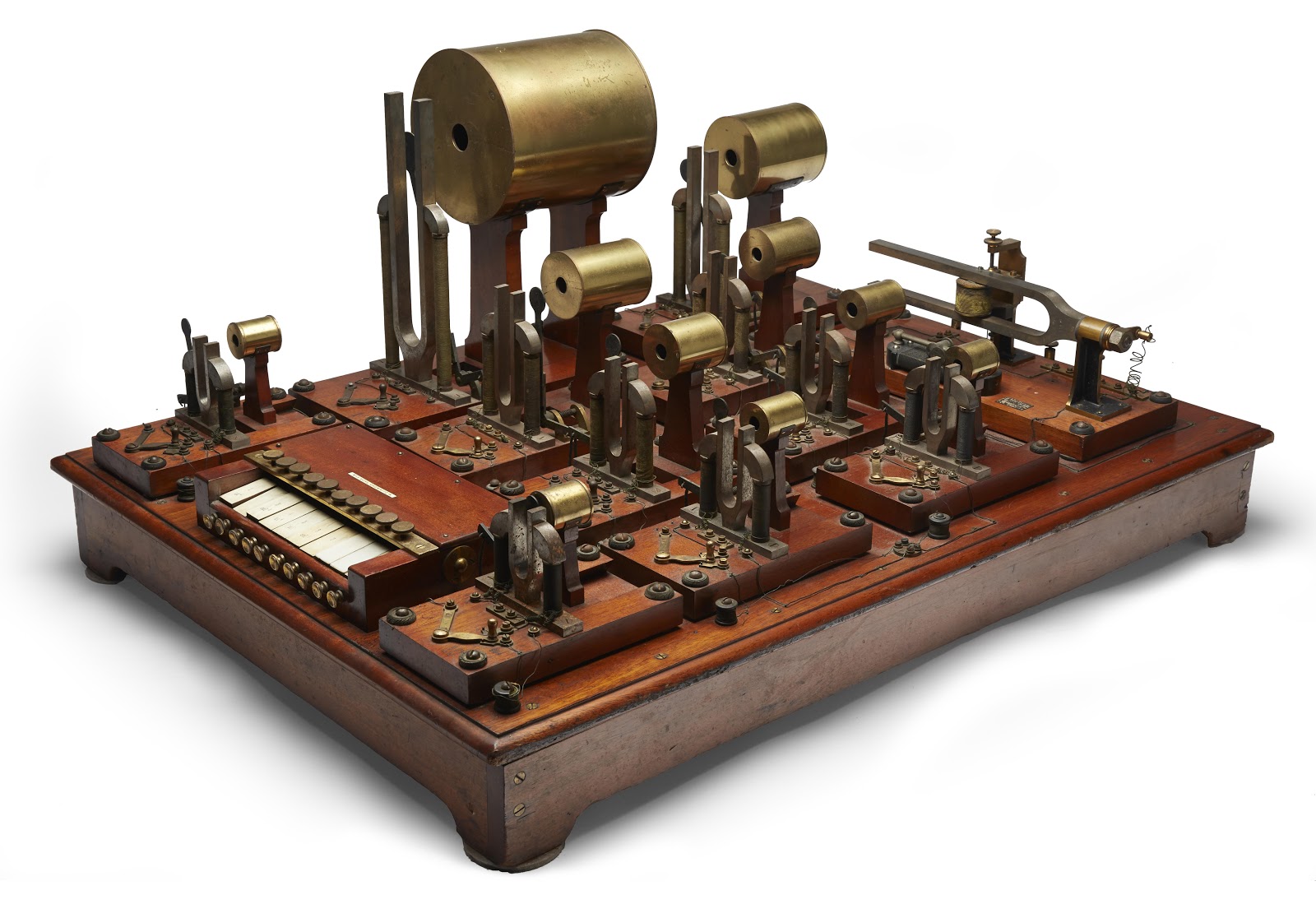
Helmholtz Sound Synthesiser. Max Kohl. Germany, 1905

Helmholtz Sound Synthesiser
Max Kohl’s ‘Helmholtz Sound Synthesiser’, 1905. Image: Bonham’s History of Science auction, 22 October 2014, New York – http://www.bonhams.com/auctions/22247/lot/245.
Max Kohl AG, founded on 14 March 1876, was a well-known company that designed and built scientific, mechanical, and electrical instruments and was based in Andorfer Strasse, Chemnitz, Germany. The company developed a wide range of equipment sold worldwide to laboratories and universities, including a sound instrument based on a design by the German physicist and psychologist Hermann von Helmholtz.1 Max Kohl Catalogue https://www.sil.si.edu/DigitalCollections/trade-literature/scientific-instruments/files/51637/index.htm accessed 02/11/2026 The Max Kohl AG factory in Chemnitz was destroyed by Allied bombing during World War II, and most of the remaining equipment was transported intact after the war to the Soviet Union.
Helmholtz
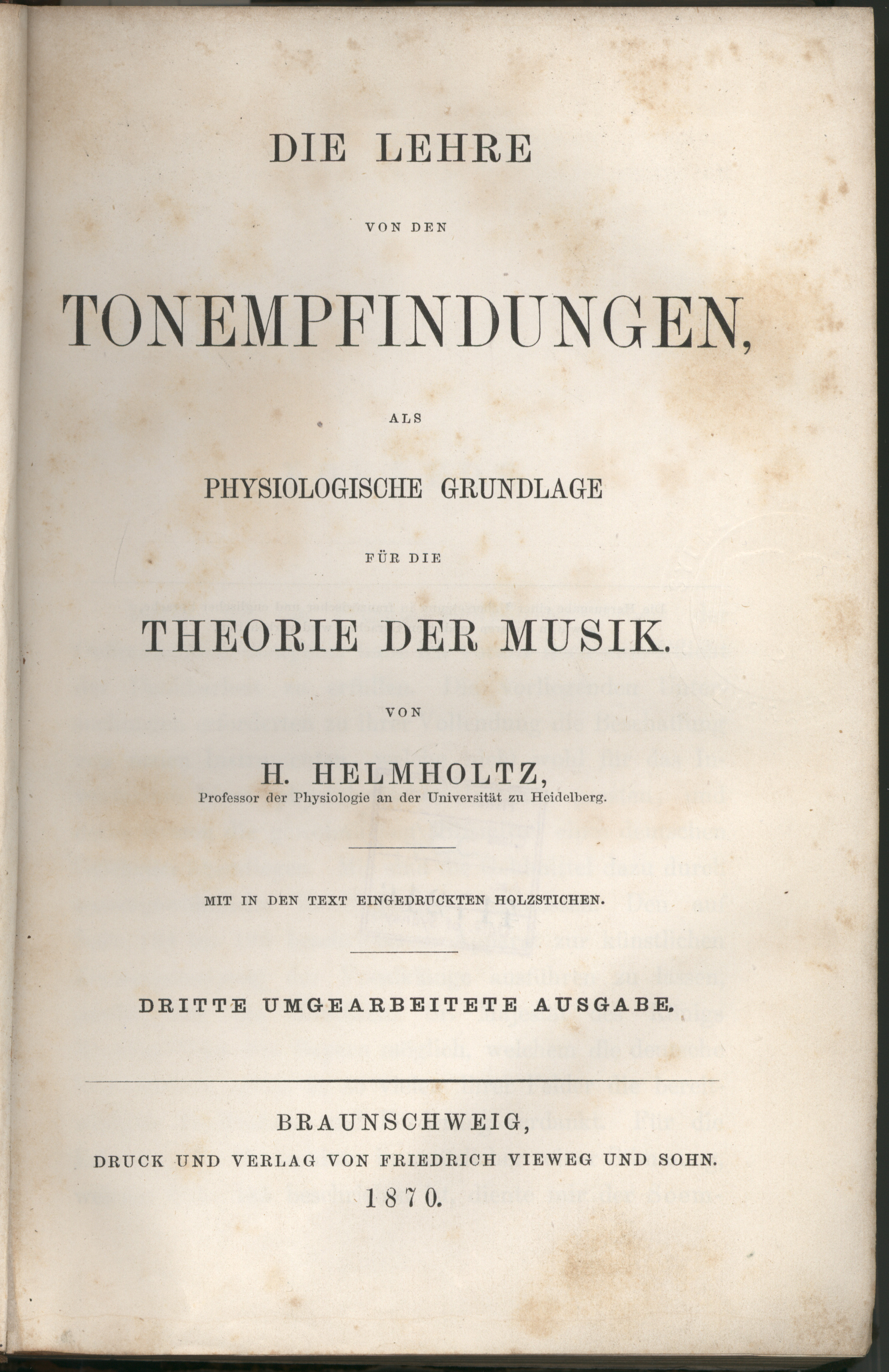
Hermann von Helmholtz ‘On the Sensations of Tone as a Physiological Basis for the Theory of Music’ 1870. Image: openlibrary.org 2023
The ‘Sound Synthesiser’ was not intended as a musical instrument but a scientific tool to demonstrate and analyse the effect of overtones in complex sound as described in Helmholtz’s revolutionary 1870 book Die Lehre von den Tonempfindungen als physiologische Grundlage für die Theorie der Musik ( ‘On the Sensations of Tone as a Physiological Basis for the Theory of Music‘ ) which had a huge impact on musicologists and instrument designers throughout the twentieth century. Using acoustic resonators, Helmholtz demonstrated that the components of complex sounds are a combination of overtones of a fundamental note (e.g. a “fundamental” pitch G 440Hz contains a harmonic series of whole number multiples of this  440Hz frequency or overtones – 880Hz G, 1320Hz, 1760Hz, etc., at variable volumes). 2Rees, Orben. (2010) ‘Helmholtz’s apparatus for the synthesis of sound: an electrical ‘talking machine”, Explore Whipple Collections, Whipple Museum of the History of Science, University of Cambridge.The Sound Synthesiser used a number of tuning forks that produced almost pure tones, driven by electromagnets, which in turn were amplified by a Helmholtz Resonator to generate overtones. The range of overtones could be ‘filtered’ by a mechanical shutter. The instrument helped in the understanding of the nature of speech and vowel sounds; vowel sounds being varied combinations of resonant overtones or ‘formants’ created by the muscles of the vocal tract.3Helmholtz, H.(1895) On the sensations of tone as a physiological basis for the theory of music, London, New York : Longmans, Green, and Co.
Portrait of Hermann von Helmholtz; 1821-1894. By: Photographische Gesellschaft Berlin (Photographic company). Ludwig Knaus.
Many variations of Helmholtz resonators were built; some used brass spheres with hand-held tuning forks, while others employed electromagnets to excite the tuning forks. Max Kohl’s 1985 version had ten forks and their corresponding resonators attached to a 39½ x 29-inch mahogany base. The system is driven by an intermittent current supplied by a large horizontal master tuning fork and is operated by pressing keys on a small ivory keyboard, which transmits the current to the corresponding electrically driven tuning forks. The keyboard is marked; ut [Do, or C] to 4 octaves, mi [E] to 3 octaves, and sol [G] to 3 octaves. The synthesiser was capable of combining timbres of 10 harmonics to form multiple vowel sounds.

Images of Max Kohl’s Sound Synthesiser


Sources

  • 1
    Max Kohl Catalogue https://www.sil.si.edu/DigitalCollections/trade-literature/scientific-instruments/files/51637/index.htm accessed 02/11/2026 ↩︎
  • 2
    Rees, Orben. (2010) ‘Helmholtz’s apparatus for the synthesis of sound: an electrical ‘talking machine”, Explore Whipple Collections, Whipple Museum of the History of Science, University of Cambridge. ↩︎
  • 3
    Helmholtz, H.(1895) On the sensations of tone as a physiological basis for the theory of music, London, New York : Longmans, Green, and Co. ↩︎

The ‘Ether Wave Violin’ or ‘Aetherwellengeige’ Erich Zitzmann-Zirini, Germany 1934

Aetherwellengeige
The ‘Ether Wave Violin’ or Aetherwellengeige shown here in a 1952 Film

The ‘Aetherwellengeige’ was one of many instruments inspired by Leon Termen’s Theremin using the same heterodyning principle and body capacitance to generate a variable tone from two thryatron vacuum tubes (other instruments were the Sonar (1933) , Neo Violena (1927), Electronde (1927), Emicon (1932) and Croix Sonore (1929) amongst others) . This version was built by the amateur electronic engineer and musician Erich Zitzmann-Zirini in Berlin in 1934 after he had witnessed the Berlin Philharmonic Orchestra using Termen’s Theremin in 1927. Zitzmann-Zirini appeared with his instrument in the 1934 Funkausstellung ‘Orchestra of the Future’

"Sounds from the air from the self-made Ether Wave Violin"
Poster “Sounds from the air from the self-made Ether Wave Violin”

Zitzmann-Zirini used his one-off instrument as the centrepiece of his career in vaudeville, circus, radio, and TV shows, he renamed his instrument the ‘musical Sputnik’ after Gagarin’s space flight in the 1960s.


Sources:

André Ruschkowski ‘Soundscapes’, pp. 23 (1st edition, Berlin 1990)

The ‘Polychord’ Harald Bode, Germany, 1949

The Polychord II
Bode’s Polychord III 1951

The Polychord Organ was Harald Bode’s first postwar design commissioned by the Bayerischer Rundfunk, Southern German Radio as an electronic organ for live radio broadcasts and was often heard played by the popular organist Fekko von Ompteda and on occasions by Harald Bode himself.  The instrument remained in use at Bayerischer Rundfunk from 1950 until 1973 used for  in-house productions such as special effects, music for comedy shows, dance music and religious music.

Early version of the Polychord

The Polychord was a simpler, polyphonic version of the rather complex Melochord, re-designed with the professional organist in mind; offering a bank of preset sounds as well as free control of sound synthesis. Bode produced a second version, The Polychord III in 1951, produced and marketed by  Apparatwerk Bayern gmbh (ABW) company in Bavaria Germany, and the Bode Organ which became the prototype of the Estey Electronic Organ after his departure to the USA in 1954. The Bayerischer Rundfunk Polychord can be seen (2014) at the Musical Instruments collection at the Deutsches Museum von Meisterwerken der Naturwissenschaft und Technik in Munich, Germany.


Bode's notes for a prototype of the Polychord c 1949
Bode’s notes for a prototype of the Polychord c 1949
Bode's notes for a prototype of the Polychord c 1949
Bode’s notes for a prototype of the Polychord c 1949


Sources

Bode’s Melodium and Melochord by Thomas L. Rhea. Contemporary Keyboard magazine (January 1980)

http://cec.sonus.ca/econtact/13_4/palov_bode_notebooks.html

The ‘Subharchord’, Gerhard Steinke & Ernst Schreiber , Germany (DDR), 1960

subharchord-studio-adlershof
The Subharchord at the Labor für Akustisch-Musikalische Grenzprobleme, Berlin Adlershof DDR in 1960

In the late 1950’s the East German government decided that it needed to develop an ability to produce electronic music for film and TV for ‘Eastern block’ media as well as provide a platform ‘serious’ modern electronic music to compete with the likes of WDR Electronic Music Studio in west Germany. The result of this was the foundation of the first East European electronic music studio under the auspices of the East German National Radio (RFZ) in 1956 (and closed in 1970). The studio was called the “Labor für Akustisch-Musikalische Grenzprobleme” ( laboratory for problems at the border of acoustics/music ) , and in 1960 the ‘Subharchord’ was created as the centrepiece of the Laboratory.

Subharchord
The re-constructed Subharchord
Detail of the Subharchord control panel.

The laboratory was founded in East Berlin in 1956. Gerhard Steinke, a young sound engineer who became its director, was tasked with research and development into stereo-sound and electronic sound generation. Countries all of over Europe were running similar programmes at the time, many of which were visited by Steinke in the years before East Germans were subject to travel restrictions. In 1961, a team headed by Ernst Schreiber, who was latter credited as the inventor of the Subharchord, completed work on the instrument:

While I was working as a sound engineer with the Dresden radio station, I heard of and found numerous tape recordings of Oskar Sala’s compositions for Trautonium, music that I had listened to on the radio while doing my homework, in the programs transmitted by the Weimar and Leipzig stations attached to the Dresden station, and above all in the sound archives. These unusual sounds were often used for the stations’ own programs, and even for advertising. However, what finally set me going was working with the conductor Hermann Scherchen, with whom I made a recording of Bach’s Kunst der Fuge in February 1949 in the Dresden Broadcasting Hall (the former reception hall of the German Hygiene Museum). In conversation with the conductor, it became apparent that Scherchen had long been with the radio and had already worked together with Trautwein, Hindemith and Sala around 1930.

The Düsseldorf Funkausstellung 1953 was the occasion of the first presentation of an electronic organ (Polychord), which was bought by the enthusiastic Berlin chief engineer at the radio station, despite our objections to the lack of transients and our opinion that we could make something much better ourselves. At the same time, the first studio for electronic music had been set up in the Cologne Funkhaus, with a new trautonium by Trautwein, the monochord. In 1955, in the instrument warehouse of the Berlin radio station, I unearthed the surviving parts of a quartet trautonium commissioned by Sala for the station in 1948 and that didn’t really work properly; even Sala’s visit to the laboratory failed to bring life into the instrument. But we were now more than just curious, and announced to Sala that we would develop our own much more modern device … Sala laughed jovially, patted me on the shoulder in commiseration, and went on giving concerts and producing film music with his mixture trautonium.

However, we were able to convince our chief engineer to set up a “Laboratory for problems at the interface of acoustics and music,” and recruited the resourceful television engineer and organ lover Ernst Schreiber. The work on the development began in April 1959. It almost collapsed when the Ministry of Culture objected that subharmonic sounds were a musical fiction since subharmonics did not exist in nature. … However, we were able to prove their existence by dividing saw-tooth sounds into a number of sub-oscillations, and were allowed to start. We were not allowed to develop the organ we had planned, mainly because Dessau had, at my lecture in the Academy of Arts on the presentation of a Polychord electronic organ, complained that such bombastic sounds with such a strong vibrato were more appropriate in a brothel, while the sounds of the trautonium were capable of inspiring the composer’s creativity. However, this wary ministerial representative soon disappeared off to the West, and we cheerfully worked on in the laboratory.

A first subharchord was ready in 1961, and was immediately welcomed with enthusiasm by the composer Addy Kurth from the field of cartoon films and by others in radio and television. We were now able to produce mixture compositions in a laboratory studio, pursue the further development of the instrument and later begin series production. The first marionette cartoon to be accompanied by the subharchord, The Race, was a huge success. We had maintained our contacts with Scherchen over the years and on 9 July 1961, shortly before the unexpected construction of the Berlin Wall, Dessau, who had always supported our development work, Scherchen and I met in the West Berlin Hotel Kempinski to discuss the prototype – although Dessau remained critical of the lack of a second manual, which he had always insisted on.

The development and series production, and the many recordings made at the same time in the laboratory studio, led to the creation of the subharchord II by 1969. Unfortunately, Khrushchev had condemned electronic music as a “cacophony” that was inappropriate to “socialist realism,” which meant that the studio and any further research were abandoned. Nevertheless, a few instruments survived, and two were reconstructed in 2005 and 2007. They are now being used for new creative works.”

Gerhard Steinke “The Creation of the Subharchord – a Recollection ” 2008

Bratislava_Stockhausen_kl
Karlheinz Stockhausen at the Bratislava (CZ) studio using the Subharchord

The Subharchord’s history dates back to  pre-WWII exploration of ‘subharmonic’ synthesis of Dr Friedrich Trautwein’s  Trautonium and Oskar Sala’s Mixturtrautonium. These instruments uniquely used a technique of octave dividing sub-harmonic frequencies to modulate a synthesised tone creating a wide range of complex effects and sounds. Unlike the Trautonium family however, the Subharchord was less focussed on micro-tonal tuning and deployed a standard keyboard manual in stead of a sliding scale wire resistor.

Patent
Schriber’s DDR Patent for the Sunharchord 1960

Like it’s western counterpart, The Trautonium, the Subharchord was used extensively in film soundtracks and TV production throughout the Eastern block during the sixties and seventies; Karl-Ernst Sasse, former conductor of the DEFA (East German Film Company) Symphony Orchestra, worked with the subharchord in Dresden on the soundtracks of cult science fiction classics, such as ‘Signale’ ( a popular eastern block ‘Star Trek’ series). The subharchord was also used for many of the DEFA’s cartoons. Other composition from the studio include Der faule Zauberer (Kurth, 1963); Amarillo Luna (Kubiczek, 1963); Quartet für elektronische Klänge (Wehding, 1963); Variationen (Hohensee, 1965); Zoologischer Garten (Rzewski, 1965


Sources

www.subharchord.com

Electronic and Experimental Music: Pioneers in Technology and Composition. Thomas B. Holmes, Thom Holmes

www.krautopia.de

http://www.residentadvisor.net/feature.aspx?1771

La musique électroacoustique en République démocratique allemande (RDA) : une avant-garde paradoxale Tatjana Böhme-Mehner July 2012


The ‘Mixturtrautonium’ Oskar Sala, Germany, 1936

Oskar Sala's mixturtrautonium
Oskar Sala’s mixturtrautonium

Later developments of Freidrich Trautwein’s original  Trautonium were continued by the Trautonium virtuoso and composer Oskar Sala. In 1936, Sala christened his first instrument the ‘Rundfunktrautonium’ (‘Radio-Trautonium’) and also developed a concert version, the “Konzerttrautonium”. After the end of the Second World War the instrument was re-named the ‘Mixturtrautonium’ but all were essentially developments of the original subtractive synthesis principles of the Trautonium.

Mixturtrautonium at the Vienna Technology Museum
Mixturtrautonium at the Vienna Technology Museum, showing two resistant-string manuals and double foot pedals

The essential design principles of the Trautonium were retained by Sala; sound production on the basis of sub-harmonic ‘mixture’, and the method of playing with two string manuals. The latter are made of wire-covered catgut strings which act as variable resistors. according to the position at which they are pressed againts the contact rail beneath them, they control the frequencies of the electronic sound generators. when the finger glides over the string a continuous glissando results over the entire tonal region which has just been tuned up. Micro-tonal intervals could be produced on the Mixturtrautonium. To ensure accurate contact with the notes leather covered sprung and moveable metal tongues are added to each string.  Unlike with a vibrating string, the gradation of the electrical-resistant string manual is linear and not exponential so that all octave have the same finger range.

Sala at the
Sala at the Mixturtrautonium

The 1948 post-war Mixturtrautonium was a polyphonic version of the original Trautonium, generating sound from two AEG Thoraton tubes with a 3 ½ octave range (which could be extended with an octave switch). The instrument could also be controlled with a foot pedal that not only allowed variation in volume but also with a lateral foot movement, select three different sets of sub-harmonics. The Sub-harmonic ‘mixture’ technique basically used un-natural low frequency harmonics to modulate a sawtooth signal creating complex harmonic ‘mixtures’ which could be further coloured with noise generators, mixers, an envelope controller and a frequency shifter.

mixturtrautonium2
Mixturtrautonium

During the pre-war period, the ”Rundfunktrautonium’ was used extensively for film and radio broadcasts and after Paul Hindemith’s endorsement, became the instrument of choice for ‘serious’ electronic music composition (Hindemith’s switching of allegiances from Jörg Mager’s Sphärophon family of instruments to the Trautonium signalled the end  of Mager’s career in instrument design). A portable version, the ‘Konzerttrautonium’ was designed in 1936 specifically for the composer  Harald Genzmer’s ” Conzert für Trautonium und Orchestrer” and saw more than fifty performances before the outbreak of the war.

Berlin had in the early Thirties become the world capital of electronic music, with inventors and designers such as Jörg Mager , Oskar Vierling , Fritz Sennheiser , Bruno Helberger, Harald Bode, Friedrich Trautwein and Oskar Sala (with much of the work centred around the Heinrich-Hertz-Institute). These instruments often explored radical new approaches to tonality and expression and were enthusiastically adopted by the avant-garde of the period. This period of musical ferment coincided with the seizure of power by Adolf Hitler’s National Socialist party (NDSAP), who initially tried to absorb this strain of modernism for their own propaganda ends – indeed, the name ‘Volkstrautonium’ echoes the name ‘Volkswagen’ as a peoples instrument for a modern, new Germany. On the 18th August 1933, Joseph Goebbels (Hitler’s Propaganda Minister) presided over the IFA ‘Internationale Funkausstellung’ (International Radio Exhibition) in Berlin. The music for the exhibition was provided by the ‘Future Orchestra’ (Das Orchester der Zukunft) composed of the most advanced electronic instruments of the time: The Volkstrautonium played by Oskar Sala, Bruno Helberger’s Hellertion, Oskar Vierling’s Elektrochord , the Neo-Bechstein of Walther Nernst, a collection of electric violins and cellos and Leon Termen’s  Theremin.

'Das Orchester der Zukunft' at the Berlin IFA 1933
‘Das Orchester der Zukunft’ at the Berlin IFA 1933

The rise of the Hitler’s National Socialist party presented electronic and avant-garde musicians with a difficult choice; either the hope that by collaborating they would survive and be left alone and be able to continue working or, simply, leave the country. Trautwein, who had joined the NDSAP in the late thirties used his connections:

Luckily Trautwein knew a general who was on our side and arranged that we could play the instrument to the minister of propaganda Joseph Goebels, Hitler’s right hand man. I Played something by Paganini and of course he liked it. After that, they left us in peace.
Oskar Sala

This collaboration resulted in a commission from the Reich’s Radio organisation for several new instruments to be built for a weekly fifteen minute programme “Musik Auf Dem Trautonium” (playing German classical music accompanied by a pianist) and later commissions to use the instrument at large scale NDSAP rallies, outdoor concerts, speeches and, (alongside other electronic instruments such as Vierling’s GrosstonOrgel) the Olympic Games in Berlin in 1936. However, this patronage was short-lived as the Nazi’s asserted their traditional conservatism; Atonal, Experimental and avant-garde music alongside Jazz and other non-German culture was branded ‘entarte’ or ‘degenerate’. Trautwein and Sala’s workshop was denied funding and closed, the Trautonoium was relegated to performing Reich-approved music. Sala spent the war years touring throughout Germany and Axis occupied countries until he was conscripted in 1944 and sent to the Eastern Front

Oskar_Sala_Konzert_Trautonium_Friedrich_Trautwein_Leo_Borchard_Budapest_1942
Oskar Sala playing the Trautonium at a concert with Leo Borchard, Budapest 1942

After the end of the war Sala founded a studio for film music soundtrack production in Berlin,where, amongst many other projects, he recorded music for Hitchcock’s “the birds” .

Oskar Sala and Alfred Hitchcock working on the sound effects for "The Birds"
Oskar Sala and Alfred Hitchcock working on the sound effects for “The Birds”


Music

Oskar Sala – Triostück Paul Hindemith


Sources:

Electronic and Experimental Music: Pioneers in Technology and Composition. Thomas B. Holmes, Thom Holmes

Framing the Fifties: Cinema in a Divided Germany. edited by John Davidson, Sabine Hake

Music and German National Identity. edited by Celia Applegate, Pamela Potter

Peter Badge (2000). Oskar Sala:Pionier der elektronischen Musik. Satzwerk, 100pp. ISBN 3-930333-34-1

http://www.trautoniks.de/

The ‘Saraga-Generator’, Wolja Saraga, Germany,1931.

The Saraga Generator
One of the sound generating devices built by Wolja Saraga at the HHI. Photo; Saraga family archives

Wolja Saraga was a research doctoral student and then lecturer from around 1929 until 1936 at the newly formed (1928) Heinrich-Hertz Institut Für Schwingungsforschung (Heinrich hertz Institute for Frequency Research or HHI for short) based on Franklin Str 1, Charlottenburg, Berlin, Germany. The HHI was tasked with research into all forms of frequency research – communications, radio, physics, acoustics and electronic musical instruments. Under the direction of Prof Gustav Leithäuser the HHI became the international center for the development of electronic musical instruments through the work of figures such as Fritz Sennheiser,  Oskar Vierling , Harald Bode , Winston Kock , Friedrich Trautwein and Wolja Saraga.

The Heinrich-Hertz-Institut für Schwingungsforschung, Charlottenburg, Berlin. Image: Architekturmuseum der Technischen Universität Berlin Inv. Nr. F 8108.

In 1932 Saraga began to investigate the opportunities and practicalities of musical sound production via three main approaches: optical sound synthesis, direct sound generation through ‘direct discharge’ and by using a voltage controlled tungsten arc-lamp.1Saraga, Wolja, (1932), Technischer Bericht Nr. 55,99, 100, Heinrich-Hertz-Institut für Schwingungsforschung, HHI Archives. The name Saraga-Generator has has become used for his more well-known photo-electrical instrument but probably applies better to his ‘direct discharge’ instrument that used a high voltage power generator to create spark-gap transmissions of sound waves. In this text it applies to all of his electronic musical experiments.

Saraga’s experiments with direct sound generation at the HHI  circa1930. Image: Funkbastler, H24, 1930, 409-10.

The Direkte elektrische Schallerzeugung or Direct Electrical Generator created a musical tone through direct stimulation of the air without loudspeakers – a method similar to Simon and Duddel’s early Singing Arc experiments of 1899. The result would have been at quite a high volume or, as Saraga put it “The desired kinetic effect is not negligible”. 2Saraga, Wolja, (1932), Technischer Bericht Nr. 55, 25 Jan 1932, Heinrich-Hertz-Institut für Schwingungsforschung, HHI Archives. The technique is explained in Saturday Review (1952): “The effect takes advantage of several physical principles:[5] First, ionization of a gas creates a highly conductive plasma, which responds to alternating electric and magnetic fields. Second, this low-density plasma has a negligibly small mass. Thus, the air remains mechanically coupled with the essentially massless plasma, allowing it to radiate a nearly ideal reproduction of the sound source when the electric or magnetic field is modulated with the audio signal.” 3 Villchur, Edgar, (1952) A New Speaker Principle, Saturday Review, 1952 Sep 27, 60-61.

Writing in Funkbastler Magazine, Saraga describes the sound of the instrument:

“The high-frequency glow arc also works with low background noise. Sometimes the presence of the counter electrode is also the cause of disturbing side effects. The air between the plates can oscillate itself and the acoustic change circumstances. Special forms of the counter electrode will probably prove to be particularly favourable. If you listen to the performances of the peak discharge, you will particularly notice the good reproduction of the high frequencies; the hissing sounds are very natural. The favourable acoustic radiation of the lower frequencies seems to be much more difficult, as the reproduction generally sounds a bit thin.“4Saraga, Wolja, (1930) Schallerzeugung durch Hochfrequenzentladungen, Funkbastler, Heft 24, 409-10.

Saraga probably abandoned research in direct transmission for this reason – the low frequency reproduction was poor and because of the impracticalities of the approach: the amount of energy required and potentially hazardous by products produced by the ionisation process. 

The second approach Musikinstrument mit Wolframbogenlampe or Music Instrument with Wolfram Bow Lamp used used a tungsten arc-lamp connected to a loudspeaker without an amplifier which produced “very high volumes”. The tone of the lamp was modulated using a resistance manual; probably a metal strip touched by the player. 5Saraga, Wolja, (1932), Technischer Bericht Nr. 100, 13th September 1932, Heinrich-Hertz-Institut für Schwingungsforschung, HHI Archives.

Saraga’s photo-electrically controlled instrument the Elektrisches Photozellenmusikinstrument described in his 1932 HHI report, was a monophonic device that consisted of an audio oscillator controlled by movements of the performer’s hand between a low voltage neon lamp and a narrow V-shaped slit in the lid of a box. The white painted interior of the box had a photocell mounted on it positioned so that direct light would not reach it. The range of the instrument was about four octaves. Articulation and loudness were controlled by a switch, held in the performer’s other hand, and a volume pedal. 6Davies, Hugh (1984), Saraga-Generator, Grove Dictionary of Musical Instruments, Oxford University Press, 383. Saraga’s photo-cell instrument was patented in 1932 and demonstrated at the Berlin Radio Exhibition (IFA – Internationale Funkaustellung, Berlin) alongside the Orchester der Zukunft (the all-electric Orchestra of the Future) in the same year. Saraga described the timbral quality of the basic instrument as poor but one that could be easily rectified using the same type of format filters as Trautwein’s Trautonium.  7Saraga, Wolja, (1932) Ein Neues Elektrisches MusikInstrument, Funkbastler, Heft 10, 433-5.

"Electric Concerts" with the electroacoustic "orchestra of the future", 1932/1933 On the occasion of the 9th and 10th IFA in Berlin 1932 and 1933 for the first time found concerts with "Electric Music" instead. They played by the so-called "Orchestra of the future" all electroacoustic musical instruments then available. The "Elektischen concerts" made at the time an exceptional level of interest and broad support in the public, as the cooperating with private Theremingerät Erich Zitzmann-Zerini [second right] the engineer Gerhard Steinke told while gave him this original image. The orchestra consisted of two theremin instruments Trautonium [by Trautwein], Heller desk [of B. and P. Helberger Lertes], a neo-Bechstein grand piano [for suggestions of O. Vierling, S. Franco, W. Nernst and H . Driescher], Vierling piano [electro Acoustic piano by O. Vierling], electric violin, electric cello and Saraga generator [a light-electric device by W. Saraga, in principle, similar to the Theremingerät]. Photo: archive Gerhard Steinke
A concert by the electroacoustic “Orchestra of the Future” at the 9th and 10th IFA in Berlin 1932. Consisting of: (L-R) Bruno Hellberger playing his Hellertion, unknown playing the Electric Cello, Oskar Sala playing the Volkstruatonium, unknown playing the Neo Bechstein Electric Piano, Oskar Vierling playing the Electrochord, unknown playing the ‘Electric Violin’, unknown playing the ‘unknown instrument’,  Erich Zitzmann-Zerini with the Theremin, Unknown playing the Volkstrautonium. Saraga (not in the photograph) gave lectures on electronic music and demonstrations of his photo-electric instrument after each performance. Photo: archive Gerhard Steinke.
Saraga escaped Germany in 1936 (Bringing with him a Volkstrautonium purchased as a promotional model from Telefunken – which was confiscated by German authorities at the border) and eventually found employment in Orpington, Kent, UK. 8Interview with Esther Saraga, London 2015 In May 1946, Saraga founded the Electronic Music Group at the Northern Polytechnic (Holloway Rd, London) and tried to renew interest in his photo-electric instrument with public demonstrations of its capabilities and searched for commercial applications for the instrument including film soundtrack music and musical therapy for blind war veterans.

Saraga describes his instrument in an article in the Electronic Engineering journal, July 1945:

Basic diagram showing the box light-receiving device. Image: Electronic Engineering, July1945, 601

“A photo-electric cell is used as playing manual for controlling the pitch, the amount of light falling on this cell determining the frequency of the oscillation produced.* Thus the player can play on this instrument by varying the amount of light falling on the cell by moving his hand be- tween the cell and a source of light. This playing technique is in some aspects similar to that employed in Theremin’s instrument ; but there are some important differences which will be discussed, and it is hoped that the new playing technique will provide players and composers with new, hitherto unknown or technically im- possible, methods of expression.

The loudness of the tone produced can be controlled by means of a pedal which actuates a variable resistance or potentiometer. In a more elaborate form of the instrument it is intended to control the loudness by varying the amount of light falling on a second photo -electric cell. It is expected that this method of loudness control will be useful also in connection with other electronic musical instruments. For starting and stopping the tone the player uses a switch held in one hand which opens or closes the loud- speaker circuit. This switch is necessary because the loudness control by means of a pedal is rather slow. Instead of using a switch the player can close the- loudspeaker circuit by touching two metal contacts with his hand as a conducting link.” 9Saraga, W, (1945), An Electronic .Musical Instrument With a Photo -Electric Cell as Playing Manual, Electronic Engineering, 601.

Saraga argued that his instrument was superior to Termen’s Thereminvox in that it was easier and more natural to play:

“practical experience with Theremin’s instrument shows that its playing technique, while relieving the player from the resistance and inertia of the instrument, increases the resistance and inertia of his own hand because the hand has to be moved freely in the air for long periods with- out any physical support and without any visible indication of the correct positioning of the hand. Moreover, the pitch produced depends not only on the position of the hand but, to a smaller degree, also on the position of the whole body. Furthermore, the character of the electrostatic field of the rod in which the player moves his hand is such that it is very difficult to produce a linear pitch scale, i.e., to make the pitch proportional to the distance of the hand from the rod. The object of the new instrument […] is to eliminate these disadvantages of Theremin’s instrument. For this purpose the use of a photoelectric cell as -playing manual for determining the pitch or the loudness of the musical tones seems to be particularly convenient, because the geometrical relations of light beams’ and light and shadow which determine the amount of light falling on the cell when the hand of the player is in a certain position are much simpler, and much easier to control, than the geometrical relations of electrostatic fields which determine the hand capacitance in a certain position of the hand.“10Saraga, W, (1945), An Electronic .Musical Instrument With a Photo -Electric Cell as Playing Manual, Electronic Engineering, 601.

Wolja Saraga working on the 'Saraga Generator' at the HHI, Berlin in 1932
Wolja Saraga working with a tungsten arc lamp for sound generation at the HHI, Berlin in 1932. Image: Saraga family archives.
Wolja Saraga. Berlin, 1930s
Wolja Saraga. Berlin, 1930s. Image: Saraga family archives.
Wolja Saraga working at the HHI, Berlin 1932. (Photo; TU Archives, Berlin)

Wolja Saraga: Biographical Notes

Wolja Saraga was a German Jewish Physicist, born in Berlin, Germany on 03-09-1908  to a Romanian father and a Russian mother. He studied telecommunications at the Heinrich Hertz Institute (Heinrich-Hertz Institut Für Schwingungsforschung or ‘HHI’) at the Technical University, Berlin under Prof Gustav Leithäuser. Saraga became a research assistant at the HHI and later  a lecturer from 1929-1933. He also studied physics and mathematics at the Humboldt University of Berlin, where he was awarded a Dr. phil. in physics in 1935.

saraga_presse_kart
Wolja Saraga’s ticket for the 1936 ‘Great-German Radio Exhibition’ (image; Saraga Family Archive 2016)

During his time in Berlin, Saraga was very energetic in promoting the potential of electronic music; He wrote numerous articles for journals and magazines on the subject of acoustics and audio technology and made several public presentations and demonstrations of electronic instruments including Theremins, Trautoniums and his own Saraga Generator. Saraga was also present playing the Saraga Generator at the 1932/3 International Funkaustellung (IFA) where the first ever electronic musical orchestra performed  – Das Orchester der Zukunft.

It became clear to Saraga in 1935-6 that as a Jewish scientist he would have no future in the new National Socialist German Reich and began to apply to leave the country, first of all to Switzerland and then to the UK. Saraga finally left Berlin in 1938 at the age of 29. he was initially held for six months on the Isle Of Man Hutchinson Camp as a German internee but was given a position working for the Telephone Manufacturing Company (or ‘TMC’) in St Mary’s Cray, Kent where, despite his unhappiness at his employers lack of interest in research, he remained until 1958.

A press card for a presentation by W.Saraga entitled 'Electronic Music'
A press card for a presentation by W.Saraga entitled ‘Electric Music – a presentation and musical demonstration of the Trautonium’. Berlin 1933. (Photo; Saraga Family Archive 2016)

Saraga then joined The Associated Electrical Industries Research Laboratory in Blackheath, London as a Research Scientist and Group Leader where he specialised in telephony filter design. In 1962, Saraga’s key contributions were recognised by the award of the Fellowship of the Institute of Electrical and Electronics Engineers, ‘for contributions to network theory and its application in communications’. In 1972, Saraga moved full time to Imperial College, London where he became a postgraduate lecturer and researcher in network theory and mathematics and wrote a number of books and filed several patents on network theory and telephony. Wolja Saraga died in London on Feb 15 1980.11Scanla, J,O,(1980) Obituary of Wolja Saraga, CIRCUIT THEORY AND APPLICATIONS, VOL. 8, 341.   , 12 (1980) Obituary of Wolja Saraga,  IEEPROC, Vol. 128, Pt. G, No. 4, AUGUST 1981. 13 Crab, Simon, (2015) Interview with Esther Saraga, london 2015.


References:

  • 1
    Saraga, Wolja, (1932), Technischer Bericht Nr. 55,99, 100, Heinrich-Hertz-Institut für Schwingungsforschung, HHI Archives. ↩︎
  • 2
    Saraga, Wolja, (1932), Technischer Bericht Nr. 55, 25 Jan 1932, Heinrich-Hertz-Institut für Schwingungsforschung, HHI Archives. ↩︎
  • 3
    Villchur, Edgar, (1952) A New Speaker Principle, Saturday Review, 1952 Sep 27, 60-61. ↩︎
  • 4
    Saraga, Wolja, (1930) Schallerzeugung durch Hochfrequenzentladungen, Funkbastler, Heft 24, 409-10. ↩︎
  • 5
    Saraga, Wolja, (1932), Technischer Bericht Nr. 100, 13th September 1932, Heinrich-Hertz-Institut für Schwingungsforschung, HHI Archives. ↩︎
  • 6
    Davies, Hugh (1984), Saraga-Generator, Grove Dictionary of Musical Instruments, Oxford University Press, 383. ↩︎
  • 7
    Saraga, Wolja, (1932) Ein Neues Elektrisches MusikInstrument, Funkbastler, Heft 10, 433-5. ↩︎
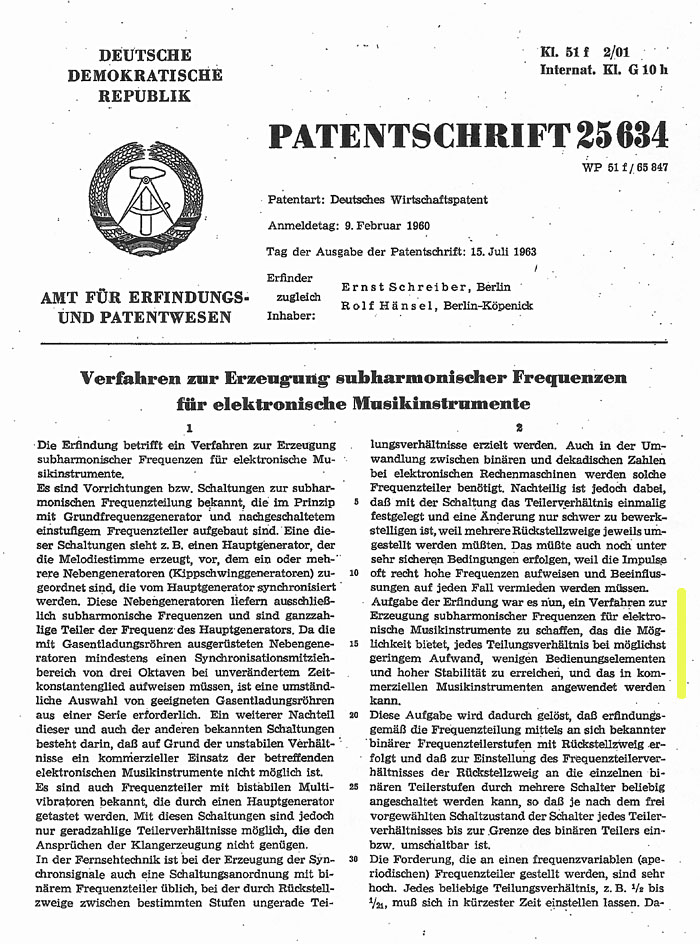
  • 8
    Interview with Esther Saraga, London 2015 ↩︎
  • 9
    Saraga, W, (1945), An Electronic .Musical Instrument With a Photo -Electric Cell as Playing Manual, Electronic Engineering, 601. ↩︎
  • 10
    Saraga, W, (1945), An Electronic .Musical Instrument With a Photo -Electric Cell as Playing Manual, Electronic Engineering, 601. ↩︎
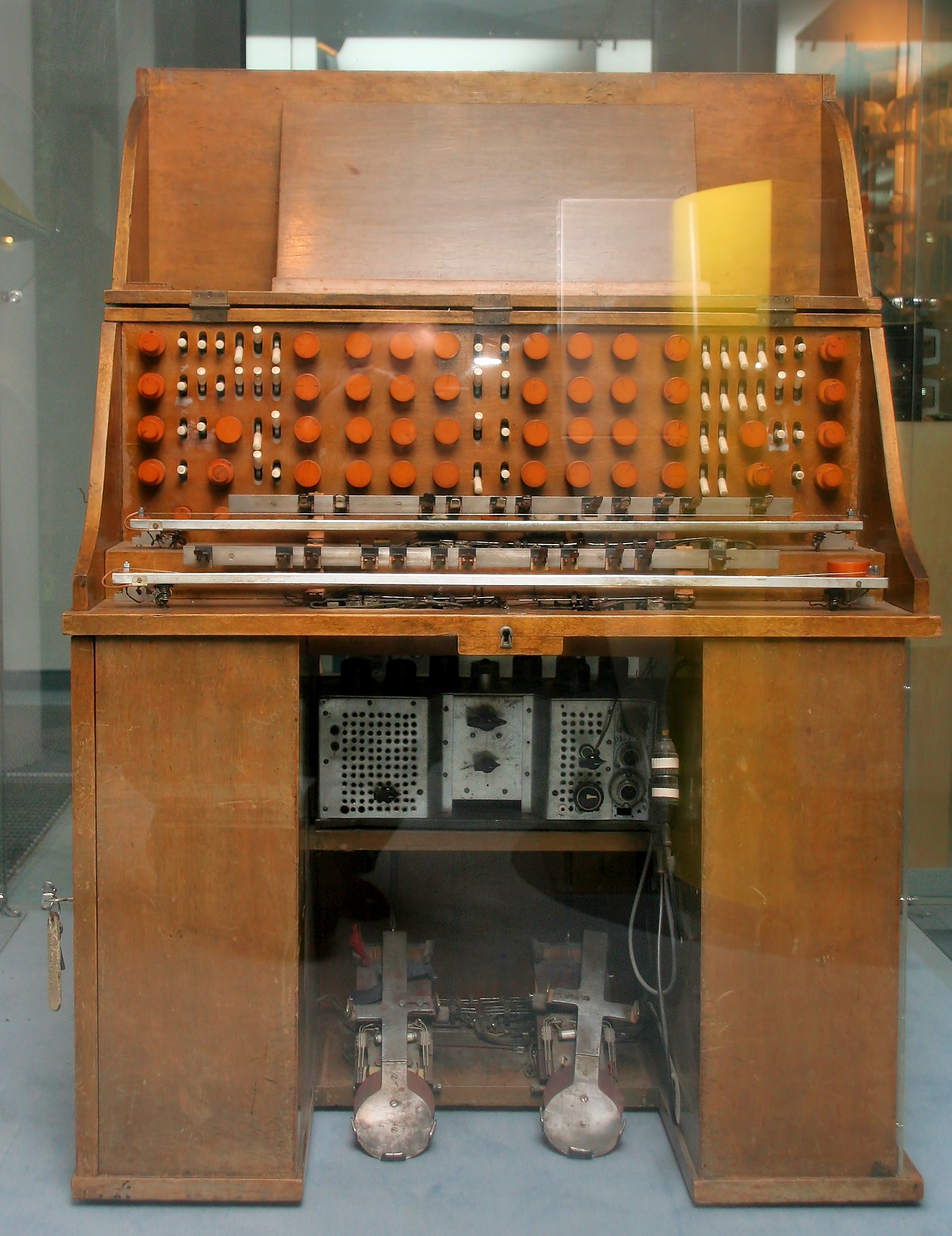
  • 11
    Scanla, J,O,(1980) Obituary of Wolja Saraga, CIRCUIT THEORY AND APPLICATIONS, VOL. 8, 341.    ↩︎
  • 12
    (1980) Obituary of Wolja Saraga,  IEEPROC, Vol. 128, Pt. G, No. 4, AUGUST 1981. ↩︎
  • 13
    Crab, Simon, (2015) Interview with Esther Saraga, london 2015. ↩︎